BullBrezza | Macro & Crypto

3.7K posts

BullBrezza | Macro & Crypto banner
BullBrezza | Macro & Crypto

BullBrezza | Macro & Crypto

@BullBrezza

Crypto | Bitcoin & Altcoins Macro × Finance × AI × Real Estate I track global power shifts and capital flows before they show up in price.

The Wind Of Prosperity. Katılım Temmuz 2022
253 Takip Edilen2.6K Takipçiler
Sabitlenmiş Tweet
BullBrezza | Macro & Crypto
BullBrezza | Macro & Crypto@BullBrezza·
No marketing. No paid narratives. Not a promoter. Not a guru. Not a fund. I write about power, capital flows, and crypto infrastructure as global systems rewire. No hype. No signals. Just first principles.
English
1
0
24
7.4K
BullBrezza | Macro & Crypto
@QCompounding PEG is a useful filter, but a dangerous conclusion. A low PEG can signal value—or it can signal that the market simply doesn't believe the growth forecasts. Markets don't price reported growth. They price the probability that growth actually materializes.
English
0
1
0
67
BullBrezza | Macro & Crypto
@NoLimitGains Scarcity doesn't just increase the value of assets. It increases the value of attention. The people who are always available become a commodity. The ones who protect their time become selective capital allocators. Attention follows scarcity.
English
1
0
2
48
NoLimit
NoLimit@NoLimitGains·
Be hard to reach. People value what takes effort to access. That includes you.
English
68
40
1K
212.8K
BullBrezza | Macro & Crypto
@AshCrypto The biggest winner from regulatory clarity may not be Bitcoin. It may be tokenized securities, stablecoins, and on-chain capital markets. Speculation opened the door. Infrastructure is about to move in.
English
0
0
1
74
Ash Crypto
Ash Crypto@AshCrypto·
Everyone pushing to pass the Crypto Clarity Act in the next 2 weeks: 1. President Trump 2. Treasury Secretary Bessent 3. Senator Lummis 4. $15 trillion BlackRock 5. $13 trillion Charles Schwab 6. $7 trillion Fidelity 7. $4 trillion Goldman Sachs and more. Clarity is coming.
English
248
419
2.9K
151.3K
BullBrezza | Macro & Crypto
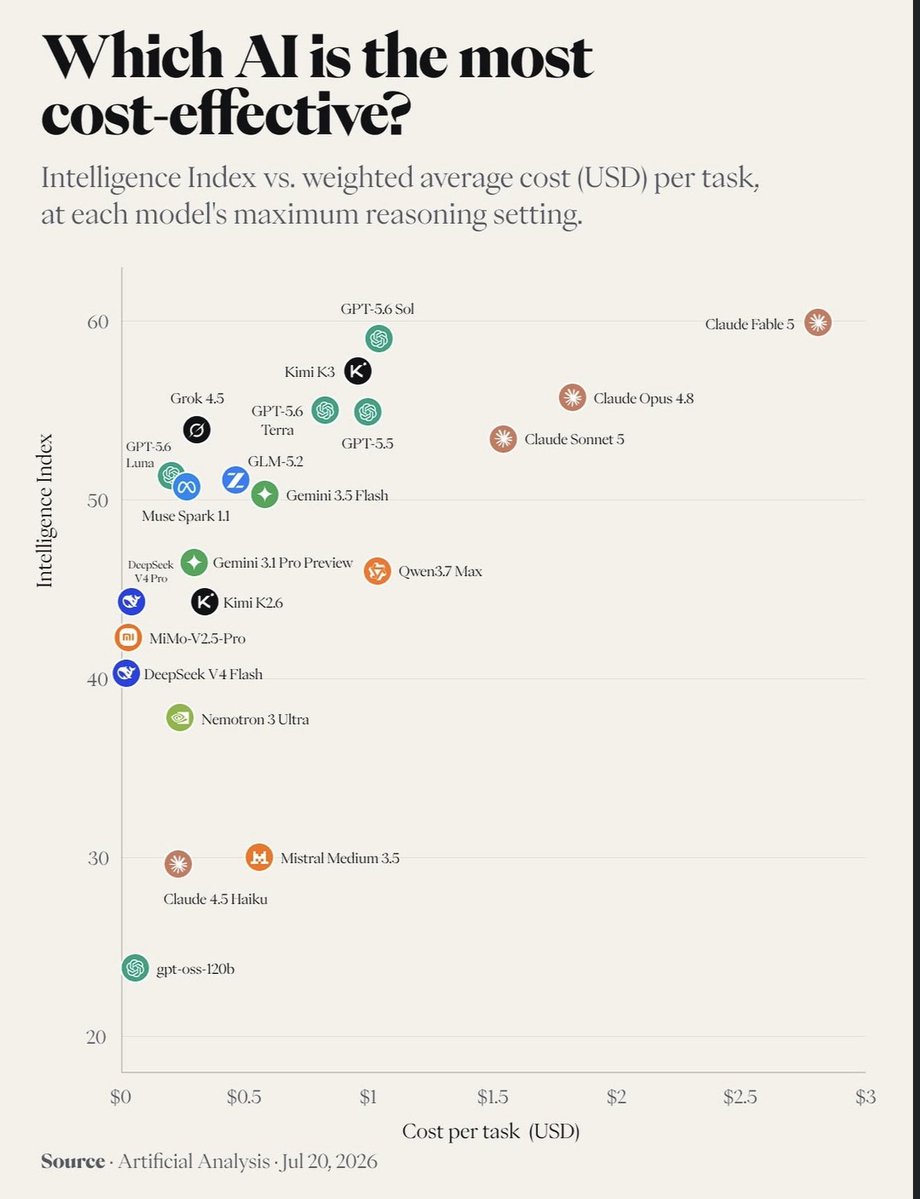
The cheapest model isn't necessarily the best investment. What matters is intelligence per dollar at scale, not benchmark scores in isolation. Every technology eventually becomes commoditized. Distribution, developer ecosystem, and switching costs are where durable value gets created.
English
0
0
0
22
Rand Group
Rand Group@randgroup·
This AI chart is just an efficient frontier. Same logic you use in the market. Upper left is where you want to be: high intelligence, low cost.
Rand Group tweet media
English
29
21
181
24.8K
BullBrezza | Macro & Crypto
@leadlagreport Markets spend too much time modeling demand and not enough time modeling legislation. A single paragraph buried in a 96-year-old law just rewrote industry economics overnight. The biggest risk premium is often hidden in legal text, not earnings reports.
English
0
0
1
20
Michael A. Gayed, CFA
Michael A. Gayed, CFA@leadlagreport·
Regulation risk can come from statutes everyone forgot. FMR notes Section 338 (Tariff Act of 1930) was revived July 20 to impose a 50% duty on Canadian beer/wine/whisky, effective Aug 19. Pricing power is now a legal artifact. freemarketsreport.com/washington-rea…
English
6
0
30
19.2K
BullBrezza | Macro & Crypto
@BitcoinNews The biggest misconception wasn't that crypto was "just memes." It was assuming the token was the product. The token funds, secures, and coordinates the network. The network is the product. History rarely rewards those who mistake the rails for the train.
English
0
0
1
28
Bitcoin.com News
Bitcoin.com News@BitcoinNews·
🎙️"The real contributions of crypto is... It is faster, it is cheaper... you can trade stocks 24-7 internationally," former NY Gov. Andrew Cuomo said this week. "The biggest misconception was that crypto was seen as tokens, memes," Cuomo added. 💬
English
45
24
103
51.4K
BullBrezza | Macro & Crypto
The interesting part isn't whether gold is a "bubble." It's that every monetary system eventually ends up recreating a scarce reserve asset people trust more than governments. Gold survived empires, defaults, inflation, and fiat experiments not because it generates cash flow, but because trust compounds longer than any balance sheet. A bubble bursts when confidence disappears. Gold has outlived every issuer of paper money.
English
3
0
0
140
NoLimit
NoLimit@NoLimitGains·
According to Citi, gold is in a 6,000-year bubble. If something can stay a bubble for 6,000 years, are we all just a bubble too lol?
NoLimit tweet media
English
143
48
1.5K
252.7K
BullBrezza | Macro & Crypto
Most people ask, "Why does Bitcoin have value?" Very few ask, "Why does paper money keep losing it?" Change the question, and the answer changes itself.
English
0
0
0
108
BullBrezza | Macro & Crypto
$850 billion in one year. Quadrupled since 2025. 450% above the 2000 average. Foreign demand for US equities has never been stronger. Here's what the chart doesn't say. This isn't confidence. It's capitulation. The rest of the world has nowhere else to go. Europe is stagnant. China is frozen. Japan is yielding nothing. Emerging markets are burning. The US is the only game in town. So the money comes. Not because it wants to. Because it has to. The 2010 peak was post-crisis recovery. The 2021 meme stock peak was speculation. This is something else. This is the world buying the least bad option in a menu of terrible choices. The dollar is overpriced. The market is overvalued. The debt is unsustainable. But the alternative is worse. So they buy. The real question isn't whether this is sustainable. It's not. The real question is what happens when the alternative becomes less bad. When Europe finds a growth path. When China restructures. When the dollar finally breaks. The money will leave the same way it came. Fast. Quiet. Without warning. The record is the signal. The exit is the story. The inflow is the peak. The peak is the warning.
English
0
1
0
60
The Kobeissi Letter
The Kobeissi Letter@KobeissiLetter·
Shocking stat of the day: Foreign purchases of US equities are up to a record ~$850 billion over the last 12 months. This figure has more than QUADRUPLED since the start of 2025. This is also ~450% above the average recorded during since 2000. As a % of total equity market cap, foreign purchases are up to ~1.3%, the highest level since the post-Financial Crisis recovery in 2010. By comparison, the 2021 meme stock frenzy peak was ~1.1%. Foreign demand for US equities has never been stronger.
The Kobeissi Letter tweet media
English
134
216
1.5K
237.3K
BullBrezza | Macro & Crypto
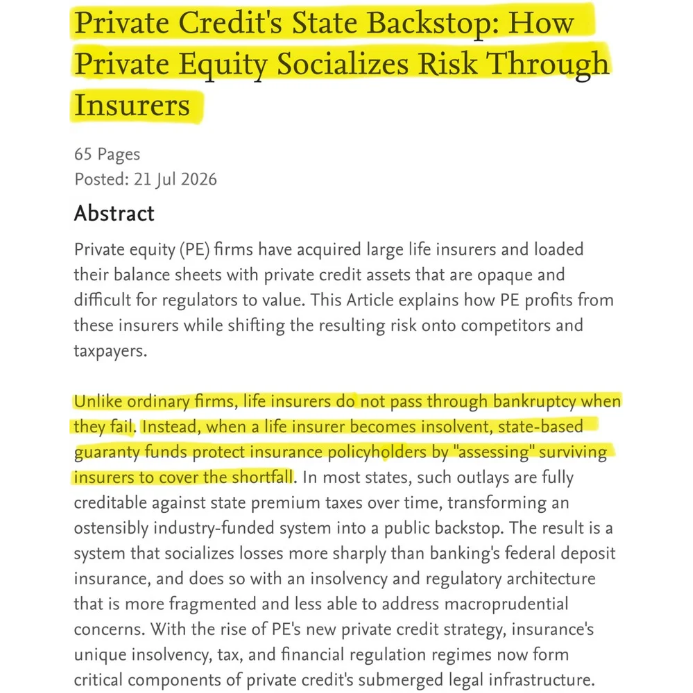
Private equity bought insurers. Loaded them with opaque debt. Now the taxpayers are the backstop. The playbook is the same one that blew up the banks in 2008. This time they bought the balance sheets of life insurance companies and filled them with private credit no one can value. $849 billion of it. Double what they held a decade ago. The regulators can't see it. The rating agencies can't model it. The policyholders don't know it exists. But the moment the valuations crack, the states step in. They don't call it a bailout. They call it a "guaranty fund assessment." The other insurers pay. They deduct the payment from the taxes they owe. The public pays through lower tax revenue. No bill. No vote. No headline. Just a quiet transfer of risk from the people who made the bet to the people who didn't know they were in the game. This is the 2008 playbook rewritten for the private credit era. The losses are hidden. The leverage is enormous. The regulators are asleep. The public is the backstop. And the architects are already planning the next ride. Michael Burry is right. The question is whether anyone will listen before the music stops. The insurers are the battery. The private credit is the charge. The public is the ground waiting to complete the circuit.
English
2
0
2
76
Bull Theory
Bull Theory@BullTheoryio·
MICHAEL BURRY JUST WARNED THAT PRIVATE EQUITY MAY BE USING LIFE INSURERS TO PUSH LOSSES ONTO THE PUBLIC. Burry is highlighting a new paper by two Yale/Texas researchers, "Private Credit's State Backstop: How Private Equity Socializes Risk Through Insurers." Firms like Apollo, KKR, and Blackstone have bought up life insurers. They've filled these insurers' balance sheets with private credit, loans that are hard for regulators to check or price properly. Life insurers now hold $849 billion in this kind of debt, more than double what they held in 2014. Here's the trick: If one of these insurers can't pay its bills, states step in to protect policyholders. They do this by charging other insurance companies a fee to cover the gap. Those companies then get to subtract that fee from the taxes they owe the state. So in the end, the public pays for it through lower state tax collections, without it ever being called a bailout. This has already started happening. Two companies, First Brands and Tricolor, went bankrupt in 2025 after lenders realized they couldn't properly value the debt they were holding. And the next risk is AI: Big tech companies are funding their AI data centers using the same kind of complex, hard to value debt. If AI spending doesn't pay off fast enough, that risk doesn't stay with tech companies. It lands on the same insurers already holding piles of this debt.
Bull Theory tweet mediaBull Theory tweet mediaBull Theory tweet media
English
142
877
3.4K
215.9K
BullBrezza | Macro & Crypto
The U.S. Dollar has lost 30% of its purchasing power over the last six years. That's not inflation. That's a tax. The people who notice are the ones who check their grocery receipt. The ones who don't are the ones who still think the dollar is stable because the number on their savings account didn't change. The number changed. The value didn't. Here's the math that matters. $1 in 2020 buys what 70 cents bought in 2018. The dollar didn't crash. It melted. Slowly enough to feel normal. Fast enough to empty your wallet. The Fed printed more money in the last six years than in the previous 100 combined. That's not a conspiracy. That's a statement of fact. The supply increased. The value decreased. Basic economics. The only mystery is why anyone is surprised. The 1970s did the same thing. The dollar lost 50% of its purchasing power in a decade. People bought gold. People bought real estate. People bought anything that couldn't be printed. The ones who held cash watched their retirement evaporate. The ones who held assets watched their net worth soar. The playbook is the same. The actors are different. The outcome is identical. The dollar is losing value. The question is whether you're holding the thing that's melting or the thing that's rising.
English
0
0
0
148
BullBrezza | Macro & Crypto
Thirty percent in six years. That's not inflation. That's a tax. The people who notice are the ones who check their grocery receipt. The ones who don't are the ones who still think the dollar is stable because the number on their savings account didn't change. The number changed. The value didn't. Here's the math that matters. $1 in 2020 buys what 70 cents bought in 2018. The dollar didn't crash. It melted. Slowly enough to feel normal. Fast enough to empty your wallet. The Fed printed more money in the last six years than in the previous 100 combined. That's not a conspiracy. That's a statement of fact. The supply increased. The value decreased. Basic economics. The only mystery is why anyone is surprised. The 1970s did the same thing. The dollar lost 50% of its purchasing power in a decade. People bought gold. People bought real estate. People bought anything that couldn't be printed. The ones who held cash watched their retirement evaporate. The ones who held assets watched their net worth soar. The playbook is the same. The actors are different. The outcome is identical. The dollar is losing value. The question is whether you're holding the thing that's melting or the thing that's rising.
Hedgeye@Hedgeye

The U.S. Dollar has lost 30% of its purchasing power over the last six years

English
0
0
0
122
BullBrezza | Macro & Crypto
The next trillion-dollar crypto projects won't win because they have the highest TPS or the loudest community. They'll win because they remove the biggest bottlenecks holding the digital economy back. • $SUI is making blockchain usable enough for the next billion users. • $MON is making decentralized applications feel as responsive as Web2. • $WAL is building decentralized memory so AI doesn't have to start from zero every time. • $ARB is extending Ethereum's capacity without replacing its security. • $TAO is creating an open marketplace where intelligence can be produced, measured, and rewarded. Every great investment starts with a simple question: "What problem becomes impossible to ignore over the next decade?" That's where I'm looking.
English
0
0
1
146
BullBrezza | Macro & Crypto
Here's what the calendar doesn't tell you. The Fed decision is already priced. The earnings are already known. The inflation data is just the confirmation of what the bond market already whispered. The real signal isn't on the schedule. Markets don't move on news. They move on the gap between the news and the expectation. That gap is the only edge that matters. The Fed will cut or hold. The earnings will beat or miss. The inflation will come in hot or cool. And the market will react in the direction that makes the most people wrong. The Iran pause is the trap. The relief is the bait. The real move comes when the pause ends and nobody sees it coming. The calendar is the theater. The real show is underneath.
English
0
0
0
61
The Kobeissi Letter
The Kobeissi Letter@KobeissiLetter·
Key Events This Week: 1. Markets React to US/Iran Pausing Strikes - Today, 6 PM ET 2. July Consumer Confidence data - Tuesday 3. July Fed Interest Rate Decision - Wednesday 4. Microsoft, $MSFT, Meta, $META, Report Earnings - Wednesday 5. July PCE Inflation data - Thursday 6. Apple, $AAPL, Amazon, $AMZN, Report Earnings - Thursday 7. July MI Consumer Sentiment data - Friday 8. July MI Inflation Expectations data - Friday We have a huge week ahead.
English
122
483
3.5K
454K
BullBrezza | Macro & Crypto
“I could make more in the market” is the most expensive sentence in personal finance. Not because it's wrong. Because it assumes the person saying it has the discipline to execute the trade and the nerve to stay invested when the market drops 30%. Most people don't. They buy the top, sell the bottom, and wonder why the math didn't work. Paying off the mortgage early is a psychological hedge. It's not about maximizing returns. It's about minimizing regret. The person who owns their house outright can take risks. The person with a 30-year anchor can't. The equity in the house is locked. You can't panic-sell a wall. You can't check the Zillow price every hour. You can't watch it drop 40% on a news headline and hit sell. The market will test you. The mortgage won't. The mortgage is a fixed cost. The market is a variable one. The variable one breaks people. The fixed one just gets paid. The people who argue against paying the mortgage are the same people who argue for 100% equities. They've never seen a real drawdown. They've never felt the weight of debt when the income stops. They've never had to make the decision to sell a stock to pay a bank. The math is clean. The psychology is not. The mortgage is the anchor. The market is the storm. The wise captain doesn't ask which one is faster. They ask which one keeps the ship from sinking.
NoLimit@NoLimitGains

In my opinion, paying off your mortgage early is very smart. “I could make more if I invested it in the stock market” blah blah blah. When money is easy to reach, chances are you will take some out. Your house on the other hand, you cannot sell 23% of it. You can technically borrow against it, but barely anyone actually does.

English
0
0
1
201
BullBrezza | Macro & Crypto
The difference is the difference between the lion tamer and the lion. Gates built the cage. Musk is trying to burn it down. One is the system. The other is the threat to the system. The media doesn't ask Gates hard questions because Gates is the reason they still have jobs. He built the software that runs their newsrooms. He funded the foundations that pay their reporters. He is the establishment. And the establishment does not interrogate itself. Musk is the outsider who bought the platform, fired the editors, and let the people speak. He is the one who proved that the media's power was always borrowed. He is the one who made them irrelevant in real time. They hate him for it. Not because he's wrong. Because he's right. And being right is the one thing they can't forgive. The legacy media spent 50 years building a moat around the truth. They decided what was news, who was credible, and what you were allowed to think. Then the internet came. Then Twitter came. Then Musk came. And the moat drained overnight. They are still standing in the ditch, wondering where the water went. Gates is a billionaire who plays by their rules. Musk is a billionaire who writes his own. The media loves the first and fears the second. The silence around Gates is the sound of the system protecting itself. The money is the story. But the silence is the signal. The people who control the narrative will always protect the people who built it. The interviews are the theater. The silence is the strategy. The strategy is the story.
English
0
0
1
94
DogeDesigner
DogeDesigner@cb_doge·
Why do legacy media interviewers never ask Bill Gates the same hostile, propaganda-filled questions they ask Elon Musk?
English
548
2.1K
33.4K
834.3K
BullBrezza | Macro & Crypto
The world tells you to diversify your investments. Very few tell you to diversify your money. Bitcoin is monetary diversification.
GIF
English
0
0
1
104
BullBrezza | Macro & Crypto
Changing your mind isn't a weakness. It's the only way to survive. Markets don't reward conviction. They reward adaptability. The people who cling to an idea after the evidence shifts are not principled. They're just stuck. They confuse loyalty to a thesis with loyalty to themselves. The best traders I know have no ego about being right. They care about being less wrong than the next person. They update their priors without drama. They admit they were wrong before the market proves it for them. Normalize changing your opinion. It's OK. It's not OK to stay the same when the world has changed. That's not consistency. That's just denial with better marketing. The information is the input. The change is the signal. The refusal is the risk.
English
0
0
0
127