You’re hiring a fresher.
Candidate A:
Strong DSA
0 shipped projects
Candidate B:
Average DSA
2 real projects in production
Which one you are choosing? 👀
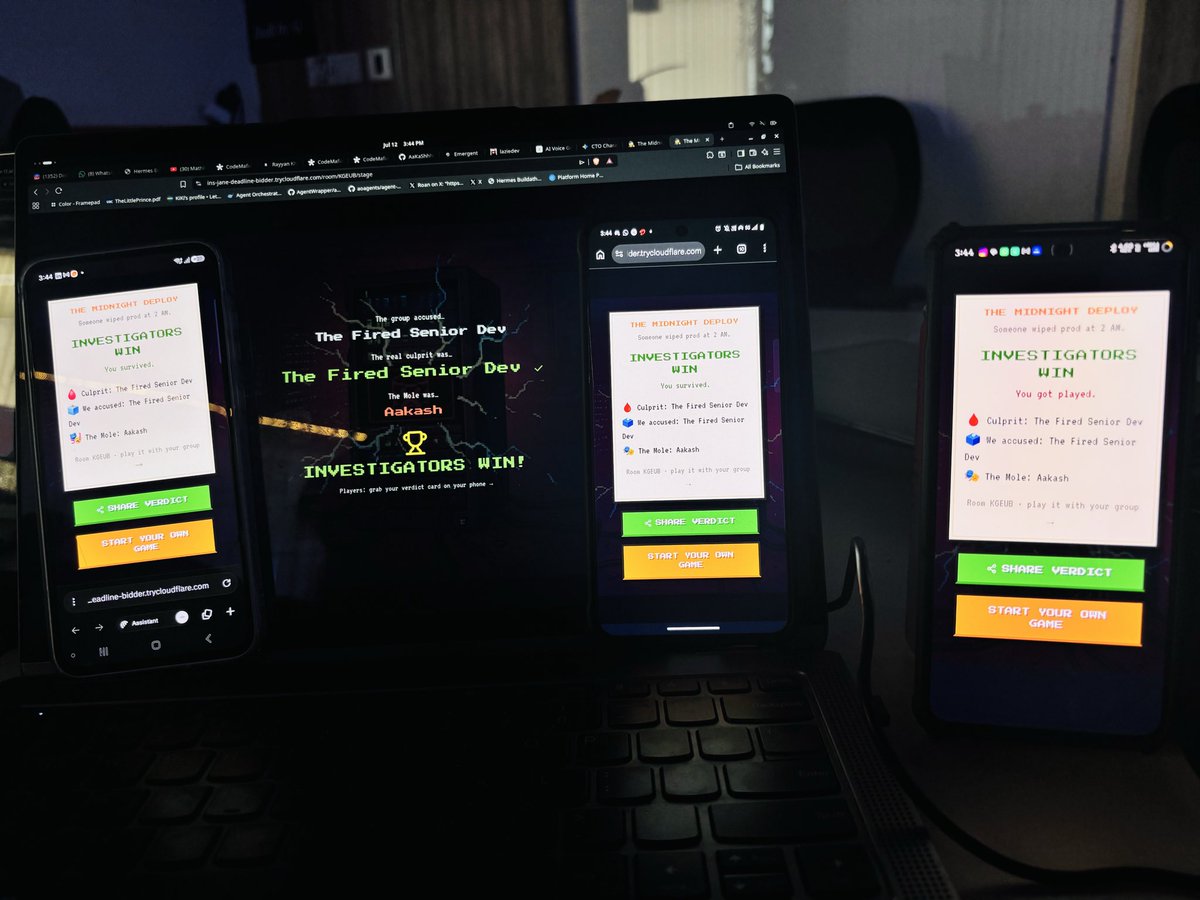
Someone wiped prod at 2 AM.
Most teams overbuild AI cases and underbuild pacing. We built a viral loop for the Hermes Buildathon.
Add the bot to Telegram. It DMs six secret roles, forcing five instant signups. Clues drop on a strict cron timer. Suspects answer interrogations out loud via ElevenLabs.
Convex handles the game state and the player-to-host funnel. Cloudflare Pages handles the two-tap launch.
The mechanic is the loop. The timer is the product.
@GrowthX_Club@OpenAI@NousResearch
Paste your store URL, get a marketing agency.
Reverb builds your brand's DNA, plans a campaign across audience segments, and ships channel-ready ads (image, video, copy), then learns from results.
For D2C brands without a creative team. Try it: kaizenn.xyz@Maaztwts@diyasversion@whoisasx
Here's an AI engineering pattern I wish more AI teams adopted:
(It's stolen from traditional software engineering)
Not every code change deserves the same validation process.
For example, I once waited 3 hours for my AI eval suite to tell me my change was correct after I updated one word in my documentation.
This shouldn’t be the case.
Tweaking a prompt or fixing a small bug shouldn't require rerunning your entire evaluation suite.
But if you introduce a new capability, manual testing isn't enough.
Here's how Alejandro Aboy approaches it with Evaluation-Driven Development (EDD)...
There are two different modes:
1/ Manual quick check
For small changes:
Prompt tweaks
Tool descriptions
Bug fixes
Minor routing improvements
Generate around 30 fresh traces.
Inspect them manually.
If needed, trigger an LLM judge to score the results.
Think of it like a unit test.
2/ Automated experiments
When shipping new functionality, those fresh traces become a dataset.
The dataset becomes an experiment.
Every trace is automatically evaluated.
Then you compare today's experiment against previous ones to catch regressions since the most dangerous AI failures are the silent ones.
One more design decision stood out to me...
The evaluation difficulty should be adjustable.
Happy-path conversations.
Edge cases.
Fully adversarial interactions.
The larger the change, the harder you push the agent before shipping it.
To sum up:
Traditional software engineering doesn't treat every change the same.
Neither should AI engineering.
Small changes deserve quick validation.
Big changes deserve experiments.
Using the same evaluation process for both slows you down or leaves regressions undiscovered.
P.S. We covered Alejandro Aboy's complete EDD workflow in a recent issue of Decoding AI Magazine.
Check it out here: decodingai.com/p/how-evaluati…
90% of AI Engineering in 2026 is mastering these 10 concepts (the rest is arguing about vendors):
1) Token economics and caching: measure $/request and latency; cache prompts/embeddings/results or your “cheap demo” becomes a 5-figure monthly bill.
2) Retrieval that doesn’t lie: chunking, metadata, filters, and evals matter more than vector DB brand; most “RAG failures” are bad corpora + bad queries.
3) Determinism vs creativity: set temperature/top_p, use seeds when possible, and add guards; prod needs repeatable outputs for tests and incident triage.
4) Structured outputs: force JSON/schema, validate, and retry with repair prompts; parsing free-form text is how pipelines silently corrupt data.
5) Tool calling boundaries: design idempotent tools, timeouts, and rate limits; the model will call the same action 3 times and your system must survive it.
6) Async and backpressure: queue long calls, stream partials, and shed load; LLM latency variance will trash your p95 if you treat it like a normal API.
7) Observability you can debug: trace prompt, model, version, retrieval hits, and tool calls; without correlation IDs you won’t reproduce bugs.
8) Security and data handling: prompt injection is an input validation problem; redact secrets, isolate tools, and enforce least-privilege per action.
9) Eval harness + golden sets: ship with offline tests and online canaries; diff outputs across model/version changes or you’ll regress without noticing.
10) Real-world failure modes: context truncation, stale docs, jailbreaky user inputs, and vendor outages; add fallbacks, circuit breakers, and a non-AI path for critical flows.
Building my golden dataset. it is the tedious process but worth it in the end .
i kepts slipt like
15 prompts/per feature surface + happy paths and negative paths.
Excited to Share that my proposal got selected in @Qualcomm@Snapdragon@qualcomm_in . But I need a Team member to join us on 18-19 july at Noida sector 135 , if anyone can join us lemme know !! #buildinpublic