Christian T. Elbaek

6.5K posts

Christian T. Elbaek banner
Christian T. Elbaek

Christian T. Elbaek

@CElbaek

Assistant Professor @AarhusUni || investigating how scarcity and economic inequality influences financial and moral judgment & decision-making

Aarhus, Denmark Katılım Mart 2009
2.8K Takip Edilen1.4K Takipçiler
Sabitlenmiş Tweet
Christian T. Elbaek
Christian T. Elbaek@CElbaek·
Trying out the other site as well 🦋 You can find me at @celbaek.bsky.social Still not leaving this one completely behind (yet)
English
1
0
0
120
Christian T. Elbaek retweetledi
Robin Schimmelpfennig
Robin Schimmelpfennig@schimmelrob·
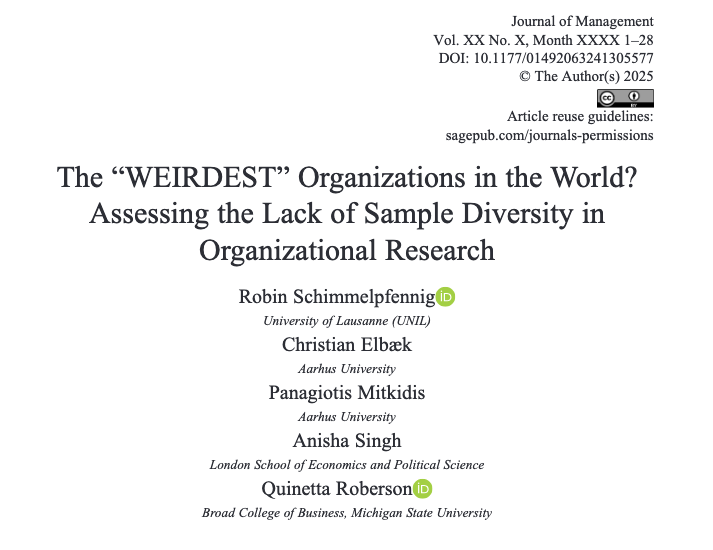
Have you ever wondered why findings in organizational research are not always applicable to practical contexts & grand challenges our times? 🧐 Maybe it is the of data we sample?! New paper out in JOM Yearly Review! @CElbaek Panagiotis Mitkidis @anisha0singh Quinetta Roberson
Robin Schimmelpfennig tweet media
English
1
10
13
1.5K
Christian T. Elbaek retweetledi
Christian T. Elbaek
Christian T. Elbaek@CElbaek·
Interested in social perspectives on dishonesty? We are organising a EASP group meeting on the future of behavioral ethics, in Berlin in May. We invite researchers of all career stages to present their work on dishonesty. You can find all info here: easp.eu/news/itm/easp_…
English
0
4
8
626
Christian T. Elbaek
Christian T. Elbaek@CElbaek·
Excited to head to NYC tomorrow for @SJDM_Tweets this weekend! If you’ll be there and want to grab a coffee, I’d be happy to meet up and talk!
English
0
1
3
477
Christian T. Elbaek
Christian T. Elbaek@CElbaek·
🚨 New pre-print out! 🚨 Led by the brilliant @Kelly_Kirkland_ and in collaboration with @ChristophKlebl and @jetten_j, we investigate how perceptions of anomie (i.e., the belief that society's social and political fabric is crumbling) influence support for redistribution.
Kelly Kirkland@Kelly_Kirkland_

Ever feel like the very fabric of society is crumbling at the seams these days? Same. Our latest preprint reveals how a shared sense that society is deteriorating may shape attitudes on important policies like wealth redistribution. Check it out below: osf.io/preprints/osf/…
English
0
1
8
931
Christian T. Elbaek retweetledi
Morten N. Støstad
Morten N. Støstad@MortenStostad·
New publication: "Inequality as an Externality", w. F. Cowell in the Journal of Public Economics. We argue that most major economic models assume that economic inequality has essentially no societal consequences. Why? The idea is that economic inequality is an externality.
Morten N. Støstad tweet media
English
9
152
713
102.8K
Christian T. Elbaek retweetledi
David Amodio
David Amodio@david_m_amodio·
🚨New in @PNASNews, led by @DSchultner & Ben Stillerman: In 8 studies, we test a mechanism through which exposure to societal stereotypes—even those we know may be false—can implicitly transform into individual-level prejudice and then spread across a community.
David Amodio tweet media
English
1
42
140
25K
Christian T. Elbaek
Christian T. Elbaek@CElbaek·
"If the United States were to adopt the tax and transfer insurance effects of its peer countries, its intergenerational poverty persistence could decrease by more than one-third."
Zach Parolin@ZParolin

New at Nature Human Behaviour w/ Esping-Andersen, Pintro-Schmitt & @PFallesen: The intergenerational persistence of poverty (the link between poverty in childhood vs. adulthood) is 4x stronger in the US than in Denmark and 2x stronger than in UK/AUS. Why? nature.com/articles/s4156…

English
0
0
0
252
Christian T. Elbaek retweetledi
Nature Human Behaviour
Nature Human Behaviour@NatureHumBehav·
Intergenerational poverty is particularly high in the US compared to four other high income countries, report @zparolin et al., who also examine the mechanisms through which poverty persists. nature.com/articles/s4156…
English
0
5
15
1.9K
Christian T. Elbaek retweetledi
Christoph Klebl
Christoph Klebl@ChristophKlebl·
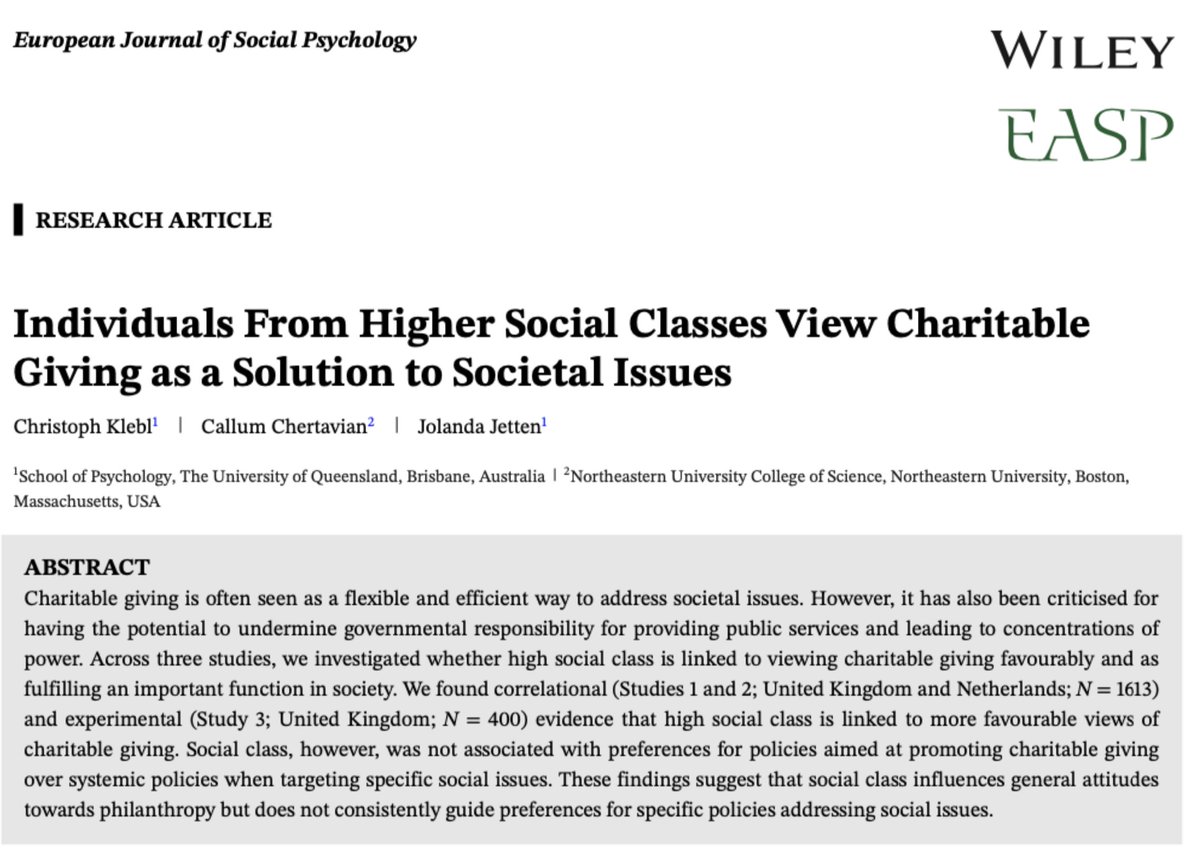
Excited to share our new research! We investigated how social class shapes attitudes toward philanthropy and found that individuals from higher social classes view charitable giving more favourably and view it as a solution to societal issues. @jetten_j onlinelibrary.wiley.com/doi/10.1002/ej…
Christoph Klebl tweet media
English
3
11
51
3.8K
Christian T. Elbaek retweetledi
Max Roser
Max Roser@MaxCRoser·
The World Bank's data portal for poverty, inequality, and growth data has gotten much better! Their replacement for the older PovcalNet is called PIP — the 'Poverty and Inequality Platform'. If you are interested in poverty it is worth having a good look around. They just updated their data. → pip.worldbank.org/home
English
5
115
421
73.8K
Christian T. Elbaek retweetledi
Michael Bang Petersen
Michael Bang Petersen@M_B_Petersen·
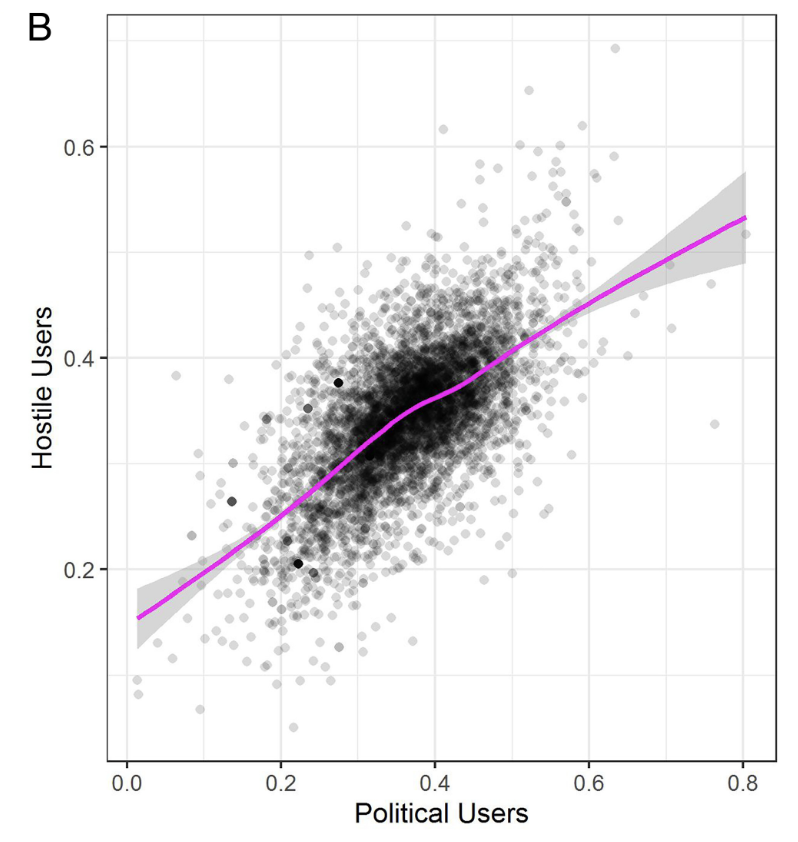
🚨 Just out in @PNASNews 🚨 Combining administrative registers and individual Twitter behavior among Danes, we show that multiple offline indicators predict online hostility: Having many more criminal verdicts increase the likelihood of being hostile online. But - against common stereotypes of online haters - so does having high school grades when you grew up. The reason: Hostility is about politics and those from an affluent background are much more likely to tweet about politics. All in all, hostility is not just about algorithms and the features of online discussions. Individual offline dispositions matter too. Thank you for another great collaboration to @stighebbelstrup and @boralexander1!
Michael Bang Petersen tweet mediaMichael Bang Petersen tweet mediaMichael Bang Petersen tweet media
English
6
47
172
25.7K
Christian T. Elbaek retweetledi
Daron Acemoglu
Daron Acemoglu@DAcemogluMIT·
I and twenty-two other Nobel economists signed a letter endorsing Kamala Harris for President. We believe Harris's policies will result in a stronger economic performance, with economic growth that is more robust, more sustainable, and more equitable. cnn.com/2024/10/23/pol…
English
5.2K
7K
25K
2M
Christian T. Elbaek retweetledi
Valerio Capraro
Valerio Capraro@ValerioCapraro·
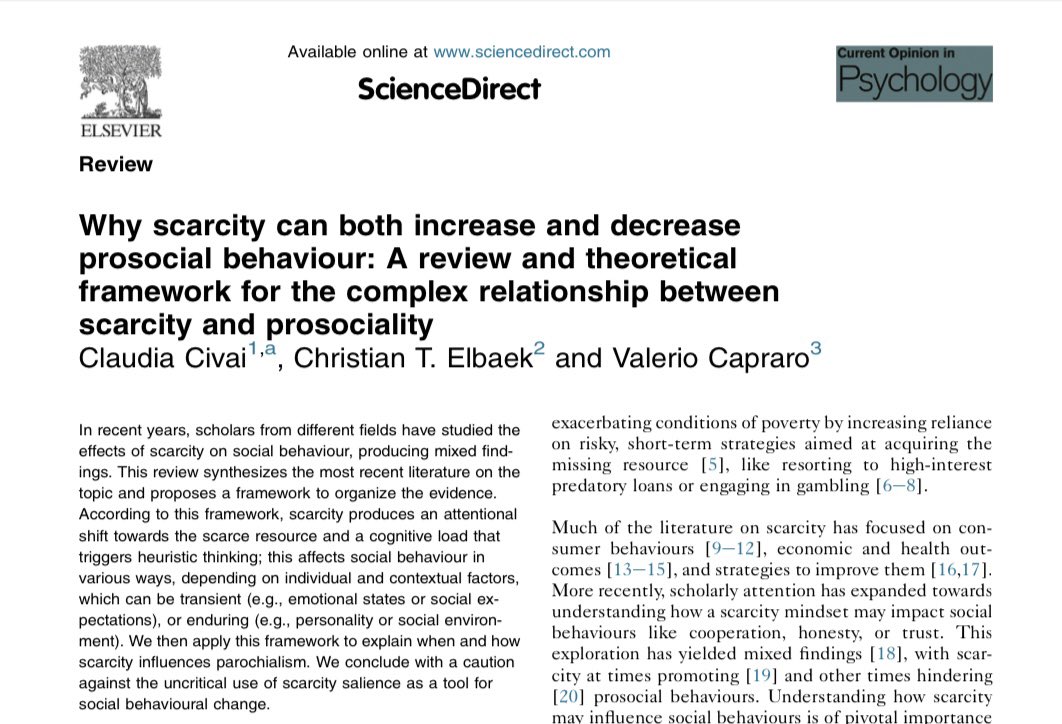
Does scarcity of resources make us more selfish or more prosocial? This question is complex, as experimental research finds that scarcity can sometimes make us more selfish and, at other times, more prosocial. Yet, these effects are not random. In this review article, we propose a conceptual framework to organize the experimental evidence. We suggest that the impact of scarcity on prosocial behavior is mediated by situational, transient individual and social factors, and moderated by enduring individual and social factors. One particular case we explore in detail is parochialism: Does scarcity increase or decrease it? Well, it depends… In societies with tight norms, where ingroups and outgroups share similar norms, scarcity increase cooperative behavior with both groups. In contrast, in societies with loose norms, scarcity may intensify parochialism. Greater uncertainty about social norms makes cooperation riskier, prompting more ingroup favoritism. We also caution that nudges based on scarcity should be applied carefully, as they may backfire. For instance, emphasizing vaccine shortages could inadvertently lead people to prioritize others they see as more in need, ultimately reducing overall vaccination uptake. The full paper is available open access at: sciencedirect.com/science/articl… w/ @claudiacivai & @CElbaek
Valerio Capraro tweet media
English
2
22
87
9.7K