Corey Hoffstein 🏴‍☠️

41.4K posts

Corey Hoffstein 🏴‍☠️ banner
Corey Hoffstein 🏴‍☠️

Corey Hoffstein 🏴‍☠️

@choffstein

CEO & CIO, Newfound Research | 🥞 Return Stacked® ETFs | 🌊 Liquidity Cascades | 📆 Rebalance Timing Luck | ⚡️ Risk cannot be destroyed, only transformed.

🎙 www.flirtingwithmodels.com Katılım Ekim 2009
1.2K Takip Edilen84.2K Takipçiler
Sabitlenmiş Tweet
Corey Hoffstein 🏴‍☠️
Corey Hoffstein 🏴‍☠️@choffstein·
My company, Newfound Research, turned 15 today. Coming up on this anniversary, I reflected quite a bit on my career.  I’m not sure why, but this milestone feels larger than I would've expected. So I decided to write something. 15 Ideas, Frameworks, and Lessons from 15 Years
English
98
275
1.7K
652.5K
johnnyairport
johnnyairport@johnnyairport·
@choffstein The Delorean from Back to the Future proves your analogy incorrect. Originally designed to run on high grade plutonium, it is converted to run on banana peels and garbage and can now fly. Worse fuel yet better performance - all through creativity and engineering.
English
1
0
0
119
Corey Hoffstein 🏴‍☠️
@izebel_eth I mean, I'm not sure you can disagree with the whole "path dependency vs expiration time" trade-off... But you're absolutely correct on the fungibility. That said, for people not trading intraday, the lack of fungibility is a feature. And even intraday people are using 0dte
English
1
0
2
176
jez (equity perps era)
jez (equity perps era)@izebel_eth·
its a strange feeling having a novel/informed take slowly just become completely mainstream consensus
jez (equity perps era)@izebel_eth

@veH0rny @RaReAlt @heart_ @0xGoogly @tmnxeq yeah thats the pt, robinhood users just want levg and otm weekly calls/puts are their only options, they dont know what greeks or IV or anything they just fking slamming high delta, if perps existed on robinhood options would have 0 volume

English
18
5
262
42.1K
Corey Hoffstein 🏴‍☠️
my growing concern for perp dex valuations is that without onboarding natural producers and consumers, OI/volume is constrained by speculators who net lose money over time. well, until I went to vegas last week and was reminded that the speculator class is undefeated.
English
5
1
54
6.3K
ginzabike
ginzabike@godjira110·
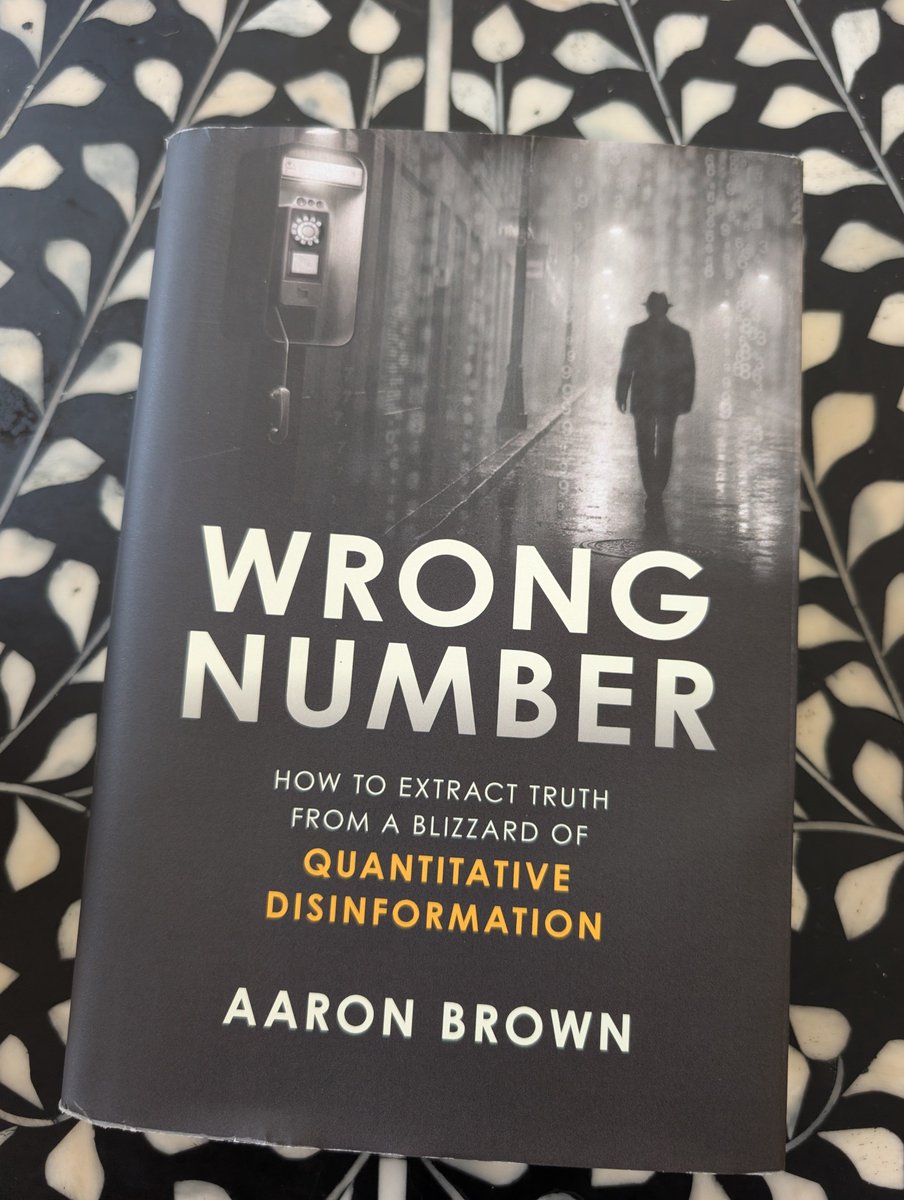
@choffstein aaron brown's red blooded risk is one of those great books too, but somehow rarely spoken about. similar to robert bookstaber's demon of our own design.
English
2
0
5
201
Corey Hoffstein 🏴‍☠️
@stalmico bad study design and a poor understanding of both probability and statistics leads to lots of numerical claims in public issues (e.g. the impact of gun controls on murder rates or whether marijuana is bad for your heart) that don't stand up to scrutiny.
English
0
1
13
467
Corey Hoffstein 🏴‍☠️
@EricBalchunas @DaveNadig Yeah, both things can be true I think. Super late mega ipos have the potential of exploiting naive passive indexing rules to the benefit of prior shareholders AND passive can be very, very, very, very hard to beat.
English
0
0
2
312
Eric Balchunas
Eric Balchunas@EricBalchunas·
@choffstein @DaveNadig Re the SPX outperforming most strategies regardless of whether Space X is good or bad or when it includes it I'm not sure he'd disagree, the evidence is super strong it will, but I also have to ack the future is unknowable at end of day.
English
1
0
2
985
Eric Balchunas
Eric Balchunas@EricBalchunas·
Re all the ‘index funds are the exit liquidity, those poor dumb saps’ feigned concern responses to this. I’ve heard this many times bf and yet it still outperforms the vast majority of the “smart money” out there so 🤷
Eric Balchunas@EricBalchunas

Passive S&P 500 funds could have to buy roughly 19% of public SpaceX shares within 6mo under fast-tracking framework (it would enter the index at the est 6th spot), Russell 1000 and Nasdaq 100 may buy another 5.5% within weeks of the IPO. Thrown in active MFs benchmarked to those indices and you get to HALF of SpaceX shares. Nice study from my colleague @rduboff

English
13
7
124
38.2K
Ptuomov
Ptuomov@ptuomov·
@13F_Pro @choffstein @nresiduums Yes, there’s no way to make progress on the question I’m interested in without actually using a valuation model to compute the duration of stocks.
English
1
0
0
207
Ptuomov
Ptuomov@ptuomov·
I disagree with this view. My logic is the following. The overall cap-weighted stock market's cash flows are, in fact, highly predictable and stable. This is the so-called "Shiller's volatility puzzle." Given this stability, it's relatively easy to compute the duration for the overall stock market. 1/the total payout yield is a very reasonable measure of the overall stock market duration. In the US, it's always longer than the longest-maturity TIPS. If you fund the overall stock market by shorting the longest-maturity TIPS, you'll get a "pure" measure of equity premium that has less maturity mismatch between the long and short legs. It turns out that this pure equity premium is very negatively correlated with long-term TIPS returns. Why is that? It's some sort of fluctuation in the market's time preference and risk aversion that causes flight-to-safety and flight-from-safety behavior. In my opinion, the low correlation of growth stocks with TIPS comes from the fact that growth stocks have high betas on the pure equity premium. The risk premium on growth stocks shrinks a lot when long-term real yields go up.
Dow@mark_dow

The discount rate is next to meaningless for companies whose future cash flows/earnings are highly uncertain. The long duration asset argument is one of those things that sounds reasonable in theory, but falls apart when you think about it in reality. This is why high growth stocks are a lot less interest rate sensitive, as we've seen since 2022. A marginally higher or lower growth trajectory swamps changes in the discount rate. The general rule is the more predictable and low-variance the cash flows, the more interest rates matter. When ppl talk about equities with highly uncertain earnings forecasts as long duration assets, it's a sign of disqualifyingly bad analysis and they lose all credibility.

English
8
2
56
31.4K
Corey Hoffstein 🏴‍☠️
@ptuomov @nresiduums If CORR(S,T)=0, I can guarantee it's negative. But of course it'll rely on their relative volatility. That's how correlation works... CORR(S-T, T) = -1/sqrt(k^2 + 1) where k = sigma_S / sigma_T
English
1
0
0
115
Ptuomov
Ptuomov@ptuomov·
If I understand your claim correctly, it is not true. The stocks and TIPS having exactly zero correlation doesn’t alone determine the correlation of stocks minus TIPS and TIPS. If it did, you could just tell me what the correlation is (without knowing the volatilities). But I don’t think you can.
English
1
0
1
118
13F Pro
13F Pro@13F_Pro·
@ptuomov @choffstein @nresiduums The mechanical correlation point is sharp but misses the real issue. If stocks and long-term TIPS are uncorrelated in steady state, then yes, any negative correlation you're seeing is positioning/hedging, not fundamental
English
2
0
0
26
Corey Hoffstein 🏴‍☠️
You're saying "it is the correct thing to do" and I'm saying "it's numerically meaningless." We can't both be correct. And if the correlation between stocks and long-term TIPs is zero, it means that the negative correlation you're seeing is 100% mechanical. It's literally the limiting case. We have to be talking past each other here...
English
1
0
1
123
Ptuomov
Ptuomov@ptuomov·
@choffstein @nresiduums Yes, and that is the correct thing to do in this situation. After the fact, it’s obvious that if stocks and long-term tips returns have about zero correlation, then the pure dividend risk and the real term premium realizations must be very negatively correlated.
English
1
0
1
118
Corey Hoffstein 🏴‍☠️
If you compute a duration, subtract the return of that specific duration TIP from equities, and then regress against long-dated TIPs, you're still dealing with the issue that you likely have a very high correlation between the bond you subtracted and the long-dated TIPs series you're regressing against.
English
2
0
0
139
Ptuomov
Ptuomov@ptuomov·
That’s precisely what you don’t want to do, because long term bond returns and return on a pure dividend risk claim without a duration mismatch can be and in fact are correlated. The only way to do what I want to do is to use a valuation model to compute the duration of stocks.
English
1
0
1
125
Corey Hoffstein 🏴‍☠️
I don't believe the model you discuss in your original post can actually support that question. It's flawed by construction. For example, let's say instead you orthogonalize equity returns vs long dated TIPs and then regress the residuals against long dated TIPs. Of course you'd get zero beta.
English
1
0
0
127
Ptuomov
Ptuomov@ptuomov·
@choffstein @nresiduums I want to understand whether long term bonds hedge pure dividend risk where the pure dividend risk doesn’t have any direct duration exposure.
English
1
0
1
155
Corey Hoffstein 🏴‍☠️
@ptuomov @nresiduums Sorry, I read that as "stocks - t-bill return ~ t-bill return @ t-1" I guess to my original point: if you're reading into the correlation in any way, I'm not sure I understand why. If you're using the model for some other reason.... you do you?
English
1
0
0
127
Ptuomov
Ptuomov@ptuomov·
@choffstein @nresiduums The one month T-bill realized return is literally equal to the beginning of the month yield, so that’s an exact relationship.
English
1
0
1
106
Corey Hoffstein 🏴‍☠️
@ptuomov @nresiduums Pretty sure that rate persistence is high enough that even though you've fixed the contemporaneous return linkage, you're still pretty much going to end up with a significant negative correlation pull by design.
English
1
0
0
110
Ptuomov
Ptuomov@ptuomov·
One month T-bill return T, R+1 on the left hand side, one month T-bill yield T on the right hand side. You get a coefficients of one and approximately 100% R2. Then using the same conventions equity premium on the left hand side and T-bill yield on the right hand side. There’s a mechanical link but the regression is still interesting.
English
2
0
1
212