Tupamaro

4.3K posts

Tupamaro banner
Tupamaro

Tupamaro

@nresiduums

high speed life lessons.

Katılım Nisan 2020
2.3K Takip Edilen203 Takipçiler
Sabitlenmiş Tweet
Tupamaro
Tupamaro@nresiduums·
Trump is not a change of agent. Manufacturing jobs are not coming back. The US has a distribution problem, not a bilateral trade deficit problem. Even if tomorrow US produces everything and anything, the statesmen will still have to tackle the same distribution of income problem.
English
1
0
2
1.8K
Tupamaro
Tupamaro@nresiduums·
@choffstein @ptuomov Corey has a good point, if it’s not mechanical then ipso facto the same level of correlation should be apparent in the two variables anyway
English
1
0
0
157
Corey Hoffstein 🏴‍☠️
@ptuomov Well, we replace the long equity leg with T-Bills, then the correlation goes to -1 by construction. You'd need the beta between stocks and long-dated tips to be >1 for the correlation to be positive.
English
1
0
0
410
Ptuomov
Ptuomov@ptuomov·
I disagree with this view. My logic is the following. The overall cap-weighted stock market's cash flows are, in fact, highly predictable and stable. This is the so-called "Shiller's volatility puzzle." Given this stability, it's relatively easy to compute the duration for the overall stock market. 1/the total payout yield is a very reasonable measure of the overall stock market duration. In the US, it's always longer than the longest-maturity TIPS. If you fund the overall stock market by shorting the longest-maturity TIPS, you'll get a "pure" measure of equity premium that has less maturity mismatch between the long and short legs. It turns out that this pure equity premium is very negatively correlated with long-term TIPS returns. Why is that? It's some sort of fluctuation in the market's time preference and risk aversion that causes flight-to-safety and flight-from-safety behavior. In my opinion, the low correlation of growth stocks with TIPS comes from the fact that growth stocks have high betas on the pure equity premium. The risk premium on growth stocks shrinks a lot when long-term real yields go up.
Dow@mark_dow

The discount rate is next to meaningless for companies whose future cash flows/earnings are highly uncertain. The long duration asset argument is one of those things that sounds reasonable in theory, but falls apart when you think about it in reality. This is why high growth stocks are a lot less interest rate sensitive, as we've seen since 2022. A marginally higher or lower growth trajectory swamps changes in the discount rate. The general rule is the more predictable and low-variance the cash flows, the more interest rates matter. When ppl talk about equities with highly uncertain earnings forecasts as long duration assets, it's a sign of disqualifyingly bad analysis and they lose all credibility.

English
8
2
56
31.4K
Tupamaro retweetledi
Isabella M Weber
Isabella M Weber@IsabellaMWeber·
Germany is in panic over Chinese companies taking over its markets at home, abroad and in China. Having spent quite some time in China in the 2010s, I can’t help but thinking back to the arrogance and quite frankly racism of German expat businesses people. Chinese engineers with Ivy League degrees speaking fluent English and German looked down upon by German engineers with a degree from some German university, unimpressive English and less than two sentences of Chinese. The Germans didn’t see it coming because they couldn’t imagine Chinese people becoming better at what they are doing than themselves. An industry insider told me at the time how keen Chinese entrepreneurs were to collaborate with German car companies on EV development. But all the Germans worried about was they are going to steal our IP. Well, here we are.
English
436
2.1K
11K
912.3K
Tupamaro
Tupamaro@nresiduums·
IG tightening while USTs going up. Long live the claims on United economic zones of America.
English
0
0
0
14
Tupamaro
Tupamaro@nresiduums·
@joefrancis505 Do you think it’s the aggregate effect of many variables or one single variable such as affordability
English
1
1
1
81
joseph francis
joseph francis@joefrancis505·
Having read the post, I agree with Jesús: "The direct effect of smartphones is not zero, but it is not, by itself, that large." That seems sensible. They are a mediator.
Jesús Fernández-Villaverde@JesusFerna7026

Smartphones are not the explanation for the recent decline in fertility. Instead, they are an accelerator of deeper forces already at work. Let’s start with the facts. Fertility is falling almost everywhere: in rich, middle-income, and poor countries; in secular and religious countries; and in countries with high and low levels of gender equality. The decline accelerated around 2014. So, no country-specific explanation will work unless you are willing to believe that 200 distinct country-specific explanations arrived at roughly the same time. Smartphones look like the obvious candidate: the first iPhone was released in 2007, and global adoption has been astonishingly fast. Economists understand the first major decline in fertility in advanced economies, from 6 or 7 children per woman throughout most of human history to about 1.8, that occurred between the early 1800s and roughly 1970, well before smartphones. The main drivers were a sharp fall in child mortality (effective fertility was rarely above 3 and often close to 2) and the shift from a low-skill, rural agrarian economy to a high-skill, urban industrial one. We have quantitative models that fit these facts well. Country-specific factors mattered too, of course. Proximity to low-fertility neighbors accelerated Hungary’s decline, while fragmented landowning structures accelerated France’s. But these were second-order mechanisms. This is also why most economists long considered Paul Ehrlich’s doom scenarios implausible. We forecast that fertility in middle- and low-income economies would follow the same path as in the rich, probably faster, because reductions in child mortality reached India or Africa at lower income levels (medical technology is nearly universal, and most gains come from handwashing and cheap antibiotics, not Mayo Clinic-level care). Much of what we see in Africa or parts of Latin America today is still that old story. But in the 1980s, a new pattern appeared. Japan and Italy fell below 1.8, the level we had thought was the new floor. By 1990, Japan was at 1.54 and Italy at 1.36. This second fertility decline began in Japan and Italy earlier than elsewhere, driven by country-specific factors, but the underlying dynamics were widespread: secularization, an education arms race, expensive housing, the dissolution of old social networks, and the shift to a service economy in which women’s bargaining power within the household is higher. The U.S. lagged because secularization came later, suburban housing remained relatively cheap, and African American fertility was still high. U.S. demographic patterns are exceptional and skew how academics (most of whom are in the U.S.) and the New York Times see the world. My best guess is that, without smartphones, Italy’s 2025 fertility rate would be about 1.24 rather than 1.14. I doubt anyone will document an effect larger than 0.1-0.2. Italy was at 1.19 in 1995, not far from today’s 1.14. The TFR is cyclical due to tempo effects, so I do not read too much into the rise between 1995 and 2007 or the decline from 1.27 in 2019 to 1.14 today. The direct effect of smartphones is not zero, but it is not, by itself, that large. Where social media, in general, and smartphones, in particular, matter is in the diffusion of social norms. What would have taken 25 years now happens in 10. Social media are not the cause of fertility decline; modernity is. But they are a very fast accelerator. That is why social media are a major part of the story behind Guatemala (yes, Guatemala) going from 3.8 children per woman in 2005 to 1.9 in 2025. Without them, Guatemala would also have reached 1.9, just 20 years later. Modernity, in its current form, is incompatible with replacement-level fertility. By modernity, I do not mean capitalism: fertility fell earlier and faster in socialist economies than in market economies. Socialist Hungary fell below replacement in 1960, and socialist Czechoslovakia in 1966 (both experienced small, short-lived baby booms in the mid-1970s). By modernity, I mean a society organized around rational, large-scale systems and formalized knowledge. Countries will not converge to the same fertility rate. East Asia is likely stuck near 1, possibly below, given its unbalanced gender norms and toxic education systems. Latin America faces the same gender problem plus weak growth prospects, so I expect something around 1.2. Northern Europe has more egalitarian family structures and might hold near 1.5. The very religious societies are probably the only ones that will sustain 1.8. All of this could change with AI or changes in population composition. We will see. But on the current evidence, deep sub-replacement fertility is the “new new normal.” Unless we reorganize our societies, better learn to handle it as best we can.

English
3
5
58
5K
Tupamaro retweetledi
ebipere
ebipere@ebipere·
The Pettis–Tooze divergence may actually be quite straightforward. Pettis is looking at the financial economy: debt, bad investment, suppressed consumption, and losses waiting to be recognised. Tooze is looking at the real economy: factories, batteries, EVs, solar panels, supply chains, and industrial capacity. They are connected - loosely-coupled - but they are not the same thing. In a fiat world, that distinction matters more because the tie between financial claims and real output is looser, more political, and more discretionary than it was under gold. A bubble in finance does not automatically destroy productive capacity. And productive capacity does not automatically validate every financial claim written against it. That is why both Pettis and Tooze may be right at the same time. Pettis sees the distortion in the claims. Tooze sees the strength in the capacity. The real question is how the state manages the gap between the two. Under gold, that gap had a harder edge. Bad claims could persist for a while, but they eventually ran into the convertibility constraint. Under fiat, adjustment can be deferred, socialised, refinanced, inflated away, repressed, or pushed through the fiscal state. That is the post-1971 world: the financial economy can lie for longer, the real economy can endure beneath the lie, and the state decides how violently the two are made to meet - and who bears the loss. Pettis: carnegieendowment.org/china-financia… Tooze: adamtooze.substack.com/p/chartbook-44… #ElasticEconomics #FunctionalFinance #MalleableMonetarism
English
12
37
219
33.1K
Tupamaro retweetledi
Boston Smalls
Boston Smalls@smalls2672·
Claude is asked how it feels being used by the U.S. military.
English
141
1K
3.4K
133.8K
Tupamaro retweetledi
derek guy
derek guy@dieworkwear·
the new middlebrow podcast with @mcmansionhell is very enjoyable. many of the points raised feel salient to menswear — deskilling in the trades, rise of bad taste because an uneducated customer goes wild with options, poptimism vs cultural criticism, etc IG middlebrowpod
English
91
588
9.9K
316.4K
Tupamaro retweetledi
Kyle Griffin
Kyle Griffin@kylegriffin1·
NYT confirms — with new details: Last year, Navy SEALs used two boats to escort Kash Patel and nine others on what a Pentagon email called a 'VIP Snorkel' next to one of the military's most sacred sites, the underwater tomb of the U.S.S. Arizona. One Navy vet called the swim "horrifying." nytimes.com/2026/05/15/us/…
English
1.2K
6.6K
22.7K
3.2M
Tupamaro retweetledi
FedResearch
FedResearch@FedResearch·
Think fed funds trading reveals reserve scarcity? Not so fast. In the ample-reserves era, administered rates suppress the signal. We isolate the true interbank market and show that liquidity frictions emerge in bank-to-bank lending: federalreserve.gov/econres/feds/a…
English
0
8
29
2.4K
Tupamaro
Tupamaro@nresiduums·
@JeremyWS Treat yourself to a döner at NATO in Karoköy! And if you are into a Turkish bath, highly recommend Kılıç Ali!
Română
1
0
1
90
Jeremy
Jeremy@JeremyWS·
For now though, more important things… enjoying the sunset in Istanbul.
Jeremy tweet media
English
1
0
11
712
Jeremy
Jeremy@JeremyWS·
Great week for the core rates view… 2027 dates across the world leading the sell off… and fed hikes finally part of the debate We got to ~4.60 10y and 96.00 SFRZ7 much quicker than anticipated. ER u6u7u8 fly up at 27 and GBP rates immolated (but for very different reasons!!)
Jeremy tweet mediaJeremy tweet media
Jeremy@JeremyWS

Global Rates Outlook #5: Price V Quantity & a New Era For Central Banking. Scenario based Fwd guidance & G10 responds to the Iran war more with Price than they do Quantity. And an attempt to argue the bullish case for the UK economy?? Yeh.. jwsmacro.substack.com/p/global-rates…

English
5
2
48
5.3K
Tupamaro retweetledi
LateNighter
LateNighter@latenightercom·
Colin Jost says he pitched Pete Hegseth mistakenly quoting Pulp Fiction as Bible verse in the SNL writers room—then Hegseth actually did it.
English
159
5.9K
105.6K
3.5M
Tupamaro retweetledi
محمدباقر قالیباف | MB Ghalibaf
So you're funding Hegseth the failed TV host at rates unheard of since 2007, so he can cosplay as Secretary of War in our backyard in Hormuz? You know what's crazier than $39 trillion in debt? Paying a pre-GFC premium to fund a LARP and all you'll get is a brand new GFC.
محمدباقر قالیباف | MB Ghalibaf tweet media
English
638
2.7K
12.3K
610.2K
Tupamaro
Tupamaro@nresiduums·
@WarrenPies Did you expect Gold to work in this regime? And do you expect it will continue to after its recent break from equities but not rates?
English
0
0
0
48
Tupamaro retweetledi
Warren Pies
Warren Pies@WarrenPies·
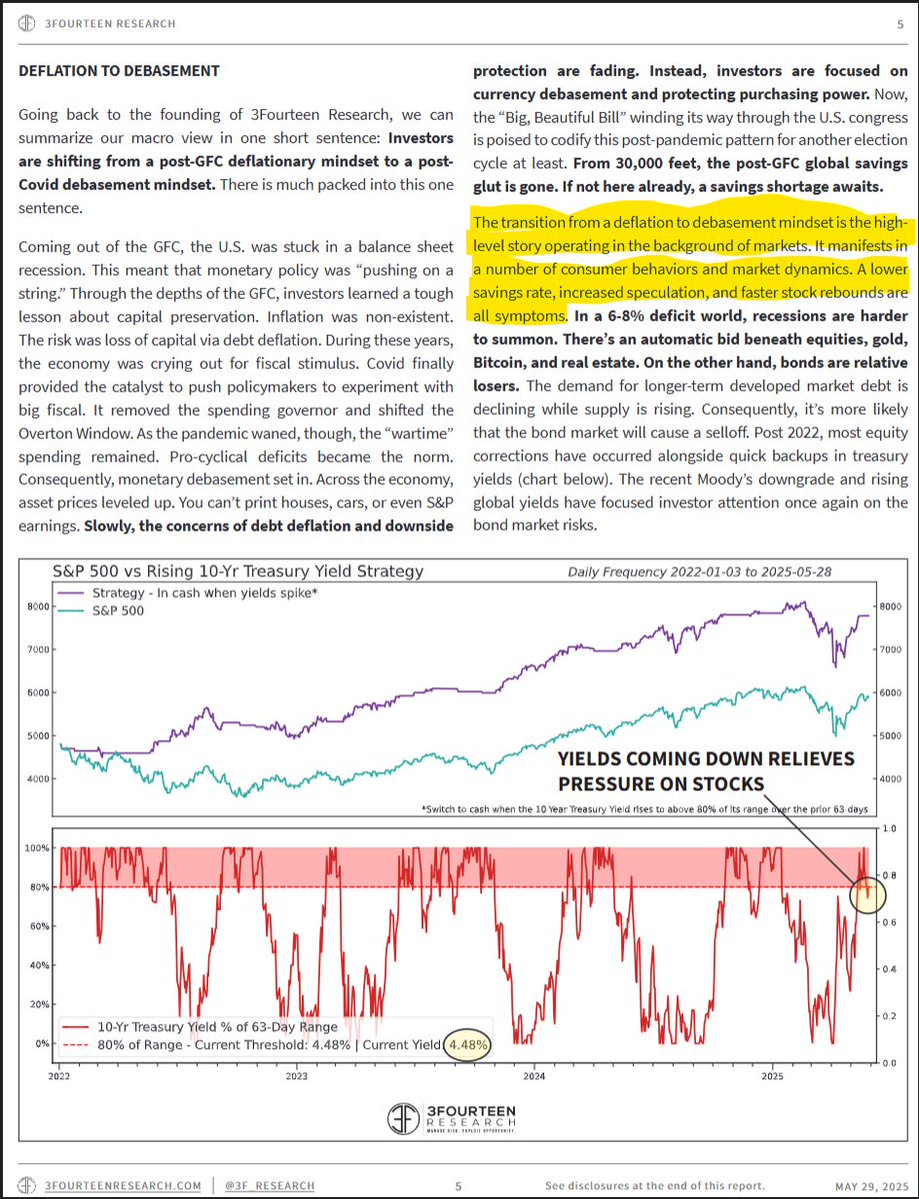
We recorded a momentum thrust off the 2023 correction, 2025 mini-bear, and the 2026 correction. Highly abnormal to have this many momo thrusts and at ATHs...We have argued these v-shaped rebounds are a feature of the "debasement regime."
Warren Pies tweet media
Walter Deemer@WalterDeemer

2/ It’s proving to be a legitimate Major Thrust a la Breakaway Momentum and Zweig Breadth Thrusts. Major Thrusts have significant long-term bullish implications. But they’re supposed to occur at the beginning of a major move -- not at an all-time high, a year after a significant low.

English
28
56
531
76.4K
Tupamaro
Tupamaro@nresiduums·
Market doesn’t top until bitcoin joins in on the action. I don’t make the rules.
English
0
0
0
20
Tupamaro retweetledi
Alpha_Ex_LLC
Alpha_Ex_LLC@Alpha_Ex_LLC·
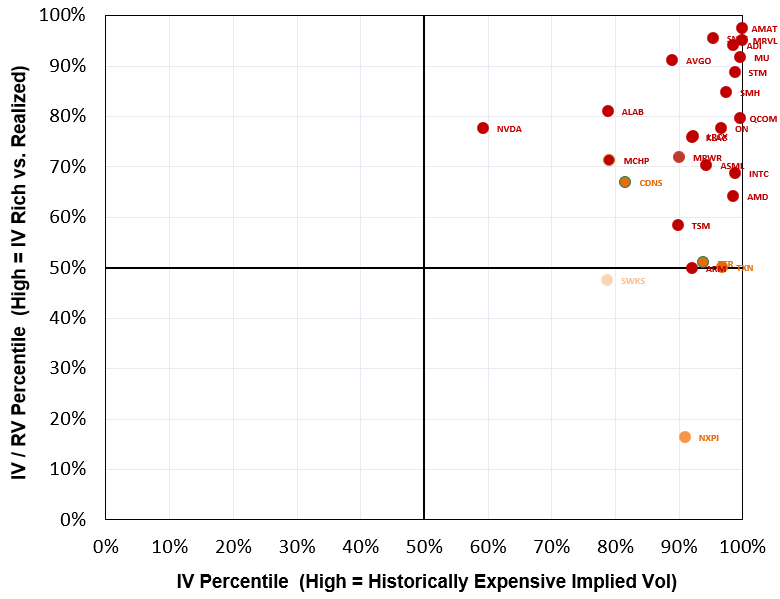
they say a picture is worth a thousand words... it's a "spot up, vol up" world, you just live in it this chart nails the option dynamics for members of the $SMH ... horizontal is the %ile of 1m implied vol (2y lookback window)...vertical is the %ile of the ratio of implied to realized. what is incredible here is that the mean and median 1m return of these stocks is 31 and 26%, respectively. two things are true at once: these stocks have such momentum, history tells us they can easily run further AND... they are likely to experience a very sizeable drawdown in the not too distant future.
Alpha_Ex_LLC tweet media
English
3
12
68
7.8K