"Reconstruction plans imposed on Palestinians with the implicit aim of destroying Palestinian life in Gaza demonstrate the reason Lemkin reserved a place for architecture in is conception of the crime of genocide." /n
Eyal Weizman: "The image of luxury towers constructed above mass graves, with tens of thousands presumably buried under the earthworks, embodies the logic of 21st century genocide." @LRBlrb.co.uk/the-paper/v48/…
If Nigel Farage is to be taken at his word when he talks about abolishing laws on smoking, then a vote for Reform is a vote for lung cancer. And cot death.
lrb.co.uk/blog/2026/apri…@LRB
Check put the new piece by @JLCastroGarcia:
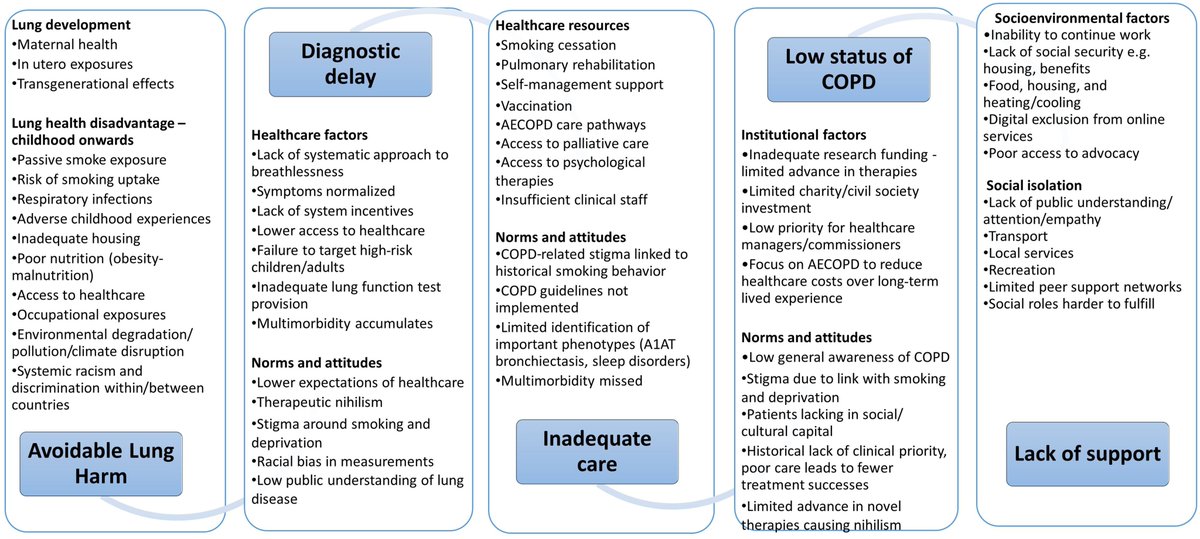
COPD and Asthma: What the Air Around Us Is Telling Us
Breathing 🫁is one of the few things people rarely think about until it becomes difficult.
It happens automatically, quietly, without interruption, which makes it easy to overlook how dependent it is on the environment around us. The #air feels like a constant, something shared and therefore neutral, even in places where its quality shifts from day to day.
For millions of people, conditions like chronic repiratory diseases #COPD and asthma do not begin with illness in the traditional sense, but with years of exposure to air that was never as safe as it seemed.
No single event, no sharp turning point, no obvious line between health and disease. Instead, these conditions develop gradually, shaped by environments that people learn to live with, and exposures that feel ordinary precisely because they are constant.
Air pollution rarely feels urgent in the moment. Its impact becomes visible later, when the body begins to carry the weight of what was once invisible.
A Life That Changed Without a Clear Beginning
Rafael had never smoked, and nothing in his early life suggested that breathing would one day become the defining constraint of his daily routine.
He lived in Mexico City, moving through a dense and fast-paced environment where air quality was part of the background rather than a source of concern. Some days felt heavier than others, the horizon less defined, but it remained something to adapt to, not something to challenge. Like many people, he adjusted without connecting those conditions to long-term health.
His symptoms did not interrupt his life in a single moment. They appeared gradually, blending into everyday routines in a way that made them easy to overlook. A cough that lingered. Shortness of #breath during small efforts. A fatigue that felt ordinary enough to ignore. He slowed down slightly, avoided certain routes, and carried on.
When he sought medical advice, clarity did not follow.
Different doctors offered different explanations, treatments changed, and the underlying problem remained unresolved. The diagnosis, when it finally came, arrived late and fully formed: advanced COPD.
Relief came first, because it was not cancer. Understanding came later, and it came slowly.
Today, Rafael lives on #oxygen. Each movement requires planning, each outing is limited by supply, and each space in his home has been adapted to support a condition that now defines how he moves through it. His wife and daughter have reshaped their own lives around his care, adjusting work, time, and routines in ways that extend far beyond the patient himself.
A Disease We Understand—But Frame Incompletely
From a scientific perspective, COPD and #asthma are well understood. Their biological mechanisms are clear, and their progression follows patterns that are widely recognized.
The limitation lies in how they are framed, as the conversation continues to center on individual behavior, with #smoking rightly positioned as a central driver of risk. That focus has been critical in improving population health, and stopping smoking remains one of the most effective ways to protect lung health. At the same time, it does not fully explain the growing number of people who develop chronic respiratory disease #CRDs without ever smoking, nor does it account for environments where exposure is shared and continuous.
Air pollution defines that gap. It does not arrive as a single event or an obvious threat. It is persistent, shaped by transport systems, industrial activity, construction, and urban design, becoming part of daily life rather than something separate from it. People do not step into it occasionally. They live within it.
And over time, the lungs reflect that reality.
The Gap Between Cause and Response
There is a clear mismatch between the drivers of chronic respiratory disease and how it is addressed.
Health systems focus on treating symptoms and managing progression, often at stages where the disease is already advanced. Environmental policies regulate air quality, though often within thresholds that reflect what is considered acceptable, which may not always align with what is fully protective over a lifetime. Urban systems continue to prioritize movement, density, and growth, sometimes at the expense of breathable space.
Each system operates within its own boundaries, but exposure does not. People experience a cumulative effect, where repeated, low-level exposures across environments add up to disease, while the causes remain distributed and the response remains concentrated within healthcare.
The Invisible, but Decisive Role of Stigma
COPD is often strongly associated with smoking and individual responsibility, which has helped reinforce prevention efforts. At the same time, the reality is more layered. Many people continue to struggle with smoking, not from a lack of awareness, but because addiction is shaped by stress, environment, and long-standing patterns, making sustained cessation difficult despite repeated attempts.
Recognizing this does not reduce the importance of quitting. It highlights the need for consistent support and broadens the understanding of risk, especially for the many individuals who develop COPD without ever smoking.
Why These Diseases Remain Politically Invisible
COPD and asthma share a structural disadvantage that affects how they are prioritised. They do not behave like crises that demand immediate attention. They develop slowly, progress over time, and are distributed across populations rather than concentrated in a single moment or event. There is no defining point that captures attention or forces urgency.
If the global burden of chronic respiratory disease unfolded in visible, acute events, it would dominate public discourse. Instead, it accumulates quietly, and in #globalhealth, attention tends to follow visibility as much as it does data. Chronic conditions that unfold over time struggle to compete for priority, even when their impact is substantial.
The Price of Inaction
The consequences of this invisibility are significant and measurable. At the human level, they appear in lives like Rafael’s, where #diagnosis comes late, mobility narrows, and independence gradually declines. What begins as a manageable limitation becomes a defining constraint that shapes how life is lived.
Health systems absorb repeated exacerbations and hospitalizations, often at stages where intervention is more complex and less effective. Economies absorb the loss of productivity, as many individuals reduce their work or leave the #workforce during years that would otherwise be active and productive. Families absorb the remaining burden, taking on caregiving responsibilities, financial strain, and emotional pressure.
At a global level, the economic cost of COPD is projected to reach into the trillions over the coming decades. Much of this burden, however, is preventable. Cleaner air reduces exacerbations, safer workplaces reduce long-term damage, and earlier diagnosis improves outcomes. The evidence is clear, yet the response remains uneven.
A System Without Clear Ownership
One reason these conditions persist is that responsibility is distributed across systems. Air quality is managed by #environment agencies, workplace exposure falls under labor regulations, health systems handle diagnosis and treatment, and urban planning shapes daily exposure.
No single system holds full ownership of the problem. When responsibility is distributed, accountability can become diffuse. For individuals, however, the experience is not divided. It is cumulative. People do not experience policy in separate categories; they experience it through their lungs.
Reframing the Problem
If COPD and asthma are understood as signals, the response must shift accordingly. The focus needs to move from treatment to #prevention, from individual behavior to shared responsibility, and from isolated interventions to coordinated policy.
This shift does not diminish the importance of smoking cessation. It places it within a broader context, one that recognises both the difficulty of behavior change and the role of environments that shape risk over time. It also acknowledges that millions of people affected by these diseases have never smoked at all.
The Question We Need to Ask
Rafael’s life now revolves around oxygen, yet his illness took shape long before diagnosis, built into the air he breathed and the systems that never fully registered his risk. His story is less an exception than a signal.
We already understand that COPD and asthma can be prevented in part, and the pathways are well established. What remains unresolved is whether we are willing to see these conditions for what they represent: not only diseases to manage, but indicators that the systems shaping everyday exposure require attention.
Because the way we define the problem will ultimately determine the response—and for too long, that definition has remained incomplete.
Royal Assent for Tobacco and Vapes Bill means children born from 2009 onwards will never legally be sold tobacco in the UK!
ash.org.uk/media-centre/n…@AshOrgUK
"I think it is scandalous that the NHS is allowing the substitution of doctors by individuals without sufficient medical knowledge instead of the obvious response to doctor shortages: hiring more doctors." Dr Mel Ryan, BMA lead on preventing doctor substitution.
Advanced practitioners are being used to cover doctor rota gaps across the NHS. Read more: theguardian.com/society/2026/a…
"The best model of care is not about one profession replacing another. It is about ensuring patients have timely access to the right clinical expertise at the right time, with appropriate oversight from a senior doctor."
rcp.ac.uk/news-and-media…@RCPhysicians
Hard to think of a more effective way to enhance distrust than the recommendation by the @Yale Committee on Trust in Higher Education than their recommendation to remove “improving the world” from the the University’s Mission Statement.
#ThisIsOurLaneyaledailynews.com/articles/shut-…
7/n
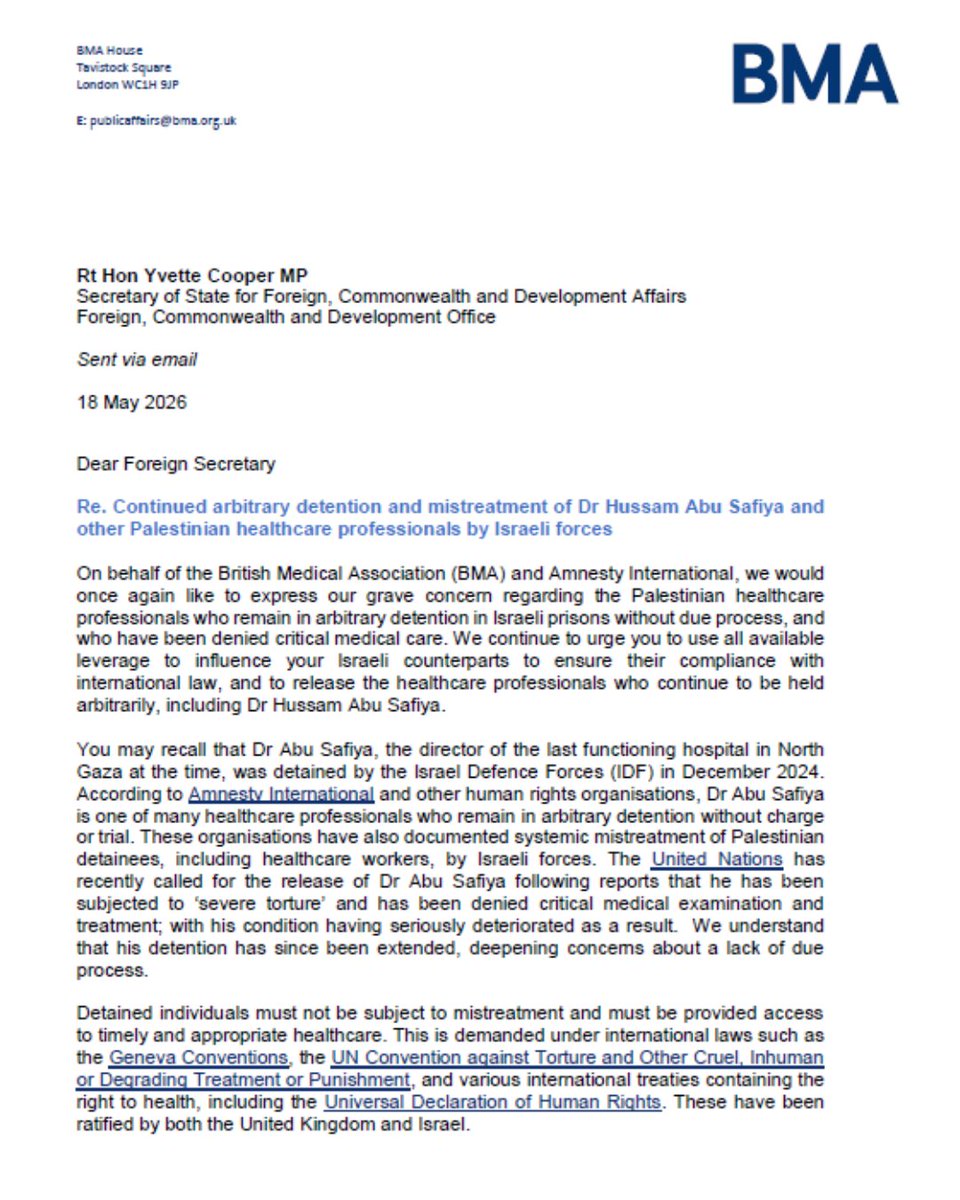
🙏🏼🙏🏼🙏🏼 to authors Drs Spinou, Abu Hussein, Al-Farra, Amirav from London, New Haven, Gaza, Tel Aviv and Alberta, for the courage and determination to draw attention and demand action to save the health of lungs of the children of Gaza!!
sciencedirect.com/science/articl…
🚨 Almost HALF of all NHS Trusts are using non-doctors to fill doctor rotas due to “shortage of doctors”
FYI - 40,000 doctors applied for only 10,000 available training posts last year
Doctors are unemployed
Doctor substitution is real
And it’s DELIBERATE
Resident doctors told us that advanced practitioners were used on their rotas.
Our data shows this is the case, appearing to be in breach of NHS guidelines in England. NHSE says APs “should not replace the roles of doctors”, yet here we are.
theguardian.com/society/2026/a…
1/n
Our new Lancet Respiratory Medicine commentary is out!! While the worlds' attention has shifted to Iran and Lebanon, the health disaster in Gaza continues - and we highlight a topic frequently ignored - the threats to Children's Respiratory Health!! thelancet.com/journals/lanre…