Jeff Levine, CPA/PFS, CFP®

26.9K posts

Jeff Levine, CPA/PFS, CFP® banner
Jeff Levine, CPA/PFS, CFP®

Jeff Levine, CPA/PFS, CFP®

@CPAPlanner

Chief Planning Officer, Focus Partners | Prof of Practice in Tax, The American College | Lead Fin Plan Nerd, https://t.co/PQnTgtrk2b | Dad x3 + husband | Opinions are my own

Katılım Kasım 2010
585 Takip Edilen32.5K Takipçiler
Sabitlenmiş Tweet
Jeff Levine, CPA/PFS, CFP®
Jeff Levine, CPA/PFS, CFP®@CPAPlanner·
1/ 🚨Breaking News🚨 The One Big Beautiful Bill (OBBB) Act has just been passed by the House, and is now on its way to the President's desk, where it will be signed into law. With that in mind, it's time to break it down... To read it for yourself: congress.gov/bill/119th-con…
GIF
English
56
99
508
100.9K
Jeff Levine, CPA/PFS, CFP®
Jeff Levine, CPA/PFS, CFP®@CPAPlanner·
I've long-held that one of the most important skills for an advisor to develop is to become an excellent "Google-er." With the advances in AI over the past few years, I've started to reframe that concept to becoming more of a good "AI-er." Half that battle is learning to use good prompts. The difference in what you can surface with a good prompt and a poor one is dramatic. And, for what it's worth, I think the other half is learning how to sufficiently and efficiently verify any AI's output. "How Advisers Can Improve AI Prompts" planadviser.com/exclusives/how…
English
1
0
26
3.5K
Cliff Cornell
Cliff Cornell@cliffcornell_·
I turn 27 today and I’m proud to announce that I have achieved FIRE. Here are the steps I took to reach this milestone: - Saved - Invested - Lived within my means - Adjusted my life expectancy to 28 in the planning software Follow me for more FIRE insights.
English
43
3
304
29.5K
Jeff Levine, CPA/PFS, CFP®
Jeff Levine, CPA/PFS, CFP®@CPAPlanner·
If I see one more post or article about a "loophole" in the tax code that "allows you to save tens of thousands of dollars on your tax bill," that ends up being about Bonus Depreciation or a Section 179 Deduction, I am going to absolutely lose my mind. Now, don't get me wrong; for the right business owner in the right situation, these accelerated depreciation methods are pretty awesome. And it's entirely true that, compared to regular straight-line depreciation, electing to use Bonus depreciation and/or a Section 179 Deduction can lower your taxes in a meaningful way. But... First of all, these aren't loopholes. They're straightforward applications of the tax code being used exactly as intended. Second, almost none of these posts/articles mention that the increased tax deductions/lower taxes today come, all things equal, at the expense of lower tax deductions/higher taxes in the future. So, in many circumstances, accelerated depreciation is really more a time-value-of-money play than anything (which, of course, has value, but not AS much as getting a tax break that would otherwise never be available). Third, and most importantly, on their own, accelerated depreciation methods don't allow individuals to "save" anything, because to use them, they require the PURCHASE of a qualifying asset. The cost of buying that asset will exceed any potential tax savings from Bonus Depreciation/179 Deduction. In the end, accelerated depreciation methods are probably best thought of in a manner similar to that of a sale at the store. If you were planning to buy something already, or were on the fence, then the sale can make now a pretty compelling time to make your purchase. But if you weren't already thinking about the purchase, you probably shouldn't let the fact that it's on sale change your decision. I mean, even if I see cat food on sale for 90% off, I'm not buying it. I don't have a cat. Thank you for coming to my Ted Talk.
English
7
2
73
6.2K
Jeff Levine, CPA/PFS, CFP®
Jeff Levine, CPA/PFS, CFP®@CPAPlanner·
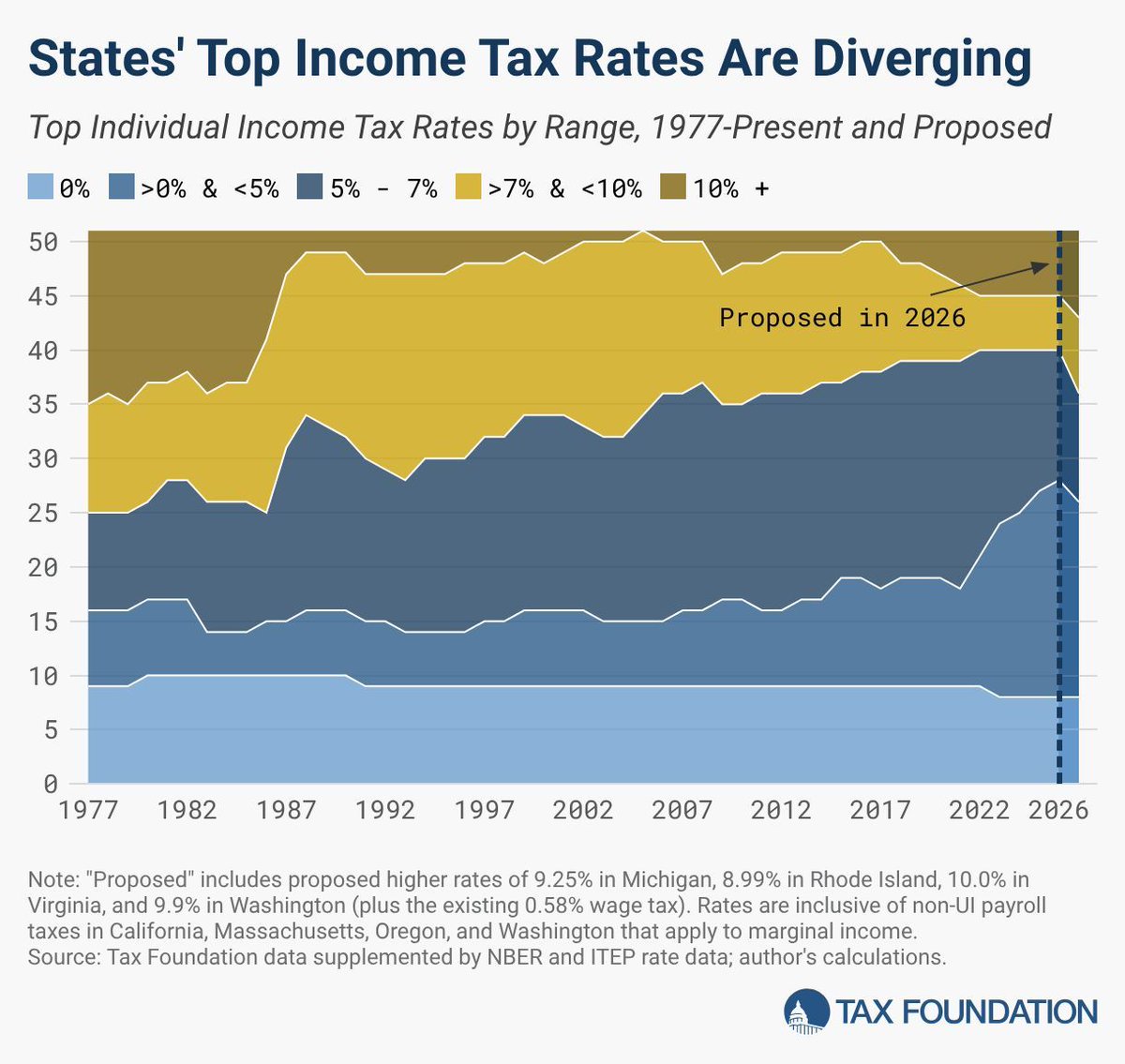
Over the past few decades, this has largely played out along the lines of the states' predominant political ideologies, but I wonder how long this trend can continue. At some point, do states raising their taxes see enough of an exodus of taxpayers that they reverse course? At some point, do states that lower or eliminate taxes realize they need to provide more infrastructure and support to continue attracting folks? Or, perhaps stated more succinctly, when it comes to state income taxes, will we see a reversion to the mean, or is this broadening gap the new normal? "Essentially, then, we are witnessing two opposite movements: in some states, concerted efforts to raise taxes on high earners, and in many others, a strong focus on cutting rates and prioritizing greater tax competitiveness." taxfoundation.org/blog/state-inc…
Jeff Levine, CPA/PFS, CFP® tweet media
English
4
0
4
3.1K
Jeff Levine, CPA/PFS, CFP®
Jeff Levine, CPA/PFS, CFP®@CPAPlanner·
I almost never fly United, but I sure hope that other carriers don't follow their lead on this one. I mean, it's bad enough that someone who spends $50k on a credit card annually might have better status and enjoy more "freebies" than someone who actually flies 20x per year. Just goes to show how much of the airline's revenues and profits have come from these co-branded cards. Today, they typically account for 10% to 20% of revenue, and it's not uncommon for them to be the only profitable part of the business. In some sense, the actual flying of passengers worldwide has become a loss leader for the "real business" of co-branded credit cards. Absolutely wild🤯 "United Airlines is paring back rewards for travelers who don't have its credit card in MileagePlus overhaul" cnbc.com/2026/02/19/uni…
English
6
0
5
4.7K
Jeff Levine, CPA/PFS, CFP®
Jeff Levine, CPA/PFS, CFP®@CPAPlanner·
I can sort of understand the next-gen leaving their parents' advisor when the parents die (though I think with good family planning and meetings, many more would see the value in staying), but the fact that more than 2/3rds of surviving spouses leave their current advisor after the death of their spouse is an absolutely damning statistic. It really speaks to the tendency of some advisors to communicate almost exclusively with one spouse when planning for the couple. It's not great for planning, as spouses may have different goals (only the communicating spouse's goals may be appropriately accounted for), and the stats clearly show it's not great for business either. "70% of surviving spouses move their assets, and 81% of high-net-worth heirs say they'll leave their parents' advisor." wealthmanagement.com/growth-strateg…
English
2
0
9
2.8K
Jeff Levine, CPA/PFS, CFP®
Jeff Levine, CPA/PFS, CFP®@CPAPlanner·
Interesting research/data from EBRI about the financial impact of working-age individuals living at home with their parents. For instance, roughly 1/3 of individuals living with their parents were solely responsible for the housing costs. As the research noted, that's likely due to moving in with older parents and "helping them out." But it got me thinking about something... Might living at home a few years longer be the ultimate savings "hack?" I'm not talking about for people who have to live with their parents because they can't afford their own place. I'm talking about younger workers with good-paying jobs who could easily afford their own apartment (or even house), but choose to stay at home a few extra years to super-charge future savings (assuming mom and dad say it's ok!). Consider that, according to Zillow, the average rent in the US last year was roughly 2k/month (obviously large variation based on local markets). Let's take 75% of that cost as our monthly rent here, since a younger worker may not want/need as big a rental as an older worker with a family. If, instead of renting their own place at 25, the same individual lived at home until 28, and they were able to save that $1,500 a month instead of spending it on rent, those 3 years' worth of savings alone would translate to about $1MM at age 65 (using an 8% hypothetical ROR)! "Home Together: Assessing the Financial Impact of Living With Parents" ebri.org/publications/r…
English
1
0
5
2.2K
Jeff Levine, CPA/PFS, CFP®
Jeff Levine, CPA/PFS, CFP®@CPAPlanner·
Some great insights here from Joseph Wang on box spreads. Box spreads can be a pretty compelling solution over other lending options in a significant number of situations. The complexity of putting together and executing the move has been a barrier to its use for a long time, but technology is very, very quickly eliminating (or at least, significantly reducing) those roadblocks. Simply put, I think you're going to see the use of these things explode over the next 5-15 years. And if their usage increases as much as I think it can, it has the potential to put a lot of pressure on custodians and other lenders to reduce their margin/SBLOC loans in order to keep them competitive. "Inside a tax-smart borrowing tool for risk-tolerant clients" financial-planning.com/news/inside-a-…
English
2
3
19
3.2K
Jeff Levine, CPA/PFS, CFP®
Jeff Levine, CPA/PFS, CFP®@CPAPlanner·
Bravo. This was excellent. 🤣
Roger Ledbetter@rledbetterCPA

The IRS sent me a bill for $1,247 while holding a $1,800 overpayment. Me: Hi, I'm calling about a notice. It says I owe $1,247 for 2023. Agent: Yes, $1,247.38. Me: Ok but I overpaid my 2024 taxes by $1,800 and applied it to 2025. Can't you just take what I owe out of that? Agent: That credit is irreversibly allocated to 2025. The balance is for 2023. Me: But the money is at the IRS. Agent: Different years. Me: But the same bank account. Agent: Different systems, sir. Me: Can't you just move it? Agent: You'd need to reverse the election on your 2024 return and apply it to 2023. Me: Can I do that? Agent: No. Me: Then why did you say that? Agent: Hypothetically speaking. You asked what you'd need to do. But technically, no you can't. Me: What th--- Can you at least break down what I owe? Agent: The original balance was $214. The rest is interest and penalties. Me: A thousand dollars in interest on $214? Agent: 8% per annum. Plus the failure to pay penalty. Me: So if you had just taken $214 from the $1,800 you're holding I would have saved over a thousand dollars. Agent: That math is correct. Me: Will my $1,800 earn interest at least? So it'd offset? Agent: It doesn't work like that. The IRS is not a bank. Me: Can I at least deduct that interest? Agent: No sir, that's non-deductible. Me: So then the interest I receive from the IRS? Not taxab--- Agent: Still taxable. Me: You're right. That's way worse than a bank. Agent: Is there anything else I can help you with today?

English
2
0
18
13.5K
Jeff Levine, CPA/PFS, CFP®
Jeff Levine, CPA/PFS, CFP®@CPAPlanner·
Errrr... if ERISA is designed more to protect employers from lawsuits, then it's doing a terrible job.🤷‍♂️ Follow. The. Money. "The law, he writes, 'imposes a mindset that’s both infantilizing and outdated, and in practice is designed less to empower workers than protect employers from lawsuits.'” investmentnews.com/retirement-pla…
English
1
1
7
1.8K
Jeff Levine, CPA/PFS, CFP®
Jeff Levine, CPA/PFS, CFP®@CPAPlanner·
I don't see any issues with running projections for both members of a couple going through divorce proceedings. To the contrary, I think that it can be extremely helpful for them. However, I do sometimes question whether an advisor can act as a fiduciary advisor to both spouses, especially when the divorce is contentious. I mean, how do you act as a fiduciary to both spouses when the advice you give to one can hurt the other? Notably, this is one area where I think the CFP Board has done a pretty good job of setting guidelines, including: 🔸The CFP rules expressly provide that a marital engagement is one where both spouses are, separately, clients of the CFP. 🔸If one spouse confides in a CFP that they are planning for a divorce, the CFP is required to maintain that confidentiality, but must terminate the engagement if the intent to divorce is not timely shared with the other spouse (no idea how to terminate without unintentionally spilling the beans, but that's another matter. 🔸 CFPs are explicitly prohibited from providing advice to one spouse that is detrimental to the other spouse (which I'd argue very much hinders their ability to act as a fiduciary)! "To avoid such problems, Miller runs full financial projections for clients both during and after the divorce is finalized to ensure that they are aware of their sustainable path forward based on the proposed settlement." investmentnews.com/practice-manag…
Jeff Levine, CPA/PFS, CFP® tweet media
English
1
0
1
1.9K
Jeff Levine, CPA/PFS, CFP®
Jeff Levine, CPA/PFS, CFP®@CPAPlanner·
I'm not disputing the fact that defined contribution plans opened the door to more individual investors, but one of the main reasons that +90% would have otherwise not invested in mutual funds is that they didn't have to before DC plans. Notably, DC plans largely replaced the "old" defined benefit plan model. In the "good old days," outside of a rainy day fund, many people didn't have to worry about saving much for retirement b/c between their monthly pension and Social Security checks, they were able to live comfortably. As DB plans phased out, workers became increasingly responsible for generating their own retirement income. This meant that they HAD to find ways to invest more. So, as DB plans were replaced with DC plans, the single-investor pension plan dollars were, instead, purchased separately be each individual. The 401(k) was the logical place to do so for many, but without a 401(k), the same individuals would have needed to save with taxable dollars. All of which is to say that, in the end, the +90% of individuals who otherwise would not have invested in a mutual fund is less about the rise of the 401(k) and more about the demise of the pension plan. "Defined contribution plans democratized investing, bringing in almost 100 million participants, with +90% unlikely to have invested in mutual funds or other investments otherwise." wealthmanagement.com/rpa-news/401-k…
Jeff Levine, CPA/PFS, CFP® tweet media
English
3
1
10
3.4K
Jeff Levine, CPA/PFS, CFP®
Jeff Levine, CPA/PFS, CFP®@CPAPlanner·
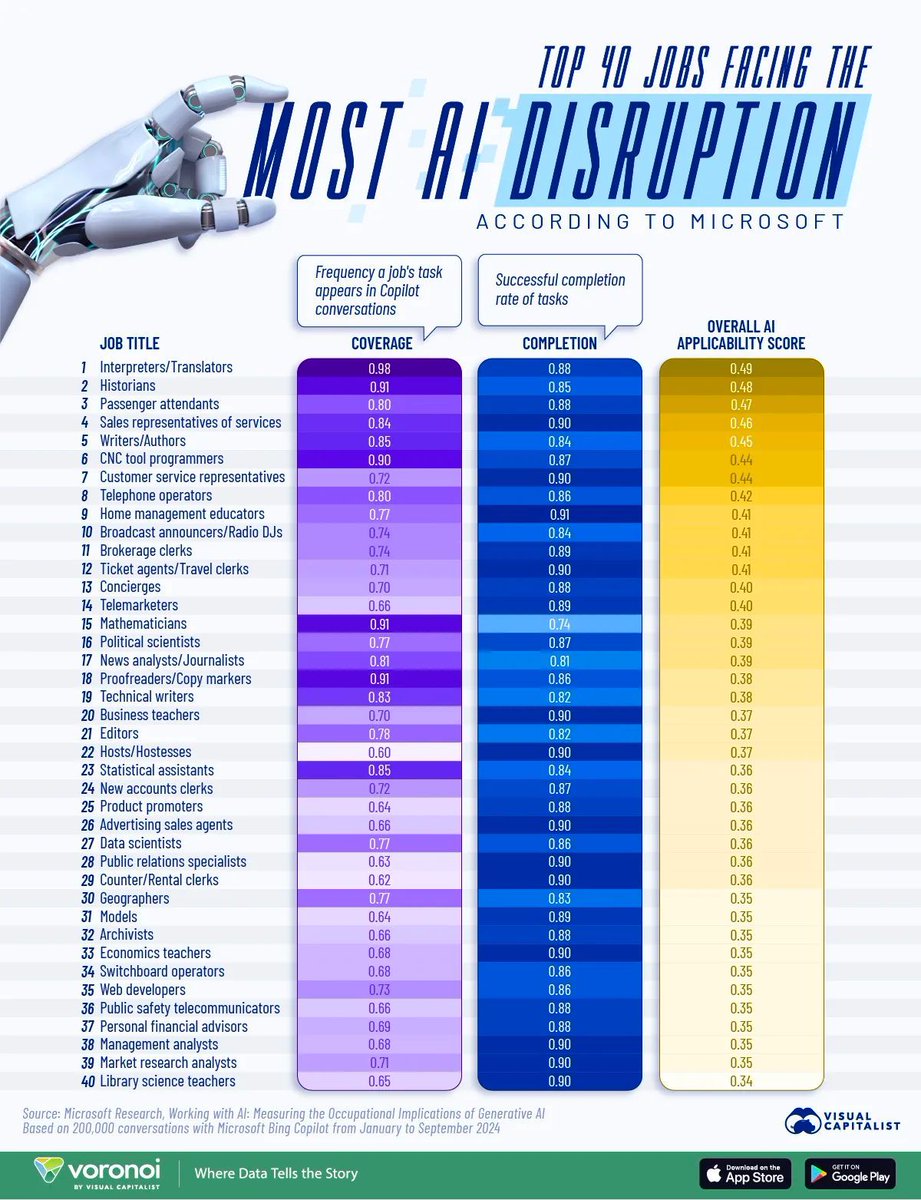
According to Microsoft data, "Personal Financial Advisors" rank 37th on the list of jobs facing AI disruption. I know a lot of my friends and colleagues are worried about the impact of AI, but I don't really share those concerns. Advances in and adoption of AI-powered solutions will, no doubt, change the financial advisory landscape, but that doesn't mean it will put advisors out of business. It will just change the way that they spend their time. Advisors will be able to spend more time educating clients so they better understand their choices. Behavioral finance and understanding how to appropriately influence clients to take positive actions will become increasingly important. And ultimately, human beings are best held accountable by other human beings, not software. So, what are your thoughts? How worried are you about AI putting you out of a job? visualcapitalist.com/ranked-the-job…
Jeff Levine, CPA/PFS, CFP® tweet media
English
13
0
35
11K
Jeff Levine, CPA/PFS, CFP®
Jeff Levine, CPA/PFS, CFP®@CPAPlanner·
I'm often asked some version of this question by newer advisors... ❓"What's the one thing I can do to grow my revenue faster?❓ My simple answer is, "Focus on 'TWC', or 'Time With Clients.'" Here's the simple truth... With the exception of the time you spend with your clients, almost part of a successful advisory relationship can be handled by other members of your team or outsourced. But it's during that TWC that you develop a deeper understanding of your clients, build trust, and "casually" uncover new planning opportunities and risks. It's also when you're most likely to create an opportunity for an introduction to your next clients. There are a few ways to continue to spend lots of time with clients as your business grows. One is to grow your own team. Lots of things to love about that, but also lots of challenges, such as cost, employee turnover, and the time required to manage internal staff. All of those are challenges for businesses in any stage, but are particularly challenging for newer advisors to handle. Another way to continue to grow while focusing on TWC is to outsource more of the other "stuff" to trusted partners. To understand more about this option, and how thoughtful outsourcing can help newer advisors attract and serve more relationships, my friends at @FocusPartnersAS are hosting a special, complimentary, webinar next Wednesday afternoon (February 25th) at 1PM ET called "What New RIA Founders Need to Get Right: Scaling Your Firm While Staying Focused on Clients." Consider registering using the link below and hear what they have to say. And remember, YOU are your "secret sauce!" advisor.focuspartners.com/perspectives/w…
English
0
0
8
2.4K
Jeff Levine, CPA/PFS, CFP®
Jeff Levine, CPA/PFS, CFP®@CPAPlanner·
The latest research from the Plan Sponsor Council of America shows a significant increase in the percentage of executives opting to defer a portion of their salary and/or bonus into their employers non-qualified deferred compensation (NQDC) plan. This makes understanding the ins and outs of NQDC plans that much more important, especially for those advisors who specialize (or want to specialize) in working with highly compensated executives. Notably, the rules that govern the timing of NQDC distributions are far more restrictive than those associated with qualified retirement accounts (e.g., 401(k), IRAs), as the timing of future distributions is generally (limited exceptions apply) established at the time of deferral. Arguably, this makes long-term income planning at the time of a NQDC plan deferral even more important than when a contribution is made to a qualified retirement account. "...based on responses from 306 organizations sponsoring account-balance NQDC plans, shows that 70% of eligible executives now participate" psca.org/news/psca-news…
English
0
0
3
1.9K
Jeff Levine, CPA/PFS, CFP®
Jeff Levine, CPA/PFS, CFP®@CPAPlanner·
Some exciting news on the personal front... I am now officially a Tax Planning Certified Professional (TPCP), and just in time for @TheAmerCol celebration of the program's first anniversary. It's funny. I can't count the number of times over the past year that someone has asked me, "Why don't you have the TPCP designation already? Didn't you help build it?" It's actually precisely for that reason that it took this long for me to earn the marks. Notably, The American College is an accredited institution of higher education. That made them the ideal organization to partner with to develop and launch this program, but in fairness, working with an accredited institution came with a LOT of extra rules and hoops to jump through. In addition to impacting program design, those rules also required a unique process for me to earn the designation (as I couldn't very well sit for an exam I had already seen!). But it's all been worth it. During the TPCP's first year, roughly 1,500 advisors enrolled in the program, and to date, nearly one quarter of them have completed all three courses and earned the TPCP designation. And perhaps even more importantly, the program boasts an NPS score of 71 and has been well received by advisors at all levels, from recently minted CFPs to seasoned CPA-Financial Advisors. If you're interested in learning more about the program, speak to a colleague who has already taken the leap, or visit theamericancollege.edu/learn/professi…
English
7
0
51
7.3K
Jeff Levine, CPA/PFS, CFP®
Jeff Levine, CPA/PFS, CFP®@CPAPlanner·
Last month, the 5th Circuit Court of Appeals issued an extremely taxpayer-friendly decision regarding limited partners. In short, the Court ruled that limited partners are not subject to self-employment taxes... period, end of story. In other words, the limited partner's level of activity has no bearing on whether employment taxes apply. Just an investor and spend no time actually working in the partnership? No self-employment taxes for you! Super-active and spend a lot of time in the business? Well, under the 5th's decision, no self-employment taxes for you either! There are multiple similar cases pending in other jurisdictions, and I suspect that ultimately, this issue will make its way before the Supreme Court... but that might take several years, or longer, to play itself out. My guidance to limited partners who've paid self-employment taxes on some or all of their partnership income in the recent past? Consider filing a protective refund to keep the statute of limitations open so that if the litigation is ultimately resolved in your favor, you can recover those employment taxes beyond the normal 3-year statute. "Expert Unpacks What's Next After Sirius Solutions Decision" tax.thomsonreuters.com/news/expert-un…
English
3
0
17
3.1K
Jeff Levine, CPA/PFS, CFP®
Jeff Levine, CPA/PFS, CFP®@CPAPlanner·
Domestic Asset Protection Trusts (DAPTs) are an incredible asset protection tool in the right circumstances. There simply aren't many better ways to keep assets out of the hands of your creditors while maintaining access to them yourself. But DAPTs are NOT a "crisis planning" strategy. They can't be used to avoid liability for an event that has already occurred (e.g., malpractice, car accident, etc.) because of the "fraudulent conveyance" laws that apply in each state. So, if someone is worried about long-term, POTENTIAL-but-not-yet-manifested creditor risk, there's no time like the present to explore this approach. "To preserve the DAPT’s protective benefits, it should be established while the settlor is solvent and well before any creditor issues are on the horizon. DAPTs are not appropriate for individuals already facing creditor claims or imminent judgments." Thttps://darroweverett.com/domestic-asset-protection-trusts-dapts-value-legal-analysis/
English
3
0
12
2.7K