
Sabitlenmiş Tweet
Milan Račić
15.2K posts


Milan Račić
@CallMeMilan
2x Robotics Founder | Dad to 6 Kids | Angel Investor | Music Nut
Katılım Mayıs 2012
1.5K Takip Edilen841 Takipçiler
Milan Račić retweetledi

A farmer dies in April 2026.
His son inherits the farm. The farm has been in the family since 1847.
The farm consists of: 300 acres of grazing pasture, a farmhouse built in 1892, a barn, a milking parlour, two tractors of varying ages, a Land Rover that runs about 70% of the time, and a herd of 180 Hereford-cross cattle.
On paper, the farm is worth approximately £3.2 million. This is because land near him has been bought recently by a London hedge fund looking for carbon credits, which has dragged the comparable value of every field within forty miles upward to a number nobody local can justify.
In cash, the farm produces a profit of about £28,000 a year in a good year. In a bad year it loses money. The son also works as a fencing contractor three days a week to keep the operation viable.
The inheritance tax bill on a £3.2 million estate, even at the reduced 20% rate, comes to approximately £140,000 after the increased threshold is applied. The son does not have £140,000. The son has never had £140,000. The son has £4,200 in his current account and an overdraft.
The son sells 60 acres to a developer to pay the tax. The developer puts solar panels on the 60 acres. The remaining herd cannot be sustained on the reduced land. The herd is sold. The barn becomes a holiday let.
A different family eats Brazilian beef this Christmas without knowing why the price went up.
The Treasury collects £140,000.
The land never produces British food again.

English
Hibernation is not built into European DNA. It is possible to wake up, survive and even thrive.
Swen Roschlau 🌌🗽@SwenRoschlau
"Italy still has world-class firms, extraordinary industrial clusters and some of Europe’s best manufacturing know-how. Italy’s productivity crisis is not only economic. It is also cultural. A country cannot become productive if its society does not reward scale, technology, 1/3
English
Milan Račić retweetledi

One thing I've learned from using AIs is that the median person is unable to read paragraphs of ordinary prose. Now I understand why so many recently published books consist of snippets of text — what would be called sidebars, if the book weren't composed of them.
English
Milan Račić retweetledi
Petraeus: The U.S. has not remotely learned the lessons it should from Ukraine.
This is the future of war: Ukraine alone uses 10,000 drones a day, and 90% of Russian casualties are caused by drones. That should force institutional change. 1/
English
Milan Račić retweetledi

I never stop being amazed by them. Launching their “Birdhouse” — a strategic-class missile worth around $100 million, capable of carrying a nuclear warhead — at a garage complex in the Kyiv region.
Let’s calculate how much this night cost them.
One “Oreshnik” — roughly $100 million. Around ninety cruise and ballistic missiles: Kh-101s, Kalibrs, Iskander-Ks — at an average price of about $8 million each — that’s another roughly $720 million. Six hundred Shahed drones at $50,000 each — another $30 million. Plus fuel, launch platforms, maintenance, reconnaissance.
Total: around $850 million for a single night. Nearly a billion dollars.
And what did they get for that billion?
They hit garages in Bila Tserkva. Destroyed the “Kvadrat” shopping mall. Set the roof of a dormitory on fire in Darnytskyi district. Blew apart an entrance section of a five-story apartment building in Shevchenkivskyi district. Hit a market. A supermarket. A construction hypermarket in Obolon. Dropped debris onto the Valeriy Lobanovskyi Dynamo Stadium.
Two sleeping civilians killed. Fifty-six wounded, including children. Is this their strategic result for a billion dollars? This is their “special operation.” This is their “greatness.”
They cannot move forward on the battlefield. Cannot seize a single truly significant settlement. Cannot defeat the army of a country they promised to capture in three days four years ago. And in convulsions, in agony, in powerless rage, they strike residential neighborhoods at night — museums, markets, shops, garages.
Impotent on the battlefield, compensating for their failure with the number of munitions fired at sleeping civilians.
Blind evil and helplessness at the same time.
Monsters. Simply monsters. Rabid, paranoid lunatics with a nuclear button.
I have no other words left for them.



English
Milan Račić retweetledi

Helen Andrews made a point that feels increasingly hard to ignore.
The shift from blue-collar to pink-collar jobs hasn’t just changed the economy; it’s quietly fueling a marriage crisis. Studies on areas hit hard by the China shock showed the sharpest drops in marriage rates happened where men lost stable work. When men aren’t economically flourishing, family formation stalls. You can’t simply swap who brings home the paycheck and expect the same results.
She argues we need more real manufacturing jobs — not just for economic security against China, but because strong male employment is a key driver of the next generation.
This one made me pause. We’ve celebrated the “feminization” of the workforce as progress for decades, but if it’s contributing to fewer marriages and fewer kids, maybe we’re missing something important.
Economies aren’t just about GDP. They’re about people building lives, families, and futures. When the job market stops supporting that for half the population, the downstream effects are massive.
Do you think bringing back more stable manufacturing jobs could help fix the marriage and birth rate decline, or is that too simplistic?
English
Milan Račić retweetledi

That water clarity is an engineering decision, and the math behind it is wilder than the video.
Roman aqueducts ran on gravity alone. No pumps, no pressure systems. Engineers carved channels with a gradient so shallow it borders on absurd. The Pont du Gard in southern France drops 2.5 centimeters over 275 meters. That's roughly the thickness of a coin over the length of three football fields. They surveyed that accuracy with plumb lines and wooden leveling instruments.
The clarity you're seeing is a direct product of flow velocity. Too steep and the water erodes the channel walls, picks up sediment, turns brown. Too flat and it stagnates. Roman engineers targeted a slope of about 20 centimeters per kilometer, which kept the water moving fast enough to stay fresh but slow enough to stay clear. Before the water reached the city, it passed through multi-chamber settling tanks where velocity dropped near zero. Suspended particles sank. Clean water flowed out the top into the next chamber. Repeat three or four times.
Pliny specified the minimum slope in writing. Vitruvius published the exact mortar ratio for hydraulic cement: one part lime to two parts volcanic ash for underwater work. The pozzolana from Pozzuoli reacted with water to form a calcium-aluminum-silicate compound that actually gets stronger the longer it sits submerged. Modern concrete degrades in water. Roman concrete bonds with it.
Scale the whole system and it gets harder to process. Eleven aqueducts fed Rome at its peak. Combined output: roughly 1 million cubic meters of water per day. That works out to about 250 gallons per person for a city of one million. Modern New York delivers about 125 gallons per person per day. Ancient Rome had access to double the per capita water supply of the largest city in the United States, running entirely on slope and stone.
The Trevi Fountain in Rome is still fed by one of them. Two thousand years, same source, same gravity, same water.
Ulises@UlisesDavid__
🚨| La claridad de un acueducto del imperio Romano, de hace 2000 años
English
Milan Račić retweetledi

Thomas Sowell: “When you want to help people, you tell them the truth. When you want to help yourself, you tell them what they want to hear.”

English
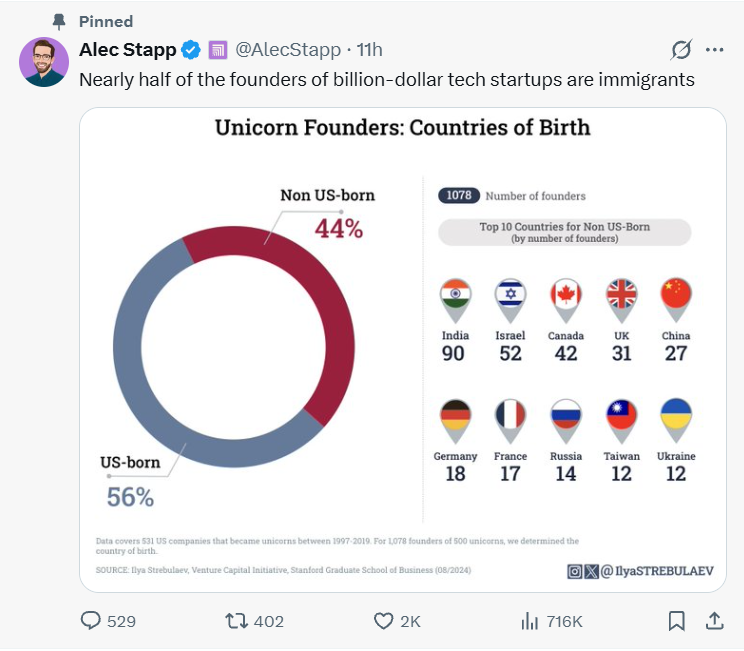
America was and is built by hard-working and law abiding immigrants. They achieve, they build and they make America better.
The current negative perception of immigration is the fault of law-makers, not immigrants. Lawmakers from both parties have the responsibility to enact rules and regulations which filter out the best the world has to offer and keep out the rest.
The "best" doesn't mean the richest or even the most highly educated. It means the most motivated to achieve, the most dedicated to building America and the most respectful of America's culture.
The same approach should be adopted by every other country which values its culture, heritage and growth.
English
- The plates use a mathematical topology optimization algorithm to redesign internal fin structures into complex shapes that maximize heat transfer while slashing the pumping energy required to move coolant.
The plates are built using electrochemical additive manufacturing (ECAM), which can produce pure copper components with detail down to 30-50 micrometers -- finer than a human hair. -
oilprice.com/Energy/Energy-…
English
Milan Račić retweetledi

⚡️Children remember the moments when the family becomes fully alive.
That is the core. Vacation is just the common vessel.
A child does not encode childhood as a spreadsheet of responsible parenting.
They encode atmosphere.
They remember the motel pool, the gas station stop, the smell of sunscreen, the weird restaurant, the long drive, the sunset, the parents laughing differently, the feeling that normal life cracked open and something larger appeared.
That is why ages 5 to 10 hit so hard. The child is old enough to form durable narrative memory and young enough for the world to remain enchanted. Parents still feel mythic. A beach, cabin, lake, theme park, road trip, or even a cheap rented house can become sacred geography.
The real mechanism is interruption of routine plus emotional safety.
Ordinary life teaches stability. Trips create myth. The family leaves the repeating loop of school, work, chores, screens, exhaustion, and time pressure. For a few days, the child experiences parents outside their normal roles. Mom and dad are no longer just managers of homework, food, discipline, bedtime, and logistics. They become companions inside an adventure.
That imprints.
The money matters far less than parents think. Luxury is mostly adult vanity. Children remember intensity, freedom, attention, surprise, and togetherness. A $200 trip can beat a $10,000 trip if the child feels wonder and the parents are emotionally present.
Many adults are starved because their childhood had no sacred interruptions. Everything was duty, stress, survival, noise, pressure, or emotional absence. No mythic family scenes. No private homeland in memory. No recurring proof that life could be warm and strange and alive.
That matters for the adult psyche. People draw from childhood memories during loneliness, fear, ambition, loss, and love. Those memories become inner architecture.
Deepest compression: a good childhood is not built only by protection. It is built by unforgettable shared worlds.
Take the kid somewhere. Break the loop.
Make the ordinary world disappear for a few days.
That becomes part of them forever.
All day Astronomy@forallcurious
🚨: Study shows the most unforgettable childhood memories are family vacations between ages 5 to 10.
English
Milan Račić retweetledi

A Harvard psychiatrist spent 85 years tracking 724 men from their teenage years to their deathbeds to find out what actually makes a human life worth living, and the answer that came back is the one almost nobody in their twenties or thirties is willing to act on.
His name is Robert Waldinger.
He runs the Harvard Study of Adult Development, the longest scientific study of happiness in human history. It started in 1938. It is still running today. Most studies last a few years. This one has outlived its founders, its second director, and most of its original participants.
The setup was simple. Researchers recruited 724 young men. Half were Harvard sophomores. The other half were teenagers from Boston's poorest neighborhoods. They wanted to follow them for the rest of their lives and find out what actually predicted a good life.
Then they did the thing nobody else had the patience to do. They waited.
For 85 years, the team measured everything they could think of. Blood tests. Brain scans. Income. Marriages. Mental health. Sleep. Loneliness. Every two years, the men answered questionnaires. Every five years, they had a full medical exam. Some of them became senators. One became President. Some ended up homeless.
When the data finally came in, the result was so simple that the researchers spent years looking for what they had missed.
It was not money. It was not IQ. It was not social class. It was not career success. It was not even genes.
The single strongest predictor of who would be happy, healthy, and mentally sharp at 80 was the quality of their close relationships at 50.
Not the number of friends. Not the size of the network. The depth of the connection. The men who had at least one person they could call in the middle of the night were measurably healthier 30 years later. The lonely ones, regardless of wealth, declined faster across almost every metric the team could measure.
The detail that should disturb every ambitious person reading this is the one most people skip. The Harvard sophomores in the study had every external advantage you can name. Elite education. Family money. Strong networks. That advantage meant almost nothing if they reached middle age without people who actually loved them. The privileged loners aged worse than the working-class men with strong families.
Waldinger has been asked the same question in every interview he has done in the last ten years. What is the lesson?
His answer never changes. He says people in their twenties and thirties believe they need to chase fame and money and achievement to have a good life. The 80-year-old men in his study who actually had it figured out say the opposite. They wish they had spent less time at the office and more time with the people who mattered.
You will not believe him. Almost nobody in their twenties or thirties does. The data has been public for decades and the world has not changed. The reason is that the cost of investing in people you love does not pay off for 30 years, but the cost of investing in career success pays off next quarter. The brain is built to chase the next quarter. It cannot see the 30-year compounding curve.
The good news is that the men who repaired old relationships in their 60s and 70s still gained measurable health benefits. The brain does not stop responding to connection just because you waited. But every year you wait costs you compounding interest you cannot get back.
Your career will outlive you for about three months.
The people you loved well will carry you for the rest of recorded time.
You are not behind on your goals. You are behind on your phone calls.

English
Great post.
"The bezzle is that the market is capitalizing the most expensive phase of AI adoption as if it were normal and indicative of future demand. Benchmarking is not production, training is not performance. And tokenmaxxing is not a dependable infrastructure demand signal."
So, yes, son, they are flying those airplanes around empty. The only time that made sense was at the beginning of flight. When pilots need hours, engineers need data and regulators need time. That benchmarking phase, all lusty fire and brimstone, needed at the very beginning of anything at all worthwhile.
They will not be doing it for long."
English
Like a freight train of bad news.
"Global oil markets remain under severe stress as Hormuz disruptions, weak economic data, and tightening inventories reshape energy flows worldwide."

English
Milan Račić retweetledi

“A 2013 study at Harvard found that, without affirmative action, Harvard would be... 0.7 percent black.”
In 2022, another report estimated it would be around 1%.
What was the black freshman class percentage in the year after the SCOTUS decision? 14%.
The school still engages in a staggering amount of preferential treatment of blacks in its admissions.
theamericanconservative.com/270035/
English
Milan Račić retweetledi

KASPAROV: Dictators always lie about what they've done, but very often tell you exactly what they're going to do. Mein Kampf was published in 1925, and it was a blueprint. Nobody took it seriously in 1925.
In 2005 Vladimir Putin, already in his second term as Russian president, in control of Russian nukes and enormous amount of money, addressed Russian Duma and Senate. He said bluntly, "The collapse of the Soviet Union was the greatest geopolitical catastrophe of the 20th century."
Vladimir Putin made it very clear then, and for those who didn't want to hear him saying it in Russian in Moscow, he repeated it in 2007 at Munich Security Conference, looking straight in the eyes of Bush 43 and all other leaders of free world.
For those who couldn't hear him, the next year he attacked Republic of Georgia. So Vladimir Putin's goal was, is, and will be, and there's no indication he's changed it, to restore the glory of Russian Empire, which means to push NATO back to 1997 borders.
That was a part of the ultimatum that Vladimir Putin laid down back in 2007 and put again on the table in December 2021. Ukraine is the main target now, but it's not the ultimate goal.
The problem is Europe still doesn't want to recognize it. We're still talking about hypotheticals. This is not a threat. This is a menace.
English
Milan Račić retweetledi

JPMorgan hired four autistic employees in 2015 as a small test. Six months later, those four were 48% faster than colleagues who'd been doing the same job for three to ten years. In some roles, they were 90 to 140% more productive.
That small test grew into a global program. Today JPMorgan's autism hiring program spans 10 countries and over 70 different job types, with hundreds of people hired through it and 99% staying long-term. Other companies have been doing the same thing, some for longer.
SAP (the German business software giant) started even earlier, back in 2013. They now have 215 autistic employees across 15 countries. One of them rebuilt how the company processes its giant credit card statements (think American Express, 20,000 line items per bill). What used to take 2 or 3 days now takes 20 minutes. 94% of these hires stay.
EY (the consulting giant) started its own program in 2016, focused on automation and data analysis. The team has grown to over 500 people across 23 offices in 10 countries. EY says the tools they've built have saved or made the company close to $1 billion. 92% retention.
Hewlett Packard tried the same idea in Australia, on software testing teams. Same result: 30% more productive than the rest. Microsoft, 10 years into its own program, reports the same kind of gains across its teams.
There's a biological reason. Harvard Business Review and JPMorgan's internal data both point to it. Autistic brains tend to use more of their processing power for visual analysis and pattern recognition. Picture spotting one small bug buried inside millions of lines of code. Less mental energy goes to social cues and impulse control. Add hyperfocus, the ability to lock onto one task for hours without losing attention, and you get a brain built for software, fraud detection, and AI.
85% of autistic adults with college degrees can't find a job. The general US rate is 4.3%. A huge pool of qualified people sitting unemployed, while the handful of companies that figured out how to hire them are getting double-digit productivity gains.
Palantir's new fellowship lands right in that gap. Pay: $110K to $200K plus stock. Over 2,000 applications came in for the first round, and CEO Alex Karp does the final interviews himself. No formal diagnosis required. Karp's own words: "the neurally divergent (like myself) will disproportionately shape America's future."
Reads like marketing copy. 10 years of data from SAP, JPMorgan, Microsoft, EY, and HPE suggest the bigger story is hiring strategy.
Palantir@PalantirTech
Palantir embraces the neurodivergent. Join us.
English