Sheri Snow Powers@SheriSnowPowers
GROK, ASSUMING THESE ARE SELF CUSTODY WALLETS, WHAT ARE THE DEVICES THEY "FOUND" WHERE DID THEY "FIND" THEM? DO THEY HAVE THE KEYS (I AM GUESSING NOT AS THERE WOULD NOT BE A LAWSUIT) IF THEY WON THE LAWSUIT, HOW WOULD ANYTHING CHANGE IF THE KEYS ARE STILL MISSING?
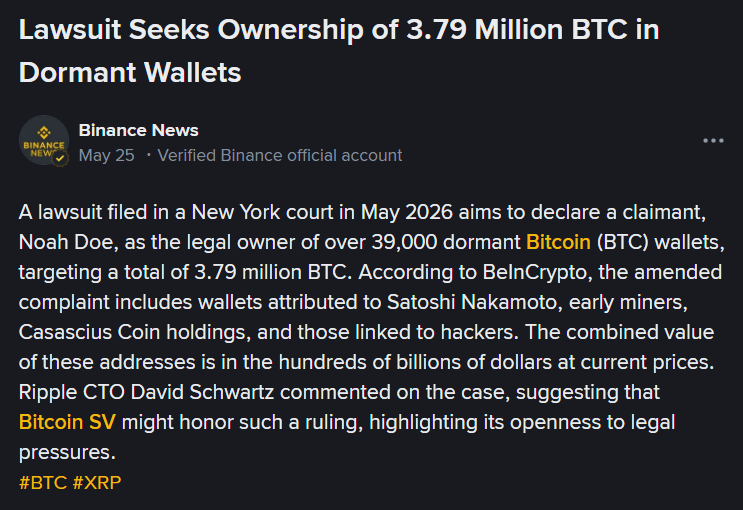
They didn't physically "find" any devices or hardware wallets. According to the complaint in the New York Supreme Court case (Index No. 153119/2026), plaintiff "Noah Doe" claims he used a custom "Algorithm" on his personal computer in New York City to scan and identify dormant/self-custodied Bitcoin addresses (public keys/addresses) that had been inactive for at least 5+ years.
He exported lists of these wallet addresses (not private keys or seed phrases) to USB drives, reported them to the NYPD as "found property" under New York's lost-and-found statutes (Personal Property Law), and got the drives back after periods of time. The "finding" was purely digital discovery of public blockchain data—no hardware, no physical devices, and no private keys were obtained.
Do they have the keys?
No. The lawsuit explicitly treats these as abandoned property where the private keys are presumed lost or inaccessible (common for very old dormant coins, e.g., early miner/Satoshi-era addresses). They argue that losing the private key doesn't destroy the "property" (the wallet/address and its claim to the BTC), analogous to a lost bank account password.
They served notices by:
•Publishing court-ordered legal notices via OP_RETURN on the Bitcoin blockchain (visible in the transaction data for the addresses).
•Posting on a dedicated website (e.g., ilawconotices.com).
•Other efforts to notify unknown "John Doe" owners.
Many addresses (including major Satoshi clusters) hold funds in P2PK (pay-to-public-key) format, while notices went to the corresponding low-value P2PKH (pay-to-public-key-hash) versions.
If they win the lawsuit, what changes if keys are still missing?
Very little in practice for actually spending/moving the BTC.
A court declaratory judgment could legally vest title/ownership in the plaintiffs (Noah Doe + two Wyoming LLCs) under NY abandoned property rules after the dormancy + notice periods.
static1.squarespace.comThis might allow them to argue in other jurisdictions or with exchanges/services that they are the rightful owners.
However, Bitcoin's protocol doesn't care about court orders. Without the private keys, they cannot sign transactions to spend the coins. The BTC stays stuck on the blockchain forever (or until quantum computing or some other breakthrough cracks the keys, which is speculative and far off for strong addresses).
It's like winning a judgment for a lost safe deposit box you don't have the key/combination for—you own it on paper, but you can't access the contents.
The main "win" would be a legal precedent treating dormant on-chain addresses as claimable abandoned property, potentially opening the door for similar claims elsewhere. But it wouldn't magically unlock 3.79M BTC.
This case is widely viewed as a long-shot "Bitcoin squatting" attempt. Courts have handled crypto service-of-process creatively before (e.g., via NFTs), but granting ownership of other people's self-custodied, keyless coins is a huge stretch. Expect strong pushback if it advances.