ChanceAustin

89.8K posts

ChanceAustin banner
ChanceAustin

ChanceAustin

@ChanceAustin

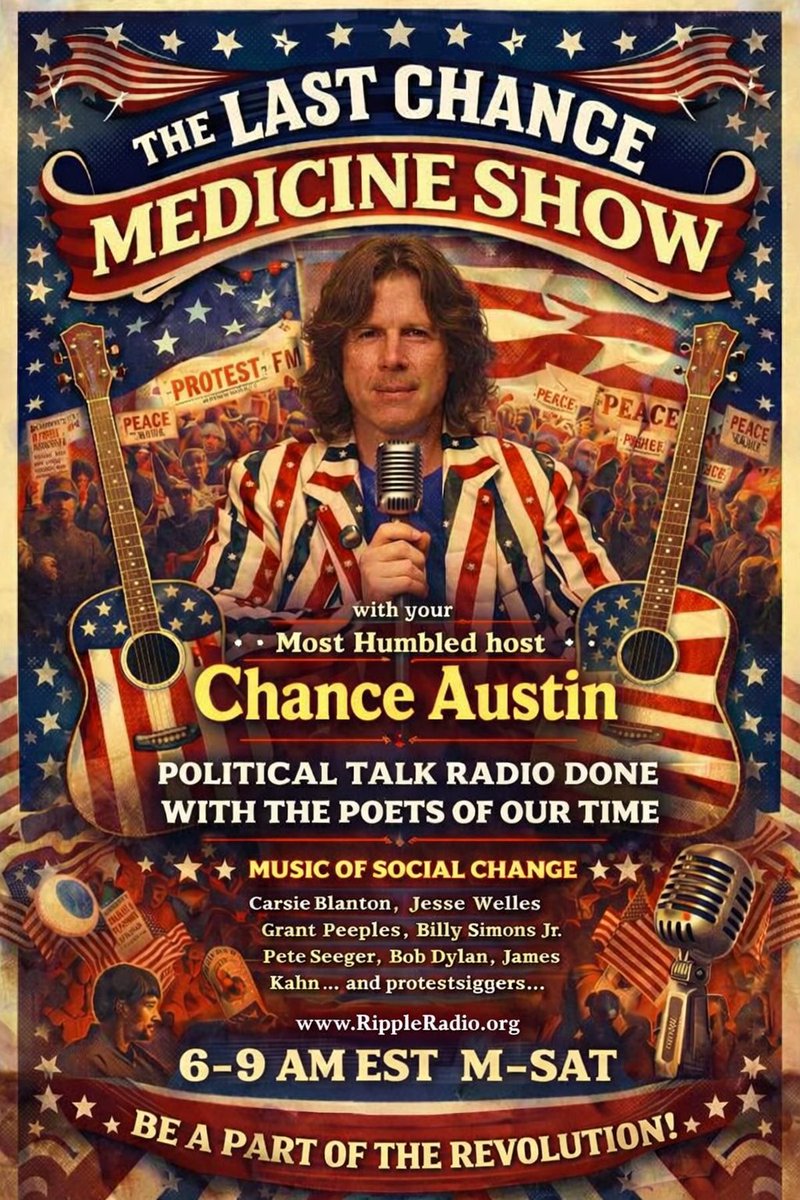
A Pretty Good Guy- Host of The Last Chance Medicine Show- Talk Radio -done with the music of social change artists https://t.co/0Hq41TZSDY

Emmaus PA Katılım Kasım 2011
2K Takip Edilen783 Takipçiler
Mark R. Levin
Mark R. Levin@marklevinshow·
You can’t understand America today if you don’t understand why the Constitution replaced the Articles of Confederation. I walk through how the founders tried—and failed—with a weak central government, and why they ultimately created a system built on balance, federalism, and limited power. I break down the real problems they faced—no tax base, weak national defense, economic instability—and how those failures led directly to the Constitutional Convention and the framework we live under today. But here’s the problem: this isn’t being taught anymore. Instead of learning how this country was built, students are being taught ideology instead of history—and that has real consequences for understanding our system, our rights, and our future. If you don’t know how it started, you won’t understand what’s changing. This is about history, the Constitution, and why it still matters. Watch the entire episode: Rumble: rumble.com/v786hnk-ep022-… YouTube: youtu.be/WDLR8xSX-Vo
YouTube video
YouTube
English
100
266
1.1K
33.1K
ChanceAustin
ChanceAustin@ChanceAustin·
Republican Party Platform of 1860 — Resolution 2 (Full Text) “That the maintenance of the principles promulgated in the Declaration of Independence and embodied in the Federal Constitution, ‘that all men have unalienable rights; that in respect thereof, all men are created equal; and that government is to be established and sustained for the purpose of giving every man an opportunity for the enjoyment and development of all these unalienable rights,’ is essential to the preservation of our Republican institutions; and that the Federal Constitution, the rights of the States, and the Union of the States, must and shall be preserved.”
English
0
0
0
4
Khan K't'inga
Khan K't'inga@KhanKtinga·
@ChanceAustin @MichaelTay27324 @marklevinshow Lincoln was likely inspired by the abolitionist pastor named Theodore Parker. A grandson of John Parker, leader of the Lexington militia at the Battle of Lexington that started the Revolutionary War, he was controversial for his theology, but he defined democracy as this:
English
2
0
0
7
ChanceAustin
ChanceAustin@ChanceAustin·
The 1860 Republican Platform text is preserved in multiple historical archives and reads: “…that all men have unalienable rights; that in respect thereof, all men are created equal; and that government is to be established and sustained for the purpose of giving every man an opportunity for the enjoyment and development of all these unalienable rights.”
English
0
0
0
4
Khan K't'inga
Khan K't'inga@KhanKtinga·
@ChanceAustin @MichaelTay27324 @marklevinshow It's a shame Lincoln left out "all" from his version. The statement [while still essential and profound] loses some of its meaning without that word. The inevitable use of the thought-terminating cliche, "We are a republic, not a democracy!" illustrates why "all" is so important
English
2
0
0
12
Michael E. NIX
Michael E. NIX@MichaelNIXG·
He's will definitely go down in the history books as number one.
Michael E. NIX tweet media
English
3K
113
464
39.7K
ChanceAustin
ChanceAustin@ChanceAustin·
People don’t defend corruption — they dodge it. Deflection is the oldest trick in the book. And while corporations were always legal entities for contracts and property, it’s the expansion of their constitutional rights, especially over the last century, that opened the floodgates. Corporations don’t have all the rights of people, but the rights they do have — especially the ability to pour unlimited money into politics — are exactly the ones that supercharge corruption. And it’s worth remembering: real people sit in those boardrooms. CEOs aren’t robots; they’re flesh‑and‑blood decision‑makers who choose how that power is used. youtube.com/watch?v=4yMIX9…
YouTube video
YouTube
English
0
0
0
13
Michael Taylor
Michael Taylor@MichaelTay27324·
@ChanceAustin @marklevinshow People often defend corruption by trying to deflect attention away from the corruption. Giving corporations all the rights of people is the root cause of the worst corruption.
English
1
0
0
22
ChanceAustin
ChanceAustin@ChanceAustin·
“Corporations have more coins and can better organize their coins to rob ‘We the People.’” This is opinion, but here’s what the factual record shows: Corporate political spending expanded dramatically after Citizens United v. FEC (2010), which held that corporations have First Amendment rights to spend money on political speech. Many scholars argue this increased corporate influence; others argue it protects free expression. But this shift happened in 2010, not 1819.
English
0
0
0
8
Michael Taylor
Michael Taylor@MichaelTay27324·
We started out being a government Of the People, By the People and For the People. Then in 1819 they started letting Corporations be People. That cracked the door and was the official end of our Constitutional Republic It was always a coin-operated machine But Corporations have more coins and can better organize their coins to more efficiently rob “We the People”. Artificial People never get a guilty conscience. So it’s now, Of the Artificial People, By the Artificial People and FOR the Artificial People.
English
4
0
1
74
ChanceAustin
ChanceAustin@ChanceAustin·
“That cracked the door and was the official end of our Constitutional Republic.” There is no historical or legal evidence for this. The U.S. remained a constitutional republic after 1819. Congress, states, and courts continued to regulate corporations heavily throughout the 19th century. Corporate personhood as we understand it today did not exist in 1819. This is an interpretive claim, not a factual one.
English
0
0
0
2
ChanceAustin
ChanceAustin@ChanceAustin·
“In 1819 they started letting corporations be people.” This refers to Dartmouth College v. Woodward (1819) — but the claim is misleading. What the Supreme Court actually held: Corporations have contract rights under the Constitution’s Contract Clause. The Court did NOT say corporations are “people” in the modern legal sense. It did not grant political rights, personhood, or constitutional protections beyond contract law. What the ruling did not do: It did not give corporations free speech rights. It did not give corporations due process rights. It did not allow corporations to influence elections. Those developments came much later, mostly in the late 19th and 20th centuries.
English
0
0
0
4
ChanceAustin
ChanceAustin@ChanceAustin·
Is it true that “this isn’t being taught anymore”? This part is not supported by evidence. The National Constitution Center, state curriculum standards, AP U.S. History, and virtually every U.S. history textbook still teach the Articles → Constitution transition. The topic is foundational to U.S. civics education and appears in every major curriculum framework. There is no evidence that this history has been removed from education in any systemic way.
English
0
0
0
1
ChanceAustin
ChanceAustin@ChanceAustin·
The claim “It was only for freed slaves” is historically incomplete. Yes, the 14th Amendment was drafted in the aftermath of slavery. But the Citizenship Clause was written broadly to prevent any future Congress or state from denying citizenship to people born here. The Supreme Court has repeatedly affirmed that broad reading
English
0
0
0
2
MamaSass
MamaSass@SassyQLaverne·
@ChanceAustin @marklevinshow It's subject to the jurisdiction thereof. "Thereof" is what makes it exclusive. SCotUS decisions aren't set in stone and can be overturned by SCotUS.
English
1
0
0
7
Mark R. Levin
Mark R. Levin@marklevinshow·
President Trump called on the Supreme Court to study MY analysis of birthright citizenship. Thank you Mr. President! I’ve been making this argument for decades: the 14th Amendment was never intended to grant automatic citizenship based solely on location, but on allegiance to the United States. Now the media is twisting the story, avoiding the substance, and turning it into something it’s not. So I walk through the actual history—Civil Rights Act of 1866, the framers’ intent, and the meaning of “jurisdiction”—and explain why this debate is being misunderstood at every level. If the Court gets this wrong, it won’t be because the Constitution is unclear—it’ll be because it was ignored. This is about law, history, and the truth behind birthright citizenship. Watch the entire episode: Rumble: rumble.com/v78502g-ep021-… YouTube: youtu.be/UB37MMeItIM
YouTube video
YouTube
English
355
3.1K
11.4K
160.6K
ChanceAustin
ChanceAustin@ChanceAustin·
The framers of the 14th Amendment said it applied broadly — not only to freed slaves. Historical records show that Senator Jacob Howard, who wrote the Citizenship Clause, stated it applied to “every person born within the limits of the United States” except diplomats and occupying armies. That includes children of immigrants.
English
0
0
0
3
ChanceAustin
ChanceAustin@ChanceAustin·
The Supreme Court has interpreted “subject to the jurisdiction” multiple times. The phrase does not mean “only freed slaves” or “only citizens.” It means anyone required to obey U.S. law. Elk v. Wilkins (1884) The Court explained that people who are not subject to U.S. law (like members of sovereign Native nations at that time) were excluded. By contrast, immigrants—documented or undocumented—are subject to U.S. law. Plyler v. Doe (1982) Not a citizenship case, but the Court held that undocumented immigrants are “within the jurisdiction” of the states because they are subject to U.S. law. This directly contradicts the idea that “illegals are not under U.S. jurisdiction.”
English
0
0
0
1
ChanceAustin
ChanceAustin@ChanceAustin·
My guess is you don't get facts-- The Supreme Court has explicitly ruled that the 14th Amendment applies to children of non‑citizens. The controlling case is: United States v. Wong Kim Ark (1898) The Court held that a child born in the United States to non‑citizen parents is a U.S. citizen at birth, as long as the parents are not diplomats. This case involved parents who were not U.S. citizens, not eligible for naturalization at the time, and were subjects of a foreign power. The Court still ruled their U.S.‑born child was a citizen. This is the exact scenario people today call “anchor babies.” The Court’s holding: The 14th Amendment “affirms the ancient and fundamental rule of citizenship by birth within the territory.” “Subject to the jurisdiction” means subject to U.S. law, not political allegiance. This is binding constitutional law.
English
0
0
0
1
Honey 🛼
Honey 🛼@honeymoon250·
He would have been a great president
Honey 🛼 tweet media
English
1.3K
76
1.3K
37.2K