ChaoWei

338 posts

ChaoWei

ChaoWei

@ChaoDWei

Associate Professor of Economics at the George Washington University; Faculty affiliate @IIEPGW.

Katılım Ekim 2016
951 Takip Edilen272 Takipçiler
Sabitlenmiş Tweet
ChaoWei
ChaoWei@ChaoDWei·
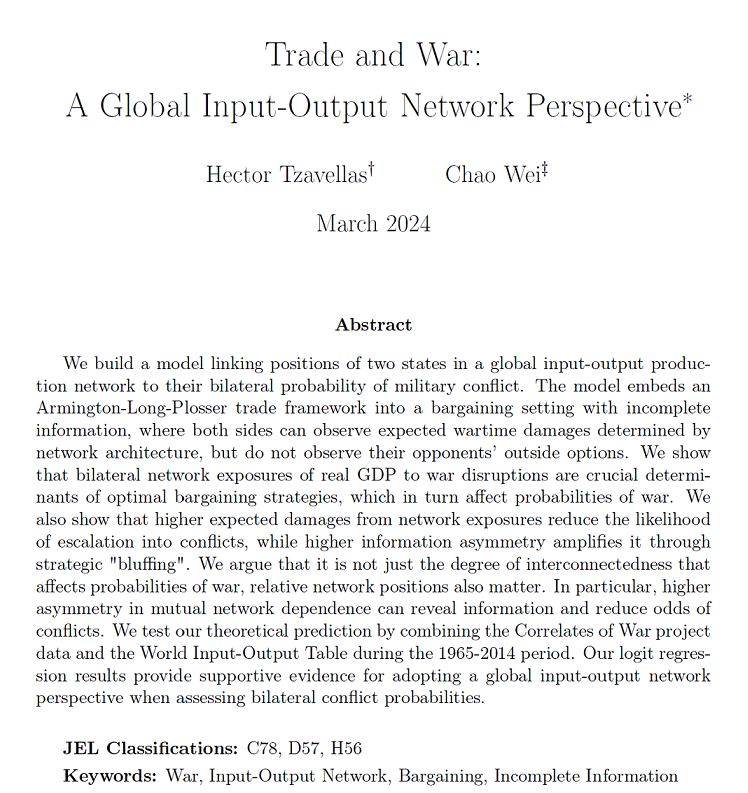
📣📣New Paper Alert📢📢 Does increased interconnectedness promote peace? It depends. In this paper, we build a model linking positions of two states in a global input-output network to their bilateral probability of military conflict. 1/14 Link: papers.ssrn.com/sol3/papers.cf…
ChaoWei tweet media
English
4
25
78
13K
ChaoWei
ChaoWei@ChaoDWei·
@nunopgpalma He said “wanting to leave.” Given what has happened, it is hard to say that the country remains as attractive—not only to accomplished foreign scientists, but also to promising young scholars who might otherwise have pursued PhD degrees here.
English
0
0
2
176
𝗡𝘂𝗻𝗼 𝗣𝗮𝗹𝗺𝗮
Massive respect for Tom Sargent, but I don't think he's getting this right. There is no evidence that top academics are systematically leaving the US. They talk about it, but they don't. European universities, for ex., don't typically offer good conditions
English
8
7
70
13.1K
ChaoWei retweetledi
Furkan Gözükara
Furkan Gözükara@FurkanGozukara·
Nobel Laureate Thomas Sargent drops a massive reality check. The US built its scientific dominance by taking in minds fleeing the Nazis. Now, due to the toxic environment in American universities, top scientists are desperately leaving. The US empire is collapsing.
English
44
903
2.8K
135.2K
ChaoWei retweetledi
John Stachurski
John Stachurski@john_stachurski·
We added a new and final chapter to Dynamic Programming Vol II (DP2) on approximation and reinforcement learning: dp.quantecon.org. DP1 and DP2 will always remain freely available online -- give me liberty or give me death 🤟💀
English
2
93
482
24.7K
ChaoWei retweetledi
Yong Zheng-Xin
Yong Zheng-Xin@yong_zhengxin·
I highly recommend all phd students (esp those starting their academic career) to read up this amazing slides / tips for students by @EugeneVinitsky that community / collaboration part is so underdiscussed, and Eugene's tips resonated with my experience (link in thread)
Yong Zheng-Xin tweet media
English
4
78
781
39.5K
ChaoWei retweetledi
John Stachurski
John Stachurski@john_stachurski·
Tom and I have finally finished a draft of Dynamic Programming Vol 2! Exhausting but satisfying. New approach to DP theory, advanced material, many applications... dp.quantecon.org
English
7
195
1.2K
78.5K
ChaoWei retweetledi
Jesús Fernández-Villaverde
Jesús Fernández-Villaverde@JesusFerna7026·
By now, I have published a fair number of papers, and one more acceptance would have close to zero marginal impact on anything that matters professionally. But getting my survey on “Deep Learning for Solving Models” accepted into the Journal of Economic Literature made me genuinely happy, for reasons that have nothing to do with my CV. I had the misfortune of studying my undergraduate degree in economics at a quite awful institution. Two professors, David Taguas and Alfredo Arahuetes, were outstanding, and I owe them a great deal. The rest were well below any reasonable professional level, and some violated the basic standards of ethical conduct. They had no business teaching economics at any level, let alone at a university that charged tuition and claimed to prepare students for professional life. I had to work out most of my education on my own. The surveys published in the Journal of Economic Literature were how I did it. I spent hours in the library’s reading room going through one survey after another on topics I had never been properly taught. Some helped more than others, but collectively they gave me a solid enough foundation that, when I arrived at Minnesota for my PhD, I discovered, to my considerable surprise, that I was ahead of nearly all the other first-year students, including some who held master’s degrees, despite the fact that I had finished my undergraduate degree just six weeks before. I owe the Journal of Economic Literature a debt I will never be able to repay. Publishing a survey there is the closest I can come to trying. So, the thought that some student somewhere, working on her own in a library or on a laptop, might find my survey useful gives me tremendous satisfaction. But there is a broader point worth making. Even in the world of AI, the profession has an important mission in making educational material widely available. Textbooks, surveys, teaching slides, these are public goods in the economist’s sense: high social value, insufficient private incentive to produce. This is also why I post all my slides and teaching material online: sas.upenn.edu/~jesusfv/deepl… We do not reward these activities nearly enough, and their supply is well below what any reasonable social planner would choose. I do not have a good proposal for changing this, and I would welcome suggestions. What I do find heartbreaking is that many of the great economists of the past couple of generations never wrote textbooks on their areas of expertise. I do not mean this as criticism. All of them maximize, and perhaps they all suffer from the same bias I suffer from: the belief that one can always do it next year. But I often think about the hours of pure intellectual pleasure I would have had reading “Time Series Econometrics: An Advanced Textbook” by Chris Sims or “Methods in Structural Estimation” by Pat Bajari. Those books do not exist. They should.
Jesús Fernández-Villaverde tweet media
English
34
202
1.3K
134.9K
ChaoWei retweetledi
Brandon Luu, MD
Brandon Luu, MD@BrandonLuuMD·
Students who took notes by hand scored ~28% higher on conceptual questions than laptop note-takers. Writing forces your brain to process and compress ideas instead of copying them.
Brandon Luu, MD tweet media
English
447
5.2K
24.5K
1.6M
ChaoWei retweetledi
Guillaume Blanc
Guillaume Blanc@gguillaumeblanc·
🚨 Visiting Faculty position @SFU Fields: Economic History, Political Economy, Development - Summer or 1-2 semesters in 2027-28 - Up to $55k stipend + $7.5k research support - Visa + moving support ⏰ Apply by May 4 🔗👇
Guillaume Blanc tweet media
English
1
48
87
15.4K
ChaoWei retweetledi
Markus K. Brunnermeier
Markus K. Brunnermeier@MarkusEconomist·
R.I.P. Christopher Sims (21 Oct. 1942 - 14 March 2026) - a giant in macroeconomics and one of the finest human beings I have ever met -
Markus K. Brunnermeier tweet media
English
34
453
1.8K
504.4K
ChaoWei retweetledi
Antonio Mele
Antonio Mele@antoniomele101·
This is a great point, @arindube , and I am really guilty of not sharing more about what I have been up to on the teaching side of things, given that this is what they pay me for! Let's get back on track with a mega post. At @LSEEcon, we've been running a series of structured experiments to figure out exactly how GenAI changes the production function of economics education. We moved past the "cheating" panic early (although we didn't really have one in our programmes) and started actively rebuilding our pedagogy around these tools. Here's what we're doing and what we're learning, and btw we will be presenting our work at CTREE 2026 in Las Vegas in late May if you are in town. The AI Economics Professor With Ronny Razin, we built a specialised, course-aligned AI tutor. The key idea Ronny had: best way to verify if a student actually understands a concept is to ask them to explain it interactively. Clearly this does not scale to the class size we have at LSE (Ronny teaches his course to 850 first-year students). But we can scale with AI! The key pedagogical principle is that the chatbot uses a Socratic framework. It refuses to hand out final answers. Instead, students are prompted with an exercise, and the chatbot asks them to identify the next step in a mathematical or logical derivation themselves, guiding them through the reasoning rather than short-circuiting it. It adapts to the students' level, for example by clarifying concepts or notation if needed. This gives students access to 24/7 personalised tutoring, levelling the playing field for those who might hesitate to speak up in small classes or office hours, and solving Bloom's "2-sigma problem" in economics education. Notice that we didn't train the bot or fine-tuned t to our course material. We just provided a system prompt embracing the Socratic approach, and the solutions to the exercise students had to solve. That's it. Off the shelf LLM model (it was Gemini 2.5 Flash). We did run a small experiment for a game theory exercise, where students had to work out strictly dominated strategies, and pure and mixed strategy Nash equilibria. The feedback we received is overwhelmingly positive: students found it useful to work through the reasoning with the chatbot, and it helped them understand the material better. We are also in the process of establishing if the use of the chatbot improves marks in the final exam, although we don't have a full analysis yet. But I can say that this was a very good year for the distribution of marks in this course, way above the average of previous years. If this proves as good as it looks, next step is to scale this to more courses, potentially expand to similar disciplines in LSE, and potentially expand to other universities. Stay tuned. AI Feedback Experiment Providing high-quality, scalable formative feedback is one of the hardest problems in our job. It's incredibly labour-intensive, and the result is that students often get too little feedback, too late to act on it. Main problem, again, is scale. Can we use AI to enhance our feedback process? We did an experiment with @MichaelGmeiner2 in one of our MSc courses. Michael is a great teacher. In his Econometrics course, he teaches students how to write referee reports, and provides feedback to each one of them on 5 submitted referee reports. We thought, why don't we provide two feedback reports for each submission, one AI-generated and one human-generated? This will allow us to evaluate how good the AI feedback is with respect to human feedback (well, Michael's feedback, which is superhuman in my view, but ok). And so we did. We didn't say which is which to students, to avoid any kind of bias. And again, we just cooked up a prompt for the LLM to generate feedback on the referee report, we provided the AI with the paper to referee, the referee report submitted by the student, and nothing more. We found out that students rated the AI-generated feedback as less useful than the human-generated, although not by a lot. Main problem with the AI-generated feedback is that it is too generic, and does not address the specific TECHNICAL issues that the student may have missed in their report. It is also too positive, and does not provide the student with the critical feedback that they need to improve. In particular, students highlighted that the AI feedback did not enhance their critical thinking, and did not address methodological problems in the research article they were refereeing. Some of these aspects can be addressed with a better prompt, and we are working on it. The technical and methodological issues can also be addressed by providing a summary of what the teacher expects students to criticise in the paper, although there may be additional challenges in this approach (what if the student finds something else to criticise that the teacher did not think of? it happens all the time). Students also mentioned they think the two pieces of feedback are complementary, and they will be happier getting both that just one of them. This points in the direction of a hybrid approach, where AI is used to enhance the human feedback process, rather than substituting it. The caveat is, of course, that we haven't used the most recent models, we didn't try with mixture-of-experts and all the tricks in the book. Teaching Python & RELAI Principles Perhaps our biggest curriculum shift: with @JADHazell we pioneered teaching AI coding tools to first-year students. In the first year macro course that Joe teaches, we introduce students to Python coding for economic analysis. This year, we decided to move in a different direction: since the advent of AI coding agents, we believe it is more important to be able to READ and ORGANISE code than writing it. It is more important to be able to explain your intent to the AI coding agent, and verify that intent has been reflected in the code, than to be able to write the code yourself and test it. But how can you teach students that have never seen a line of code to do that? Introducing Reverse Engineering Learning with AI (RELAI). Start with a full snippet of Python code. The student is told to prompt the AI to explain what the code does. Once the student understands what the code does, it can asks about the syntax and the programming concepts behind the snippet. Then can ask a study plan for those concepts, if needed. Then can try to enquire the AI about what would happen if I change this line or this parameter. Then it can experiment itself by changing the code, and debug with the help of the AI. Finally, the student can ask the AI to produce new code, based on what was learned, and the new intent. I call this the EXPLORE approach: Examine the code, eXplain what it does, Probe deeper, Link to economics, Output prediction, Recreate understanding, Extend with modification. Once students are familiar with AI coding agents, they are assessed with a challenging coursework that Joe created. The assignment has a part that is difficult to do without AI, but should be feasible with AI. There are open ended questions where students have to go beyond the simple repetition of what was learned in the course, possibly explore new datasets and questions, etc. We think this approach can help integrate AI coding agents into the curriculum in a meaningful way, and help students develop a deeper understanding of coding tools in a faster and more efficient way. Coursework is on the way, so we will be able to evaluate the impact of this approach in the next few months. I personally believe RELAI can be adapted to other topics and subjects, and can become one of the way we interact with AI when learning something new. Read more about our approach here: python-ec1b1.vercel.app AI as a productivity tool This is where you can really go nuts. I have used AI to produce new teaching material for several workshops and courses. Slides, assignments, exercises, etc. The last few exams were written with AI tools, creating a series of questions first with suggested solutions, and then choosing the most appropriate ones. I use a coding agent (@cursor_ai ) with access to my teaching materials and past exams, so that it is aware of the content and style. You get a very good exam draft in minutes, and can edit, change questions, generate new ones, etc. It used to take me days to write a good exam, now it takes me a few hours in the afternoon. I used Cursor to do deep research about a new course I wanted to design. I asked for topics, examples, current research in the field that I may not have been aware of, similar courses' syllabi, and in general what was the state of the art in the field. I got a very long list of topics that I could choose from to design my own course, based on my taste, interest and what I think my students should know. I could generate different versions of the same course for different levels (UG, MSc and PhD). Conclusion We are still at the early stages of this journey. We are learning a lot, and we are still figuring out how to best use AI to enhance our teaching. One important thing you may have noticed is that we first define our pedagogical approach and then we integrate AI tools to support it. The other principle should be, design not for the tools you have now, but the ones you will have in a few months or years. If you have comments, or have been running similar experiments, I will be happy to hear from you.
Arin Dube@arindube

I have read a ton from economists in my TL about use of AI in their research workflow. Much less about teaching. Would love to hear what folks' experience has been on that front. (Not problems of students using AI: I mean use of AI in teaching workflow, the good and the bad.)

English
8
62
274
82.9K
ChaoWei retweetledi
Joshua Gans
Joshua Gans@joshgans·
As I collect these stories, Al Roth’s Nobel prize winning paper (“The Economics of Matching: Stability and Incentives,” Mathematics of Operations Research 1982) was initially rejected by the JPE.
Joshua Gans tweet media
English
6
22
118
12.2K
ChaoWei retweetledi
Hoover Institution
Hoover Institution@HooverInst·
In December 2025, former US Senator @BenSasse announced that he had been diagnosed with stage 4 pancreatic cancer. That's the primary topic for this @UncKnowledge conversation about mortality, faith, and what truly matters when time is short. Talking to host @P_M_Robinson, Sasse reflects on "redeeming the time"—holding ambition lightly, loving family more deliberately, and resisting the urge to make politics or professional success the center of life. The discussion also covers Sasse's thoughts on the failures of Congress; the dangers of a fragmented, attention-starved republic; the crisis of higher education; and the moral challenges of technological abundance. He speaks candidly and movingly about regret, forgiveness, prayer, and suffering—arguing that while death is a real enemy, it does not get the final word. Watch the full conversation on X:
English
213
1.1K
4.6K
1.8M
ChaoWei retweetledi
Jaynit
Jaynit@jaynitx·
In 2007, a dying professor gave his final lecture to a packed auditorium. He had 10 tumors in his liver. Months to live. But he didn't talk about death. He talked about life. 13 life-changing lessons from Randy Pausch's Last Lecture: 1. We cannot change the cards we are dealt
English
7
133
419
50.9K
ChaoWei retweetledi
Erik Öberg
Erik Öberg@ek_oberg·
Macro job market candidates, see here! Mikael Carlsson, Oskar Nordström Skans, Karl Walentin and I are looking for a post-doc to help us understand heterogeneity in consumption behavior and its implications for macroeconomic stabilization policy. Full focus on research (incl your own stuff), 2-3 years. Please apply, share, and/or send me a DM if you have any questions! uu.varbi.com/en/what:job/jo…
Erik Öberg tweet media
English
0
17
64
9.2K
ChaoWei retweetledi
Brian Krassenstein
Brian Krassenstein@krassenstein·
BREAKING: A letter from Alex Pretti’s Final Nursing Student: “I was Alex Pretti’s final nursing student. He was my friend and my nursing mentor. For the past four months, I stood shoulder to shoulder with him during my capstone preceptorship at the Minneapolis VA Hospital. There he trained me to care for the sickest of the sick as an ICU nurse. He taught me how to care for arterial and central lines, the intricacies of managing multiple IVs filled with lifesaving solutions, and how to watch over every heartbeat, every breath, and every flicker of life, ready to act the moment they wavered. Techniques intended to heal. Alex carried patience, compassion and calm as a steady light within him. Even at the very end, that light was there. I recognized his familiar stillness and signature calm composure shining through during those unbearable final moments captured on camera. It does not surprise me that his final words were, “Are you okay?” Caring for people was at the core of who he was. He was incapable of causing harm. He lived a life of healing, and he lived it well. Alex believed strongly in the Second Amendment and in the rights rooted in our Constitution and its amendments. He spoke out for justice and peace whenever he could, not only out of obligation, but out of a belief that we are more connected than divided, and that communication would bring us together. I want his family to know his legacy lives on. I am a better nurse because of the wisdom and skills he instilled in me. I carry his light with me into every room, letting it guide and steady my hands as I heal and care for those in need. Please honor my friend by standing up for peace, preferably with a cup of black coffee in hand and a couple of pieces of candy in your pocket, just as he would. He would remind you that caring for others is hard work, and we must do whatever it takes to get through the long shifts. Step outside with your dog, breathe in the world, hike or bike as he loved to do, and let yourself find peace in the quiet moments within nature. Stand up for justice and speak with those whose views differ from your own. Hold your beliefs with strength, but always extend love outward, even in the face of adversity. Take one step, no matter how small, to help heal our world. Through these acts, carry his light forward in his name. Let his legacy continue to heal.”
Brian Krassenstein tweet media
English
1.7K
14.3K
59.9K
1.8M
ChaoWei retweetledi
Aasma Shaukat MD MPH
Aasma Shaukat MD MPH@AasmaShaukatMD·
One of my former research assistants was killed by ICE in Minneapolis today😢 Alex was the kindest, sweetest human and a ICU nurse with a bright future ahead of him May his soul rest in peace and this senseless carnage stop💔
Aasma Shaukat MD MPH tweet media
English
14.5K
41.7K
273.5K
4.8M
ChaoWei retweetledi
Orhan Torul
Orhan Torul@orhantorul·
PhDMacroBook is a superb new graduate textbook for first-year PhD sequences in macroeconomics. In case it would be of any use, we curated (with plenty of assistance from LLMs) some supplementary materials here: web.bogazici.edu.tr/torul/phdmacro… #EconTwitter
İstanbul, Türkiye 🇹🇷 English
4
94
454
32.8K