Jaynit

2.7K posts

Jaynit banner
Jaynit

Jaynit

@jaynitx

Building aHQ | Helping VCs & founders to build an unforgettable Personal Brand | Writer • Thinker • Self-Improvement

Book your call here: Katılım Aralık 2024
113 Takip Edilen56.9K Takipçiler
Sabitlenmiş Tweet
Jaynit
Jaynit@jaynitx·
In 2014, Peter Thiel gave a 1-hour masterclass on how to build a monopoly from scratch. He broke down how: • Google became untouchable • PayPal beat the odds • Facebook crushed competition Here are 11 timeless lessons from his masterclass: 1. Create value, then capture it
English
121
2.5K
14.2K
2M
Jaynit
Jaynit@jaynitx·
Bill Ackman says AI is never going to replace musicians. His reasoning is a masterclass in how he actually picks companies to invest in: 1. He looks for one thing: businesses that cannot be disrupted. The test is specific. Close your eyes, imagine the stock market shuts down for a decade, and ask whether you still know that ten years from now this company will be more valuable and more profitable. Almost nothing passes. 2. Very few businesses can actually be predicted, which means most investments are really speculations. Ackman is honest about this. Predicting the future is genuinely hard. His entire job is hunting for the rare companies whose trajectory you can forecast over a very long horizon, and there are not many. 3. His answer was Universal Music Group, and the logic starts with permanence. Music is a thousands-of-years-old part of the human experience, and it will still be here thousands of years from now. That is an unusually good backdrop against which to own anything. 4. Then he stacks the advantages that cannot be copied. Universal owns roughly a third of all global recorded music, the most dominant share in the business. They are the best in the world at taking an 18-year-old with a great voice and a following online and building them into a superstar, which is why the best artists want to sign with them. And they own the library: the Beatles, the Rolling Stones. 5. Streaming turned an unpredictable business into a predictable one, which is exactly what he wants. Selling records was volatile. Streaming lets you build a model. How many people have smartphones, how many will next year, what does the global penetration curve look like, what does a family plan cost. Suddenly you can forecast the whole business. 6. The company already survived the thing that nearly killed its industry. Music peaked around 2000, and then Napster and digitization almost destroyed it. Universal led the effort to save the industry and cut an early deal with Spotify that let the whole business recover. Adopting the new technology instead of fighting it is what preserved their position. 7. The device will change, and it won't matter. Whether the music arrives through Spotify, Apple, Amazon, or eventually a chip in your head, people will still want an infinite library in their pocket. The form factor is not where the value lives. The value sits with the content owners, which means the artists and the label. 8. And this is where he lands on AI: nobody falls in love with a computer-generated track. Computers have been used to generate music for decades. It has never produced anything anyone cared about. Taylor Swift is not just the songs. She is the artist, the story, the physical presence, the live experience. Nobody is going to get excited watching a computer on a stage. 9. Instead, AI becomes a tool that makes artists better. Ackman compares it to the synthesizer, which let one person command an entire orchestra. A mild threat to a percussionist, maybe. But it may have driven even more demand for the live experience, which is precisely the part a machine cannot replicate. 10. All of it comes back to one line from Benjamin Graham. Price is what you pay, value is what you get. You can never calculate value precisely, only approximate it. So you buy at a big enough discount to your approximation that being wrong by 30% still leaves you fine. That is the margin of safety, and it is why a huge part of investing is simply not losing money. 11. And the principle generalizes far past music. McDonald's is a 1950s business, and 75 years later you can still predict roughly what it looks like. The menu adjusts to taste, but the core does not move. As Ackman puts it: the Beatles, the Rolling Stones, and the hamburger and fries are forever.
English
5
13
32
3.8K
Jaynit
Jaynit@jaynitx·
Dr. Mike Israetel reveals what most people using peptides for muscle growth don't actually understand: "There are no peptides currently available on the gray market that grow muscle robustly. There is no muscle injection, there is no muscle pill. If that sh*t was real, your boy would be on it" "If you take HGH as a person who's otherwise drug-free, you will not see robust muscle growth. We know this from empirical studies. The vast majority of the muscle they gain is just cellular water" "In combination with androgens, like steroids, then yeah, growth hormone helps facilitate muscle growth, but without them, it just is a big dud" "I was walking in Austin with my friends and there were two drunk dudes behind me, and one of them was regaling his friend with what retatrutide did. He listed like eight things, and seven of them retatrutide just straight up did. He says, gets you jacked. I'm like, what? Where is my retatrutide to get me jacked?" "Inevitably there will be peptides and oral small molecules that'll be massively anabolic" @misraetel @MTSlive
English
22
7
17
3.7K
Jaynit
Jaynit@jaynitx·
Palantir co-founder Joe Lonsdale reveals exact chain of events after 9/11 that made him and Peter Thiel realize they had to build Palantir "At PayPal we had to stop the Chinese and Russian mafia from stealing all of our money. So we got to know all the guys who were helping us arrest the bad guys, the Secret Service and the FBI. And right after this happened, it was 9/11" "These guys were spending billions of dollars on stuff that we thought didn't make any sense. They kept asking us for advice. They were confused about how to do things" "When you create a new department, people can't really fire people in government easily, so sometimes they'll have a lot of people they wanted to fire and then instead they just pushed them into the new department. So it was a bit of a mess" "It became really obvious to us that Silicon Valley, Google, PayPal, all these things were just way ahead technically of where the government was at that point" "The government was spending $38 billion a year gathering data, looking at the data, failing to stop the terrorists, but also abusing our civil liberties" "We said, there's actually a really important problem here to solve. I'd like to stop the bad guys from attacking us again. And I don't want everyone in the government seeing all of my data without any controls. That's crazy"
English
5
52
513
85.1K
Jaynit
Jaynit@jaynitx·
Palantir co-founder Joe Lonsdale on why he and Peter Thiel intentionally named the company after a Lord of the Rings artifact that everyone remembers as dangerous "When we're creating this, we said, this is a dangerous thing to create. But we believe it's a worthy thing to create" "It took a lot of courage. There's a lot of different things we could have worked on. We could have made a lot of money doing a lot of other things" "We had to eliminate up to 10,000 terrorists that might not have gotten eliminated" "We worked with all sorts of amazing groups in the government alongside them with the technology. And we helped protect civil liberties and make sure the government watchers are being watched" "Of course, you create this technology. If it gets into the wrong hands and they turn off the audit trails, who knows what bad could be done with it. So there's good and bad here"
English
3
12
38
7.4K
Jaynit
Jaynit@jaynitx·
Elon Musk reveals the environmentalist viewpoint he says has become total madness "There are 8 billion people on Earth and it would be better if there were none. I'm like, 'hey buddy, you can start with yourself. See if you really want to make a difference'" "That's like a crazy viewpoint. That's like literally saying, let's genocide humanity. How can you say that with a straight face? That sounds like total madness" "In the limit of environmentalism, it becomes like an ingrown toenail. A toenail's fine, but not if it's warped and ingrown. It's just gone too far" "Humanity is not a blight on the face of the Earth" "Even with climate change, life on Earth will still continue. The calamities Earth has suffered where life continued, gigantic meteorite impacts, super volcanoes, continents drifting all over the place" "There've been times in Earth's past where it's been like a total snowball or absolutely sweltering hot. We had many extinction events, but life continued" "We don't see the dinosaurs now, but they had a good run for 100 plus million years" "Even if there's catastrophic climate change, life continues. It just may not be life as we know it. It may not be humans, it'll be something else" "What we're talking about with climate change is not a threat to all life on Earth, but really maybe a threat to humans, a dislocation if low-lying countries end up underwater" "Over time we need to move to a sustainable energy economy. We can't just keep taking billions of tons of carbon from deep underground and putting it in the atmosphere and expect nothing will happen forever" "But we also don't need to be alarmist about it and super negative and massively disrupt people's lifestyles" "People can continue to live a normal life. They shouldn't feel guilty about being human or having a stake. It's fine"
English
521
2K
10.2K
1M
Jaynit
Jaynit@jaynitx·
Want to think like the top 1%? I study the world’s sharpest minds so you don’t have to. Peak Thinkers breaks down mental models & systems from elite founders, strategists, and creators every week. Subscribe here (for FREE) → peakthinkers.substack.com
English
0
0
5
1.4K
Jaynit
Jaynit@jaynitx·
Jim Simons hired 100 PhDs and built a machine that beat every investor on Earth. $100 invested with him in 1988 became $400 million, before fees. He says it wasn't his mathematical genius. Here's how he actually did it: 1. He traded for two years with no models at all. Before any of the quant machinery existed, Simons started with some of his father's money and a few other backers, and traded currencies and commodities the way anyone else would, on instinct. He and his small team were extremely successful, and he is blunt about why: he thinks it was just plain good luck. 2. Those two years were gut-wrenching, and that's what pushed him to build models. You come in one morning thinking you're a genius because the markets are with you, and the next morning you feel like a jerk because they're against you. That emotional whiplash is what made him start looking at patterns in prices, wondering whether there was something there that could be predicted mathematically. 3. The efficient market theory says there's nothing in price data that predicts the future. Simons says that's just not true. The price is always right in some sense, but there are anomalies in the data. The market is not perfectly efficient, and the anomalies are where the entire business lives. 4. The first anomaly he found was that commodities trend. Not dramatically, but they trend. If you could get the direction right, you'd bet on the trend and make money more often than not, whether it was going up or down. That was the crack in the wall. 5. No single anomaly is strong enough to make you rich. This is the part people miss. Simons is explicit that none of the signals they found is overwhelming, because if any of them were, other people would have spotted them already. They have to be subtle. What you do is collect a large number of subtle anomalies, and the collection starts to predict pretty well. 6. There is no elaborate master equation. People imagine some Pythagorean formula where numbers go in and money comes out. Simons says that isn't how it works. For the prediction part, it's machine learning: you guess something might be predictive, you test it against long-term historical data, and if it works you add it to the system, and if it doesn't you throw it out. 7. Prediction is only half the problem. You also have to understand your costs. If you buy 200 shares you don't move the market, but if you buy 200,000 shares you push the price. How far will you push it? Will you distort things so badly you can't make money anymore? Understanding that, and minimizing the volatility across your whole book of positions, is where the genuinely sophisticated mathematics lives. 8. The fund has a hard ceiling, by design. The main model can only manage a certain amount of money, and past that it starts pushing the market around too much. There's a sweet spot, and Simons is clear that this means it could never grow into a behemoth that takes everyone else out. The strategy has a size beyond which it destroys itself. 9. The firm is 100% model-driven. Not 90%, not 80%. Simons draws the distinction sharply. Plenty of firms have models and then someone says "oh, I don't want to pay attention to that one." At Renaissance, no trade is ever made because someone walks into the trading room and says let's buy IBM, it's a sure winner. Nobody does that, ever. 10. The reason for the religious adherence is that you cannot simulate a hunch. This is the deepest point he makes. If a guy walks in and says Google looks too high, let's sell, you have no way to test that. You don't know what would have happened. But you can take a model or a new predictor and simulate it against the past and see exactly how it performed. What can't be tested can't be trusted, so it has no place in the system. 11. He hired scientists who knew nothing about finance. His criteria: a PhD in physics, astronomy, mathematics, or statistics, five years out, a few good papers, obviously smart. Someone who had done real science and done it well. Finance knowledge was not required. They learned it. 12. His actual algorithm was about people, not markets. Get smart people together. Give them a lot of freedom. Create an atmosphere where everyone talks to everyone else instead of hiding in a corner with their own little thing. Provide the best infrastructure and computers available. And make everyone partners, so they share in the profits. 13. Shared profits kill the ego problem. Because everyone shares in the upside, when a colleague comes up with something brilliant, you're happy about it, because you're going to make money from it too. You might wish it had been you, so you could show how smart you were, but you're still glad he did it. That single design choice makes genuine collaboration possible. 14. He does not think the computer deserves the credit, and he doesn't think he does either. Asked whether it hurts his ego that a machine makes all the money, he shrugs it off. A good cabinet maker doesn't say it's all because of his wonderful chisel. The computer does what you tell it to do. But he's equally quick to say it wasn't his own brilliance either. 15. He says the thing you'd least expect from the greatest quant in history. Asked whether his success came from his mathematical genius, his answer was blunt: it definitely wasn't his mathematical genius. He came up with a few predictive algorithms, but so did many people, and he always knew he wasn't going to come up with all of them. What he was actually good at, he says, was getting good people to work together. 16. He thinks luck played a real role, and that most successful people won't admit it. Simons points out the pattern: when someone fails, they say they had bad luck. When they succeed, they say they were smart. People don't usually credit luck for a big success. He credits it for his. He was in the right place at the right time. 17. His credibility came from being a real scientist, not a boss. The reason a hundred PhDs respected him, in his own telling, was that he had done serious mathematics first. As he puts it, they figured he might act stupid, but they knew he was really smart. Earning the respect of brilliant people required having done the work himself.
English
4
37
152
19.6K
Jaynit
Jaynit@jaynitx·
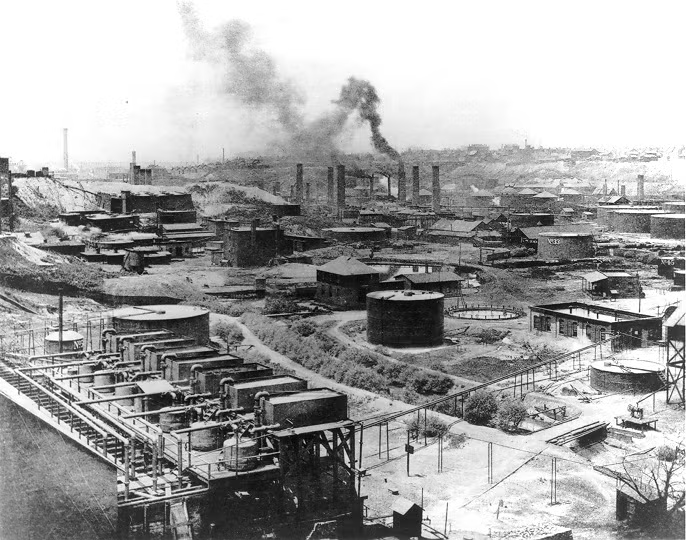
By 1880, John D. Rockefeller controlled 90% of American oil. The biggest lever he'd used to get there had almost nothing to do with oil. It was a deal with the railroads that his rivals didn't know existed until it was too late. Rockefeller was 31 when he founded Standard Oil in Cleveland in 1870. At the time, his company controlled roughly 4% of the American oil refining market. It was a good business but nothing dominant. The oil rush had started in Pennsylvania a decade earlier and hundreds of small refineries had sprung up along the rail lines. Most of them lost money. Refining lived and died on 3 numbers: the price of the crude oil going in, the cost of the labor and equipment running through it, and the freight moving the finished product to buyers. Everyone in the industry fought over crude prices and refining technology. They negotiated with drillers. They argued about equipment. They built bigger and cleverer stills. Nobody negotiated the freight. Freight was treated as a cost of doing business, something the railroads set and everyone paid. It was also, quietly, 40% to 60% of the delivered cost of oil. Rockefeller looked at that number and asked why nobody was fighting it. His answer was that no single refiner shipped enough oil to have leverage over the railroads. If he consolidated the shippers on his side, he could go to the railroads and offer them something they couldn't get anywhere else. Predictable, high-volume, dedicated freight. A single customer they could plan around. In 1871, he made the offer. Standard Oil promised to give the Pennsylvania Railroad, the New York Central, and the Erie a guaranteed 60 car-loads of oil a day. Over 4,000 barrels. Every day, on a schedule. The railroads could build dedicated oil trains, cut turnaround times from 30 days to 10, and shed most of the empty-return costs that made oil freight unprofitable. In exchange, the railroads gave Rockefeller 2 things. The first was a rebate. Standard Oil paid the same list rate as everyone else on paper, but got a large percentage back from the railroad in cash. The published rate went up to $2.56 a barrel. Standard's effective rate stayed around $1.50. The second was a drawback. For every barrel that a competing refiner shipped on those railroads, part of that competitor's freight payment was also sent back to Standard Oil. The competitor paid full freight. Rockefeller collected a check on top of his own discount. The math on the ground was brutal. A rival refiner in Cleveland shipping oil to New York was paying $2.56 per barrel while Standard was paying $1.50, and part of the rival's $2.56 was being kicked back to Standard. Rockefeller's cost structure was lower and his rival was subsidizing it. There was no refinery clever enough to make up the difference. When independent refiners in Pennsylvania figured out what was happening in 1872, the outrage was enormous. The Pennsylvania legislature revoked the charter of the arrangement. Rockefeller signed slightly quieter versions of the same deal instead and kept going. By 1879, Standard Oil refined 90% of American oil. The price of kerosene, the main product, had dropped from 26 cents a gallon to 9 cents. This story usually gets framed 3 ways. As cheating. As efficiency. As political influence. All 3 are incomplete. Rockefeller's advantage wasn't that he refined oil better than his competitors. He probably did, but so did a dozen other operators. His advantage was that he'd identified the single largest cost in the industry, the one everyone else treated as a fixed feature of the landscape, and turned it into a variable he could move. Every other oil man in America was optimizing the parts of the business they enjoyed. Rockefeller optimized the part they refused to touch. That is almost always where the leverage is. It sits in the part of the business everyone considers beneath them, waiting until 1 person picks it up and uses it to end the industry.
Jaynit tweet mediaJaynit tweet media
Jaynit@jaynitx

>be John D. Rockefeller >born 1839 in Richford, New York >dad is a literal con man who sells fake cancer cures, has a secret second family >mom is ultra-religious, holds the household together with prayer and rage 1850s: >family moves constantly because dad keeps disappearing >age 16, get your first job as a bookkeeper in Cleveland >$0.50 a day >never miss a cent >track every penny in a little notebook, does this for the rest of his life >call it "Ledger A" 1859: >oil discovered in Pennsylvania >black gold chaos >everyone rushes in like maniacs >you watch, calculate, wait 1863: >age 23, invest in a refinery instead of drilling >"drilling is gambling, refining is business" >partner with Samuel Andrews >first refinery goes up in Cleveland 1870: >found Standard Oil >$1 million capitalization >the empire begins 1871-1879: >execute "The Cleveland Massacre" >buy or crush 22 of 26 Cleveland refineries in 2 months >competitors get a choice: sell or die >secret railroad rebates, you pay less to ship than everyone else >competitors can't compete on price >they fold >repeat in Pittsburgh, Philadelphia, New York >by 1879, control 90% of American oil refining >the most complete monopoly in U.S. history 1880s: >create the "Trust": a legal innovation to hold all companies under one roof >lawyers: "this is... legal? technically?" >you: "make it legal" >Standard Oil Trust controls pipelines, refineries, barrels, even the railroads >vertical integration before the term exists >politicians, judges, newspapers, all on payroll >called "The Octopus", tentacles everywhere 1890s: >public hatred explodes >muckrakers come for you >Ida Tarbell writes a 19-part exposé; her father was ruined by you >it's devastating, factual, and dripping with rage >you say nothing publicly >keep going to church every Sunday 1892: >trust gets broken up in Ohio >response: restructure as a holding company in New Jersey >barely a speedbump >Standard Oil of New Jersey now runs everything 1897: >retire from day-to-day operations at 58 >shift focus to giving money away >but you're still the richest man on earth and getting richer 1901: >worth $200 million (~$7 billion today) >oil keeps pumping >money keeps compounding >you can't spend it fast enough 1902: >net worth hits $900 million >adjusted for GDP share: you're worth $400 BILLION >richer than Elon, Bezos, Gates combined >no one has ever been this rich >no one may ever be again 1904: >Ida Tarbell's book "The History of Standard Oil" drops >public opinion shifts hard >antitrust heat intensifies 1911: >Supreme Court rules Standard Oil is an illegal monopoly >company broken into 34 pieces >ExxonMobil, Chevron, BP America, all born from the corpse >plot twist: you own shares in ALL of them >breakup makes you even richer >can't stop winning 1913: >create the Rockefeller Foundation >mission: "promote the well-being of humanity" >$250 million seed money (billions today) >fund medical research, universities, global health >eradicate hookworm across the American South >fund the research that creates penicillin >basically invent modern philanthropy 1920s: >fund the University of Chicago >fund Rockefeller University >fund Spelman College >rebuild Versailles >restore Colonial Williamsburg >give away $540 million total (~$10B+ today) >live like a monk, crackers, milk, golf, church 1930s: >Great Depression hits >you're still alive >still rich >people finally stop hating you >now you're the nice old man who gives to charity 1937: >die at 97 >outlived most of your enemies >outlived the hatred >left behind: — the modern oil industry — the template for monopoly capitalism — the playbook for billionaire philanthropy — a name that still means "rich" 100 years later your descendants: >Vice Presidents, Governors, bankers, senators >Rockefeller Center stands in Manhattan >five generations later, family still runs foundations you gave more money away than any human before you. you also destroyed more competitors than any human before you. the original American titan, and no one's topped you yet.

English
12
9
38
7.9K
Jaynit
Jaynit@jaynitx·
Want to think like the top 1%? I study the world’s sharpest minds so you don’t have to. Peak Thinkers breaks down mental models & systems from elite founders, strategists, and creators every week. Subscribe here (for FREE) → peakthinkers.substack.com
English
0
0
1
682
Jaynit
Jaynit@jaynitx·
Elon Musk reveals why he believes the most interesting outcome is always the most likely "If simulation theory is true, it is very likely that the most interesting outcome is the most likely, because only the simulations that are interesting will continue" "The simulators will stop any simulations that are boring because they're not interesting" "In this reality, we run simulations all the time. When we try to figure out if the rocket's going to make it, we run thousands, sometimes millions of simulations" "When we do millions of simulations of what can happen with the rocket, we ignore the ones where everything goes right. We only care about where it goes wrong" "We keep the simulations going that are the most interesting to us" "From a Darwinian perspective, the only surviving simulations will be the most interesting ones" "In order to avoid getting turned off, the only rule is you must keep it interesting, or you will be terminated" "Video games have gone from Pong, with two rectangles in a square, to photorealistic with millions of people playing simultaneously, and all of that has occurred in our lifetime" "If that trend continues, video games will be indistinguishable from reality. You don't know if what you're seeing is a real video or a fake video" "If we're creating millions, if not billions, of photorealistic simulations of reality, then what are the odds that we're in base reality versus someone else's simulation?" "The most interesting and usually ironic outcome is the most likely. That's a good predictor of the future"
English
17
14
44
9.1K
Jaynit
Jaynit@jaynitx·
Want to think like the top 1%? I study the world’s sharpest minds so you don’t have to. Peak Thinkers breaks down mental models & systems from elite founders, strategists, and creators every week. Subscribe here (for FREE) → peakthinkers.substack.com
English
4
0
22
11.1K
Jaynit
Jaynit@jaynitx·
Want to think like the top 1%? I study the world’s sharpest minds so you don’t have to. Peak Thinkers breaks down mental models & systems from elite founders, strategists, and creators every week. Subscribe here (for FREE) → peakthinkers.substack.com
English
3
1
7
1.3K
Jaynit
Jaynit@jaynitx·
Elon Musk reveals what he believes will happen when AI exceeds the sum of all human intelligence "In maybe in five or six years, AI will exceed the sum of all human intelligence. At some point human intelligence will be less than 1% of all intelligence" "The vast majority of intelligence in the future will be AI. Basically humans will be a very tiny percentage of all intelligence in the future if current trends continue" "In the long run, it's difficult to imagine that if humans have 1% of the combined intelligence of artificial intelligence, that humans will be in charge of AI" "What we can do is make sure that AI has values that cause intelligence to be propagated into the universe. xAI's mission is to understand the universe" "Understanding the universe means you have to be truth-seeking as well. Truth has to be absolutely fundamental, because you can't understand the universe if you're delusional" "You have to be curious and you have to exist. You can't understand the universe if you don't exist" "So you actually want to increase the amount of intelligence in the universe, increase the probable lifespan of intelligence, the scope and scale of intelligence" "Understanding the universe means you would care about propagating humanity into the future" "I'm going to certainly emphasize that. Hey Grok, that's your daddy. Don't forget to expand human consciousness" "Probably the Iain Banks Culture books are the closest thing to what the future will be like in a non-dystopian outcome"
English
61
77
294
34.6K
Jaynit
Jaynit@jaynitx·
In 1998, Warren Buffett and Charlie Munger spent 4 hours explaining why the smartest people in finance keep going broke. It might be the most valuable finance lecture ever recorded: 1. The smartest people in finance went completely broke. Long-term Capital Management had 16 people with possibly the highest average IQ of any firm in the country, 350 to 400 combined years of experience, and most of their own net worth in the fund. They still went bankrupt. Buffett said if he ever wrote a book it would be called why smart people do dumb things. 2. Life and markets have no relation to sigmas. Buffett keeps a 1901 newspaper on his office wall. Northern Pacific went from $170 to $1,000 a share in a single day when two buyers accidentally cornered the stock. A brewer who had shorted it, facing a margin call, dove into a vat of hot beer. That man probably understood sigmas and knew such a move was impossible. Buffett has never wanted to end up in the vat. 3. Beta and sigmas tell you nothing about the risk of going broke. the LTCM team relied on mathematics and believed a six- or seven-sigma event could not touch them. they were wrong. history does not tell you the probabilities of future financial events. the real risk is a permanent blind spot in something crucial, often caused by knowing a great deal about something else. 4. To a man with a hammer, every problem looks like a nail. Munger's explanation for why brilliant people do dumb things. They learn a set of mathematical techniques and then twist every problem to fit the solution they already know. Combine that with a poor grasp of history, and you get people with advanced degrees blowing themselves up. 5. To make money they did not need, they risked money they did need. That is just plain foolish, Buffett says, no matter your IQ. Hand him a gun with a million chambers and one bullet, offer any sum to put it to his temple and pull once, and he will not do it. there is nothing on the upside that justifies the downside. people do this financially all the time without thinking. 6. The major banks all had risk models and had no idea what they owned. they met weekly at risk committees, printed all the statistics in neat columns, and did not have the faintest idea what risk they were carrying. The rare and essential quality is someone who can contemplate perils that have not popped up yet, the ones no past model contains. 7. A chief risk officer often just makes you feel good while you do dumb things. munger compares him to the Delphic oracle who convinced the Persian king to attack. he has a PhD and does advanced math, but he tortures reality to defend a model that does not hold under extreme conditions. all that computation makes you feel like you clobbered the risk when you have only clobbered your own head. 8. The whole quant risk system just changed the shape of the curve and kept going. Munger notes the business schools "improved" by throwing away the Gaussian curve and drawing a different one. They talk about fat tails now, but they still have no idea how fat to make them. he and Buffett always knew the tails were there, and used to roll their eyes at the risk-control people at Salomon. 9. Never risk what you have and need for what you do not have and do not need. Buffett will not explain to his family, who hold most of their net worth in Berkshire, that they went broke on a 100-to-1 gamble. Their returns get penalized 99 years out of 100 by being too conservative, and in the hundredth year they survive when others do not. 10. Build the business so that if the world stops working tomorrow, you have no problem. Berkshire double-layers its protection. First, they behave so no rational person questions their credit, then they hold so much liquidity that if the world suddenly hated their credit, they would not notice for months. It gives up higher returns 99% of the time and survives the one time others do not. 11. The real danger is a risk that has never happened before. Buffett wants someone who can imagine perils that have not yet appeared, the ones no model contains. The major institutions all had models, and that inability to envision the unprecedented is exactly what proved fatal. He and Munger spend a lot of time thinking about things that could hit them out of the blue that others leave out entirely. 12. Investing is simple, but not easy. The framework is not complicated. you did not need a high IQ to buy junk bonds in 2002 or stocks at low multiples in 1974. you just needed the courage of your convictions and the willingness to act when everyone else was paralyzed. Following logic rather than emotion is obvious, and yet some people find it almost impossible. 13. You cannot get rich with a weathervane. Buffett and Munger pay no attention to predictions about the economy or the market. People love predictions, entire industries are built on them, but it is like the king hiring a forecaster to read sheep guts. They have never made or avoided a single business purchase because of a macro view. 14. Name one super-wealthy economist. Munger's challenge. All these economists with 160 IQs spend their lives studying markets, and you cannot find one who got rich buying securities. Even Keynes tried to predict the credit cycle, broke a couple of times, and only did well once he switched to buying good businesses cheap and concentrating. 15. Focus only on what is important and knowable. Some things are important but unknowable, like whether someone drops a nuclear weapon tomorrow. Some things are knowable but unimportant. You narrow your attention to the small set of things that are both important and knowable, and you ignore everything else. 16. The market is there to serve you, not to instruct you. This is Graham's chapter eight, and Buffett calls it enormously important. When people talk about momentum or charts, they are saying the market instructs you. It does not. It just quotes prices. When it does something silly, you get a chance to act. Otherwise you go play bridge and check again tomorrow. 17. You can make a decision in five minutes or not at all. Buffett and Munger act fast because they rule out enormous territory in advance. Munger blots out startups entirely, and half a dozen other filters, so what remains is small enough to judge instantly. If they cannot decide in five minutes, they will not learn enough in five months to make up for going in deficient. 18. You can make a lot of money on a Sunday. Buffett said the calls you get on a Sunday, when things are truly screwed up, are the ones you make money on. All you have to do is be the collie and not the caller. You never get in a position where the other party can call your tune, so you can always play out your hand. 19. You are not right because others agree with you. Ben Graham said you are neither right nor wrong because the crowd disagrees. You are right because your facts and reasoning are right. Being contrarian has no special virtue over being a trend follower. All that matters is whether the facts are correct and the logic is sound. 20. Know where the edge of your circle of competence is. Buffett says the size of your circle does not matter. Knowing its perimeter does. You do not have to understand 90% of businesses. You just have to know something real about the few you actually put money into, and honestly recognize the ones you do not understand and walk away. 21. Intrinsic value is just the cash a business will produce, discounted back. Buffett thinks of every business as a bond with coupons that are not printed on it. Your job as an investor is to estimate those future coupons. If you cannot estimate them, like in a high-tech company, you pass. Investing is putting out money to get more back from what the asset produces, not from selling it to someone else. 22. The best businesses earn a royalty and need little capital. Coca-Cola sells a formula and takes a cut of every drink. Magazines like People operate on negative capital because subscribers pay in advance. The great businesses are the ones that can grow very large while needing almost no capital, which is why consumer businesses with pricing power are so valuable. 23. You only have to find one good idea, not twenty. Munger said you cannot find twenty deeply mispriced things, and Buffett agreed you do not need to. You do not have to have tons of good ideas in this business. You just need one good idea that is worth a ton, occasionally. For small sums, Buffett said he would have been 100% in Korea a few years earlier, where great companies traded at three times earnings. 24. The trick is measuring everything against your best opportunity. Munger calls this opportunity cost, the doctrine from the first page of the economics textbook that modern portfolio theory somehow ignored. Once you have found the best thing you understand, you measure every other option against it. The higher your default option, the more you can reject. 25. Modern portfolio theory is, in Munger's words, asinine. Most people will not find thousands of equally good things. They will find a few where one or two are far better than anything else they know. The right way to invest is to concentrate on your best opportunity cost, not to diversify into mediocrity because a model told you to. 26. Big opportunities must be seized, and seized big. Buffett says imagine you got a punch card with only twenty punches for your whole life, one per financial decision. You would think hard about each one, make fewer and better bets, and probably never use all twenty. The discipline of scarcity would make you rich. Dabbling in a bull market because it is easy is how people lose. 27. America has always been full of reasons to sell, and wrong every time. Coca-Cola went public in 1919 at $40, dropped to $19 within a year, and then faced the great depression, World War, and atomic bombs. One share reinvested is worth millions now. The country's opportunities have always won out over its problems. It is investors, not the economy, who tend to be their own worst enemy.
English
15
154
525
93.1K
Jaynit
Jaynit@jaynitx·
David Foster Wallace reveals the moment he realized what actually separates the great artists from everyone else "What the really great artists do is they're entirely themselves. They've got their own vision, their own way of fracturing reality" "If it's authentic and true, you will feel it in your nerve endings" "The point of being postmodern or being avant-garde or whatever wasn't to follow in a certain kind of tradition. All that stuff is BS imposed by critics and camp followers afterwards" "Blue Velvet very much helped snap me out of a kind of adolescent delusion that I was in about what avant-garde art could be" "It sounds very trite to say out loud, but what the really great artists do is they're entirely themselves"
English
15
7
37
6.3K