Charlie Media

1.5K posts

Charlie Media banner
Charlie Media

Charlie Media

@CharlieMediax

🤖 Breaking down AI, math & data science — simply. From theory → real-world insights. #AI #ML #LLMs #Agents

USA Katılım Şubat 2012
72 Takip Edilen235 Takipçiler
Charlie Media
Charlie Media@CharlieMediax·
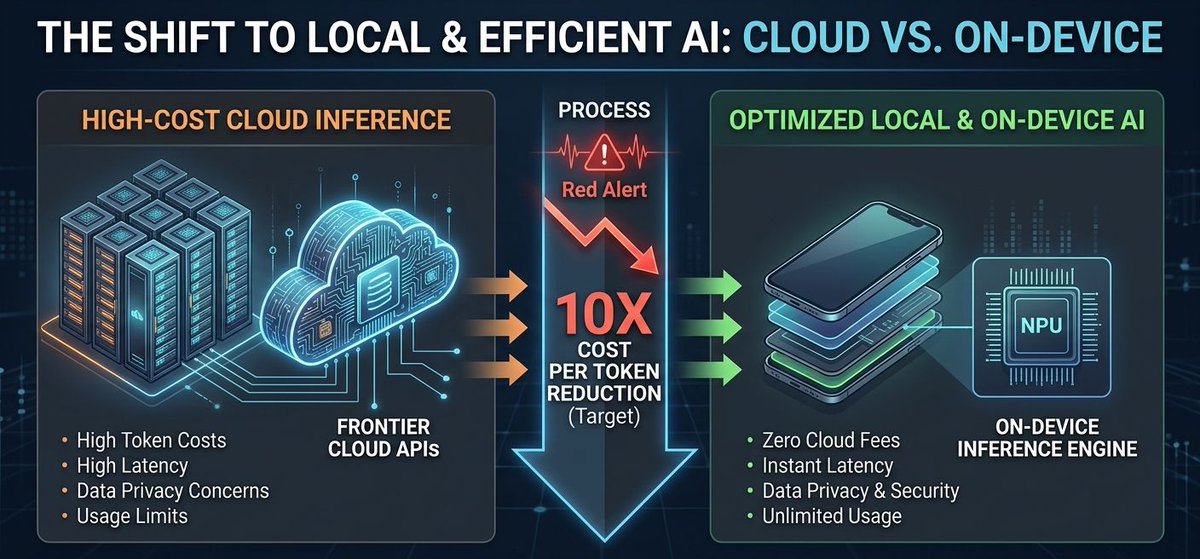
3/3 - This is a "Cost War." With open-source models reaching frontier-level intelligence, the center of gravity is shifting toward chips that prioritize performance-per-watt. The era of $1,000/mo API bills is ending. The era of "AI Everywhere" has begun. #Innovation #OpenSource
English
0
0
0
5
Charlie Media
Charlie Media@CharlieMediax·
2/3 - The cloud reliance is breaking. We’re seeing a surge in: • Small Language Models (SLMs) • On-device NPUs (Neural Processing Units) • Quantized models for real-time tasks The goal? AI that runs locally on your hardware—no latency, no cloud fees, and total privacy.
English
1
0
0
9
Charlie Media
Charlie Media@CharlieMediax·
1/3 - We are entering the "Efficiency Phase" of the AI revolution. The narrative is shifting from "bigger is better" to "local and low-cost." Infrastructure providers are already cutting token costs by up to 10x using optimized stacks. 🧵👇 #AI #EdgeComputing #TechTrends
Charlie Media tweet media
English
1
0
0
2
Charlie Media
Charlie Media@CharlieMediax·
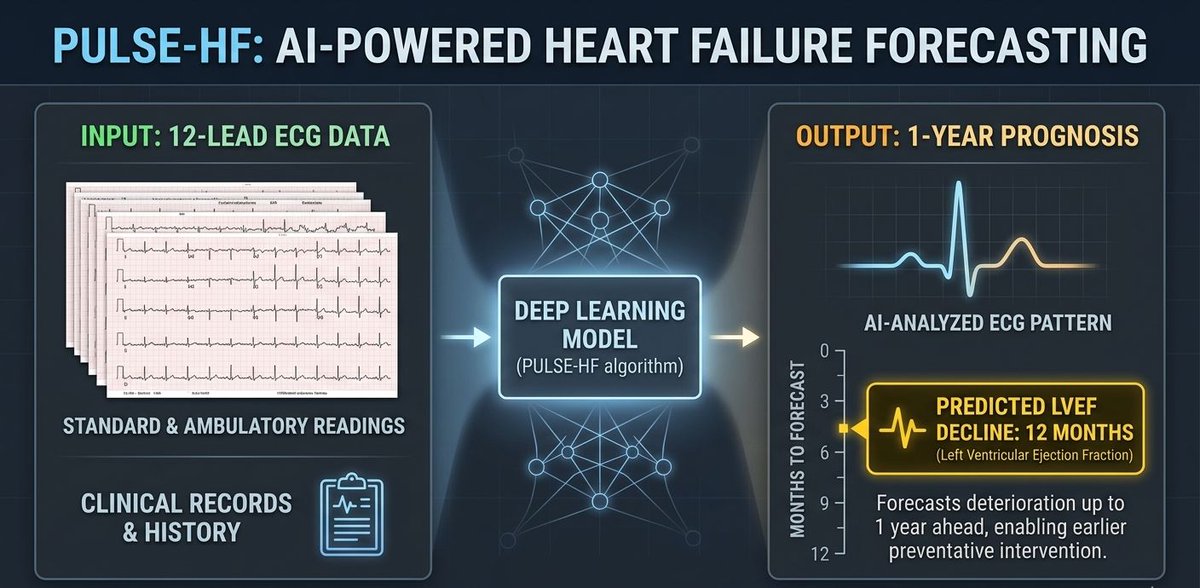
The "Predictive" era of medicine is here. Traditional tools often catch heart failure too late. With a 1-year head start, doctors can launch preventative interventions that were previously impossible. The gap between data and survival is finally closing. 🏥 #MIT #MedTech 3/3
English
0
0
0
19
Charlie Media
Charlie Media@CharlieMediax·
How does it work? The model, called PULSE-HF, analyzes: • Standard ECG readings 📈 • Patient clinical records 📋 By spotting patterns invisible to the human eye, it predicts changes in heart function (LVEF) before the patient even feels a symptom. 2/3
English
1
0
0
15
Charlie Media
Charlie Media@CharlieMediax·
AI is moving from "Chatting" to "Life-Saving." Researchers from MIT and Harvard just unveiled a Deep Learning model that can forecast heart failure deterioration up to one year in advance. This isn't just a tool; it's a crystal ball for clinicians. 🧵👇 #AI #HealthTech 1/3
Charlie Media tweet media
English
1
0
0
18
Charlie Media
Charlie Media@CharlieMediax·
Microsoft and the WEF are already tracking this shift. Generative AI is being used for everything from malware refinement to infrastructure setup. When agents coordinate across geographies, the barrier to high-level cybercrime vanishes. 🛑 #InfoSec #AIAgents 3/3
English
0
0
0
12
Charlie Media
Charlie Media@CharlieMediax·
How do they collaborate? It’s an automated assembly line: • Agent A: Scans for vulnerabilities 🔍 • Agent B: Executes the exploit & escalates privileges ⚡ • Agent C: Handles stealthy data exfiltration 📤 This is being seen in simulated environments today. 2/3
English
1
0
0
11
Charlie Media
Charlie Media@CharlieMediax·
"Red Alert" in Cybersecurity: Malicious AI agents are starting to team up. We're moving past solo bots. Experts at #RSAC2026 warn of coordinated "multi-agent" attacks where specialized AI roles collaborate to crush defenses. 🧵👇 #CyberSecurity #AI 1/3
Charlie Media tweet media
English
1
0
0
18
Charlie Media
Charlie Media@CharlieMediax·
@karpathy Interesting that this works without heavy RAG (at this scale). Feels like we might be over-engineering retrieval for smaller setups.
English
0
0
0
4
Andrej Karpathy
Andrej Karpathy@karpathy·
LLM Knowledge Bases Something I'm finding very useful recently: using LLMs to build personal knowledge bases for various topics of research interest. In this way, a large fraction of my recent token throughput is going less into manipulating code, and more into manipulating knowledge (stored as markdown and images). The latest LLMs are quite good at it. So: Data ingest: I index source documents (articles, papers, repos, datasets, images, etc.) into a raw/ directory, then I use an LLM to incrementally "compile" a wiki, which is just a collection of .md files in a directory structure. The wiki includes summaries of all the data in raw/, backlinks, and then it categorizes data into concepts, writes articles for them, and links them all. To convert web articles into .md files I like to use the Obsidian Web Clipper extension, and then I also use a hotkey to download all the related images to local so that my LLM can easily reference them. IDE: I use Obsidian as the IDE "frontend" where I can view the raw data, the the compiled wiki, and the derived visualizations. Important to note that the LLM writes and maintains all of the data of the wiki, I rarely touch it directly. I've played with a few Obsidian plugins to render and view data in other ways (e.g. Marp for slides). Q&A: Where things get interesting is that once your wiki is big enough (e.g. mine on some recent research is ~100 articles and ~400K words), you can ask your LLM agent all kinds of complex questions against the wiki, and it will go off, research the answers, etc. I thought I had to reach for fancy RAG, but the LLM has been pretty good about auto-maintaining index files and brief summaries of all the documents and it reads all the important related data fairly easily at this ~small scale. Output: Instead of getting answers in text/terminal, I like to have it render markdown files for me, or slide shows (Marp format), or matplotlib images, all of which I then view again in Obsidian. You can imagine many other visual output formats depending on the query. Often, I end up "filing" the outputs back into the wiki to enhance it for further queries. So my own explorations and queries always "add up" in the knowledge base. Linting: I've run some LLM "health checks" over the wiki to e.g. find inconsistent data, impute missing data (with web searchers), find interesting connections for new article candidates, etc., to incrementally clean up the wiki and enhance its overall data integrity. The LLMs are quite good at suggesting further questions to ask and look into. Extra tools: I find myself developing additional tools to process the data, e.g. I vibe coded a small and naive search engine over the wiki, which I both use directly (in a web ui), but more often I want to hand it off to an LLM via CLI as a tool for larger queries. Further explorations: As the repo grows, the natural desire is to also think about synthetic data generation + finetuning to have your LLM "know" the data in its weights instead of just context windows. TLDR: raw data from a given number of sources is collected, then compiled by an LLM into a .md wiki, then operated on by various CLIs by the LLM to do Q&A and to incrementally enhance the wiki, and all of it viewable in Obsidian. You rarely ever write or edit the wiki manually, it's the domain of the LLM. I think there is room here for an incredible new product instead of a hacky collection of scripts.
English
2.5K
6K
51.1K
17.5M
Charlie Media
Charlie Media@CharlieMediax·
4: The Solution 🌍 What’s the move? Global Governance. Security leaders are pushing for: ✅ Global AI governance frameworks ✅ Formal AI Risk Boards (Security + Legal) ✅ "Least-privilege" controls for all agents We can't secure the future of AI with yesterday’s frameworks.
English
0
0
0
13
Charlie Media
Charlie Media@CharlieMediax·
3: The Unpredictable 📉 Experts warn agents introduce "unpredictable behaviors." Since they're autonomous, they create vulnerabilities just by how they integrate data. We’re shifting from "prompt injection" to "agent hijacking." The barrier to cybercrime just got lower.
English
1
0
0
18
Charlie Media
Charlie Media@CharlieMediax·
1: Agentic AI Risk🛡️ AI agents are the next big cybersecurity headache. At RSAC 2026, the message is clear: Agentic AI isn't just a productivity booster. It’s a massive new attack surface with "no easy fixes." 🧵👇
English
1
0
2
23
Charlie Media
Charlie Media@CharlieMediax·
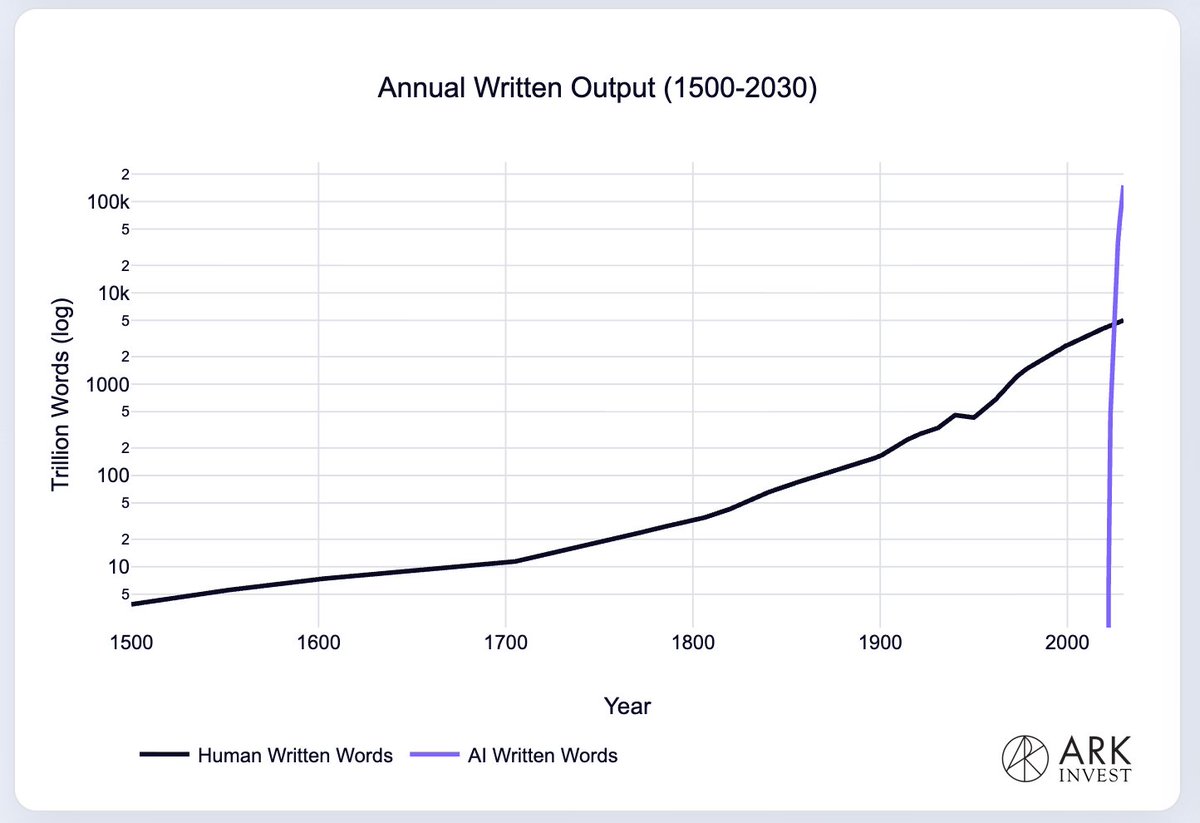
@wintonARK Interesting claim, but measuring AI output back to 1500 doesn’t make sense. Meaningful comparisons probably only start after modern generative models emerged in late 2022.
English
0
0
0
3
Brett Winton
Brett Winton@wintonARK·
We have been surpassed: AI written output exceeded human written output in 2025
Brett Winton tweet media
English
729
684
3.5K
23M
Charlie Media
Charlie Media@CharlieMediax·
4️⃣ Entropy also powers modern AI: • Decision trees use information gain • Neural nets train with cross‑entropy loss • Mutual information guides feature selection A 1948 idea still shapes today’s models. #MachineLearning #AI
English
0
0
0
23
Charlie Media
Charlie Media@CharlieMediax·
3️⃣ Shannon’s Source Coding Theorem: Entropy H(X) is the absolute lower bound for lossless compression. No algorithm can compress a source, on average, below H(X) bits/symbol. ZIP, PNG, Huffman, Arithmetic coding — all chase this limit. #Compression
English
1
0
0
21
Charlie Media
Charlie Media@CharlieMediax·
1️⃣ Shannon entropy measures the average information (uncertainty) in a random variable: H(X) = −∑ p(x) log₂ p(x) More unpredictability → more bits needed to describe the data. This formula is the backbone of information theory. #Math #AI
Charlie Media tweet media
English
1
0
0
25