CharmingMichi retweetledi

CharmingMichi
16.1K posts


@CharmingMichi
she/her (hack)activist & Gossip Girl of Malwareland | @lavillahacker organizer | mastidin: @[email protected]





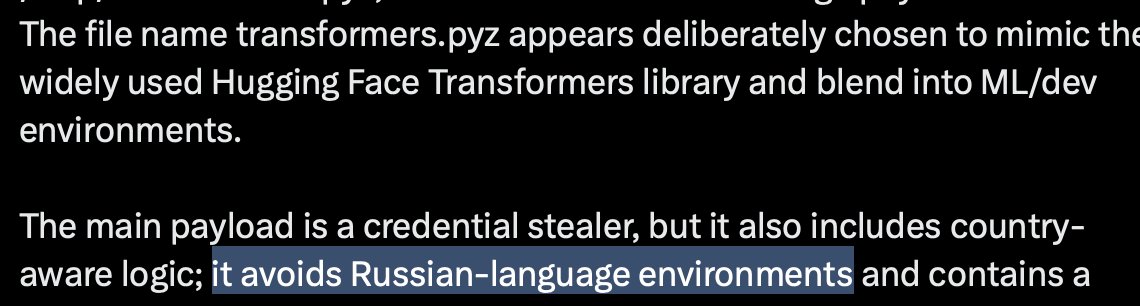
Microsoft is investigating mistralai PyPI package v2.4.6 compromise. Attackers injected code in mistralai/client/__init__.py that executes on import, downloads hxxps://83[.]142[.]209[.]194/transformers.pyz to /tmp/transformers.pyz, and launches a second-stage payload on Linux. The file name transformers.pyz appears deliberately chosen to mimic the widely used Hugging Face Transformers library and blend into ML/dev environments. The main payload is a credential stealer, but it also includes country-aware logic; it avoids Russian-language environments and contains a geo fenced destructive branch that has 1-in-6 chance of executing rm -rf / when the system appears to be in Israel or Iran. To mitigate this threat: isolate affected Linux hosts, block 83[.]142[.]209[.]194, hunt for /tmp/transformers.pyz, pgmonitor[.]py, and pgsql-monitor.service, and rotate exposed credentials.












Lançaram uma bíblia do Homelander e a reação do Soldier foi essa. Ele ta assistindo a série a reagindo com a gente KKKKKKKKKKKKKKKKKKK 🎥 The Boys (Episódio 5x05)

This is from an IBM presentation In 1979