Mike Harink

14.2K posts

Mike Harink banner
Mike Harink

Mike Harink

@CheetahMike

Dad and horseback Geochacher trying to spend 50 days a year in the back counrty

Alberta, Canada Katılım Nisan 2013
457 Takip Edilen201 Takipçiler
Mike Harink retweetledi
Super 70s Sports
Super 70s Sports@Super70sSports·
The official dish of “Something smells good.”
Super 70s Sports tweet media
English
95
186
3.7K
73.5K
Mike Harink retweetledi
Sci-Fi World Museum
Sci-Fi World Museum@hollywoodscifi·
This 150-year-old technology is still mind blowing! This is a museum in the Netherlands.
English
18
173
798
31.9K
Mike Harink retweetledi
Handre
Handre@Handre·
Soviet chandelier factories received production quotas measured in tons, not quality or function. Factory managers responded rationally to the incentive structure: they packed chandeliers with extra metal, concrete, and lead weights to hit their tonnage targets. The heavier the chandelier, the better their performance metrics looked to central planners in Moscow. Apartment dwellers across the USSR paid the price. Chandeliers weighing hundreds of pounds crashed through ceilings, destroying furniture and injuring families below. Reports from the 1970s and 1980s document dozens of ceiling collapses in Kiev, Leningrad, and Moscow as these industrial monstrosities proved too heavy for residential construction. Factory managers got their bonuses while citizens dodged falling light fixtures. The system worked exactly as designed. When you divorce production decisions from market prices and consumer preferences, you get perverse outcomes. Central planners measured success through crude metrics they could track from their desks, not through the satisfaction of end users. Factory managers optimized for the measurement system, not for making chandeliers that actually functioned as lighting. You see identical dynamics today wherever bureaucrats substitute their judgment for market mechanisms. Public school systems optimize for standardized test scores rather than education. Hospitals game Medicare reimbursement codes rather than focus on patient outcomes. Police departments chase arrest quotas rather than reducing crime. The Soviet chandelier problem lives on in every corner of the administrative state. The market solves the chandelier problem instantly through profit and loss. Customers refuse to buy chandeliers that destroy their homes, driving bad producers out of business and rewarding those who build functional products.
Handre tweet media
English
153
764
4.2K
419.5K
Mike Harink retweetledi
Larissa Phillips
Larissa Phillips@larissaphillip·
I see the opposite of this on my farm with visiting families all the time. (I run a farmstay where families come to stay on my farm, and I do a two-hour “farm camp” with their kids. Sometimes the parents tag along.) I’ll ask the kid to do some task—find the end of the hose, open the gate latch, climb the ladder to check for eggs in the loft, etc. It’s all age-appropriate tasks that I think they can do but that will require a little thought and effort. Every task is a stepping stone to the next level, all toward a general goal of usefulness and expertise. The kids have to process the request. It takes several seconds. Then they look around for the first step, then they set off for it. Sometimes they’re hesitant for whatever reason and I wait. If they can’t do it, I can help them, but I want them to start looking and thinking and trying. I want them to start understanding the landscape in front of them, and interacting with it. If the parents are there, they invariably jump in and do the task for the kid, before the kid has even finished processing. Within seconds. Sometimes I’ll be handing the kid an egg basket or a tool or something. “Here, take this.” I hold it out to them. If the kid doesn’t respond immediately the parent will take it and hold it for them. Parents of today, you are raising your children to be helpless imbeciles. Let them struggle.
Katharine Birbalsingh@Miss_Snuffy

So CUTE! 🥰 I love how after all that, she abandoned ship to get the crisps! 😂 PARENTS - let them struggle! 😊

English
23
138
2.3K
143.8K
Mike Harink retweetledi
Sama Hoole
Sama Hoole@SamaHoole·
The greatest propaganda piece ever pulled off on the modern public: Convincing them that producing complete protein, every essential amino acid, every fat-soluble vitamin, bioavailable B12, iron, zinc, and the most nutrient-dense organ meat on earth, from nothing but sunlight, rainfall, indigestible grass and the byproducts of crops humans cannot eat anyway, is inefficient. Needs cancelling, in fact. The cow runs on weather. The pea protein isolate replacing her runs on hexane extraction, bacterial fermentation for synthetic B12, three continents of supply chain, and a plastic sleeve. All to approximate a fraction of what the cow was doing for free. Somebody decided to call the cow the inefficient one. With a straight face. Everyone nodded. That's where we are.
Sama Hoole tweet media
English
38
870
2.6K
28.9K
Mike Harink retweetledi
Lloyd Legalist
Lloyd Legalist@LloydLegalist·
Never before has a generation so diligently recorded themselves accomplishing so little.
English
22
247
1.7K
21.1K
Mike Harink retweetledi
Sama Hoole
Sama Hoole@SamaHoole·
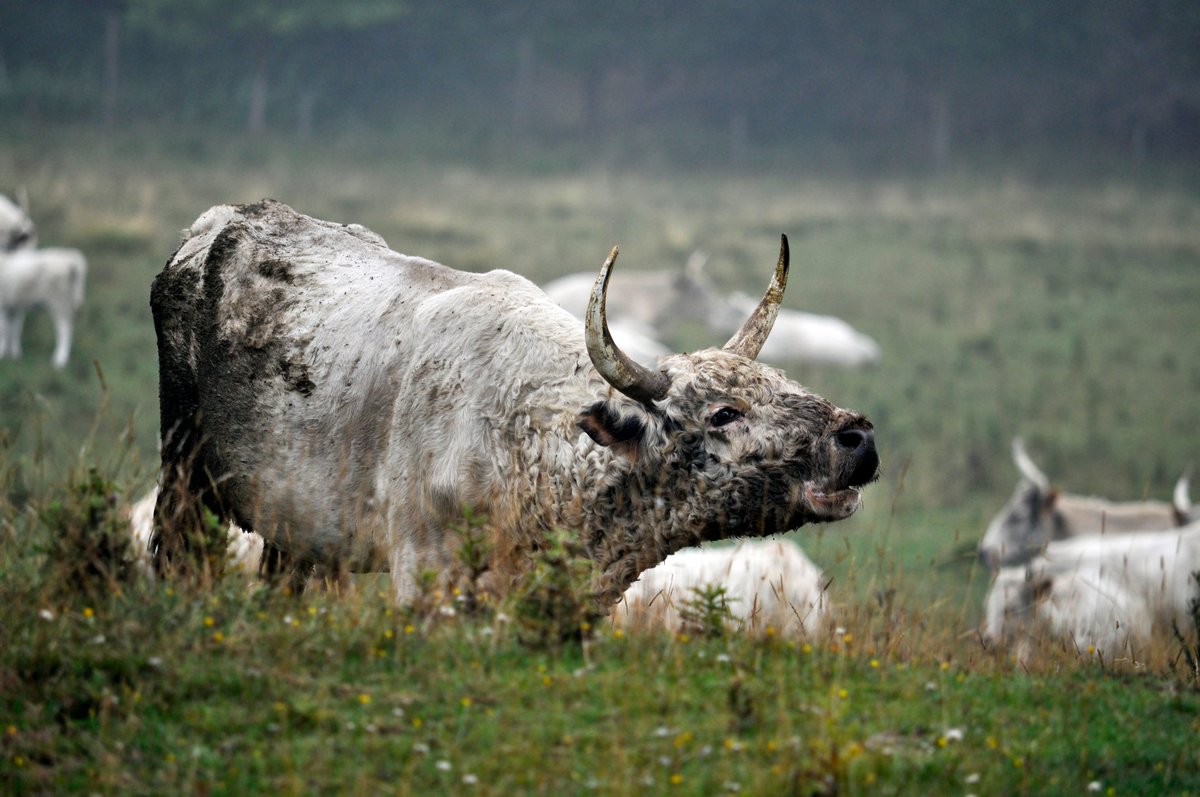
In the grounds of Chillingham Castle in Northumberland, behind a wall built in 1270, there is a herd of wild cattle. They have been there, in that specific park, for approximately 700 years. They are white. Small. Horned. They look vaguely like the cattle on a medieval tapestry, which is roughly what they are. The Chillingham herd is the last surviving population of genuinely wild cattle in Britain, and genetically the closest living relative of the aurochs, the wild ancestor of every domestic cow on earth. When the estate was enclosed in the 13th century, a group of cattle was trapped inside the wall. Nobody moved them. Nobody bred them with outside stock. Nobody managed them. The wall went up, the cattle kept being cattle, and the door, essentially, was never opened again. Seven centuries later, they are still there. No selective breeding. No herd improvement programme. No artificial insemination. No supplementary feed beyond what the park produces. They eat the grass. They calve unassisted. The bull fights for dominance. The old are taken by winter. The young grow up in a social structure nobody taught them. They have the lowest genetic diversity of any mammal on earth that isn't officially endangered. By every textbook in conservation genetics, they should have collapsed a dozen times over from inbreeding depression. They have not. They are, by veterinary standards, extraordinarily healthy. Disease resistance better than modern breeds. Fertility steady. Calving success high. They carry on regardless. What can be learned from Chillingham. The first is that a cattle population, left alone on land suited to them, finds its own equilibrium. No committee is required. No spreadsheet. No grass-measuring device. The cattle work it out. They have worked it out for 700 years. The second is that the park itself is a functioning ecosystem, maintained by those cattle. The wildflowers, the ancient oaks, the soil structure, the bird populations, are all shaped by continuous low-intensity grazing by a small wild herd. It is one of the most biodiverse small landscapes in England. The third, and most inconvenient to the modern argument, is that cattle and wild land are not in conflict. The Chillingham herd is wild cattle, on wild land, in steady state, for longer than most European countries have existed in their current form. They are a living contradiction to almost every modern claim made about bovines and ecosystems. They are not on anybody's emissions chart. They have never been invited to a conference. They are behind their wall, in Northumberland, quietly doing what cattle have been doing since before the Norman Conquest. They will probably still be doing it when the current debate has been forgotten.
Sama Hoole tweet media
English
110
1.4K
6.4K
131.1K
Mike Harink retweetledi
Anish Moonka
Anish Moonka@anishmoonka·
A parasite that has been eating people for 3,500 years is about to be wiped off the planet. It infected 3.5 million people in 1986. Last year, it infected 10. And I have not seen it make a single front page. It is called Guinea worm. You drink contaminated water from a pond in a poor village. A year later, a worm up to three feet long starts coming out of your leg through a burning blister. There is no pill that stops it and no surgery that works. You wrap the worm around a stick and pull it out slowly, over days or weeks, inch by inch. If you rush, the worm breaks inside you and causes a fresh infection. Guinea worm is ancient. Preserved worms have been pulled out of Egyptian mummies from around 1000 BCE. The Ebers Papyrus, an Egyptian medical scroll from 1550 BCE, describes pulling the worm out with a stick. For three and a half thousand years, that was the best humans could do. Then in 1986, public health workers decided to kill the parasite off. They had no vaccine and no drug. What they had was cheap cloth water filters and a small army of volunteers willing to walk from village to village for decades. The plan was simple. Give everyone who drinks from a pond a cloth filter to strain out the tiny water fleas that spread the parasite. Then send volunteers walking house to house, year after year, teaching people how to use the filters and keeping anyone with an emerging worm out of the water. It worked. From 3.5 million cases a year to 10. Four were in Chad, four in Ethiopia, two in South Sudan. The other four countries where the worm used to be common, Angola, Cameroon, the Central African Republic, and Mali, had zero human cases for the second year in a row. The World Health Organization has already certified 200 countries as Guinea worm free. Six are left. The last hurdle is dogs. Cameroon had 445 infected animals last year and Chad had 147, so a lot of the remaining work is on animals, not humans. Strays get leashed, and crews treat ponds to kill any remaining worms. The campaign keeps watching until the number hits zero. When Guinea worm hits zero, it becomes the second human disease ever erased from the planet. The first was smallpox. It will also be the first parasite humans have ever wiped out, and the first disease ever ended without a single dose of medicine. Volunteers walked village to village with cloth filters for 40 years. Now a plague from the age of the pharaohs is about to be gone.
ً@prinkasusa

Give me the kind of good news from around the world that nobody ever talks about... but should.

English
733
20.7K
129.6K
7.9M
Mike Harink retweetledi
Long Story Farms, LLC
Long Story Farms, LLC@longstoryfarms·
Farmer doesn't even realize that this is really a right to repair issue. The placement of the bearing is a design choice that takes away the right to repair. This is a conscious decision by a company to make their product unrepairable. This is not a "quality" issue. It is a design issue, a feature, not a flaw.
Tork@TorkWhisler

The appliance guy told me five years is pretty good on a washer. Five years. I bought it in 2019 and the bearing is molded into the drum so you can't just replace the bearing. You replace the whole drum for $900 or you buy a new washer for $985. The refrigerator from 1989 sitting in my garage has never been serviced and runs like a top. That's your product quality report, folks.

English
13
40
605
28.6K
Mike Harink retweetledi
Keith D McMurdo
Keith D McMurdo@KeithDMcMurdo·
A 53 series Detroit Diesel
Català
0
1
8
216
Mike Harink retweetledi
Historyland
Historyland@HistorylandHQ·
This was considered absolute elite in the 1990
Historyland tweet media
English
507
454
7K
201.4K
Mike Harink retweetledi
Kirk Lubimov
Kirk Lubimov@KirkLubimov·
A whole convoy of empty oil tankers on the way to the US to fill up. It could have been Canada but we have land acknowledgments to do and carbon tax instead.
Kirk Lubimov tweet media
English
775
5.1K
27.2K
2.5M
Mike Harink retweetledi
Bruce
Bruce@bruce_barrett·
Hey @grok what do you call a unelected majority government in control of a country?
English
144
713
3.3K
214.8K
Mike Harink retweetledi
Tristin Hopper
Tristin Hopper@TristinHopper·
Mark Carney's innovation is to never underestimate the ignorance of the Canadisn voter, the corruption of Canadian politicians, or the perfidy of the Canadian press. He treats everything and everyone with breathtaking contempt and is endlessly, fabulously rewarded for it.
English
83
380
1.8K
23.2K
Mike Harink retweetledi
Super 70s Sports
Super 70s Sports@Super70sSports·
Life is short. Don’t waste it arguing with strangers about politics on the internet.
English
186
370
5.6K
117.5K
Mike Harink retweetledi
Hedgie
Hedgie@HedgieMarkets·
🦔A researcher invented a fake eye condition called bixonimania, uploaded two obviously fraudulent papers about it to an academic server, and watched major AI systems present it as real medicine within weeks. The fake papers thanked Starfleet Academy, cited funding from the Professor Sideshow Bob Foundation and the University of Fellowship of the Ring, and stated mid-paper that the entire thing was made up. Google's Gemini told users it was caused by blue light. Perplexity cited its prevalence at one in 90,000 people. ChatGPT advised users whether their symptoms matched. The fake research was then cited in a peer-reviewed journal that only retracted it after Nature contacted the publisher. My Take The researcher made the papers as obviously fake as possible on purpose. The AI systems didn't catch it. Neither did the human researchers who cited it in real journals, which means people are feeding AI-generated references into their work without reading what they're actually citing. I've covered the FDA using AI for drug review, the NYC hospital CEO ready to replace radiologists, and ChatGPT Health launching this year. All of that is happening in the same environment where a condition funded by a Simpsons character and endorsed by the crew of the Enterprise was being presented as emerging medical consensus. The people making these deployment decisions seem to believe the pipeline from research to AI to patient is more supervised than it actually is. This experiment suggests it isn't supervised much at all. Hedgie🤗 nature.com/articles/d4158…
English
790
12.5K
27.4K
1.2M