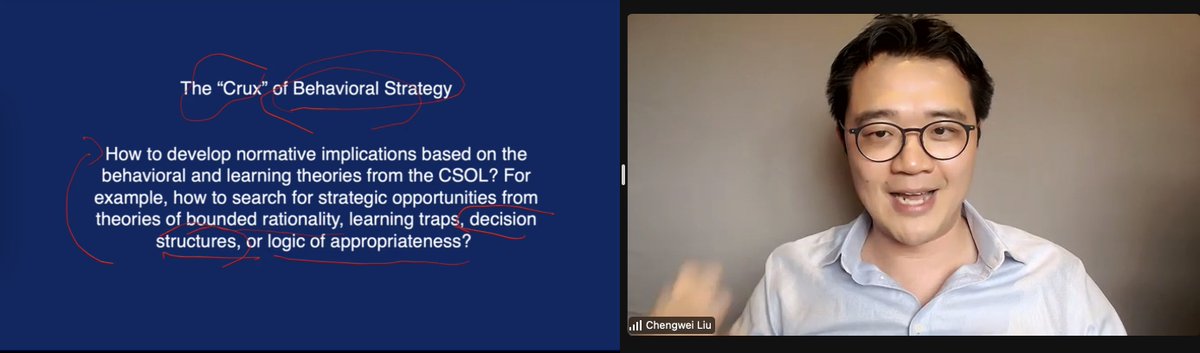
Behavioral science implies looking at what others do. Yet, behavioral strategy should be all about trying to use that baseline to our advantage. But how? Today, @ChengweiLiu shows us how underdogs and contrarians use arbitrage to outmaneuver their competition. #CSOLAcademy
I love the picture HBR editors chosen for my article on "How to Be a Smart Contrarian"!
PS. I put my strategy prof. hat on—the word "luck" does not appear once in this article
hbr.org/2021/09/how-to…
Watch @ChengweiLiu presentation of "Should We Attribute Exceptional Success to Skill or to Luck" co-authored with J. Denrell and @HenrichGreve discussion during last week's E&S Research Seminar Series on YouTube now! ow.ly/Wrpq50B54gV
My op-ed at FT: Moneyball was never about data analytics as many assumed, but about taking advantage of other's misattribution of luck. ft.com/content/5f0afa…
My first public talk on how to quantify the impact of luck using "not-quite-small" data (6m+ obs, 70+ years) goes to...wait-for-it... Manchester!
Summary: we knew the impact of luck on performances is seriously underestimated by humans and my study shows how serious it is...
Want to know the secret of enhancing your prospect of winning a fair lottery? See this article based on my latest research on luck.
wbs.ac.uk/news/how-to-ex…