Choate Academic Tech

579 posts

Choate Academic Tech banner
Choate Academic Tech

Choate Academic Tech

@ChoateAT

Wallingford, CT Katılım Nisan 2016
741 Takip Edilen128 Takipçiler
Choate Academic Tech retweetledi
Black Phillip
Black Phillip@poe_collector·
Found an AI perspective I’d never heard before from a teacher of teens. It’s a bit meandering but your three minutes will be well used.
English
435
6.5K
25.3K
840.6K
Choate Academic Tech retweetledi
Stitch by Google
Stitch by Google@stitchbygoogle·
Meet the new Stitch, your vibe design partner. Here are 5 major upgrades to help you create, iterate and collaborate: 🎨 AI-Native Canvas 🧠 Smarter Design Agent 🎙️ Voice ⚡️ Instant Prototypes 📐 Design Systems and DESIGN.md Rolling out now. Details and product walkthrough video in 🧵
English
888
4.5K
39.5K
17.8M
Choate Academic Tech retweetledi
Aakash Gupta
Aakash Gupta@aakashgupta·
Your brain has 4 slots. You’re running 40 situations. The neuroscience of why this tweet is more accurate than any wellness influencer on the platform. Your prefrontal cortex can hold roughly 4 items in working memory at any given time. That’s from Cowan’s 2001 research revising Miller’s classic “magic number 7” down to a more accurate 3 to 5. Call it 4 for most people on a good day. Now think about what you’re actually asking that system to do. Slack threads. Group chats. School pickup logistics. Calendar invites. News alerts. Market notifications. A parent’s medical situation. The contractor who ghosted you. You’re running 20 to 40 open loops against hardware rated for 4. Here’s where it gets interesting. Every time you switch between those loops, there’s a measurable cost. Rubinstein, Meyer, and Evans quantified this: task switching can consume up to 40% of your productive cognitive time. That’s your anterior cingulate cortex and prefrontal cortex releasing one context, loading another, reorienting. The average person does this 96 times per day just from phone checks alone. Each of those switches generates a cortisol pulse. I always want to be clear about cortisol because people hear “cortisol” and think “bad.” Cortisol is essential. Your morning cortisol peak is what generates alertness and focus. The problem is the pattern. A 2024 study in Psychoneuroendocrinology showed that people who hit their phone within 5 minutes of waking had 31% elevated cortisol at 90 minutes post-wake versus people who waited an hour. You’re spiking the system before the natural curve has even completed. When you do this chronically, the prefrontal cortex actually downregulates. fNIRS imaging shows reduced prefrontal activation under sustained multitasking. Your brain doesn’t push harder. It shifts into shallow processing as a protective adaptation. You lose access to the deep focus state entirely. The protocol is simple. Delay phone contact for 60 to 90 minutes after waking. Let the natural cortisol rise do its job. Batch notifications into 2 to 3 windows per day instead of responding to every ping in real time. Give the prefrontal cortex a chance to run one process deeply before loading the next one. We built this biological machine on 20 watts with no hardware update in 300,000 years. Respecting its constraints is how you get peak performance out of it.
Tim Siedell@badbanana

Man was not meant to monitor this many situations.

English
10
73
354
36K
Choate Academic Tech retweetledi
Jonathan Haidt
Jonathan Haidt@JonHaidt·
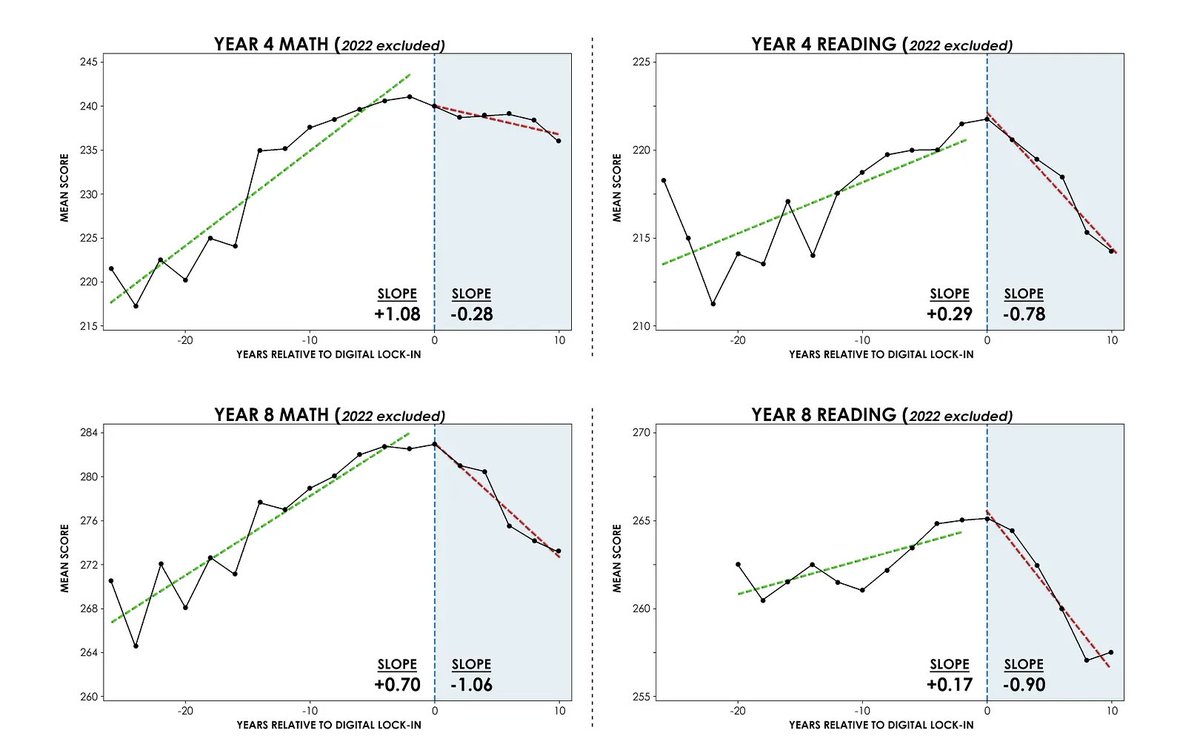
Still more evidence that EdTech harmed American education: Across states, the year that the state imposed mandates requiring computers/tablets, that's the year that test scores stopped rising and in most cases started falling. From Jared Cooney Horvath thedigitaldelusion.substack.com/p/when-correla…
Jonathan Haidt tweet media
English
40
726
2.5K
450.2K
Choate Academic Tech retweetledi
Dr. Sally Sharif
Dr. Sally Sharif@Sally_Sharif1·
I just gave a closed-book, pen-and-paper midterm exam in my 300-level course at UBC with 100 students. All exams were graded by an experienced graduate-level TA according to a rubric. *** The average was 64/100.*** My class averages at UBC are usually 80-85. Context: • This was the first midterm, covering ONLY 4 weeks of material. • Students had a list of possible questions in advance: no surprise questions. • Questions included (a) 3 concept definitions, (b) 3 paragraph-long questions, and (c) a 1.5-page essay. • I have taught this class multiple times. Nothing in my teaching style changed this semester. • We read entire paragraphs of text in class, so students don't have to do something on their own that wasn't covered during the lecture. • Students take a 10-question multiple-choice quiz at the end of every class (30% of the final grade). • Attendance is 95-99% every class. Attention during lectures and participation in pair-work activities are very high → anticipating the end-of-class quiz. *** But unfortunately, I suspect many students are not reading the material on the syllabus. They are asking LLMs to summarize it instead.*** After the midterm, students reported: • They thought they knew concept definitions but couldn't produce them on paper. • They thought they understood the arguments but struggled to connect them or identify points of agreement and disagreement. My view: It might be “cool” or “innovative” to teach students to summarize readings with ChatGPT or write essays with Claude. But we may be doing them a disservice: reducing their ability to retain material, think creatively, and reason from what they know. If you only read what AI has summarized for you, you don’t truly "know" the material. Moving forward: We have a second midterm coming up. I don't know how to convey to students that the best way to do better on the exam is to rely on and improve their own reading skills.
David Perell Clips@PerellClips

Ezra Klein: "Having AI summarize a book or paper for me is a disaster. It has no idea what I really wanted to know and wouldn't have made the connections I would've made. I'm interested in the thing I will see that other people wouldn't have seen, and I think AI typically sees what everybody else would see. I'm not saying that AI can't be useful, but I'm pretty against shortcuts. And obviously, you have to limit the amount of work you're doing. You can't read literally everything. But in some ways, I think it's more dangerous to think you've read something that you haven't than to not read it at all. I think the time you spend with things is pretty important." @ezraklein

English
522
2.5K
16.2K
3.5M
Choate Academic Tech retweetledi
Aakash Gupta
Aakash Gupta@aakashgupta·
The neuroscience here is more damning than the advice. Killingsworth and Gilbert tracked 5,000 people across 83 countries using real-time iPhone sampling. They pinged participants at random moments throughout the day, asked what they were doing, whether their mind was wandering, and how happy they felt. The finding that should change how you think about your own brain: mind wandering explained 10.8% of the variance in happiness. The actual activity you were doing explained 4.6%. What you’re thinking about matters 2.3x more than what you’re doing. And here’s the part nobody talks about. People’s minds wandered to pleasant topics 42.5% of the time. Neutral topics 31%. Unpleasant topics 26.5%. Even when wandering to pleasant topics, they were no happier than when focused on the present. The only state that reliably produced happiness was attention locked onto the current activity. This is a prefrontal cortex problem. Your default mode network activates the moment you disengage from a task. It runs simulations of the future, replays the past, and generates the anxiety you interpret as “I’m lost.” Dr. Fabiano is pointing at the right paper. The mechanism is your brain literally cannot generate satisfaction in default mode. It can only generate rumination. The 2,250 adults in this study averaged 46.9% of their waking hours in mind wandering. Almost half their conscious life spent in a state the data shows makes them unhappy. Training sustained attention on whatever is in front of you right now is the intervention, because the research says that’s the only configuration your brain produces wellbeing in. Your attention is the quest.
Nicholas Fabiano, MD@NTFabiano

You're not depressed, you just lost your quest.

English
42
662
4.8K
380.5K
Choate Academic Tech retweetledi
Alex Smith
Alex Smith@ninja_maths·
For anyone wondering how a third-grader can complete six years' worth of math in a single year. This knowledge graph spans 3,000 math topics, from 4th grade to the university level, providing the perfect basis for mastery learning. Students can go as fast or far as they want! There are no restrictions whatsoever. The only requirement is that they must demonstrate mastery of each topic before moving on to the next. Kids are capable of incredible things when given that kind of freedom and support.
Alex Smith tweet media
Nadja@unrealNadja

Today feels big. My third grader earned another stripe on his BJJ belt and then casually finished the last lesson of his Calc BC course.  This kid, who just over a year ago claimed he hated math, fell in love with the subject when he started @_MathAcademy_. He became thirsty for more and more math. He has been setting his own goals, and they vastly exceeded anything I would have dared set for him.   He finished 6th through 12th grade math in just over a year.  He hates reviews 😂 and loves new lessons. He doesn't like calculations but loves concepts. He takes math notebooks to restaurants so he can toy with proofs while he waits for his food. And he cannot wait for the MA Abstract Algebra course (@ninja_maths, counting on you!)

English
248
1.4K
15.8K
2.4M
Choate Academic Tech retweetledi
Michael Strong
Michael Strong@flowidealism·
If your child becomes a reader, about 80% of the education job is already done. That's my honest assessment after working in education for over thirty years. Everything else is secondary. Most parents think science education is important. Yes it is. But if you can't read the biology textbook, you're not going to learn biology. Reading is the meta-skill that enables all other skills. History requires reading. Science requires reading. Even math increasingly requires reading as it becomes more sophisticated. The child who reads voraciously will figure out everything else. The child who doesn't will struggle with everything.
English
422
4.3K
26.4K
2M
Choate Academic Tech retweetledi
Prof. Carl Sagan
Prof. Carl Sagan@ProfCarlSagan·
Carl Sagan wrote "The Demon-Haunted World" in 1995. We should have paid attention.
English
176
5.1K
16K
465.1K
Choate Academic Tech retweetledi
Carl Hendrick
Carl Hendrick@C_Hendrick·
Most educational apps don't work. Not "could be better." Not "work for some kids." They're architecturally incapable of producing reliable learning. Here's why 🧵
English
23
94
547
74.2K
Choate Academic Tech retweetledi
ivan
ivan@IvanVendrov·
We need "philosopher-builders" - people who can go full stack from articulating philosophical assumptions to coding to observing the code's impact on real communities... then back to update the mistakes in one's philosophy. thanks @cosmos_inst for hosting me - was a fun convo
English
10
16
215
8.7K
Choate Academic Tech retweetledi
Àgbà John Doe
Àgbà John Doe@jon_d_doe·
As a parent, I think this video has taught me something useful. I recommend that you should try it on your kids, too. I have also shared it with my wife. Credit: joe_drummer_boy on IG.
English
735
19.9K
78.2K
3M
Choate Academic Tech retweetledi
Jonathan Haidt
Jonathan Haidt@JonHaidt·
I used to think the main damage from social media was to youth mental health. Now I believe that the global destruction of the human ability to pay attention may be even larger. A meta-analysis shows the damage, to adults as well as teens, from TikTok+ psycnet.apa.org/fulltext/2026-…
Adam Grant@AdamMGrant

Bingeing TikTok reels may be hazardous to your well-being. 71 studies, >98k people: The more short-form videos teens and adults watched, the more they struggled with attention, self-control, and stress and anxiety. Read a book. Watch a movie. Long live longform.


English
193
1.3K
5.6K
752.3K
Choate Academic Tech retweetledi
Zara Zhang
Zara Zhang@zarazhangrui·
A Harvard student told me something I can't stop thinking about. When they go to the library, every single screen has ChatGPT open. Homework that used to take hours now takes minutes. But then they talk to alums who say entry-level roles are basically gone. The jobs they planned their entire college trajectory around don't exist anymore. AI made homework easier but made proving you deserve a job exponentially harder.
English
654
2.3K
22.1K
2.6M
Choate Academic Tech retweetledi
Merriam-Webster
Merriam-Webster@MerriamWebster·
The earliest known example of ‘brain rot’ comes from Henry David Thoreau in his 1854 book “Walden.” “While England endeavors to cure the potato-rot, will not any endeavor to cure the brain-rot, which prevails so much more widely and fatally?”
English
14
321
1.6K
52.3K
Choate Academic Tech retweetledi
Health & Nutrition Tips
Health & Nutrition Tips@healthnutritipz·
Why your child always pick video games over homework - Expert psychologist explains!
English
251
4.1K
17.3K
566.5K
Choate Academic Tech retweetledi
Gary Marcus
Gary Marcus@GaryMarcus·
“AI is the asbestos we are shoveling into the walls of our society and our descendants will be digging it out for generations” - @doctorow, speaking truth and taking no prisoners.
English
31
995
4.6K
77.8K
Choate Academic Tech retweetledi
Alex Prompter
Alex Prompter@alex_prompter·
This is going to revolutionize education 📚 Google just launched "Learn Your Way" that basically takes whatever boring chapter you're supposed to read and rebuilds it around stuff you actually give a damn about. Like if you're into basketball and have to learn Newton's laws, suddenly all the examples are about dribbling and shooting. Art kid studying economics? Now it's all gallery auctions and art markets. Here's what got me though. They didn't just find-and-replace examples like most "personalized" learning crap does. The AI actually generates different ways to consume the same information: - Mind maps if you think visually - Audio lessons with these weird simulated teacher conversations - Timelines you can click around - Quizzes that change based on what you're screwing up They tested this on 60 high schoolers. Random assignment, proper study design. Kids using their system absolutely destroyed the regular textbook group on both immediate testing and when they came back three days later. Every single one said it made them more confident. The part that surprised me? They actually solved the accuracy problem. Most ed-tech either dumbs everything down to nothing or gets basic facts wrong. These guys had real pedagogical experts evaluate every piece on like eight different measures. Look, textbooks have sucked for centuries not because publishers are idiots, but because making personalized versions was basically impossible at scale. That just changed. This isn't some K-12 thing either. Corporate training could work this way. Technical documentation. Professional development. Imagine if every boring compliance course used examples from your actual job instead of generic office scenarios. We might have just watched the industrial education model crack for the first time. About damn time.
Alex Prompter tweet media
English
184
1.5K
8.9K
901.6K