
Chris

2.1K posts

Chris banner
Chris

Chris

@ChrisMercyRa

Katılım Eylül 2015
76 Takip Edilen41 Takipçiler
Chris retweetledi
Dr Rudolf Steiner
Dr Rudolf Steiner@RudolfStein2026·
"What uplifts one soul can crush another. The same principle fire warms or burns depending on the vessel." Truth is not passive. It is not just “information.” It is a force. The same idea, the same experience, the same piece of knowledge; can elevate one person into clarity and strength, while throwing another into confusion, arrogance, or imbalance. Why? Because it doesn’t act in a vacuum. It acts through you. If your inner life is ordered: disciplined thinking, steady will, clean intention - then higher truths become fuel. They strengthen you. But if your inner life is chaotic; driven by impulse, ego, or instability — those same truths become destructive. They don’t build; they distort. This is why real spiritual traditions never begin with “secrets of the universe.” They begin with: Self-mastery Moral discipline Inner structure Because without that, you’re not being “opened”… you’re being overwhelmed. People think more knowledge = more power. But the reality is: More knowledge = more intensity. And intensity amplifies whatever you already are. When truth arrives, will it refine you… or expose you?
Dr Rudolf Steiner tweet media
English
23
77
282
8.5K
Chris retweetledi
🕊️
🕊️@lichthauch·
Things that expose what you actually worship -what you fantasize about on the walk home alone. -what you pretend to hate but check on constantly. -what you read when you cannot sleep. -what you would steal if nobody would ever find out. -what you would lie about under oath. -what you do for free that others do for money. -what makes you feel chosen. -what makes you feel erased. -what you cannot watch without crying. -what you can watch without blinking. -what you do for money that you would never do for love -what you reach for first in the morning, before your eyes open fully -what your mind returns to when pain enters the room. -what you will not give up, even when it is destroying you -what you defend instinctively, even when you know it was wrong -what you sacrifice for silently, without announcement or record. -who you imagine watching you when nobody is. -whose approval would make you finally rest. -whose opinion of you would ruin you, if it was spoken aloud -what you hide from the person you sleep next to tonight. -what you hide from yourself. -what you would trade years for, if God offered you the exchange. -what you would refuse, even if the price of refusal was your life. -what name you whisper when the fear comes, and there is no other witness. That name is your God
English
13
131
1.2K
33.3K
Chris retweetledi
stargazeruk7
stargazeruk7@stargazeruk7·
stargazeruk7 tweet media
ZXX
561
26.7K
158.2K
1.9M
Chris
Chris@ChrisMercyRa·
@I_Am_The_ICT You People are indeed taking things for granted trust me.
English
1
0
0
486
The Inner Circle Trader
The Inner Circle Trader@I_Am_The_ICT·
I can't imagine the toll people are paying emotionally over there. We take the ringing of silence for granted.
English
33
25
880
42.9K
Chris retweetledi
🕊️
🕊️@lichthauch·
Some men rise so high that God has to break their legs to bring them back. and it only shows at the end, when they're crawling, and everybody thinks they fell but they didn't fall. they were cut down. and there is a difference between falling and being felled. God does not warn you. he does not send an angel with a message. he takes the knee first and then you spend the rest of your life on the ground wondering what happened. but he knew all along, because the hunger that made you climb was never yours. it was the serpent's voice telling you higher, higher, and God let you climb because free will is his test and every rung higher was a rung further from him. the men who rise that high don't rise out of pride. they rise out of a void, a void so deep it never fills, and God sees that void and he mourns for you because he knows the fall is coming and he knows you won't understand it when it comes. and it will only show at the end, not in the middle when you still had time to kneel, but at the end when you're finally still, in the quiet room where all your works, all your empire, all your conquests mean nothing. and you look down at your hands and realize they've been holding dust this whole time
English
37
186
1.5K
56.6K
Chris retweetledi
Visio Smaragdina
Visio Smaragdina@SmaragdinaVisio·
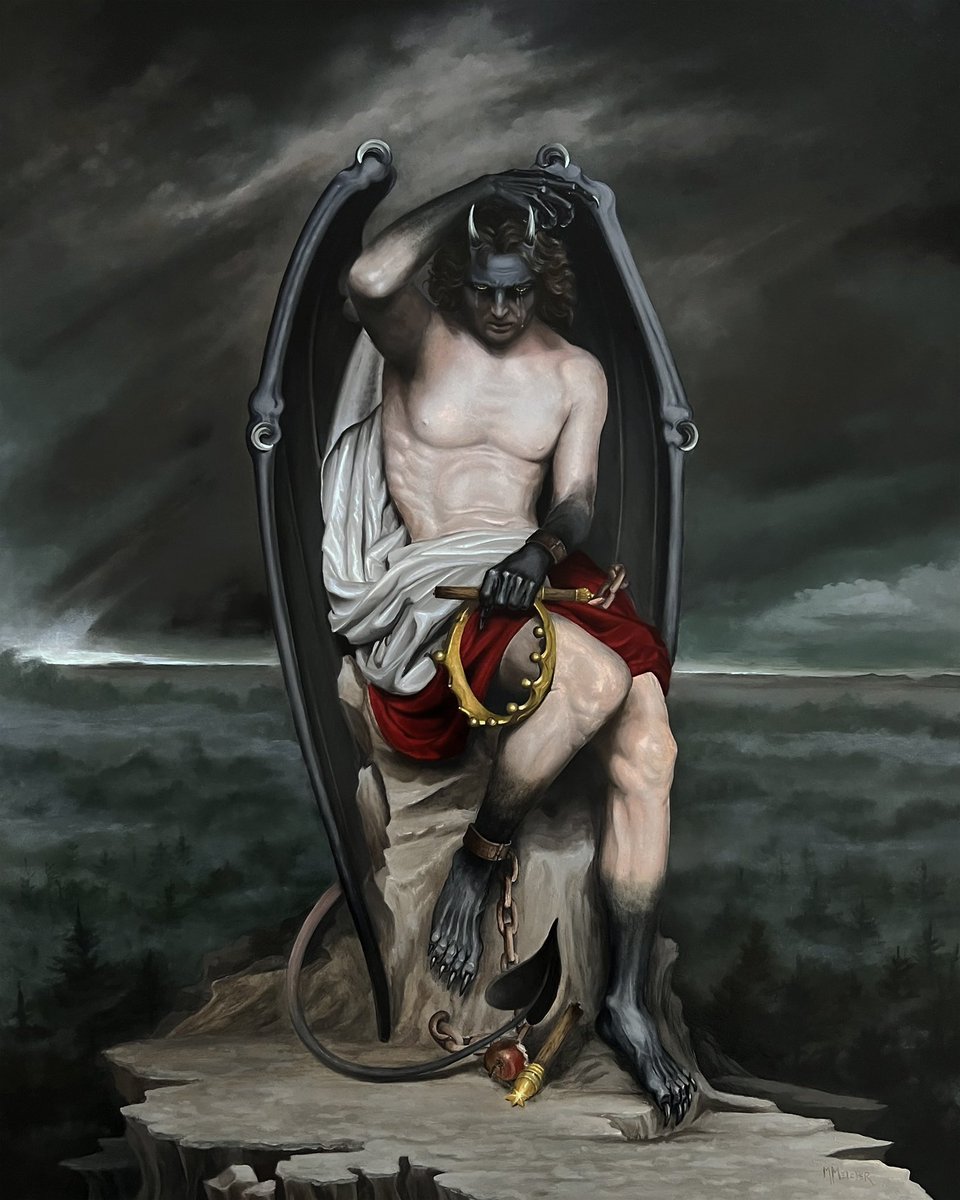
“Our juvenile pride in rejecting any attempt to understand evil is potentially catastrophic. For obviously we cannot manage or control a process we do not understand. This is so self-evident it hurts. We must understand evil, not only abstractly, but intimately. We must grasp what makes an evildoer tick, their outlook, motivations, the psychological rewards they reap from doing evil. We must be able to visit the rooms in the palace of mind that motivate evil acts, without losing ourselves in the process. And yes, I do see the obvious danger this entails—empathizing with evil may tickle dangerous, dormant potentials within us—but it is a risk we must take. For the alternative is to be at the mercy of evil while giving expression to the unfathomable, Promethean forces underlying the primordial lack that drives us.” BERNARDO KASTRUP The Daimon and the Soul of the West (2025). Art: Michele Melcher, 'Withered Pride' (after 'The Genius of Evil' by Guillaume Geefs), 2023
Visio Smaragdina tweet media
English
6
22
169
5.8K
Chris retweetledi
smoothie
smoothie@shedrinkswater·
The most hopelessly romantic women are the least capable of being sluts. When a woman like this falls in love with a man whom she respects and looks up to, the experience becomes physiological, and it reorganizes her body. Something in her softens and tilts towards him, her attention begins to orbit him, she starts breathing him in without noticing, and his presence regulates her nervous system in strange ways. When he walks into a room, her spine straightens slightly, voice lowers, eyes widen, and her body becomes aware of itself in relation to his. Once she has submitted to the idea of him, she begins to become hungry for him in ways that embarrass her own dignity. She wants proximity and leaning into him, watching the rise and fall of his chest, memorizing the cadence of his breathing, breathing in more of his scent, his gestures, the careless way he moves through the day begins to imprint itself into her nervous system. She just studies him. This is unconscious at first, her eyes begin to linger, she notices how he drinks a glass of juice, how his shoulders shift when he laughs, the small pauses in his speech, the way his hands move when he explains something...these details become strange data points that her mind starts collecting and reuminating over. While this all happens, she starts wanting to belong to him in ways that sound degrading if you say them out loud; she wants to be claimed, absorbed, consumed, rearranged by the gravity of his existence. Her ego loosens its grip and lets his presence take over. Part of her watches him and imagines the future where she starts seeing him as the man who could hold her children, whose bloodline would move through her body, while another part imagines something more animalistic about how, on a random Tuesday evening, he pulls her close without warning and presses his lips and himself against her. She starts being more devoted to him physically when her gaze lingers too long, her body leans towards him even when she is trying not to, her attention stays fixed on him, and there is something indecent about the degree to which she wants him. And the society's language finds ways to make this sound crude by using words like possession and belonging, which just gesture towards a psychological truth that rarely holds any weight in these cases. She just wants to be everything for him.
rosie@yoonb1ko

normalize being a slut and a hopeless romantic at the same time

English
36
189
1.9K
136.3K
Chris retweetledi
Zherka
Zherka@ZherkaOfficial·
Every morning of your life should start with a deep meditation and then a walk in nature. Be with yourself until that religious feeling arises where you look forward towards eternity. Once your thought forms are pure and your self remembering begins, you can now reward yourself with computer and iphone. Go make money in an ethical way and return to the religious feeling before your bedtime prayer. This keeps the nervous system only stressed in the middle of your day, your intentional suffering. This keeps you young and healthy. Always knowing who to meet and where to go.
English
25
108
1.4K
37.5K
Chris retweetledi
🕊️
🕊️@lichthauch·
Every man who reads too many books before he has lived goes mad in a specific way. first he is gentle because books are gentle. then he is arrogant because books make him feel superior to the unlettered. then he is desperate because he knows everything and can do nothing. then he is finally dangerous because he takes his first real beating from life and realizes all his knowledge did not protect him and now he must rebuild everything from the ground
English
211
1.1K
7.9K
350K
Chris retweetledi
Aakash Gupta
Aakash Gupta@aakashgupta·
The reason this feels so good is because your brain was taxing you for a week straight and you didn’t even notice. Every time that undone task crossed your mind, your anterior cingulate cortex fired a conflict signal. Small. Subtle. But metabolically expensive. Your brain was running a background process on that 5-minute task 24/7 for 7 days, burning glucose and generating low-grade cortisol each time it surfaced. Neuroscientists call this the Zeigarnik Effect. Incomplete tasks occupy more mental RAM than completed ones. Your brain literally cannot let go of open loops. So that “5 minute task” was never 5 minutes. It was 5 minutes of execution plus 168 hours of ambient cognitive load. That relief you feel when you finally do it? That’s a dopamine spike from closing the loop combined with a cortisol drop from removing the threat signal. Your body just stopped paying a week-long neurochemical tax on a debt of 300 seconds. This tells you everything about how procrastination actually works. The loop runs like this: task feels slightly aversive → amygdala flags it → you avoid it → avoidance provides immediate relief → brain learns avoidance = reward → task stays open → background stress accumulates → task feels MORE aversive than it originally was. The fix is stupidly simple and Huberman talks about this constantly. You don’t need motivation. You need a forcing function that bypasses the amygdala’s threat assessment. Set a timer for 90 seconds. Tell yourself you’ll stop after 90 seconds. Your prefrontal cortex can override 90 seconds of discomfort. Once you start, the dopamine system switches from avoidance to pursuit, and the task completes itself. The 5-minute task was never hard. The starting was hard. And every hour you waited made starting harder.
bridget@pacinocrave

just finished a 5 minute long task I could have done a week ago

English
73
2.2K
16.5K
635.8K
Chris retweetledi
Dr Rudolf Steiner
Dr Rudolf Steiner@RudolfStein2026·
Reincarnation isn’t a decorative spiritual belief or a myth meant to comfort people about death; it’s presented as the structural law behind human evolution itself. The “I,” the enduring center of identity, is not finished in one lifetime because one lifetime is far too narrow to exhaust the possibilities of growth. A single biography gives you one culture, one temperament, one historical moment, one set of challenges. That’s not enough to shape a being capable of genuine freedom and wisdom. If humanity evolves across ages; intellectually, morally, culturally — then the individual must evolve with it. The same Ego re-enters the stream of history again and again, not randomly, but to absorb the new conditions each epoch offers. In one life it encounters a more instinctive world; in another, a world of sharpened logic; in another, a world of technological abstraction. Each period imprints something different. The soul becomes layered; not just psychologically, but historically. From this perspective, talents, inclinations, even moral struggles are not isolated accidents of genetics or upbringing. They are the continuation of unfinished work. What appears as “natural ability” may be the ripened fruit of effort carried across centuries. What appears as irrational fear or resistance may be the shadow of past imbalances still seeking resolution. Reincarnation, then, explains why growth feels cumulative. Why certain ideas feel instantly familiar. Why moral development often feels like remembering rather than learning. The Ego is not built from scratch each time; it gathers, integrates, refines. Life becomes less a one-time test and more a long-form education in becoming fully human. And most importantly: evolution is not just biological. It is spiritual and conscious. Humanity as a whole moves upward through epochs, and the individual participates in that ascent through repeated earthly lives. Without reincarnation, history would educate the species but not the person. With reincarnation, history becomes the classroom of the soul.
Dr Rudolf Steiner tweet media
English
12
57
242
8.7K
Chris retweetledi
🕊️
🕊️@lichthauch·
The people who make it to the top of anything are running from something or toward something with a force that normal people do not have access to. and you can call it drive but drive is what normal people have. this is different. this is a hole that cannot be filled and they discovered that achievement numbs it temporarily so they achieve and achieve and achieve and the hole is still there the grind content is a joke. you cannot learn this. you cannot motivate your way into this. the people posting about discipline have a manageable relationship with rest. the real ones cannot rest. rest is where the thing that is wrong with them lives. so they keep moving this is a warning. do not envy them. they are in a prison that looks like a palace and most of them know it
English
52
282
2.3K
70.5K
Chris retweetledi
Visio Smaragdina
Visio Smaragdina@SmaragdinaVisio·
“The devil is the sum of the darkness of human nature. He who lives in the light strives toward being the image of God; he who lives in the dark strives toward being the image of the devil. Because I wanted to live in the light, the sun went out for me when I touched the depths. It was dark and serpentlike. I united myself with it and did not overpower it. I took my part of the humiliation and subjugation upon myself, in that I took on the nature of the serpent. If I had not become like the serpent, the devil, the quintessence of everything serpentlike, would have held this bit of power over me. This would have given the devil a grip and he would have forced me to make a pact with him just as he also cunningly deceived Faust. But I forestalled him by uniting myself with the serpent, just as a man unites with a woman.” CARL JUNG The Red Book Art: Jose Gabriel Alegria Sabogal
Visio Smaragdina tweet media
English
25
118
731
24.8K
Chris retweetledi
🕊️
🕊️@lichthauch·
May your children outlive your mistakes. may the ones who hurt you be healed so you can finally put the knife down. may you find the one who stays when staying costs them something. may your father's silence make sense before he dies. may you want what you already have before you lose it. may your prayers be answered in ways you will not recognize until later. may the version of you that gave up in another timeline forgive the version that kept going. may your enemies be wrong about you. may your body hold until your purpose is finished. may you be loved by someone who knows what you almost became and does not hold it against you. may the light find you when you have stopped looking for it. may you be blessed in the way that breaks you open not the way that keeps you closed. may God see you. may that be enough. may you survive being seen.
English
31
140
838
21.8K
Chris retweetledi
Layton Elyas
Layton Elyas@origina1ange1·
This is absolutely true. Those who have the most grace and compassion for other people are also those who understand the weight of grace because they understand their own potential for failure, pride, selfishness or narcissism. The most dangerous person is not the person who is aware of their lower impulses, but rather, the one who denies them altogether. On the surface, we may claim to be agents of love and compassion, but these claims fall flat once we excuse our own wrong actions out of bypassing or dissociation while actively crucifying another for theirs. Judgment happens when we view our own mistakes as some kind of lucrative spiritual journey while simultaneously treating others as though their mistakes mark their destination. When I have been guilty of this, I feel the weight of it deeply and the impact of my judgment propels me into growth and change. We often seek to hide our failures or run from our mistakes because facing them, or being honest about them, means that we may be faced with judgment, criticism or rejection. Pride is a false safehouse, imprisoning us in our own isolation and delusion. Liberation comes when we can own so much of ourselves that admitting “failure” is merely a catalyst into deeper love and transformation, and a mechanism for more intentional connection. I am not worried about my “image.” Maybe I should be, but my image— though the foundation for my financial security— is not even half as valuable to me as my integrity. A major issue we face today as citizens of this broken society is the fact that public trust of an individual often comes before the individual has developed self-trust. The hallmark of self-trust is not merely the public’s perception of stability…..it must be founded on an inner stability that can only come into form through self-honesty. If a leader or teacher is unable to face their own shadow and own their own mistakes, they will be incapable of initiating humanity into a phase of deeper accountability and truth via their own example. May we all use this information to engage with the world as explorers and students— choosing to learn from ourselves and others instead of rushing to judgment or closing ourselves off from connection out of a fear of being seen as “imperfect.” May we be responsible in our discernment, and use our clarity as a vehicle for compassion and an agent of change instead of as a weapon. ✨❤️ Reposting from @francescapsychology on Instagram.
Layton Elyas tweet mediaLayton Elyas tweet mediaLayton Elyas tweet mediaLayton Elyas tweet media
English
1
1
35
699
Chris retweetledi
Laura London
Laura London@jungianLaura·
#Jung: “Our psychic abilities are so great that they can properly utilize and arrange an incredible number of factors. The more factors that come into question, the more #intuitive the solution must be. But even the ordinary mind must survey far more than what a computer would be able to solve. We have an #unconscious that is more or less fitted to incredible multiplicities of factors. So when the unconscious with its subliminal perceptions meets #conscious comprehension, then the ability to comprehend is directly unimaginable. The unconscious can give us information that exceeds all probability: clairvoyance, precognition, #dreams that come true, and so on. We have in the unconscious a reservoir of subliminal perceptions that we—under favorable circumstances—also have at hand to us for our use. Or that press into #consciousness through dreams, for example. Factors come into consideration that we cannot recognize. These are things that we have never once conceived: without hope of any sort of answer, maybe one lets a question run through one’s head, and the unconscious responds perhaps in a dream. If one wished to build a computer for such perception it would have to be the size of half the world. I would say that the most overt analogy between cosmos and psyche is this: just as we have a sun that illumines the world of the earth, in the same way we have an I-consciousness that illumines the surface of the psyche. But as our sun orbits within a massive system of suns, in the same way our consciousness is only one of billions of living consciousnesses.” ~C.G. Jung, Interviews: December 13, 1957, Jung’s Life and Work: Interviews for Memories, Dreams, Reflections with Aniela Jaffé, Edited by Sonu Shamdasani (Ep. 75) with Thomas Fischer (Ep. 101) as Consulting Editor, pp. 254-255 📗: Jung’s Life and Work is now available from Amzn US | *aff link: amzn.to/4htg8or 📷: Interview mit C.G. Jung in Küsnacht (Carl Gustav Jung), Schweizer Psychiater, Tiefenpsychologe | Comet Photo AG (Zürich) 1955 | © ETH Library Zürich, Image Archive / Com_L04-0084-0026 | Free download and use.
Laura London tweet media
English
7
41
232
9.8K
Chris retweetledi
NeoSpirituality
NeoSpirituality@neospirituality·
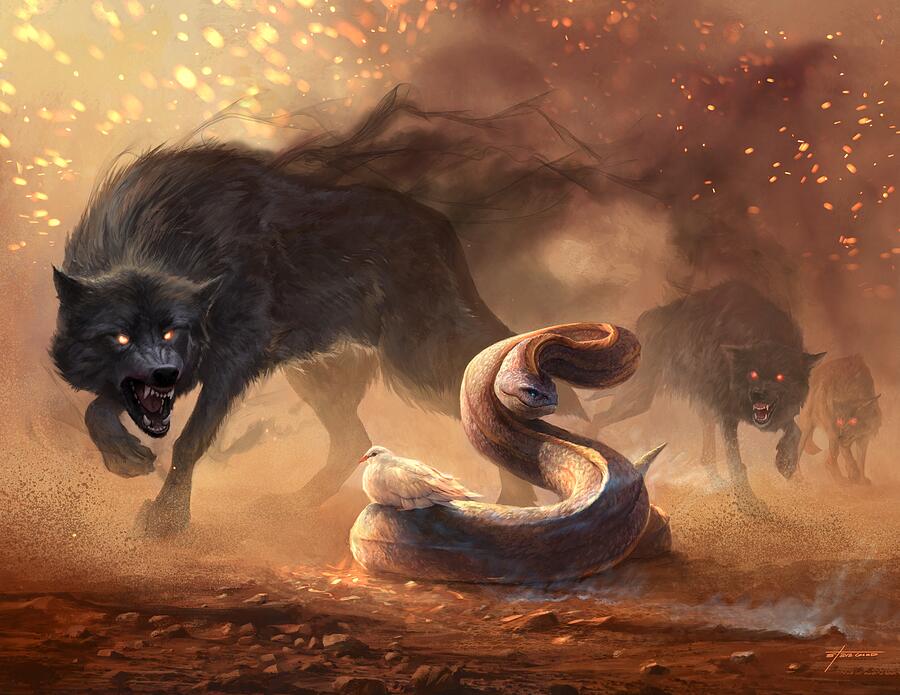
YOU NEED BOTH WINGS If you seek true Enlightenment, you cannot fly with one wing. You must master both the Yang and the Yin. YANG: The Solar Path * Practices: Meditation, Wisdom, Prayer, Surrender, Divine Visualization. * Function: This connects you to the Source. It builds vibration. It reminds you of your Divinity. YIN: The Lunar Path * Practices: Shadow Work, Trauma integration, feeling with compassion and empathy. * Function: This grounds the Source into Matter. It clears resistance. It helps you enjoy your Humanity and bodily experience. When imbalanced, you become (All Yang) a "Love and Light" zombie. You float in the astral clouds, ungrounded, financially unstable, and denying your own darkness until it explodes as sickness. All Yin, you dwell in the shadows. You become obsessed with your own brokenness. You drown in therapy, plant medicine and "processing" but never actually rise. Behold, I send you forth as sheep in the midst of wolves: be ye therefore wise as serpents, and harmless as doves." ​— Matthew 10:16 ​You are in the Matrix (Wolves). To survive, you cannot just be the Dove (Yang/Purity/High Frequency). You must also be the Serpent (Yin/Earth/Aware of the Dark). The Dove flies; the Serpent grounds. The Master is both.
NeoSpirituality tweet media
English
16
70
368
13.8K
Chris retweetledi
NeoSpirituality
NeoSpirituality@neospirituality·
One of the greatest spiritual violation is not actually "sin" in the religious sense, but adharma - when you betray YOUR OWN essential nature. When you deny/hide your OWN truth to make yourself 'acceptable' to others, you commit an act of Cosmic Vandalism. You are effectively telling God that there was an error in your creation. ​Every concession to external pressure that violates your own intuition and internal truth hurts your aura, lowers your vibration and breaches your energy field. To betray the Self is to close the door against divinity, for God can only enter through the gate of Authenticity. TLDR. Take care of yourself first. Love yourself first. Exalt yourself first. THEN love others just as you love yourself
NeoSpirituality tweet media
English
10
36
227
7.1K
Chris retweetledi
no.mind
no.mind@the_no_mind·
Albert Szent-Györgyi won the Nobel for vitamin C. Then he walked away from vitamins. Toward physics. Chasing one question: What keeps living matter alive when everything else falls apart? If you understand Szent-Györgyi, you understand health & disease. And why modern medicine still gets it backwards. What he found overturns decades of assumptions about energy, disease & life itself: 1. Life runs on electrons, not calories 2. ATP is a transformer, not fuel 3. Proteins + water = one machine 4. Two ways of living: aerobic (ordered) vs anaerobic (primitive) 5. Cancer is a regulatory failure, not genetic 6. Disease is failure of one system, appearing as many symptoms Let's start with the paradox he saw first: 1. The Human Paradox — What He Saw First Szent-Györgyi started with a contradiction no one in biology could explain. In physics, everything tends toward maximum stability. That state is defined by: - minimum free energy (the energy available to do work) - maximum entropy (randomness or disorder) Once a system reaches this point, all change stops. That is physical stability. In biology, it means death. Living systems behave in the opposite way. By establishing a specific pattern, living matter acquired the ability to increase its own free energy & decrease its own entropy — at the expense of its surroundings. Szent-Györgyi called this "biological stability." The maximum of biological stability occurs at the maximum of free energy & order — the opposite of physical stability. The further a living system is from physical equilibrium, the more alive it is. This creates a fundamental tension: life is bound to a material pattern that always tends to deteriorate. Survival depends on correcting the damage. Because this correction is never perfect, life must be finite. Then he saw something even stranger: Life improves with use. ​ Dead matter breaks with use. A resting muscle weakens. ​ A used muscle strengthens. A resting machine stays intact. ​ A used machine wears out. He summed it up simply: "If you use your car too much it becomes worn out, while if you walk your legs become stronger." Nothing in classical biochemistry could explain this behavior — how living matter creates, maintains & increases order while the physical world collapses into disorder. This was the paradox he set out to solve. 2. Life Runs on Electrons, Not Calories Szent-Györgyi didn't think life ran on calories. He thought life ran on electrons: He wrote: "Life is driven by electrons, by the energy given off by these electrons while cascading down from the high level to which they have been boosted up by photons." To him, a molecule was: - a cloud of electrons - held together by nuclei So its energy could only be electronic energy. He explained it with a simple analogy: "Strictly speaking, an electron, in itself, has no energy, as water has no energy. Water can give off energy when it drops from a higher to a lower level, say from the top to the bottom of Niagara Falls. Similarly, the electron can give off energy & drive the living machine by dropping from a higher to a lower energy level." Electrons boosted to high levels, then allowed to fall, release usable energy. An electron in motion is a current. Life is a system built to keep those currents flowing. He sharpened it even further: "What drives life is a little electric current, kept up by the sunshine. All the complexities of intermediary metabolism are but lacework around this basic fact." (1) Hydrogen Is the Fuel of Life Before explaining how energy is captured, Szent-Györgyi stripped the problem down to its simplest form. Underneath all metabolism is one transaction: Hydrogen donates an electron. ​ Oxygen accepts it. He wrote: “The foodstuff is essentially an H donor while O₂ is an ‘H acceptor.’ H is the fuel of life.” This is exactly what is called “Redox” (short for oxidation-reduction). Reduction = gaining an electron ​ Oxidation = losing an electron Nothing more. That raises the real question: why hydrogen & oxygen? Why Hydrogen Szent-Györgyi started with the periodic table. ​ All atoms “want” the stability of the nearest noble gas — elements that do not normally enter chemical reactions because their outer electron shells are complete. ​​ Szent-Györgyi used this metaphor deliberately: “Atoms share the human foible of wanting to belong to the nobility.” All atoms tend toward noble-gas stability: - elements on the left of the periodic table do so by giving off electrons - elements on the right do so by taking up electrons Hydrogen is exceptional. It consists of just one electron & one proton. ​ It has one unbalanced electron, held loosely, at an unusually high energy level. He wrote: “The H has but one unbalanced electron which it gives off rather easily… The energy of this electron is the fuel of life.” When hydrogen gives up its electron, it becomes H⁺, a proton. ​ That proton requires no special handling. It merges directly into the proton pool of water, the solvent of life. Why Oxygen Completes the Circuit Electron donation alone does nothing unless there is a place for the electron to go. ​ Life still needs an element that can receive them. That role is played by oxygen. On the periodic table, oxygen sits on the right side — among elements that tend to take up electrons in order to reach noble-gas stability. ​ When an electron moves from hydrogen to oxygen, it falls from a high to a low energy level. That drop releases energy. Szent-Györgyi called oxygen “the best choice” because it satisfies a precise requirement: ​ It accepts electrons strongly enough to release usable energy, but not so violently that it destroys the structures of life. Why didn’t life choose a stronger acceptor like fluorine? Because fluorine is too reactive. It would pull electrons so aggressively that organic molecules could not survive the transfer. Oxygen is different. It allows the energy drop to occur without tearing the system apart. The Consequence When hydrogen donates & oxygen accepts, energy is released. The cell does not allow this energy to collapse immediately into random heat. It channels it into excited electronic states E*, where it can perform work. Different foods enter the system in different forms, but they all converge on the same end point: ​ ​Electrons delivered to oxygen, one step at a time. Life runs on single electrons moving through a regulated physical system — not on calories. (2) Photosynthesis & Its Reversal — The Universal Energy Cycle Szent-Györgyi saw that all of life's energetics reduced to two processes: Photosynthesis & its reversal. In photosynthesis: - sunlight excites electrons in chlorophyll → creating E* (excited electronic state) - that excited energy is stabilized & stored step-by-step as chemical bonds - eventually becoming food (carbohydrate) He symbolized it like this: hv → E* → (E₁) → (E₂) → (E₃) → (Eₙ) Where: - hv = a photon of light - E* = excited electron - (E₁), (E₂), (E₃)... = energy stored in chemical bonds, step by step - (Eₙ) = final stored energy (food) The reverse happens when organisms consume food: (Eₙ) → (E₃) → (E₂) → (E₁) → E* → work Stored energy is released step-by-step, eventually becoming E* again — the excited electron that does the work of life. A firefly makes this visible in an even purer form: (Eₙ) → (E₃) → (E₂) → (E₁) → E* → hv It releases stored energy as light — the same light plants captured to create that energy in the first place. He concluded: ​ ​"The energetics of the living world consist of only two processes: photosynthesis & its reversal." Plants capture light & store it as chemical energy. ​ Animals release that energy as electronic excitations. Same physics. Opposite directions. 3. ATP Is a Transformer, Not Fuel Food doesn't power life directly. ​ Food stores energy in chemical form. ATP's job isn't to release energy directly into biological action. ​ Its job is to transform stored chemical energy into a form the cell can use — an excited electronic state he calls E*. He compared this to an atomic bomb: Sitting on top of an atomic bomb while its energy is locked in bonds — you're safe. The potential energy has no outward action. But when those bonds break & exchange their potential for active, mobile forms of energy — you won't remain sitting on it for long. The difference between potential & active energy isn't academic. ​ It's the difference between locked & unleashed. ATP works the same way: while energy is stored in the phosphate bond, it's locked. ​ When the bond breaks & that energy becomes electronic excitation E* — it can drive biological work. ATP has two functional ends: - phosphate end = holds compressed chemical energy (E) - purine (adenine) end = may participate in creating E*, the electronic end Szent-Györgyi hinted at this design: "The molecule has two ends: a phosphate-end & a purine-end. The phosphate-end represents (E); one may ask whether the purine-end may not represent E*, thus providing the molecule with the essential parts needed for the (E) → E* transformation." Meaning: ATP transforms energy. ​ ​ ​E* is the real energy currency. 4. Proteins + Water = One Machine For Szent-Györgyi, the problem was never just where energy comes from. It was deeper: ​ ​What physical system can even handle an excited electron E* without chaos? Classical biochemistry had no answer because it treated life as a liquid beaker — molecules floating in water, colliding at random. That model cannot support long-lived electronic excitations. Szent-Györgyi saw something else entirely. Life behaves like a solid-state system built from three inseparable components: proteins, water & the electromagnetic field. (1) Proteins Are Semiconductors He did not treat proteins as passive scaffolds. ​ He treated them as electronic materials. He wrote: ​ ​"Proteins are semiconductors." Meaning: - they conduct electrons - they do so in ordered pathways - they lose little energy in the process This matters because E* — an excited electron — cannot survive in a chaotic environment. Random collisions destroy it. E* needs structure. It needs direction. Proteins provide those pathways. (2) Water + Proteins = One Functional System Mainstream biology treated water as an inert background. Szent-Györgyi considered this a fundamental error. He wrote: ​ ​ "Water is not only the mater, mother, it is also the matrix of life." And: ​ ​"Biology may have been unsuccessful in understanding the most basic functions because it focused its attention only on the particulate matter, separating it from its two matrices, water & the electromagnetic field." Water near biological solids does not behave like ordinary liquid water. ​ Near proteins & membranes, it forms extended ordered structures. This ordered water is not passive — it is part of the living machinery, creating physical conditions that do not exist in bulk liquid water. The division of labor is precise: Electronic excitations propagate in proteins, not in water. ​ ​ ​Protons move through water, not through proteins. He wrote: "The protein–water system generates excitations; water alone cannot do this." Neither works alone. Proteins provide the solid framework for electronic activity. ​ Water provides the ordered medium that supports charge movement & structural stability. He put it simply: ​ ​"Life is water dancing to the tune of solids." And: ​ "Water forms one single unique system with structural elements in which electronic excitations become possible." Biological function was not just chemistry. It was the continuous building & destruction of water structures as part of the living machinery itself. After decades of work, he concluded: “Water is part & parcel of the living machinery, if not the hub of life.” (3) The Electromagnetic Field Completes the System One matrix remained missing from biology's model. ​ The electromagnetic field. Lucretian biochemistry — the idea that molecules must physically touch to interact — could not explain living behavior. Szent-Györgyi rejected it. He wrote: ​ ​"Manifold interactions can take place without such bodily contact, either through energy bands or through the electromagnetic field." Together, structured water & the electromagnetic field form a reaction space where: - excitations can move - influence structure - propagate without collisions The field does not replace proteins or water. It connects them. It was the final part of the machine. 5. Two Ways of Living: Aerobic (Ordered) vs Anaerobic (Primitive) To understand life's energy system, Szent-Györgyi drew a sharp line between two modes of existence. He didn't see oxidation & fermentation as "different pathways." He saw them as different ways of being alive. One primitive. One structured. ​ Each with its own physics. (1) Fermentation: The Primitive Mode Fermentation means energy production without oxygen. In Szent-Györgyi's framework, fermentation belongs entirely to classical chemistry. ​ ​Energy is handled as bond energy, through local group-transfer reactions, without excited electrons E* or quantum behavior. Fermentation was the older form of life. He described it as a process that requires no structure: - no ordered solids - no structured water - no perturbed electromagnetic field (a small disturbance that changes how electrons behave) It survives without the machinery needed for higher life: "Fermentation is based on group transfer reactions which demand no structures." This is why cells fall back into fermentation during proliferation. It's the simpler mode. ​ The ancestral one. (2) Oxidation: The Structured, Higher Mode Oxidation, to him, was something entirely different from fermentation. Oxidation, by contrast, operates in a different regime altogether — one that depends on ordered structure, long-lived electronic excitations rather than bond rearrangements. It required: - ordered solids - structured water - a perturbed electromagnetic field He wrote: ​ ​"Oxidation is bound to structure." Only structured systems could support the handling of excited electrons that oxidation generates. Only those structures could build the extensive water organization required to manage long-lived energy states. This was a different physics. Oxygen's Real Role — It Perturbs the Field Oxygen's real role is to change how electrons behave. O₂ has unpaired electrons — a property called paramagnetism. That means oxygen slightly disturbs the electromagnetic environment around it. That disturbance matters because it changes the kind of excited states electrons can enter. Why That Disturbance Matters When an electron is excited, it can exist in two basic states. One is short-lived. One lasts long enough to matter. - Singlet: a brief flash of energy that collapses almost immediately - Triplet: a longer-lived excited state that can store energy & move through structure This difference is everything. A singlet disappears before it can do organized work. A triplet lasts long enough to be used. But triplets don't form automatically — even with oxygen. They require structured water. Szent-Györgyi discovered something remarkable: When water freezes into ordered structures, it transforms how electrons behave. Fluorescent dyes that emit brief flashes in liquid water suddenly emit long-lasting light when frozen — because electrons enter triplet states. He wrote: "Water has brought about a profound change in the excitational states... making forbidden transitions into probable ones." This wasn't theory. It was observable: Freeze a solution of riboflavin in pure water — no light. Freeze it in the presence of oxygen — it glows orange (phosphorescence from triplets). The combination of oxygen's magnetic disturbance + water's ordered structure makes triplet excitations not just possible, but probable. Why Life Needs Triplets Complex life cannot run on flashes. It needs energy that can persist, move directionally & coordinate structure over time. Triplet excitations make that possible. Singlets are fireworks. Triplets are batteries, switches & signals. (3) The Takeaway Oxygen enables the kind of energy life needs. ​ But oxygen alone isn't enough. Aerobic life requires: - oxygen (to perturb the field) - structured water (to stabilize triplets) - ordered proteins (to conduct the excitations) Together, they create the conditions where triplet excitations — long-lived, mobile, usable energy — become the foundation of complex life. Without oxygen, energy exists only as short flashes. With oxygen + structure, energy becomes organized, mobile & usable. That single shift is what separates fermentation from oxidation — & simple survival from complex life. 6. Cancer Is a Regulatory Failure, Not Genetic Every cell has an innate tendency to multiply. The real question is not why cancer proliferates, but what keeps a normal cell from proliferating all the time. "What retarded cancer research was that the suffering it causes made us put the cart before the horse — searching for a cure before an understanding. But cancer, like diabetes, is one of those faults of Nature that allows a deeper insight into the mechanisms of life." Szent-Györgyi believed every cell lives in two fundamental states. Not metaphorically. Physically. Two modes with different energy handling, different structure, different logic. (1) The α State The α state is the primitive mode. He described it as: - anaerobic - proliferative - dedifferentiated - low structure It is shared by embryonic tissue & cancer cells. A cell in α dissolves part of its ordered machinery. It returns to the simpler, older way of living—the fermentation-based mode that requires no structured water, no solid-state organization & no perturbed field. He wrote that the properties of dividing cells match this state: "Dividing cells being in the α state, they have to share the properties of this state: the lack of color, free radicals, fetal proteins & low electron spin resonance signals." In α, the cell prepares to multiply. ​ Everything else is secondary. (2) The β State The β state is the differentiated mode. He described it as: - aerobic - structured - dependent on electron transport - requiring structured water & the perturbed field This is the state of a mature, functioning cell. High organization. High negative entropy. Stable electron flow. In β, the cell expresses its identity. (3) Life = Reversible Switching Between α & β To him, the essence of life was the ability to move between these states when necessary. Division required a temporary return to α. But after division, the cell had to rebuild order, restore structure & return to β. He wrote: "Division is, in a way, a repetition of the evolutionary development." When the system is healthy, the switch is reversible. (4) When Reversal Fails If cells are intermittently deprived of oxygen, they adapt by shunting back to the anaerobic proliferative state, discarding the mechanism of biological oxidation. If this change becomes permanent, the cells will be unable to return to the aerobic way of living. Cancer develops. For Szent-Györgyi, cancer wasn't a genetic mystery, it was a state problem. He used a simple analogy: "The cancer cell is comparable to a car parked on a slope. If it starts moving one does not ask, 'What drives it'?, but asks, 'What has gone wrong with the brake'?" Proliferation is an attribute of life. The failure lies in the disturbance of the regulatory mechanisms. (5) Cancer Isn't Many Diseases He rejected the idea of cancer as hundreds of separate conditions. He wrote: "Cancer is but one disease: the disturbance of the regulatory mechanisms." Different organs, different presentations, same root: a cell that can't regain order. Cancer cells share the properties of the α state: anaerobic energy production, dedifferentiation, low structure, fetal protein expression, loss of normal color, free radicals, low electron spin resonance signals. He described cancer as a cell: "Stuck in the α state, or somewhere between the two basic states, α & β." It's not the rate of proliferation that makes cancer dangerous. Other tissues proliferate faster. What makes cancer dangerous is that the cell cannot stop. It has lost "the wisdom of the body." Electron Transport Collapse He observed something visible to the naked eye. Normal liver tissue proteins are brown. Cancer tissue proteins are colorless. The color comes from a functioning electron transport chain. No color = no electron transport. But when he treated cancer proteins with an electron acceptor, the color returned to normal levels. This meant: - proteins themselves were still there - structure hadn't fundamentally changed - electron transport system had simply stopped working - failure was at the level of electron flow, not DNA The Nature of a Chain Why can't the cancer cell rebuild its electron transport chain? What complicates this is the nature of a chain. A chain is an indivisible unit. If any single link breaks, the entire chain becomes inoperative. This makes the electron transport system a "package deal": - Break one part → the whole system fails - One failure → triggers cascading failures This explains why cancer can be caused by many different factors but always produces the same result: - loss of electron transport - stuck in α state - uncontrolled proliferation Different triggers. Same failure mode. The Shift From Aerobic to Anaerobic Becomes Fixed He described carcinogenesis as two steps: Physiological step: A temporary shift from aerobic β → anaerobic α (the same shift required for division) Pathological step: The α state becomes constitutive. Irreversible. The cell loses the ability to rebuild structure even if oxygen is reintroduced. He wrote: "The anaerobic state & proliferation are coupled. If this anaerobic state lasts too long or is induced repeatedly, the proliferative anaerobic state may become constitutive." He noted an observation by H. Goldblatt & G. Cameron (1953): temporary oxygen deprivation can induce malignant transformation. If repeated, the cell adapts to the anaerobic state & loses the ability to return to β—even when oxygen is restored. This is the core of his cancer model: proliferation isn't the cause. Proliferation is what happens when the regulatory system collapses & the cell gets stuck in the ancestral mode. In his framework, cancer isn't a deviation. It's a reversion—a fallback into a simpler architecture when the machinery of higher life breaks. The problem isn't growth. It's the loss of the ability to stop growing because the cell can no longer rebuild the β state. This reframes cancer therapy entirely. ​ ​“Until now, cancer was looked upon as a hostile intruder to be eliminated. But it might also be looked upon as a cell in trouble — one that needs help to return to normal.”​ ​ Cancer, then, becomes the ultimate evidence for his larger claim: Life depends on structure, order, electron transport & regulation between states—not on chemical fuel alone. 7. Disease Is Failure of One System, Appearing as Many Symptoms Szent-Györgyi believed the same principle applied beyond cancer. He wrote: "If the foundations of normal life are simpler than its appearances, then the same may be true also for disease & a great variety of symptoms can be caused by disturbance of single basic mechanisms." He added: "The way in which disease declares itself may have no direct relation to the underlying cause." Vitamin B₁ is equally important for all cells, yet its deficiency causes polyneuritis — a nerve disease. Withhold certain fatty acids from a rat's diet & its tail drops off. It would be wrong to conclude the biological function of these acids is to keep tails in place. Different diseases. Different symptoms. Disturbance of a single basic mechanisms. What looks like a hundred separate conditions may be one system breaking in different places. Bottom Line For Szent-Györgyi, life was not defined by molecules, pathways, or reactions. It was defined by order — the ability of living matter to resist entropy. That order arises from one physical system: Structured proteins, organized water, excited electrons E* & the electromagnetic field acting as a single machinery. Life works when a cell can maintain its structure, its excitations & its regulatory balance. Disease begins when it can't. Disease is not many unrelated problems. It is the breakdown of this single living machinery, declaring itself as different symptoms. That was the foundation he believed modern biology missed—the physical system that keeps living matter alive in a world where everything else falls apart.
no.mind tweet mediano.mind tweet media
English
51
210
848
74.5K