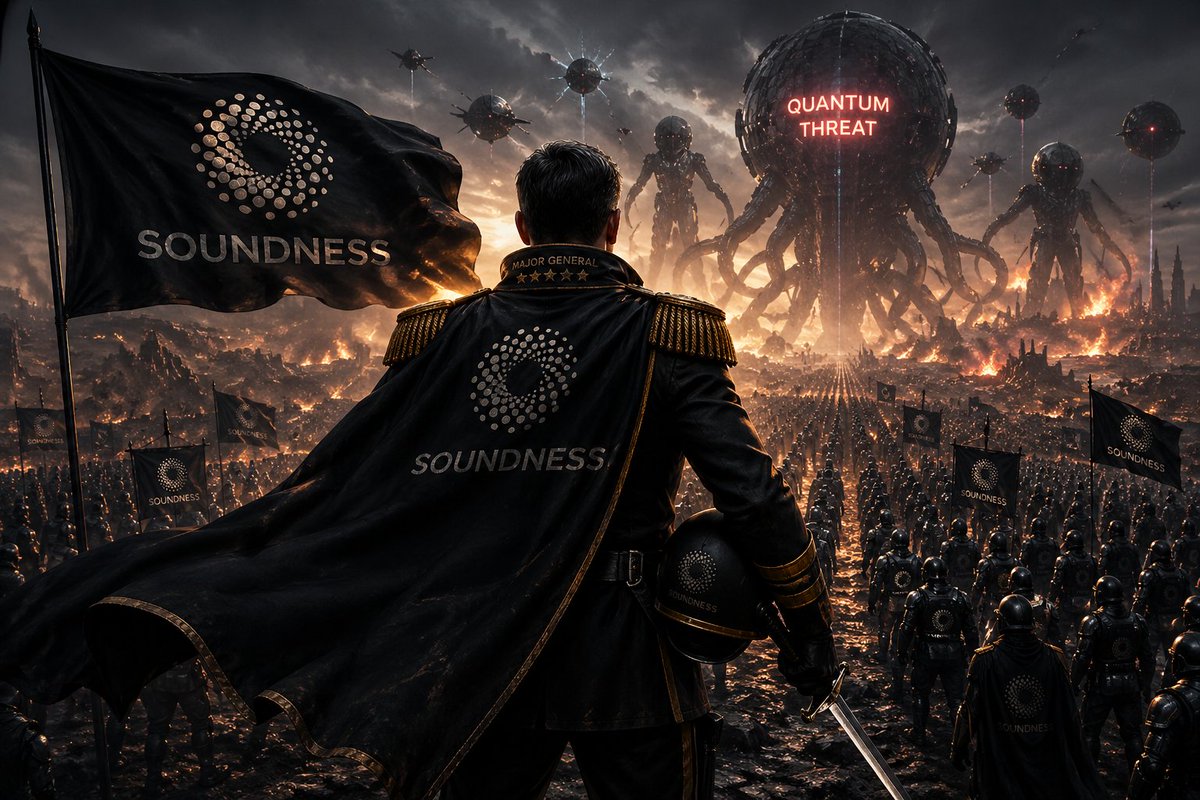
Soundness, Walrus, and Sui: Building the Next Avengers of Web3. Web3 is evolving fast, but one of the biggest bottlenecks is how to verify computation efficiently. Traditional blockchains weren’t designed to handle the heavy lifting required by zero-knowledge proofs (ZKPs). Without scalable proving, DeFi, rollups, and cross-chain systems hit serious limits. This is where @SoundnessLabs steps in. Instead of a closed, centralized proving service, @SoundnessLabs is building a prover marketplace; a decentralized ecosystem where anyone can generate, store, and verify proofs. By combining the storage power of Walrus and the settlement speed of Sui, @SoundnessLabs is positioning itself as a new foundational layer for Web3. 🧩 Why Soundness Matters Soundness is important because it tackles three problems at once: scalability, accessibility, and interoperability. Rollups and DeFi apps need faster and cheaper verification, but current proving systems are too heavy. Proof generation is usually expensive and locked behind centralized services, making it inaccessible to smaller builders. And many existing solutions are built for one specific ecosystem, limiting interoperability. Competitors like @SuccinctLabs, @RiscZero, are also working in this area. For example, Succinct is creating a proving-as-a-service model but keeps infrastructure more centralized. RiscZero builds zkVMs for general computation, but this often requires heavy computation and high costs. @SuccinctLabs focuses on specialized circuits for cross-chain verification, but the scope is narrower. @SoundnessLabs takes a different path. Instead of building a closed system, it offers a marketplace like model in which proves can be generated and verified openly, stored efficiently through @WalrusProtocol, and settled on-chain via @SuiNetwork. This makes it lighter, community-driven, and adaptable across use cases. 🔗 How Walrus and Sui Power Soundness Soundness doesn’t work alone, it’s powered by Walrus and Sui. @WalrusProtocol is the decentralized storage layer. When you generate a proof on Soundness, it doesn’t get dumped directly on-chain. Instead, it’s uploaded to Walrus as a “Blob,” which is cheaper and easier to access later. This keeps blockchain storage unclogged while still ensuring proofs are permanent and verifiable. @SuiNetwork is the settlement layer. Once a proof is uploaded, the CLI registers it on Sui, which acts as the blockchain receipt. This means the proof has both storage integrity (via Walrus) and an on-chain record (via Sui). In simple terms: Walrus works like the hard drive for proofs. Sui works like the receipt that proves the proof exists and is valid. Together, they make @SoundnessLabs fast, cheap, and reliable. N/B: Charley @SoundnessLabs is cooking something big and is still in the testnet phase (currently gated), but here’s a guide on how to participate. 🧑💻 How to Join the Soundness Testnet Now let’s move from “what” to “how.” Here’s the complete beginner-friendly walkthrough to get started with the Soundness testnet. To participate you will need : 1️⃣ Set Up Your Environment a) Linux/macOS (or Windows with WSL) b) Rust toolchain c) Git + build essentials Or you can run all this in your GitHub codespace terminal.. i) Install Rust: curl --proto '=https' --tlsv1.2 -sSf sh.rustup.rs | sh 2️⃣ Install the Soundness CLI curl -sSL raw.githubusercontent.com/soundnesslabs/… | bash source ~/.bashrc soundnessup install soundnessup update 3️⃣ Create and Manage Your Keys Generate: soundness-cli generate-key --name my-key Import your key: soundness-cli import-key --name "my-key" --mnemonic "Input your seed phrase here" N/B: If you already submitted one (key) during onboarding, just import it with your seed phrase. Be careful with your password, it won’t be visible as you type, but anything you enter will be accepted. Double-check or write it down before confirming.