

Citizen
354 posts




Brendan Carr admits he will be censoring the press.
Brendan Carr@BrendanCarrFCC
Gavin Newsom isn’t standing up to me or for any legitimate interest. He’s simply doing the bidding of his liberal Hollywood donors—the billionaires in media who have no interest in the FCC holding them accountable to their statutory public interest obligations. They want free rein to distort the news, broadcast hoaxes, and serve their own narrow interests and in doing so force their radical worldview on Americans without any regard to their broadcast license obligations. Not anymore.
English


Model Y is the best-selling car of any kind in the world!
Mason@webdevMason
We just got a 7-seat model Y, and we're gonna make that itty bitty third row work for us by hook or by crook because **** I love this car Full self-driving is the first real life changing quality of life improvement I've gotten from a product in as long as I can remember
English
To compliment the @BillAckman accurate description of the Net Worth Sweep of 100% of Fannie and Freddie profits, one must also look at how the Obama Treasury forced F2 to cook their books.
Then Treasury Secretary Tim Geithner continued the Hank Paulson large bailout plan that exacerbated the mortgage market crisis and extended credit losses beyond the sand States. Geithner hired both Blackrock and Blackstone to direct F2 to find as many write downs as they could to justify the $100B each bailout that protected F2 bondholders.
When F2 internal models were stressed they each could not come close to $100B in losses.
Paulson and Geithner wrongly compared street private label mortgage losses to the relatively safer book of GSE mortgages failing to recognize that GSEs had strong first loss cover in private mortgage insurance and in bank legal obligations to repurchase fraudulent and defectively underwritten mortgages.
Obama Treasury forced F2 to cook their books and zero out all PMI ($43B of trapped liquid claims paying ability) and all lender recourse (another $61B of liquid bank assets - $20B alone with BofA) that provided F2 legally obligated claims paying ability.
Treasury ignored that first loss liquidity forcing F2 to post large credit provisions in 2008-2010.
The policy was extend and pretend for the banks and PMIs but to force F2 into conservatorship.
Yet the PMI and recourse funds were being collected while bad loan repurchases mushroomed.
F2 also tightened the credit box and doubled GFees during this period. It was a total double standard to target F2 investors. In hindsight F2 never needed the bailouts for cash flow because the credit loss provisions and other valuation allowances were non-cash. The bailouts were optics done for mostly foreign bondholders. American homeowners and F2 shareholders were the victims of that failure.
Then with the high non cash credit losses F2 each wrote off $31B and and $21B of Deferred Tax Assets in 2008 respectively. In 2009-2011 another $29B Fannie and $8B Freddie DTA write downs for a total of $89B.
Combining the $104B non-cash credit losses with the $89B DTA write downs coincidentally equalled the amount of Treasury F2 bailout in Senior Preferred.
Yet in 2010 and 2011 F2 were collecting the PMI, lender recourse, the higher GFees and trends started to look good for home price recovery.
Treasury knew ahead of the NWS taking that F2 would be rolling in profits. Nonetheless F2 kept loan loss allowances high and gave no model value to the liquid PMI first loss claim receipts. They all knew ahead of 2012 that the DTAs and loan loss provisions would appear anomalous.
Facing obvious valuation allowance reversals, Treasury rushed to implement the 2012 NWS.
Smart folks inside witnessed the accounting and loan loss committee gimmickry - with some still working at F2.
Bill Ackman@BillAckman
A number of press reports have characterized our and other shareholders’ efforts on behalf of Fannie and Freddie (F2) as seeking a ‘gift’ or ‘handout’ from the government. We, the shareholders of F2, seek no such thing. Hundreds of financial institutions were bailed out during the GFC by the U.S. Treasury. Nearly all of the financial institution bailouts during the GFC involved an injection of capital in the form of senior preferred stock by Treasury at an interest rate of 5%, plus warrants to acquire common stock in an amount equal to 15% of the face amount of the preferred with an exercise price at the then-current stock price of the rescued institution. For example, Treasury’s preferred stock investment in Goldman Sachs was in an amount of $10 billion and, in addition, Treasury received warrants on $1.5 billion of GS' common stock at its then market price. The bailout terms for F2 were materially more burdensome and expensive, with a higher interest rate and substantially more warrant coverage, than that of every other financial institution (other than those of AIG whose terms were similar). Despite the F2 bailouts’ massively more burdensome terms, shareholders are not complaining about the original terms. Treasury invested $193 billion in F2 in the form of senior preferred stock (SPS), including funding for $2 billion of commitment fees, with a 10% coupon (twice that of the banks). Treasury also received warrants on 79.9% of both companies’ outstanding shares. Fannie and Freddie have since repaid Treasury $301 billion, which includes interest on the SPS at a blended rate of 11.6%, an interest rate which is 160 basis points more per annum, and have returned the entire $193 billion of outstanding principal, $25 billion in excess of what was contractually owed. In summary, the F2 SPS has been fully repaid according to its original contractual terms plus an extra $25 billion. Despite the fact that the SPS has been more than repaid in full, Fannie and Freddie have not accounted for these payments on their respective balance sheets, and the $193 billion of SPS remains an outstanding liability as if no principal payments had ever been made. How can it be, you might ask, if indeed F2 have repaid $301 billion to Treasury when only $276 billion was due could there be any remaining balance of the SPS on the F2 balance sheets? The answer relates to something called the ‘Net Worth Sweep (NWS).’ During the second term of the Obama administration, on August 12, 2012, two quarters after F2 returned to profitability, Treasury announced that it was unilaterally amending the terms of the SPS stock to provide that Treasury would take 100% of the profits of F2 each quarter in lieu of the 10% annual dividend rate. This was not a negotiated resolution with F2. It was a unilateral amendment of the original terms of the SPS that was done in bad faith. The supposed rationale for the amended terms of the SPS was akin to the IRS garnishing the wages of someone who will never be able to pay the taxes that they owe. That is, the Treasury said F2 will never be able to pay the 10% coupon, let alone the SPS’ $193 billion principal balance, so it decided instead to ‘settle’ for 100% of F2’s profits forever. In discovery, shareholders learned that the stated justification for the amendment was false. In mid 2012, the Obama administration had come to learn that both companies would soon be reversing tens of billions of reserves on their balance sheets as housing values had increased and the reserves taken during the GFC had been excessive. The NWS was instituted by Obama to forestall F2 from forever being able to recapitalize and be released from conservatorship. The NWS was not a ‘settlement’ for a lesser amount of future payments. It was the outright theft of the forever profits of both companies. Never before or since has the government ‘swept’ 100% of the profits of any company, let alone a financial institution in conservatorship, a form of government intervention where the goal is rehabilitation of the institution, and where the hierarchy of corporate claims has always been respected. The accounting for the NWS payments while it was in effect (until Secretary Mnuchin terminated the NWS in Trump’s first term) was also unusual. The NWS was treated by F2 as a quarterly adjustment to the dividend rate on the SPS such that the dividend amount owed was made equal to the after-tax profits of F2 for that quarter with no limitation. In other words, regardless of the amount of profit F2 generated for the quarter – whether or not it was in excess of the original 10% annual dividend – the dividend payable under the NWS was made equal to the quarterly profit. The absurd terms of the NWS sweep therefore made it impossible for any partial or full repayment of the SPS to take place as every dollar paid to the Treasury on the amended terms of the SPS was considered a dividend payment, even if the amount was massively in excess of the original contractual SPS terms. The absurdity of the NWS was made clear just two quarters after the NWS went into effect. Fannie Mae generated a profit of $59 billion in the first quarter of 2013, and the SPS dividend rate for that quarter was set at $59 billion so the entire amount was swept to the government, more than 10 times the contractual dividend rate. I had the opportunity to discuss F2 and the NWS with Warren Buffett about a decade ago and he said that he “couldn’t believe what the government had done.” In short, the shareholders of F2 are simply asking the government to respect the original and highly burdensome terms of the SPS. There is no dispute that Treasury has received more than the original 10% coupon and full repayment of principal of the SPS, that is, an extra $25 billion. We and the millions of other shareholders of F2 are simply asking the administration to honor the original SPS terms and properly account for the $301 billion of payments, thereby eliminating the SPS liability from both companies’ balance sheets. Shareholders have not asked for the extra $25 billion to be returned to the two companies. Treasury can decide whether to keep those funds or return them to the companies. Accounting for the repayment of the SPS has other important implications. Namely, it is critically important that conservatorships respect the rule of law, in particular, the contractual terms of corporate instruments and the hierarchy of claims. Otherwise, no financial institution that gets into trouble will be able to raise rescue capital in the private markets. Notably, the treatment of F2 in conservatorship explains why Silicon Valley Bank and other recent large bank failures since the GFC were unable to raise private capital and avoid government intervention or a forced sale to J.P. Morgan. If the government with the stroke of a pen during conservatorship can at a whim wipe out common and preferred shareholders, no one is going to step in to try to save a financial institution that gets into trouble, and only the top few banks will be possible rescuers of big banks that fail. Furthermore, because of F2’s history, their reputation in the capital markets has been greatly damaged. F2 raised $22 billion of preferred stock in the year or so prior to conservatorship as the government pressed both companies to raise capital. Institutions were willing to invest billions of dollars of capital into both institutions before they failed because, based on all precedent conservatorships, the contractual terms of all financial instruments and the hierarchy of claims had been preserved. Unfortunately, in light of the precedent of the net worth sweep, no investor can be confident that they won’t be wiped out in a future conservatorship so none has been willing to take the risk. Some have proposed that Treasury simply convert the SPS into junior preferred and common stock and massively dilute shareholders. Putting aside the potential legal challenges to this approach, the result will be that Treasury will at best own something approaching 95% of both companies rather than 79.9%. While the government’s percentage ownership stake would be larger in the SPS conversion approach, the value of the government’s larger stake would be considerably lower as the companies would become un-investable. Who would invest in F2 alongside the government when they just wiped out the previous owners? In the SPS conversion scenario, the government’s stake, at best, if it could be sold, would trade at a massively discounted valuation, well below the value of the government's stake if Treasury retained only its contracted for 79.9% stake and respected the original terms of the SPS. In other words, a slightly smaller ownership stake of much more highly valued companies would equate to considerably more value for Treasury and taxpayers. In a public letter to Rand Paul after his first term in November of 2021, President Trump recognized that the net worth sweep was theft from the shareholders of Fannie and Freddie. He wrote: “Another Obama/Biden scam in legal trouble was when they allowed the Federal Housing Finance Agency (FHFA) to steal the retirement savings of hardworking Americans who had invested in Fannie Mae and Freddie Mac…The idea that the government can steal money from its citizens is socialism and is a travesty brought to you by the Obama/Biden administration. My Administration was denied the time it needed to fix this problem because of the unconstitutional restriction on firing Mel Watt. It has to come to an end and courts must protect our citizens.” I couldn’t have said it better than President Trump. Now that you have the time, Mr. President, let’s Stop the Steal!
English

$FNMA $FMCC
@BarackObama, thanks for reminding us of that time you plundered Fannie Mae & Freddie Mac with the net worth sweeps so you could fund Obamacare while destroying the financial futures of hard-working American shareholders.
We deserve justice...and so do you.
Barack Obama@BarackObama
The day the Affordable Care Act passed was one of my proudest moments as president, because it meant that millions of Americans would have access to health care, some for the first time. The ACA also prevented insurance companies from denying people with pre-existing conditions coverage, allowed young people under the age of 26 to remain on their parents’ plan, expanded Medicaid, and so much more. But the ACA was always meant to be a first step. We still have to do more to expand access and make health care more affordable for everyone.
English
Citizen retweetledi

.@BillAckman bought $FNMA at $2.29 in 2013. Wall Street ignored him. The government fought him. He's held for 12 years.
The plan he laid out a decade ago is now being executed.
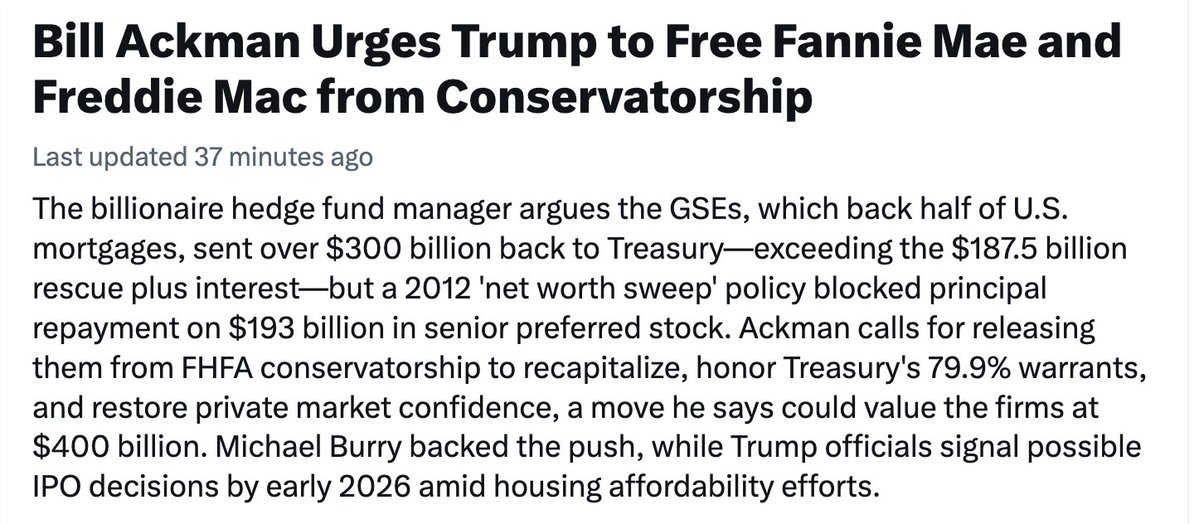
The government put $191B into Fannie and Freddie during the crisis & got $301B back.
Then in 2012 they changed the deal. Took 100% of profits. Every quarter. No end date.
Ackman saw the setup and went long.
What most people get wrong:
Fannie Mae is not "the company that blew up in 2008." What blew up was a leveraged trading book that no longer exists. What's left is a toll road on 70% of American mortgages. These are high quality borrowers & not subprime.
Ackman's plan has three steps.
1) Forgive the senior preferred (Treasury's already been more than repaid). Convert Treasury's warrants into equity. The government becomes the largest shareholder.
2) Relist on NYSE. These stocks already trade on pink sheets. Relisting brings in institutional money, analyst coverage, and a real market.
Ackman's price range: $23-$47 vs. $5.50 today.
3) Sequential IPOs. Fannie first, Freddie second. Government sells down its stake gradually over five years. Patience here is worth hundreds of billions.
End state: $300B in value for taxpayers through the equity position alone.
He's done this playbook before with GGP, a bankrupt mall company. He put in $60M, restructured it, relisted on NYSE, and turned it into $1.6B+.
Why now:
No Congressional action needed. Treasury and FHFA can do this alone. Both companies have been quietly rebuilding capital and hiring for what comes next.
English
Citizen retweetledi

A number of press reports have characterized our and other shareholders’ efforts on behalf of Fannie and Freddie (F2) as seeking a ‘gift’ or ‘handout’ from the government. We, the shareholders of F2, seek no such thing.
Hundreds of financial institutions were bailed out during the GFC by the U.S. Treasury. Nearly all of the financial institution bailouts during the GFC involved an injection of capital in the form of senior preferred stock by Treasury at an interest rate of 5%, plus warrants to acquire common stock in an amount equal to 15% of the face amount of the preferred with an exercise price at the then-current stock price of the rescued institution.
For example, Treasury’s preferred stock investment in Goldman Sachs was in an amount of $10 billion and, in addition, Treasury received warrants on $1.5 billion of GS' common stock at its then market price.
The bailout terms for F2 were materially more burdensome and expensive, with a higher interest rate and substantially more warrant coverage, than that of every other financial institution (other than those of AIG whose terms were similar). Despite the F2 bailouts’ massively more burdensome terms, shareholders are not complaining about the original terms.
Treasury invested $193 billion in F2 in the form of senior preferred stock (SPS), including funding for $2 billion of commitment fees, with a 10% coupon (twice that of the banks). Treasury also received warrants on 79.9% of both companies’ outstanding shares.
Fannie and Freddie have since repaid Treasury $301 billion, which includes interest on the SPS at a blended rate of 11.6%, an interest rate which is 160 basis points more per annum, and have returned the entire $193 billion of outstanding principal, $25 billion in excess of what was contractually owed. In summary, the F2 SPS has been fully repaid according to its original contractual terms plus an extra $25 billion.
Despite the fact that the SPS has been more than repaid in full, Fannie and Freddie have not accounted for these payments on their respective balance sheets, and the $193 billion of SPS remains an outstanding liability as if no principal payments had ever been made.
How can it be, you might ask, if indeed F2 have repaid $301 billion to Treasury when only $276 billion was due could there be any remaining balance of the SPS on the F2 balance sheets?
The answer relates to something called the ‘Net Worth Sweep (NWS).’
During the second term of the Obama administration, on August 12, 2012, two quarters after F2 returned to profitability, Treasury announced that it was unilaterally amending the terms of the SPS stock to provide that Treasury would take 100% of the profits of F2 each quarter in lieu of the 10% annual dividend rate. This was not a negotiated resolution with F2. It was a unilateral amendment of the original terms of the SPS that was done in bad faith.
The supposed rationale for the amended terms of the SPS was akin to the IRS garnishing the wages of someone who will never be able to pay the taxes that they owe. That is, the Treasury said F2 will never be able to pay the 10% coupon, let alone the SPS’ $193 billion principal balance, so it decided instead to ‘settle’ for 100% of F2’s profits forever.
In discovery, shareholders learned that the stated justification for the amendment was false. In mid 2012, the Obama administration had come to learn that both companies would soon be reversing tens of billions of reserves on their balance sheets as housing values had increased and the reserves taken during the GFC had been excessive. The NWS was instituted by Obama to forestall F2 from forever being able to recapitalize and be released from conservatorship. The NWS was not a ‘settlement’ for a lesser amount of future payments. It was the outright theft of the forever profits of both companies.
Never before or since has the government ‘swept’ 100% of the profits of any company, let alone a financial institution in conservatorship, a form of government intervention where the goal is rehabilitation of the institution, and where the hierarchy of corporate claims has always been respected.
The accounting for the NWS payments while it was in effect (until Secretary Mnuchin terminated the NWS in Trump’s first term) was also unusual. The NWS was treated by F2 as a quarterly adjustment to the dividend rate on the SPS such that the dividend amount owed was made equal to the after-tax profits of F2 for that quarter with no limitation.
In other words, regardless of the amount of profit F2 generated for the quarter – whether or not it was in excess of the original 10% annual dividend – the dividend payable under the NWS was made equal to the quarterly profit. The absurd terms of the NWS sweep therefore made it impossible for any partial or full repayment of the SPS to take place as every dollar paid to the Treasury on the amended terms of the SPS was considered a dividend payment, even if the amount was massively in excess of the original contractual SPS terms.
The absurdity of the NWS was made clear just two quarters after the NWS went into effect. Fannie Mae generated a profit of $59 billion in the first quarter of 2013, and the SPS dividend rate for that quarter was set at $59 billion so the entire amount was swept to the government, more than 10 times the contractual dividend rate.
I had the opportunity to discuss F2 and the NWS with Warren Buffett about a decade ago and he said that he “couldn’t believe what the government had done.”
In short, the shareholders of F2 are simply asking the government to respect the original and highly burdensome terms of the SPS. There is no dispute that Treasury has received more than the original 10% coupon and full repayment of principal of the SPS, that is, an extra $25 billion.
We and the millions of other shareholders of F2 are simply asking the administration to honor the original SPS terms and properly account for the $301 billion of payments, thereby eliminating the SPS liability from both companies’ balance sheets.
Shareholders have not asked for the extra $25 billion to be returned to the two companies. Treasury can decide whether to keep those funds or return them to the companies.
Accounting for the repayment of the SPS has other important implications. Namely, it is critically important that conservatorships respect the rule of law, in particular, the contractual terms of corporate instruments and the hierarchy of claims. Otherwise, no financial institution that gets into trouble will be able to raise rescue capital in the private markets.
Notably, the treatment of F2 in conservatorship explains why Silicon Valley Bank and other recent large bank failures since the GFC were unable to raise private capital and avoid government intervention or a forced sale to J.P. Morgan. If the government with the stroke of a pen during conservatorship can at a whim wipe out common and preferred shareholders, no one is going to step in to try to save a financial institution that gets into trouble, and only the top few banks will be possible rescuers of big banks that fail.
Furthermore, because of F2’s history, their reputation in the capital markets has been greatly damaged. F2 raised $22 billion of preferred stock in the year or so prior to conservatorship as the government pressed both companies to raise capital. Institutions were willing to invest billions of dollars of capital into both institutions before they failed because, based on all precedent conservatorships, the contractual terms of all financial instruments and the hierarchy of claims had been preserved. Unfortunately, in light of the precedent of the net worth sweep, no investor can be confident that they won’t be wiped out in a future conservatorship so none has been willing to take the risk.
Some have proposed that Treasury simply convert the SPS into junior preferred and common stock and massively dilute shareholders. Putting aside the potential legal challenges to this approach, the result will be that Treasury will at best own something approaching 95% of both companies rather than 79.9%.
While the government’s percentage ownership stake would be larger in the SPS conversion approach, the value of the government’s larger stake would be considerably lower as the companies would become un-investable. Who would invest in F2 alongside the government when they just wiped out the previous owners?
In the SPS conversion scenario, the government’s stake, at best, if it could be sold, would trade at a massively discounted valuation, well below the value of the government's stake if Treasury retained only its contracted for 79.9% stake and respected the original terms of the SPS. In other words, a slightly smaller ownership stake of much more highly valued companies would equate to considerably more value for Treasury and taxpayers.
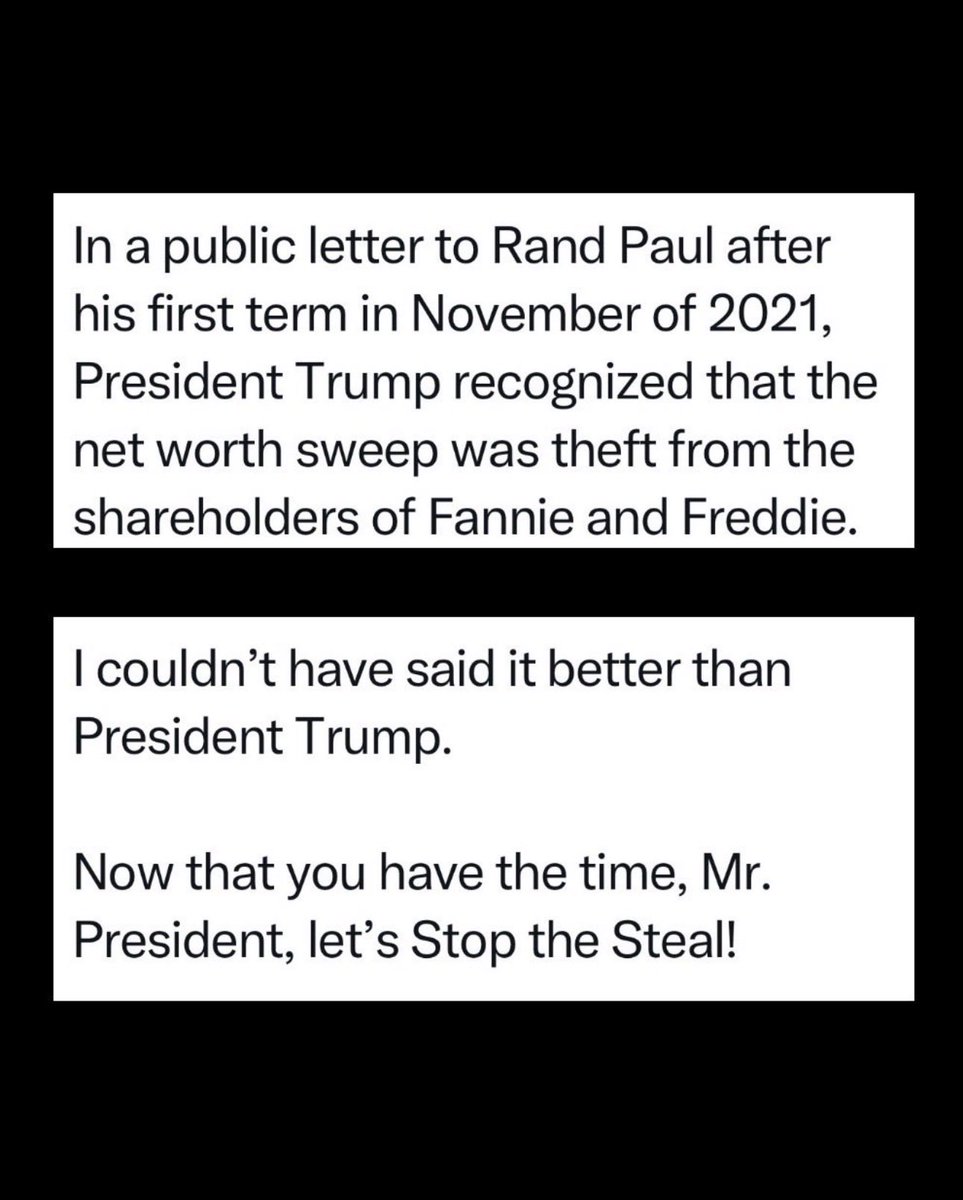
In a public letter to Rand Paul after his first term in November of 2021, President Trump recognized that the net worth sweep was theft from the shareholders of Fannie and Freddie. He wrote:
“Another Obama/Biden scam in legal trouble was when they allowed the Federal Housing Finance Agency (FHFA) to steal the retirement savings of hardworking Americans who had invested in Fannie Mae and Freddie Mac…The idea that the government can steal money from its citizens is socialism and is a travesty brought to you by the Obama/Biden administration. My Administration was denied the time it needed to fix this problem because of the unconstitutional restriction on firing Mel Watt. It has to come to an end and courts must protect our citizens.”
I couldn’t have said it better than President Trump.
Now that you have the time, Mr. President, let’s Stop the Steal!
English

free $FNMA $FMCC now President Trump 🇺🇸🇺🇸🇺🇸
English
Citizen retweetledi

@michaeljburry @BillAckman $FNMA STOP THE STEAL @SecScottBessent @pulte @howardlutnick @realDonaldTrump
English
Citizen retweetledi

I agree with Bill Ackman/Pershing Square. @BillAckman.
This is an important read for all interested in Fannie Mae and Freddie Mac. Treating shareholders fairly here is about much, much more than these two companies.
“Accounting for the repayment of the SPS has other important implications. Namely, it is critically important that conservatorships respect the rule of law, in particular, the contractual terms of corporate instruments and the hierarchy of claims. Otherwise, no financial institution that gets into trouble will be able to raise rescue capital in the private markets.
Notably, the treatment of F2 in conservatorship explains why Silicon Valley Bank and other recent large bank failures since the GFC were unable to raise private capital and avoid government intervention or a forced sale to J.P. Morgan. If the government with the stroke of a pen during conservatorship can at a whim wipe out common and preferred shareholders, no one is going to step in to try to save a financial institution that gets into trouble, and only the top few banks will be possible rescuers of big banks that fail.”
$FNMA $FMCC
Bill Ackman@BillAckman
A number of press reports have characterized our and other shareholders’ efforts on behalf of Fannie and Freddie (F2) as seeking a ‘gift’ or ‘handout’ from the government. We, the shareholders of F2, seek no such thing. Hundreds of financial institutions were bailed out during the GFC by the U.S. Treasury. Nearly all of the financial institution bailouts during the GFC involved an injection of capital in the form of senior preferred stock by Treasury at an interest rate of 5%, plus warrants to acquire common stock in an amount equal to 15% of the face amount of the preferred with an exercise price at the then-current stock price of the rescued institution. For example, Treasury’s preferred stock investment in Goldman Sachs was in an amount of $10 billion and, in addition, Treasury received warrants on $1.5 billion of GS' common stock at its then market price. The bailout terms for F2 were materially more burdensome and expensive, with a higher interest rate and substantially more warrant coverage, than that of every other financial institution (other than those of AIG whose terms were similar). Despite the F2 bailouts’ massively more burdensome terms, shareholders are not complaining about the original terms. Treasury invested $193 billion in F2 in the form of senior preferred stock (SPS), including funding for $2 billion of commitment fees, with a 10% coupon (twice that of the banks). Treasury also received warrants on 79.9% of both companies’ outstanding shares. Fannie and Freddie have since repaid Treasury $301 billion, which includes interest on the SPS at a blended rate of 11.6%, an interest rate which is 160 basis points more per annum, and have returned the entire $193 billion of outstanding principal, $25 billion in excess of what was contractually owed. In summary, the F2 SPS has been fully repaid according to its original contractual terms plus an extra $25 billion. Despite the fact that the SPS has been more than repaid in full, Fannie and Freddie have not accounted for these payments on their respective balance sheets, and the $193 billion of SPS remains an outstanding liability as if no principal payments had ever been made. How can it be, you might ask, if indeed F2 have repaid $301 billion to Treasury when only $276 billion was due could there be any remaining balance of the SPS on the F2 balance sheets? The answer relates to something called the ‘Net Worth Sweep (NWS).’ During the second term of the Obama administration, on August 12, 2012, two quarters after F2 returned to profitability, Treasury announced that it was unilaterally amending the terms of the SPS stock to provide that Treasury would take 100% of the profits of F2 each quarter in lieu of the 10% annual dividend rate. This was not a negotiated resolution with F2. It was a unilateral amendment of the original terms of the SPS that was done in bad faith. The supposed rationale for the amended terms of the SPS was akin to the IRS garnishing the wages of someone who will never be able to pay the taxes that they owe. That is, the Treasury said F2 will never be able to pay the 10% coupon, let alone the SPS’ $193 billion principal balance, so it decided instead to ‘settle’ for 100% of F2’s profits forever. In discovery, shareholders learned that the stated justification for the amendment was false. In mid 2012, the Obama administration had come to learn that both companies would soon be reversing tens of billions of reserves on their balance sheets as housing values had increased and the reserves taken during the GFC had been excessive. The NWS was instituted by Obama to forestall F2 from forever being able to recapitalize and be released from conservatorship. The NWS was not a ‘settlement’ for a lesser amount of future payments. It was the outright theft of the forever profits of both companies. Never before or since has the government ‘swept’ 100% of the profits of any company, let alone a financial institution in conservatorship, a form of government intervention where the goal is rehabilitation of the institution, and where the hierarchy of corporate claims has always been respected. The accounting for the NWS payments while it was in effect (until Secretary Mnuchin terminated the NWS in Trump’s first term) was also unusual. The NWS was treated by F2 as a quarterly adjustment to the dividend rate on the SPS such that the dividend amount owed was made equal to the after-tax profits of F2 for that quarter with no limitation. In other words, regardless of the amount of profit F2 generated for the quarter – whether or not it was in excess of the original 10% annual dividend – the dividend payable under the NWS was made equal to the quarterly profit. The absurd terms of the NWS sweep therefore made it impossible for any partial or full repayment of the SPS to take place as every dollar paid to the Treasury on the amended terms of the SPS was considered a dividend payment, even if the amount was massively in excess of the original contractual SPS terms. The absurdity of the NWS was made clear just two quarters after the NWS went into effect. Fannie Mae generated a profit of $59 billion in the first quarter of 2013, and the SPS dividend rate for that quarter was set at $59 billion so the entire amount was swept to the government, more than 10 times the contractual dividend rate. I had the opportunity to discuss F2 and the NWS with Warren Buffett about a decade ago and he said that he “couldn’t believe what the government had done.” In short, the shareholders of F2 are simply asking the government to respect the original and highly burdensome terms of the SPS. There is no dispute that Treasury has received more than the original 10% coupon and full repayment of principal of the SPS, that is, an extra $25 billion. We and the millions of other shareholders of F2 are simply asking the administration to honor the original SPS terms and properly account for the $301 billion of payments, thereby eliminating the SPS liability from both companies’ balance sheets. Shareholders have not asked for the extra $25 billion to be returned to the two companies. Treasury can decide whether to keep those funds or return them to the companies. Accounting for the repayment of the SPS has other important implications. Namely, it is critically important that conservatorships respect the rule of law, in particular, the contractual terms of corporate instruments and the hierarchy of claims. Otherwise, no financial institution that gets into trouble will be able to raise rescue capital in the private markets. Notably, the treatment of F2 in conservatorship explains why Silicon Valley Bank and other recent large bank failures since the GFC were unable to raise private capital and avoid government intervention or a forced sale to J.P. Morgan. If the government with the stroke of a pen during conservatorship can at a whim wipe out common and preferred shareholders, no one is going to step in to try to save a financial institution that gets into trouble, and only the top few banks will be possible rescuers of big banks that fail. Furthermore, because of F2’s history, their reputation in the capital markets has been greatly damaged. F2 raised $22 billion of preferred stock in the year or so prior to conservatorship as the government pressed both companies to raise capital. Institutions were willing to invest billions of dollars of capital into both institutions before they failed because, based on all precedent conservatorships, the contractual terms of all financial instruments and the hierarchy of claims had been preserved. Unfortunately, in light of the precedent of the net worth sweep, no investor can be confident that they won’t be wiped out in a future conservatorship so none has been willing to take the risk. Some have proposed that Treasury simply convert the SPS into junior preferred and common stock and massively dilute shareholders. Putting aside the potential legal challenges to this approach, the result will be that Treasury will at best own something approaching 95% of both companies rather than 79.9%. While the government’s percentage ownership stake would be larger in the SPS conversion approach, the value of the government’s larger stake would be considerably lower as the companies would become un-investable. Who would invest in F2 alongside the government when they just wiped out the previous owners? In the SPS conversion scenario, the government’s stake, at best, if it could be sold, would trade at a massively discounted valuation, well below the value of the government's stake if Treasury retained only its contracted for 79.9% stake and respected the original terms of the SPS. In other words, a slightly smaller ownership stake of much more highly valued companies would equate to considerably more value for Treasury and taxpayers. In a public letter to Rand Paul after his first term in November of 2021, President Trump recognized that the net worth sweep was theft from the shareholders of Fannie and Freddie. He wrote: “Another Obama/Biden scam in legal trouble was when they allowed the Federal Housing Finance Agency (FHFA) to steal the retirement savings of hardworking Americans who had invested in Fannie Mae and Freddie Mac…The idea that the government can steal money from its citizens is socialism and is a travesty brought to you by the Obama/Biden administration. My Administration was denied the time it needed to fix this problem because of the unconstitutional restriction on firing Mel Watt. It has to come to an end and courts must protect our citizens.” I couldn’t have said it better than President Trump. Now that you have the time, Mr. President, let’s Stop the Steal!
English
Citizen retweetledi

Janet, your proposal is well-intentioned and clearly aimed at delivering value to taxpayers which is an objective some could / would agree with. Țhis situation differs however and is remarkably unique in stature, math and market dynamics, and present significant challenges that cannot be overlooked simply by acknowledging the GSEs have returned the bailout of $187 billion USD and have factually returned in excess of an extra $113 billion dollars totalling $301 billion USD.
In practice, it is highly unlikely that sophisticated institutional investors or banking participants would allocate meaningful capital into a structure characterized by substantial dilution risk—particularly one that remains under conservatorship. The presence of ongoing government control introduces material constraints on capital deployment, strategic flexibility, and overall enterprise valuation. These factors inherently suppress investor appetite and limit the ability to achieve the premium valuations suggested.
Capital markets require clarity, alignment of incentives, and a credible path to normalized operations. A framework that simultaneously contemplates large-scale equity issuance, government majority control, and unresolved legacy obligations creates conflicting signals that undermine confidence and pricing efficiency.
A more durable and market-aligned solution would be to fully terminate the SPSA and definitively close that chapter. Removing this overhang would provide the clean capital structure necessary to reestablish credibility with investors and counterparties. From there, relisting on the NYSE and restoring standard governance frameworks would allow both enterprises to operate as intended—independent, competitive, and accountable to shareholders who by the way are also taxpayers.
With that foundation in place, focus can return to the core mission: enhancing liquidity in the housing market, improving affordability, and supporting sustainable homeownership.
That is ultimately how these institutions can best serve taxpayers and help advance the broader goal of expanding access to the American Dream 🇺🇸
And very importantly this plan moving forward would not have ingredients to trigger any new lawsuits.
Janet Tavakoli@JanetTavakoli
.@michaeljburry I urge a longer, taxpayer-friendly path to an IPO and wrote FHFA @pulte and other D.C. stakeholders with steps to prepare. $FNMA $FMCC x.com/JanetTavakoli/…
English



MUST WATCH video of President Trump discussing the two strong executive orders he recently signed to improve housing affordability:
"Under the Trump Administration, we want to make it possible for every American to live that American Dream in a beautiful home." - @POTUS
🏡🇺🇸
English

Many people will regret not owning $XRP & $HBAR
There are so many incredible options in this space, but the developments happening around these two ecosystems is just so bullish.
English
English
$FNMA $FMCC
GSE haters...Bring it!
Fannie Mae & Freddie Mac shareholders with conviction are impervious to your negativity.
We're gonna fly...& we remain in good company.
@michaeljburry & @BillAckman, thank you for your input, gentlemen!
Great work as always, @TylerEHand!
Cassandra Unchained@michaeljburry
Thank you Tyler - agree on all of this.
English