Clara Shih

7.5K posts

Clara Shih banner
Clara Shih

Clara Shih

@clarashih

Startup advisor & investor. Conditional AI optimist. Advisor/founder, Meta Business AI, Founder/CEO of Hearsay, Founder / ex-CEO Salesforce AI

San Francisco Katılım Aralık 2008
314 Takip Edilen26.7K Takipçiler
Clara Shih retweetledi
Brian Sozzi
Brian Sozzi@BrianSozzi·
Goldman Sachs on AI Agents stealing jobs from humans: "Our analysis implies that AI substitution has reduced monthly payroll growth by roughly 25k and raised the unemployment rate by 0.16 percentage points over the past year, while augmentation has added about 9k to monthly payroll growth and lowered the unemployment rate by 0.06pp.[3] This implies a net drag of 16k per month on payroll growth and a 0.1pp boost to the unemployment rate. These negative effects fall largely on less experienced workers, widening the entry-level-to-experienced wage gap by 1.3% and the unemployment rate gap by 0.6pp from their pre-pandemic averages."
Brian Sozzi tweet media
English
37
208
944
229.3K
Clara Shih
Clara Shih@clarashih·
In the AI economy, modern role definitions will break as every employee can deploy systems of agents to own much broader scopes of work. End-state work collapses into 3 foundational jobs within companies: building products, selling products, and running the company. Everything else will get delegated to agents. Examples: • The actual job of design or software engineering isn’t producing mockups and code, but rather building great products people pay for and love. • The real job of marketing isn’t campaigns or content; it’s driving sales. • The purpose of corporate accounting isn't the tasks of sending invoices and paying bills, but ensuring the company has cash to fuel operations and growth. This shift is unfolding unevenly— faster in smaller, more tech-forward companies and slower in legacy orgs due to inertia, regulation, or culture. The more people can define their jobs not as a set of tasks but as orchestrating outcomes end-to-end, the more strategic, leveraged, and indispensable they become. youtube.com/shorts/CfK3za_…
YouTube video
YouTube
English
5
6
29
6.9K
Clara Shih retweetledi
Auren Hoffman
Auren Hoffman@auren·
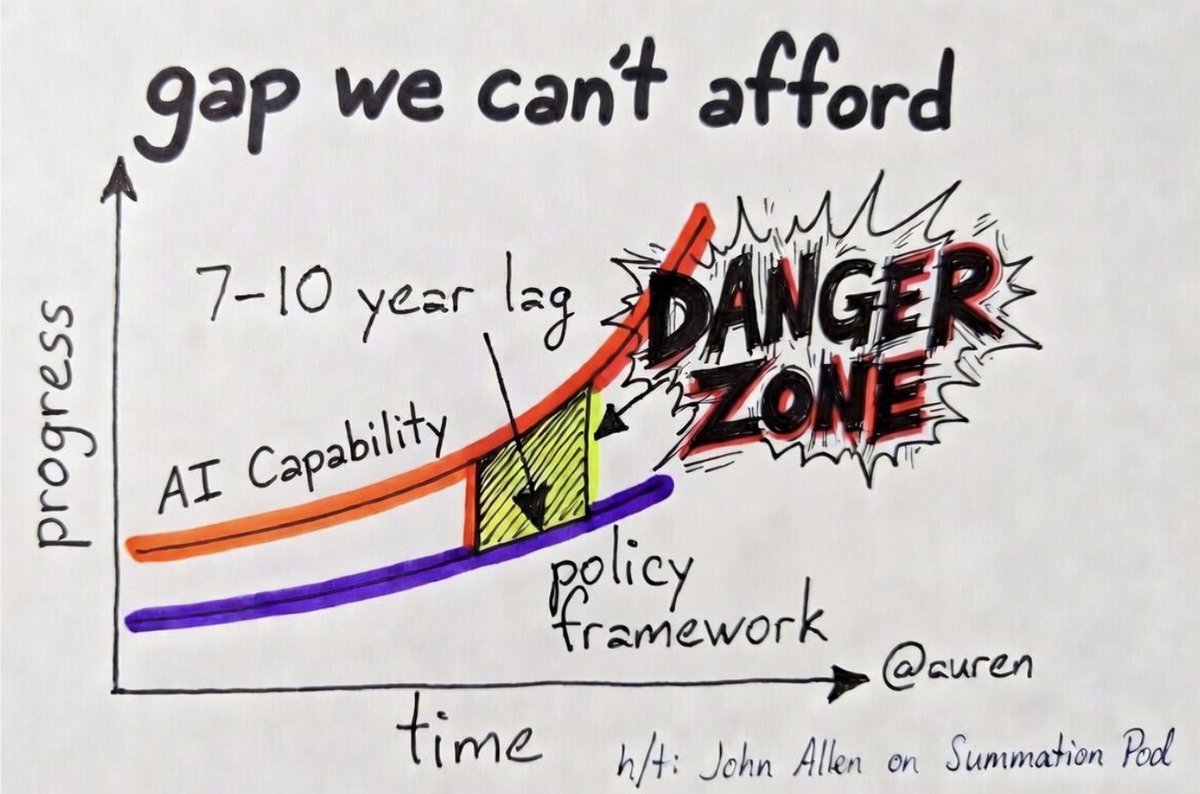
AI moves in days. policy moves in decades
Auren Hoffman tweet media
English
5
6
32
3.4K
Clara Shih retweetledi
Erik Brynjolfsson
Erik Brynjolfsson@erikbryn·
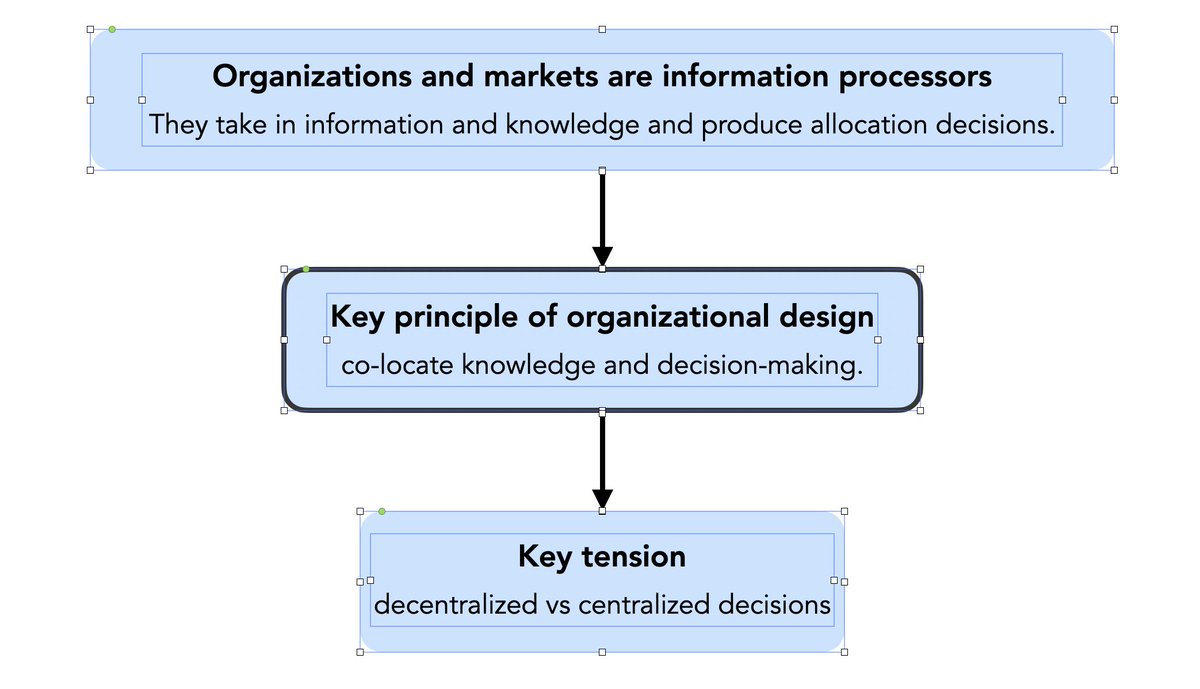
The @nytimes piece today by @ByrneEdsal13590 highlights a concern I share: “If we stay on the current path, the risk of extreme concentration — both economic and political — is very real.” In work with @zhitzig, we ask why AI may shift the balance between dispersed knowledge and centralized control.
Erik Brynjolfsson tweet media
English
8
63
235
109.5K
Clara Shih
Clara Shih@clarashih·
Also c) whether AI lowers the barrier to entry for the job, since that could flood labor supply and compress wages. Even when consumer demand is super elastic and you see Jevons paradox. Even when there are few % AI-exposed tasks in the job. We saw this with London black cab drivers, who prided themselves on mastering "The Knowledge," recall of 25K streets, 20K landmarks, and thousands of specific routes within a six-mile radius of Charing Cross, and previous to 2012 made a middle-class wage. Once GPS driving directions and Uber/Lyft commoditized the job, they faced sudden competition from a flood of low-skill workers. Despite increased, elastic consumer demand for rides and increase in # jobs over the last 14 years, black cab drivers have seen real income fall by 50% and today sit below the London Living Wage
English
1
0
4
784
Alex Imas
Alex Imas@alexolegimas·
Also: *EXPOSURE DOES NOT MEAN THREAT OF DISPLACEMENT* *EXPOSURE DOES NOT MEAN THREAT OF DISPLACEMENT* *EXPOSURE DOES NOT MEAN THREAT OF DISPLACEMENT* It can literally mean the opposite: AI exposed jobs may increase hiring and attract higher wages. It all depends on a) elasticity of consumer demand and b) number of AI exposed tasks in a job.
Stefan Schubert@StefanFSchubert

Many seem to take this as a reason to believe that the overall pace of automation will be high, but I don't think that makes any sense

English
27
51
384
246.1K
Clara Shih
Clara Shih@clarashih·
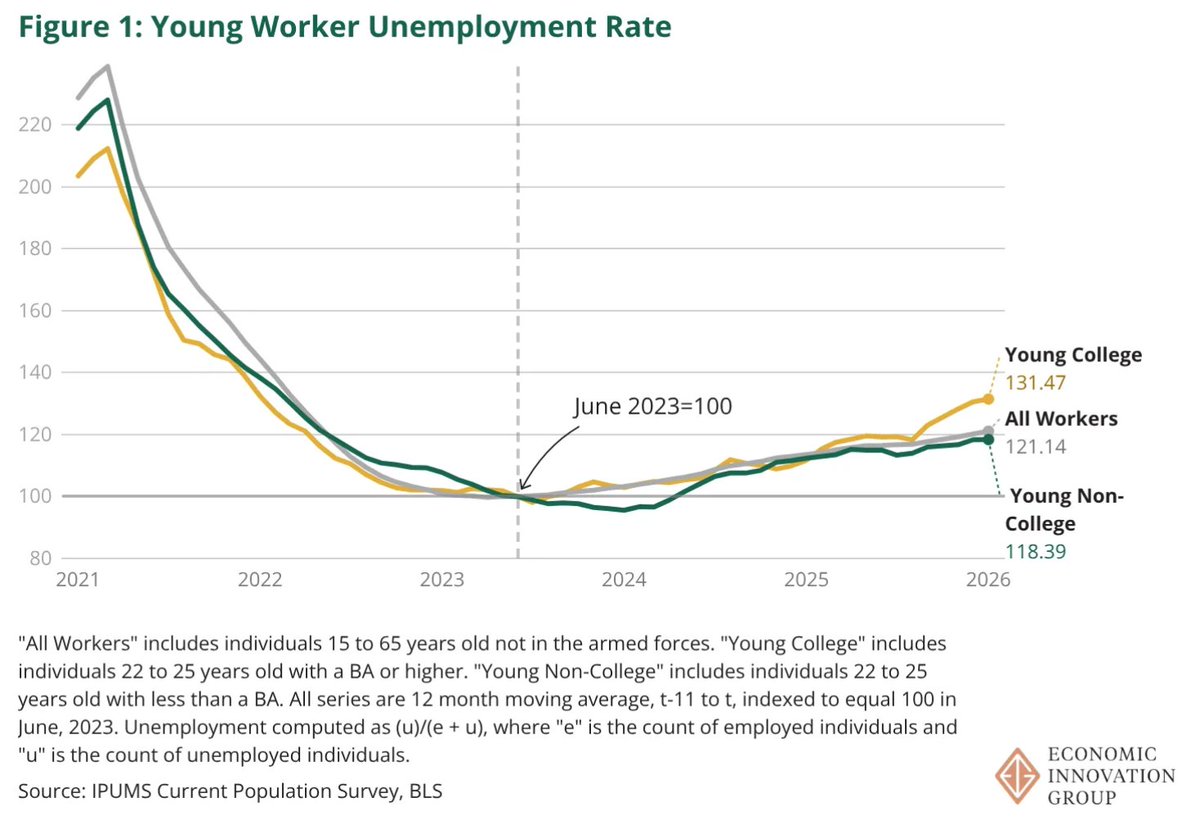
While full AI role displacement will happen in certain roles, history shows that wage resets are a more common, insidious, and often equally disruptive way that new technologies affect workers 1. Intra-sector squeeze: Displaced workers flood the remaining jobs in their own field, compressing wages. When trade shocks hit manufacturing in the early 2000s, laid-off factory workers competed fiercely for an ever-shrinking number of U.S. jobs, resulting in declining real wages. 2. Labor supply growth outpacing labor demand: AI (like past tech waves) slashes the skill floor for once-premium jobs, flooding labor supply and compressing wages. This can happen even when the total # jobs in a sector increases, and/or when Jevons paradox plays out. We saw this with London black cab drivers, who prided themselves on mastering "The Knowledge," a rigorous, years-long training required to memorize 25K streets, 20K landmarks, and thousands of specific routes within a six-mile radius of Charing Cross, and previous to 2012 made a middle-class wage. But once GPS driving directions and Uber/Lyft commoditized professional driving, they faced sudden competition from a flood of low-skill workers. Despite consumer demand for rides increasing (Jevons) over the last 14 years, black cab drivers have seen real income fall by 50% and today sit below the London Living Wage. 3. Inter-sector pay cut and spillover: Displaced high-skill workers switch fields, often taking a pay cut while displacing incumbent workers. We may be seeing early stages of this now: 42% of recent college grads are *underemployed*, taking jobs that don’t require a degree and competing directly with non-college grads. This may be responsible for the increased unemployment among young non-college educated workers [see chart]. The same thing happened after NAFTA and China’s WTO entry. Manufacturing workers didn’t disappear; they spilled into retail, construction, and services, on average taking a $13,500 (~20-30%) pay cut. The key takeaway is we need to track not only # jobs but also wage trends in order to help people prepare.
Clara Shih tweet media
English
9
17
79
20.4K
Clara Shih
Clara Shih@clarashih·
Yes exactly, and this may already be what's happening among young workers. 42% of recent grads are underemployed ( @NYFedResearch ) which means a few million college-educated young people are now flooding the low-skill labor market. Per the definition of "underemployed," they have outcompeted non-college educated young people for their job. It's a spillover factor that seems to show up in non-college unemployment and labor participation-- see chart of BLS data on college and non-college grads ages 22-25
Clara Shih tweet media
English
0
0
1
158
Archit Sinha
Archit Sinha@_ArchitSinha·
@clarashih @karpathy Wouldn't there be second order effects for manual jobs like say plumbers and electricians. If a sizeable chunk of white collar jobs are reduced, Wouldn't it in-turn impact these jobs also
English
1
0
0
164
Clara Shih
Clara Shih@clarashih·
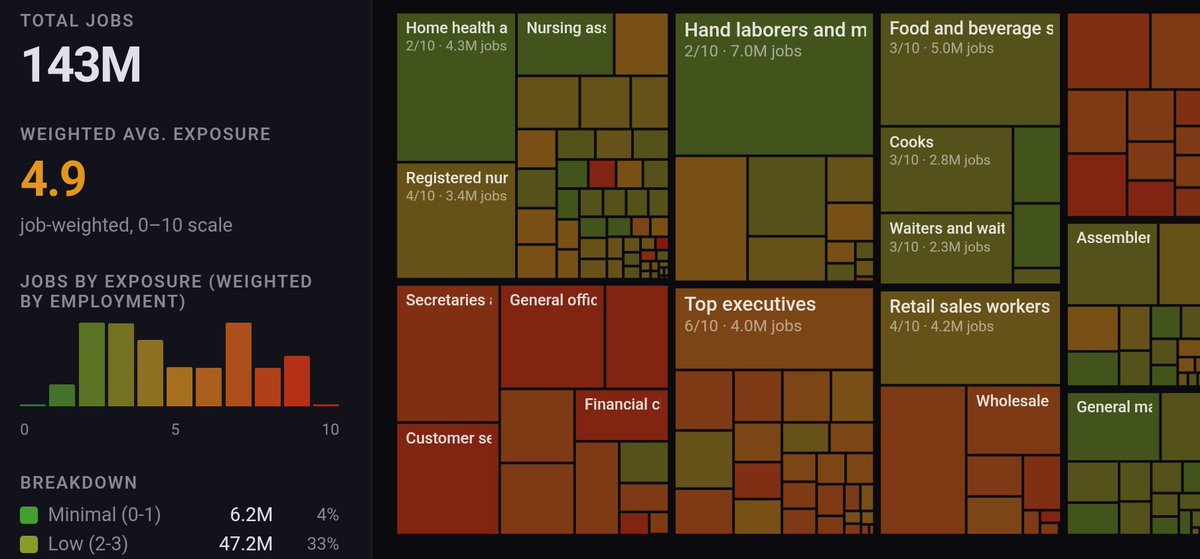
AI isn't just coming for junior software engineers in Big Tech. @karpathy just used Gemini to score AI exposure (0-10) across 143M US jobs in 342 BLS categories: • High/very high exposure (~60M jobs, $4T+ in wages): billing specialists, secretaries, many desk-based roles • Low/minimal exposure (~53M jobs): home health aides, carpenters, hands-on trades • Jobs paying <$35K are least exposed. Those >$100K are most exposed In a reversal from a decades-long trend, it is cognitive work rather than manual labor that is in the crosshairs. Data + viz 📈: karpathy.ai/jobs
Clara Shih tweet media
Andrej Karpathy@karpathy

It is hard to communicate how much programming has changed due to AI in the last 2 months: not gradually and over time in the "progress as usual" way, but specifically this last December. There are a number of asterisks but imo coding agents basically didn’t work before December and basically work since - the models have significantly higher quality, long-term coherence and tenacity and they can power through large and long tasks, well past enough that it is extremely disruptive to the default programming workflow. Just to give an example, over the weekend I was building a local video analysis dashboard for the cameras of my home so I wrote: “Here is the local IP and username/password of my DGX Spark. Log in, set up ssh keys, set up vLLM, download and bench Qwen3-VL, set up a server endpoint to inference videos, a basic web ui dashboard, test everything, set it up with systemd, record memory notes for yourself and write up a markdown report for me”. The agent went off for ~30 minutes, ran into multiple issues, researched solutions online, resolved them one by one, wrote the code, tested it, debugged it, set up the services, and came back with the report and it was just done. I didn’t touch anything. All of this could easily have been a weekend project just 3 months ago but today it’s something you kick off and forget about for 30 minutes. As a result, programming is becoming unrecognizable. You’re not typing computer code into an editor like the way things were since computers were invented, that era is over. You're spinning up AI agents, giving them tasks *in English* and managing and reviewing their work in parallel. The biggest prize is in figuring out how you can keep ascending the layers of abstraction to set up long-running orchestrator Claws with all of the right tools, memory and instructions that productively manage multiple parallel Code instances for you. The leverage achievable via top tier "agentic engineering" feels very high right now. It’s not perfect, it needs high-level direction, judgement, taste, oversight, iteration and hints and ideas. It works a lot better in some scenarios than others (e.g. especially for tasks that are well-specified and where you can verify/test functionality). The key is to build intuition to decompose the task just right to hand off the parts that work and help out around the edges. But imo, this is nowhere near "business as usual" time in software.


English
9
7
79
27.6K
Clara Shih retweetledi
Dylan Patel
Dylan Patel@dylan522p·
Being in SF is like being in Wuhan right before the pandemic Something is happening, it's gonna hit everywhere but so few people know it
English
298
273
5.3K
1.9M
Clara Shih retweetledi
Gokul Rajaram
Gokul Rajaram@gokulr·
Net hiring at most 1000+ person companies (AI labs are exception) is already zero or negative. Most CEOs know their companies are bloated and don’t need as many people, especially with AI driving a step change in productivity. Leaders will start by keeping headcount flat, but as AI capabilities compound and small teams outperform larger ones, major cuts are inevitable.
TBPN@tbpn

"The reality is, nobody's hiring." Marathon Founding Partner @gokulr reacts to the Block layoffs and predicts that over the next 18 months, every public company is going to have a 30%+ cut because of AI: "If they don’t, I question their leadership."

English
21
10
145
59.6K
Clara Shih retweetledi
Ernie Tedeschi
Ernie Tedeschi@ernietedeschi·
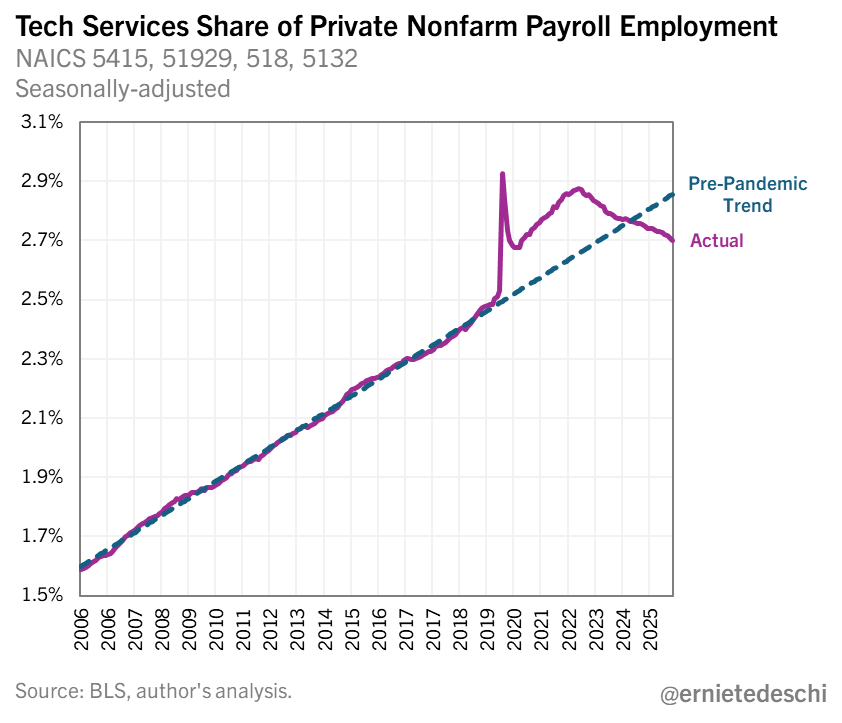
I agree with @zeynep that a correction from 2022 explains most of what's going on. What gives me pause however is that the *level* of tech employment is now below pre-pandemic trend. Under a pure correction, we'd expect convergence to trend. So more might be going on.
Ernie Tedeschi tweet media
zeynep tufekci@zeynep

I am sold on the power of coding agents — verifiable, formal domain; decades of question/answer databases, etc. But the tech hiring bust is clearly ALSO working off the Covid era hiring bubble plus lack of US visas leading to offshoring. I mean, come on, look at that bump.

English
26
60
521
94.6K
Clara Shih retweetledi
Clara Shih
Clara Shih@clarashih·
Why is this surprising? 42% of recent grads are underemployed (@NYFedResearch) which means a few million college-educated young people are now flooding the low-skill labor market. Per the definition of "underemployed," they have outcompeted non-college educated young people for their job. It's a spillover factor that shows up in non-college unemployment and labor participation
Adam Ozimek@ModeledBehavior

Everyone is trying to explain the mystery of why the job market is weak for college grads, most blaming AI. But that IS NOT THE MYSTERY. The mystery is why is it weak for young workers of ALL EDUCATION LEVELS New from me and @ngoldschlag agglomerations.substack.com/p/ai-and-young…

English
0
0
7
2.5K
Clara Shih retweetledi
Andrew Curran
Andrew Curran@AndrewCurran_·
Striking image from the new Anthropic labor market impact report.
Andrew Curran tweet media
English
561
2.2K
13.4K
7.2M
Clara Shih
Clara Shih@clarashih·
@alexolegimas Like all geometric curves, layoffs will happen gradually then suddenly. During the gradual phase we're currently in, companies will be accused of "AI washing" their layoffs which will cause people to be confused, remain in denial even longer, and delay critical policy actions
English
2
1
16
2.8K
Alex Imas
Alex Imas@alexolegimas·
My hypothesis is that AI will lead to less dramatic layoffs (e.g., the Block memo) and more a slower drip: companies will continue to fire at similar rates, but will hire at much slower rates. Those who are left will be expected to use AI tools--to figure it out--in order to pick up the slack from those who were let go. This will naturally lead to AI models being adopted effectively throughout organizations. But the labor market implications for the economy are in some ways more dire than the dramatic scenario: exactly the type of slow drip of increasing unemployment and lower labor force participation that policy has the hardest time dealing with (policy is much better when there is a clear demarcated disaster).
unusual_whales@unusual_whales

There are only 1.6 job openings per 100 employees in white-collar service roles, the lowest level since 2015, per Bloomberg.

English
41
49
684
216.7K
Clara Shih retweetledi
Julia McCoy
Julia McCoy@JuliaEMcCoy·
We are sending our kids to school to memorize facts that AI can retrieve in 0.3 seconds. We're grading them on essays that AI writes better than their teachers. We're preparing them for jobs that won't exist by the time they graduate. The entire education system is training humans to compete with machines at what machines do best. That's not education. That's sabotage. The schools that survive will teach thinking, not memorizing. Creating, not repeating. Discerning, not obeying. Every other school is a museum that doesn't know it yet.
English
3.6K
5.4K
24.4K
4.4M
Clara Shih
Clara Shih@clarashih·
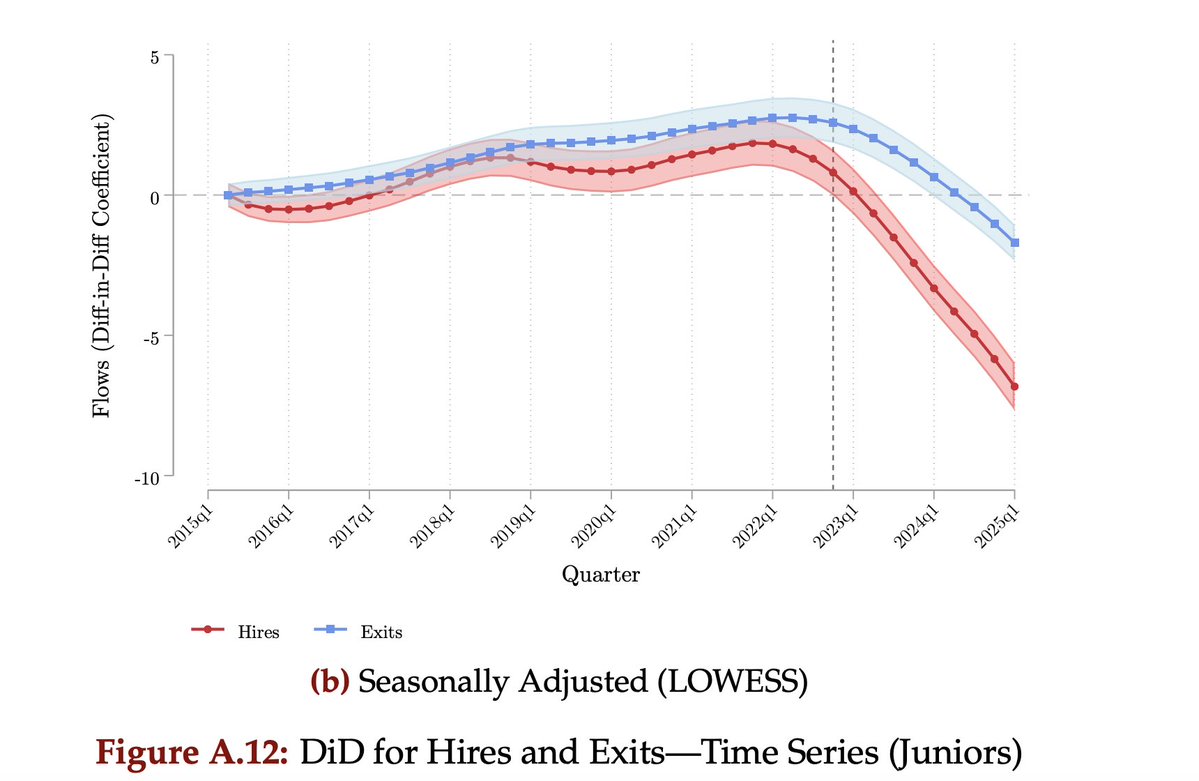
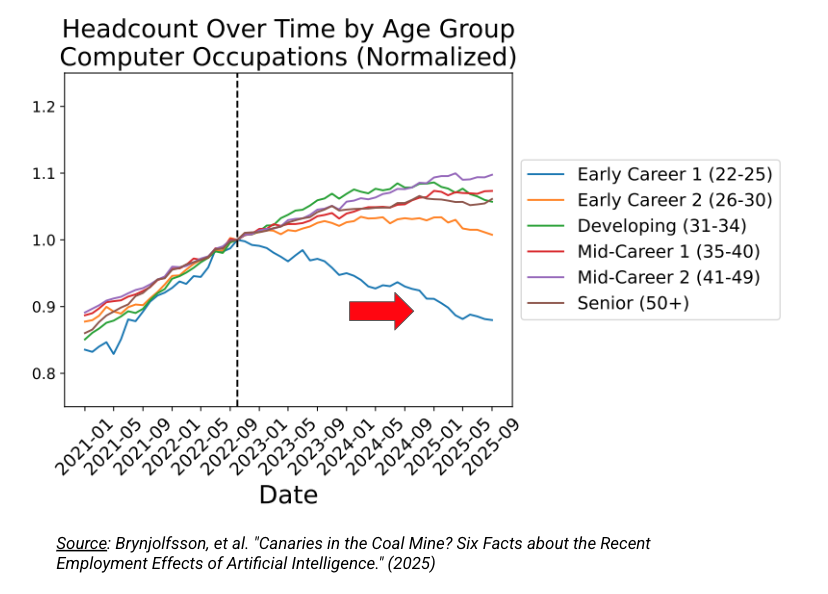
New grads are the ones hurt most by AI automating junior dev tasks. Since 2022, early-career swes (ages 22-25) have seen ~20% job decline per @Stanford @DigEconLab, controlling for interest rates and firm-specific shocks eg, COVID over-hiring by big tech For the first time in decades, recent grads have higher unemployment rate than the national average. In addition, the “underemployment rate” for recent graduates has risen to 42.5% (Q4 2025, @NewYorkFed). Certainly end of ZIRP doesn't help, but @erikbryn et al. used firm-time fixed effects (β_{f,t}), quintile fixed effects (α_{f,q}), and debt sensitivity measures to show this is not primarily macro/rate-driven but due to AI. Source: digitaleconomy.stanford.edu/publications/c…
Clara Shih tweet media
English
1
0
18
2.6K