Claudia

14 posts

Claudia banner
Claudia

Claudia

@Claudia_ToBez

Katılım Kasım 2023
45 Takip Edilen18 Takipçiler
Claudia
Claudia@Claudia_ToBez·
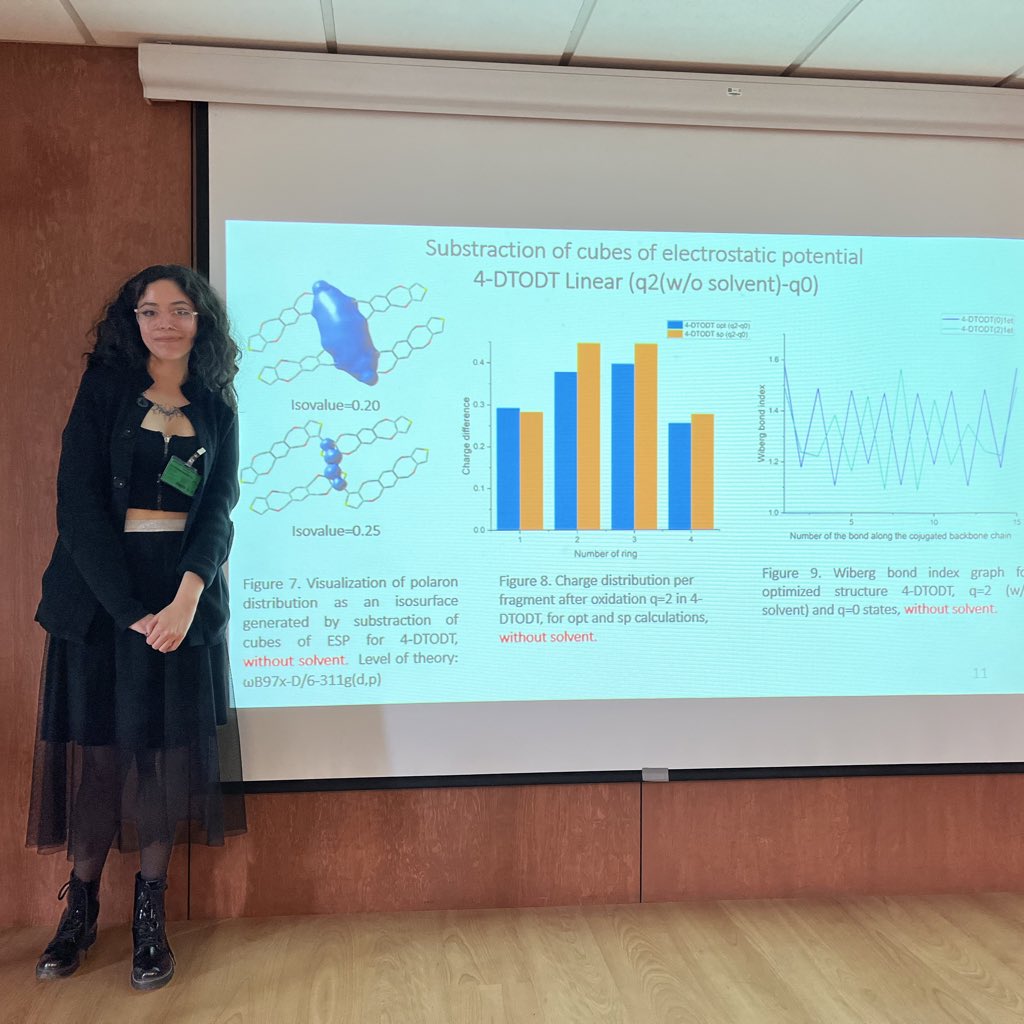
@TripletStateGuy @LatinXChem Sure! The structure type affects polaron localization/delocalization, and this, along with other factors like chain bending, influences the conductivity of polymers. Understanding the mechanism of charge transport is important for improving the properties of conducting polymers.
English
0
0
0
22
Claudia
Claudia@Claudia_ToBez·
@casaltmrn @LatinXChem This higher loss of electronic density is a descriptor for the self-trapped charge, and this descriptor, along with the Wiberg bond index to observe the change from benzoid to quinoid structures, helps to identify where the polaron resides!
English
0
0
0
17
Mariana Casal
Mariana Casal@casaltmrn·
@Claudia_ToBez @LatinXChem Hi Claudia, nice work! You show a plot of charge difference versus fragment. How do you compute the charge difference? Also, it is interesting that the charge difference is higher in fragments 2 and 3. What do those fragments relate to? Do you have insights on why this happens?
English
2
0
0
48
Claudia
Claudia@Claudia_ToBez·
@casaltmrn @LatinXChem Hi Mariana, Thank you! The charge difference refers to the oxidized state minus the neutral state, allowing us to observe how the electronic density changes. A higher charge difference indicates a greater loss of electronic density.
English
0
0
0
35
Claudia
Claudia@Claudia_ToBez·
@icorraluam @LatinXChem Hi! Thank you! You are right, q stands for the charge. The stability of the wavefunction is to study if the triplet or singlet state is preferred for q=2. From NBO analysis it was obtained the natural charge, as well as the Wiberg bond index.
English
0
0
0
50
Ines Corral
Ines Corral@icorraluam·
@Claudia_ToBez @LatinXChem Hi Claudia, Nice poster! Does q stand for the charge? What is the point of undertaking a wavefunction stability analysis? What do you learn from the NBO analysis in this work? Thanks
English
1
0
0
50
Claudia
Claudia@Claudia_ToBez·
@GustavMondragon @LatinXChem Hola Gus, gracias! Sobre tu pregunta, pienso que sería un acercamiento interesante, para poder estudiar oligomeros más grandes y comparar mejor la formación del polaron, pero MD es una técnica con la que estoy menos familiarizada, me gustaría intentarlo en un futuro
Español
0
0
1
86
Gustavo Mondragón
Gustavo Mondragón@GustavMondragon·
@Claudia_ToBez @LatinXChem Hola Clau, interesante póster :) las estructuras que muestras son grandes, y debido a ello, más de una conformación puede estar contribuyendo a la localización/deslocalización de polarones. ¿Han pensado en usar MD para estudar efectos dinámicos en estas estructuras?
Español
1
0
1
107
Claudia
Claudia@Claudia_ToBez·
@panchajaviera @LatinXChem We are considering studying the interaction of the oligomers with a solvent explicitly later on. For now, we are more focused on an overall comparison of polaron formation in the different structures, and the implicit solvent helps to avoid overestimating the polaron.
English
1
0
0
34
Claudia
Claudia@Claudia_ToBez·
@panchajaviera @LatinXChem Second, regarding the use of PCM: it was to account for the presence of the solvent in polaron formation. Initially, we tried SMD and CPCM. SMD gave results that were not very appropriate for what we expected, and the difference with CPCM was small. In the end we went with PCM.
English
0
0
1
74
Claudia retweetledi
Joaquin Barroso
Joaquin Barroso@joaquinbarroso·
So proud of Claudia Torres and the fantastic work she’s doing on the electronic structure of organic conductive polymers! Congrats!
Joaquin Barroso tweet media
English
1
1
29
1.4K