Pierre Colmez

3.3K posts

Pierre Colmez banner
Pierre Colmez

Pierre Colmez

@ColmezPierre

Mathématicien, ancien joueur de (tsume)go

Katılım Nisan 2020
1 Takip Edilen861 Takipçiler
David Savitt
David Savitt@dsavitt·
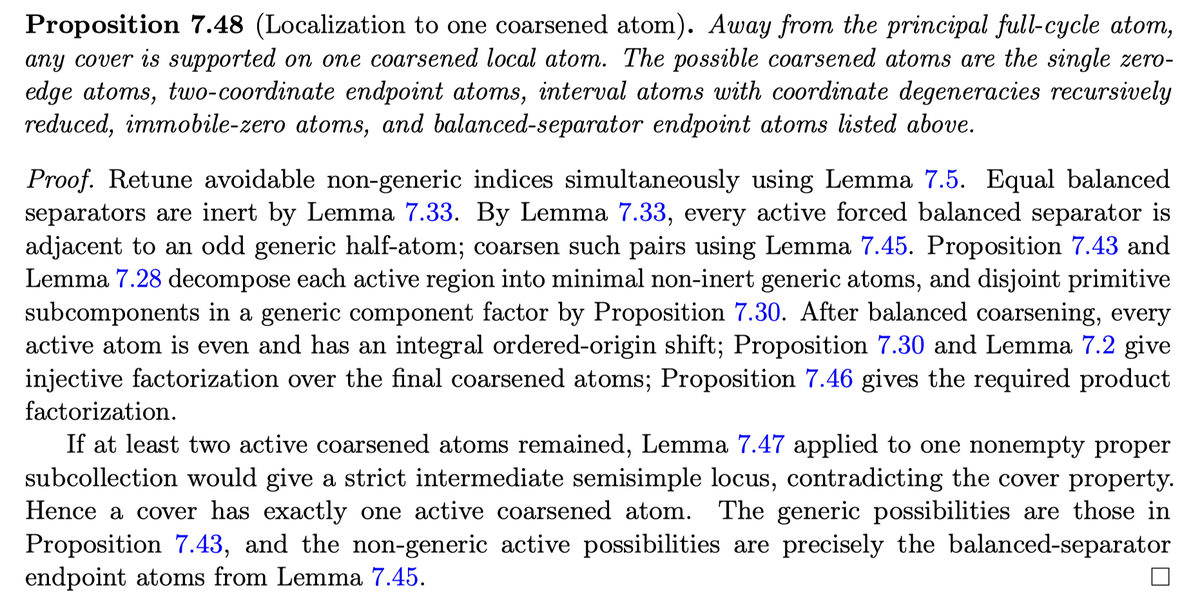
@marcusgnt I mean I'm pretty sure it solved the problem I asked it to solve (will only know for sure when the formalization is done) but this is horrifyingly unreadable. I'll have to try turning the formalization back into natural language to see if that's any better.
English
2
1
1
217
David Savitt
David Savitt@dsavitt·
Well, good luck everybody.
David Savitt tweet media
English
1
1
7
1.7K
Pierre Colmez
Pierre Colmez@ColmezPierre·
@nb4ld @SergeZaka Ça m'étonnerait fort que la cryptographie américaine soit en accès libre....
Français
0
0
0
10
Nicolas
Nicolas@nb4ld·
L'exemple à suivre en la matière, c'est celui des US : absolument tout ce qui est produit par l'administration est open-source / open-data / domaine public. Le Météo-France américain a interdiction de faire du business avec. Et ça les protège : quand Trump voulait couper les crédits, toute l'industrie s'est levée pour les défendre.
Français
2
4
23
3.5K
Nicolas
Nicolas@nb4ld·
Les données de Météo-France, 415 millions par an, permettent à des millions de citoyens d'en profiter. Avant, ça, elles coûtaient pareil au contribuable mais restaient à dormir dans des placards. Voir mon article de 2014 sur le sujet : « comment j'ai failli faire doubler le chiffre d'affaire de Météo-France à moi tout seul » ➡️ blog.bacpluszero.com/2014/06/26/com…
Ulrich Rozier@UlrichRozier

Les données de Météo-France, 415 millions d'euros par an, entraînent gratuitement l'IA de Google clubic.com/dossier-612820…

Français
5
41
346
61.1K
Pierre Colmez
Pierre Colmez@ColmezPierre·
Michael 英泉 Eisen@mbeisen

Too many threads on going on, so going to try to consolidate. I don't think anyone objects to the core principle nominally at play here that if you put science out into the world, you are responsible for that work. This is what science is. I don't want to get distracted by questions of authorship or how responsibility is apportioned amongst authors - that's an orthogonal issue. The expectation that you can trust the scientific outputs (and I'm intentionally broadening this beyond papers) of others is really a defining feature of science as a collective endeavor. And obviously, if a paper contains hallucinated references, fake citations, placeholder text, or obvious autogenerated junk, it’s hard to argue the authors exercised even minimal scholarly care. People have tried to paint me and the others who have expressed concern about the new arXiv policy as somehow questioning this. We're not. To me something deeper shift is represented by that move, and I think it warrants at least acknowledgment - and IMO deeper discussion. The value of preprint servers to the research community comes from them being fast, open, effectively unfiltered, and agnostic about correctness. A lot of great science is published first on arXiv and other preprint, and so is a lot of science that is poorly executed and often poorly presented. Since the existence of the later doesn't devalue the former, it's a bargain most people are happy with. One of the things that kept this model afloat was the fact that producing a paper required some non-trivial effort, and therefore people inclined to produce works that could en masse disrupt the ecosystem could not actually produce them at scale. AI has obviously shattered any remnant of connection between things that look like papers and scholarly output and effort (mind you, I think this is a good thing, but that's also a somewhat separate topic). **But the response to it has also broken something.** arXiv (and other preprint servers) have always had to impose some kind of screening to keep out obviously inappropriate stuff, and I think most of us agree that asking "Is this an actual work of science?" before posting something is a reasonable thing for a preprint server to do (provided that the definition of what a work of science is is intentionally fairly broad). However, the new policy is explicitly changing that bargain. The question is no longer "Is this a relevant scholarly work?" Rather it is becoming "Can we trust this authorial process?". That is a HUGE shift. Look, I understand why moderators feel existential pressure - the system isn't architected in infrastructure, processes or modes of use with a massive flood of AI-generated papers. But there are some real risks in the new direction. 1) The thing that makes preprint servers different from (and better than) journals is that there is no gatekeeping. The new policy threatens this. Once moderation becomes about inferring authorial integrity, the boundary between “quality control” and “editorial policing” gets blurry. The fact that one of the 'punishments' is to force people to go through peer review before posting to arXiv (an idea too absurd to even mock), suggests that current leadership has a comfortable relationship to journal peer review that makes the risk that arXiv will become a journal in every meaningful sense more of a risk. 2) “Incontrovertible evidence” sounds, well, incontrovertible, but moderation systems take on a life of their own via various forms of procedure, precedent and social signaling. Today it’s hallucinated references. Tomorrow it could become stylistic mimicry. Slippery slope here. 3) The policy misdiagnoses the real problem. As I've said elsewhere, the issue is not “AI use” but the system that leads people to think it will benefit them to push slop onto arXiv. LLMs may amplify the negative effects of metric-driven academia, but they didn't create it. To me we are at a fork in the road moment. There is a world within our grasp where an alignment of preprinting and AI actually breaks the toxic stranglehold that traditional publishing has on science. A world where actual communication (not the facsimile of it we have today) takes place between people, between machines and from people to and from machines, around data and ideas in science. But there is also a world where the preprint servers we love collapse in fear and a lack of imagination into irrelevancy and we lose to moment. I'm not saying this policy itself will cause that. But I am saying that it's not a good sign.

ZXX
0
0
1
153
Pierre Colmez
Pierre Colmez@ColmezPierre·
ArXiv on full dictatorial mood again... looking forward to see people leaving Academia getting colleagues they don't like being banned for life by making them co-authors of a flagged paper...
Thomas G. Dietterich@tdietterich

Attention @arxiv authors: Our Code of Conduct states that by signing your name as an author of a paper, each author takes full responsibility for all its contents, irrespective of how the contents were generated. 1/

English
1
0
4
624
Daniel Litt
Daniel Litt@littmath·
@mathandcobb The person who submitted should have been sent a code to share with you!
English
3
0
5
299
Daniel Litt
Daniel Litt@littmath·
Re: arxiv LLM policies, it is now trivial to catch hallucinated citations, obvious LLM “if you’d like I can etc.” text, and so on, *by using current-gen LLMs*. What we really want is for output to be proof-of-thought, for which the mere existence of a paper no longer suffices.
English
26
18
359
24.6K
Pierre Colmez
Pierre Colmez@ColmezPierre·
@tdietterich @arxiv That will be a lot of fun in domains where papers have an infinite numbers of co-authors...
English
1
0
5
853
Thomas G. Dietterich
Thomas G. Dietterich@tdietterich·
Attention @arxiv authors: Our Code of Conduct states that by signing your name as an author of a paper, each author takes full responsibility for all its contents, irrespective of how the contents were generated. 1/
English
116
835
5.1K
928.9K
Où va l'Argent ?
Où va l'Argent ?@ouvalargentfr·
🔴 CHIFFRES - La smicardisation touche également les professeurs. Salaire d'un professeur en fin de carrière : - 1980 : 4,1 SMIC - 2024 : 1,9 SMIC Salaire d'entrée : - 1980 : 2,1 SMIC - 2024 : 1,1 SMIC.
Où va l'Argent ? tweet media
Français
153
384
823
59.7K
Pierre Colmez
Pierre Colmez@ColmezPierre·
@yefiroth Il faut juste ne pas utiliser les DM pour l'évaluation. Les DM doivent être présentés aux étudiants comme une aide pour l'assimilation des notions, aide qui devient inutile s'il n'y a pas de réflexion personnelle.
Français
2
0
20
1.5K
!!!
!!!@yefiroth·
C'est dingue comment en trois/quatre ans l'IA a rendu obsolète l'évaluation des mathématiques sous forme de travail à la maison. Un TP à finir à la maison ? c'est mort Un DM sur une notion originale ? c'est mort
Français
20
9
197
46.9K
Valeriy M., PhD, MBA, CQF
Valeriy M., PhD, MBA, CQF@predict_addict·
Vladimir Arnold on French Bourbaki math: Unfortunately, it was an ugly twisted construction of mathematics like the one above which predominated in the teaching of mathematics for decades. Having originated in France, this perversity quickly spread to the teaching of foundations of mathematics, first to university students, then to school children in all specializations (first in France, then in other countries, including Russia). To the question “what is 2 + 3” a French primary school pupil replied “3 + 2, since addition is commutative”. He did not know what the sum was equal to and could not even understand what was being asked! Another French pupil (quite rational, in my opinion) defined mathematics as follows: “there is a square, but that still has to be proved”. Judging by my teaching experience in France, the university students’ idea of mathematics (even those taught mathematics at the Ecole Normale Supérieure: I am sorriest of all for these obviously intelligent but deformed young people) is as poor as that of this pupil. For example, these students have never seen a paraboloid and a question about the shape of the surface given by the equation xy = z 2 puts the mathematicians studying at ENS into a stupour. Drawing a curve given by parametric equations (like $x = t^3 − 3t, y = t^4 − 2t^2$) on a plane is a totally impossible problem for them (and, probably, even for most French professors of mathematics).
English
2
6
36
26.5K
Pierre Colmez
Pierre Colmez@ColmezPierre·
@YuDai_Tsai In chess, you can have fun playing against a computer, and a game is limited in time. You can do olympiad type maths this way, but this is far from what actual Mathematics are about.
English
1
0
1
75
Pierre Colmez
Pierre Colmez@ColmezPierre·
If AI turns into a device proving for you the lemmas that would be easy for experts, Mathematics would be a lot of fun. If AI starts solving our problems, people sufficiently old would enjoy the show, but they would be the last generation doing maths. Not a joyful perspective...
jacob tsimerman@Jacob_Tsimerman

I want to clarify my thoughts on problem-solving in mathematics, and the potential consequences of AI for the field. For context, I’m quoting here my post in reply to Daniel Litt (who, echoing others, I find very clear, grounded, and insightful in his thinking). The claim The short version is that I think problem-solving is an immense, and pervasive part of modern mathematical research. Consequently, if human problem-solving disappears by virtue of the AIs becoming strictly and substantially better at it, then most of the time currently spent by modern mathematical researchers will have to be spent on an activity that is altogether pretty different. Whether such an activity is viable as a professional endeavour is something I am unsure of, but strongly encourage others to think about and try to envision, so that if/when the time comes, we can steer such a future into being. Allow me to make this somewhat concrete: by problem-solving I mean questions of the form “is T true? If so find a proof. If not, find a disproof.” where T is a precise mathematical statement. I’ll also include “find an example of S, if there is one” where S is some structure (variety/category/property/isomorphism/….). The argument Ok. Now as I said (and some have echoed) I spend ~all of my time problem-solving as my primary goal. This has sub-goals, but my entire main research field disappears if someone solves the Zilber-Pink Conjecture in its more general form. This is a single conjecture (precisely stated!) and lots of mathematicians, postdocs, and graduate students are engaged in picking apart special cases of it, trying strategies, finding analogies to develop intuition, etc.. Of course, lots of motivation and intuition and analogizing and understanding have gone into deciding to make the ZP conjecture a focus! But the fact remains that this is now what is being worked on ~all of the time by this community. This is true of many mathematicians. They have a problem (or ten) and spend most of their time doing it. If someone solves it, they have to find a different problem. This can be a big, disorienting process involving a lot of energy, and is neither trivial nor always fun (though often rewarding in the end). People have written a lot about Theory building vs. Problem-solving, and I want to first of all clarify I have nothing against theory building or theory builders! It is a valuable part of mathematics, and while there are differences in perspective between the “camps” there is way more mutual respect and agreement. However, I gather there is a perception that theory-builders spend most of their time not-problem-solving, and I think this is largely untrue. Now I’m not a theory-builder primarily (though I’ve partaken a LITTLE BIT by necessity) so I am outside of my comfort zone. As such, I apologize for mistakes and welcome corrections! But theory-building constantly runs through problem-solving. Let’s say you want to define the right notion of a cohomology theory. Of course you must make candidate definitions. But then what does it mean for it to be the right one? Well, you start asking if it has natural properties. These are T statements. Does it satisfy a Kunneth formula? Is it functorial in the right way? When you have the wrong one you have to find the properties it’s missing, and when you have the right one you have to prove that it indeed has those properties. Again, I am not saying nor do I believe that this makes problem-solving “real math” and theory-building lesser. I am just trying to draw attention to the way I think research mathematicians operate, and mathematics is practiced. To put all this a different way, imagine you had access to an AI oracle that could resolve statements T, but somehow lacked any creativity to build technology or make definitions (I think this is unlikely, but for the purpose of this thought experiment lets imagine it). How would your mathematics change, if you were a theory builder? Well, you make a definition, and want to know if it’s the right one. You immediately ask your oracle a thousand questions. From “are these basic properties true” to “ooh, so is this deep conjecture true?” and start getting back answers, and amending your definitions. You could invent and resolve entire research directions in days. But the confusion you would have had to push through to flesh out your theory would largely (probably not entirely) be instantly resolved and the whole process sped up tremendously by your oracle. A big part of the process would be gone. This is very very different to modern mathematics. One more thought This post is too long already, but I’ve seen some people say that they only do mathematics to find truth and others valourize that as the only virtuous way to be. I do not do mathematics only to find truth. I do it largely because I enjoy it and I am good at it. I also find it beautiful and am grateful I get to spend my days understanding beautiful things. But I enjoy the challenge, the process, resolving confusions, finding strategies, grappling with problems. I would like to push for this being de-stigmatized. Mathematicians are people who need money, housing, food, love, exercise, and a great deal of other stuff including various forms of meaning. There are many people whose primary enjoyment of math comes through problem solving in one of its incarnations. If that disappears, that is not a trivial issue and many of them might not want to do it anymore (even if there were some way to proceed).

English
11
1
45
5.6K
Mattia Apicella
Mattia Apicella@MattiaApic91321·
@ColmezPierre the first options mean: "if we literally get stuck forever with today's ai"
English
1
0
0
181
Pierre Colmez
Pierre Colmez@ColmezPierre·
@antoineducros You could hope that it would be able to do variations on existing Mathematics, but not combine too many of these variations.... wishful thinking, I know....
English
0
0
2
248
Antoine Ducros
Antoine Ducros@antoineducros·
@ColmezPierre I cannot imagine a situation where AI is able to show easy lemmas but does not quickly improve to the stage where it can prove deep and interesting theorems... Ok, there should be a theoretical limit to the AI abilities, but I doubt this limit is precisely designed to please
English
2
0
13
488