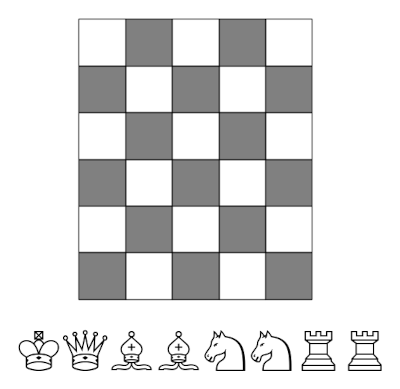
Placing all six chess pieces on a 6 by 5 board so that no piece attacks another.
Solution using Claude to generate Z3/Python.
johndcook.com/blog/2026/06/2…
“One of the main causes of the fall of the Roman Empire was that-lacking zero-they had no way to indicate successful termination of their C programs.” — Robert Firth
Deleting a file looks weightless.
No smoke. No sound.
No visible wound in the universe.
But physics says something stranger: when information is truly erased, the world must pay a small thermodynamic price.
This is Landauer’s principle.
In 1961, Rolf Landauer, working at IBM, asked a question that sounded almost too philosophical for engineering:
What is the physical cost of computation?
The answer was not hidden in the screen. It was hidden in the word erase.
A bit can be 0 or 1. If you reset it to 0, regardless of whether it began as 0 or 1, you have destroyed information about its past state. Two possible histories have been compressed into one final result.
That is not just a logical operation.
It is a physical act.
Landauer’s insight was that logical irreversibility becomes physical irreversibility. If a computation throws away information, the missing distinction does not simply vanish into nothing. The entropy has to go somewhere.
Usually, it goes into the environment as heat.
The famous bound is:
E ≥ kBT ln 2
Here, kB is Boltzmann’s constant, T is temperature, and ln 2 appears because one bit has two possible states.
At room temperature, this energy is incredibly tiny, around 3 × 10⁻²¹ joules per erased bit. Your laptop wastes vastly more energy than this for practical reasons: resistance, imperfect circuits, speed, error control, architecture.
But the principle is not about today’s inefficient machines.
It is about the basement floor of physics.
Landauer’s principle tells us that information is not an abstract ghost. A bit must live somewhere: in a voltage, a magnetic domain, a trapped particle, a quantum state, ink on paper, or neurons in a brain.
To change information, you must change a physical system.
To erase information, you must erase a physical distinction.
This also helped clarify Maxwell’s demon, the imaginary creature that seemed able to beat the second law of thermodynamics by sorting fast and slow molecules.
The demon’s trick depends on information. It measures molecules, remembers results, and uses that knowledge to extract work. But to keep operating, the demon must reset its memory.
That erasure has a cost.
The demon does not defeat thermodynamics.
It becomes part of thermodynamics.
This is why Landauer’s principle is so beautiful. It does not make physics more mystical. It makes information less mystical.
The lesson is not that thoughts create reality or that the universe is magically made of data.
The lesson is more disciplined:
Knowledge needs a body.
Memory needs a medium.
Forgetting leaves a trace.
In ordinary life, deleting something feels like making it disappear.
In physics, disappearance is never so innocent.
Even a lost bit has to go somewhere.
“Having functional programming as an ideal doesn’t imply that programs should never have side-effects. It just means that they should have no more than necessary.” — @paulg, On Lisp