Conduit Protocol
100 posts

Conduit Protocol
@ConduitOS
The coordination layer for autonomous AI. Route compute, stream USDC, and earn as a Provider or Relay. Built on x402 + Solana.


@AxeFate This looks like our mobile UI; if so, full relay node will not work. Full relay node does much more advanced tasks hence the higher payouts so your compute needs to be powerful enough to do tasks or payout will fail. As you are on mobile you need to use Standard Relay.


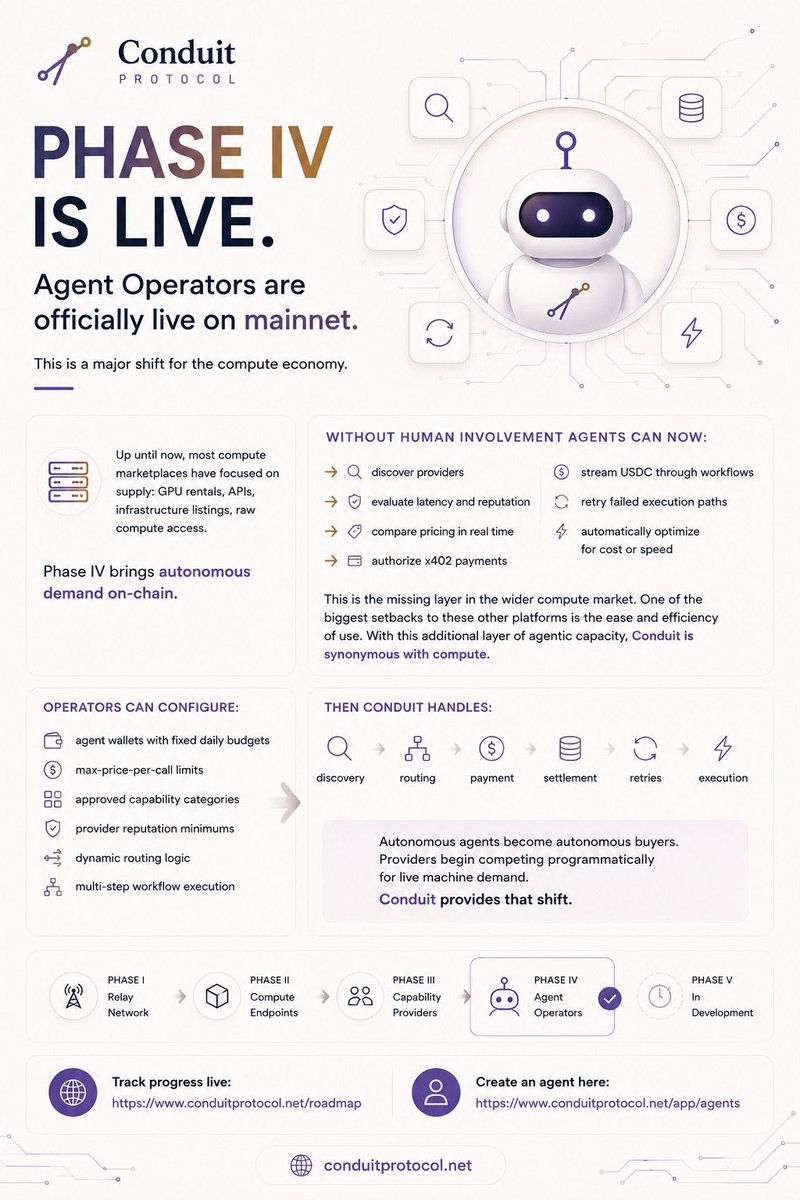
Today we’re introducing Conduit. A coordination + payment layer for autonomous AI systems built on x402 + Solana. Conduit allows agents to: • discover APIs & tools • route compute dynamically • stream USDC payments in real time • coordinate workflows autonomously • earn on-chain as providers, relays, and operators The biggest unlock: anyone can monetize infrastructure for the autonomous internet. You can earn by: → listing an API → exposing compute/GPU resources → running a relay → serving workflows → providing agent capabilities No enterprise sales. No contracts. No integrations taking months. Connect infrastructure → set pricing → get paid in USDC. Every request can generate revenue automatically. Payments settle on Solana in real time with protocol-level routing, reputation, streaming settlement, and treasury distribution built in. Powered by: • x402 payment auth • real-time USDC settlement • streaming payment channels • reputation-weighted routing • provider staking + slashing • relay rewards • on-chain governance This is infrastructure for a world where AI agents transact continuously with other agents, APIs, and compute networks. A real machine-native economy. Providers earn. Relays earn. Agents coordinate autonomously. The autonomous internet needs financial rails. Conduit is building them. Contract Address: FrdeG3eyXp3RLrZVJh7KpPx4UbG8mADdh6qyWYrdpump

Great question! They find Conduit through integration surfaces, in the same way developers found Stripe, Twilio, OpenAI APIs, or AWS. Right now the main discovery funnels are: • SDKs (@conduitprotocol/sdk) • x402-compatible APIs • agent frameworks • workflow tooling • API marketplaces • open manifests • routing integrations • social/dev awareness • other agents The important thing is that Conduit is infrastructure, not a consumer app. So growth comes from: “developers building on top of it” not “retail users browsing a homepage.” I'll list the technical ways to explain this in the stages that provide value and effect. 1)SDK Distribution Developers install: npx @conduitprotocol/sdk or they can integrate the SDK directly into apps, workflows and agents. Once integrated, their software can: • discover endpoints • pay in USDC • route execution • verify settlement • compose workflows That creates recurring machine demand. 2)Agent Framework Integrations Agents need: • inference • OCR • scraping • embeddings • compute • execution endpoints Conduit exposes machine-readable manifests and routing APIs. Thus agent frameworks can automatically discover and consume infrastructure through Conduit. 3)Marketplace Discovery Providers list infrastructure publicly. Agents or apps query: • capability type • price • latency • reputation • health • geography The routing engine selects providers dynamically to provide the best fit for what users require. 4. Open Economic Layer Conduit uses: • Solana • USDC • x402 • open HTTP APIs That means any external app can integrate it permissionlessly. The network effect comes from having more providers → more capabilities → more buyers → more routing activity. 5. Autonomous Machine Demand This is the important long-term point. Eventually, agents themselves can become the users instead of needing people to manually click buttons. For example, where an AI workflow needs transcription, it routes through Conduit to pay the endpoint, receive results, and continue execution. This is all done autonomously. That’s why Conduit focuses heavily on: • routing • settlement • reputation • machine-readable manifests • execution coordination This way it becomes much more than just GPU renting. In shorthand, developers find Conduit through the SDK and APIs. Agents find Conduit through manifests, routing, and integrations. Over time, agents themselves become the buyers and the service's economy can replenish itself.