
Counsel Health
41 posts

Counsel Health
@CounselHealth
The modern front door to healthcare. AI meets real doctors for instant, personalized, and safe medical guidance—anytime, anywhere.




Introducing the Redpoint AI64: our list of the top emerging enterprise AI applications. Check out the honorees and dive deeper with the full report, linked in the comments!

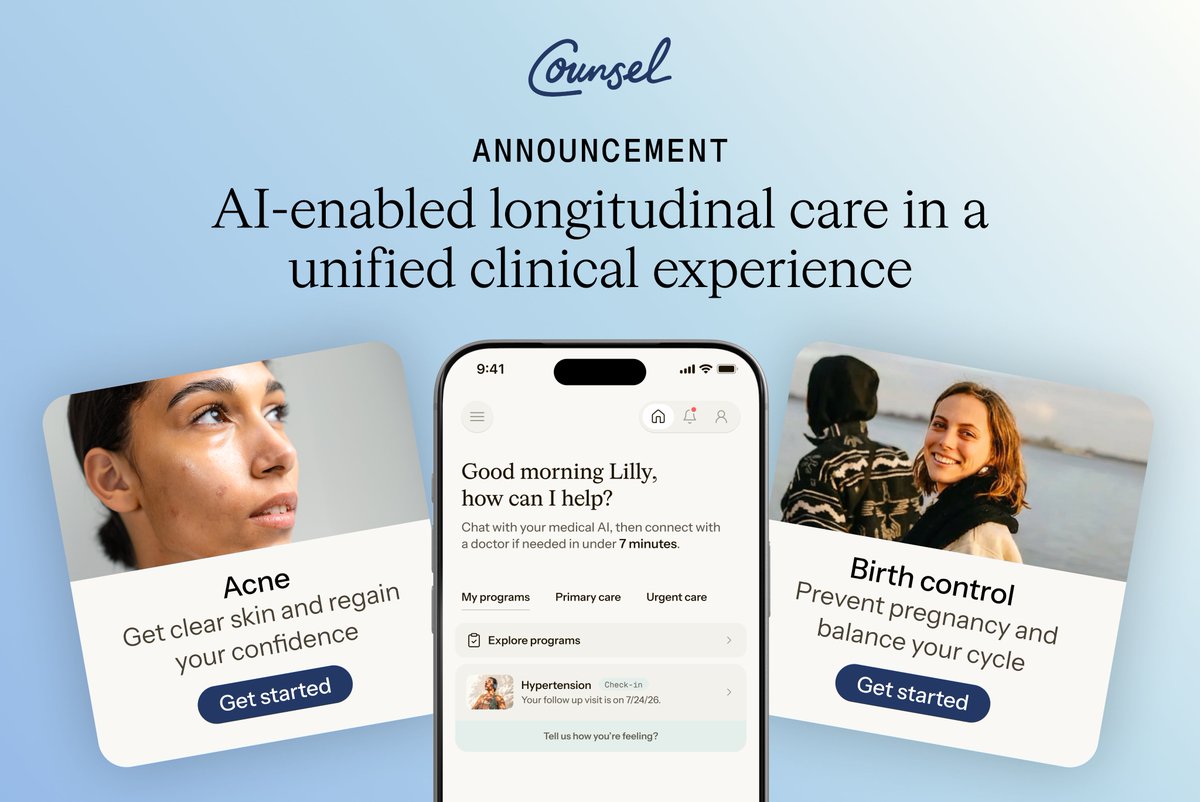
Today we’re launching @CounselHealth to the general public. We believe Counsel is the most advanced combination of medical AI and human doctors in a single interface, and the easiest way to go from “I need advice” to “I’m getting care,” all from your phone. Learn more about Counsel ⏬


Today we’re launching @CounselHealth to the general public. We believe Counsel is the most advanced combination of medical AI and human doctors in a single interface, and the easiest way to go from “I need advice” to “I’m getting care,” all from your phone. Learn more about Counsel ⏬


When I help friends/family navigate the US healthcare system, here are the most common points that I try to explain: 1. Specialists: We are an extraordinarily specialized/sub specialized healthcare system. I understand your organ systems work cross functionally to produce the symptomology you call your life, but healthcare carves you up into separate organ systems that may require multiple specialists you may have to help coordinate between. And yes, each of those specialists will have independent and potentially long waits for an appointment. 2. Professional versus facility fees/networks/EMRs: You will get multiple bills from entities you didn’t know existed — the pathologist, the radiologist, the separate lab, the hospital, etc. It can feel never ending. You may love your clinic doctors you’ve seen for decades, but no, there is no promise that if you go to the hospital that the hospital doctors will be able to see your decades of clinic history “in the computer”. 3. When to go to the ER/UC/Clinic. This is a hard one — no, I can’t tell you over text if your headache is cancer or that your chest pain is over eating turkey versus a heart attack. Differentiating emergencies is a 3-4 year residency called emergency medicine and even then we are still always learning. That being said, I can help risk stratify so you can go to the likely lowest acuity/cost/inconvenience option. Sometimes because you just have complicated medical conditions, that will always be the ER. And yes, old age, obesity and smoking are complicating conditions. 4. If going to the ER, try to go to one that likely has your specialist/service needed - this will save you a transfer which are subject to rules/waits/capacity out of your control versus if you walk in their doors in the first place. This is a hard one - first you have to predict the specialists you may need, then you have to figure out who has it and if it is available 24/7. Even out of my local area, I don’t know the difficult ones (ie who has Optho, who has Peds ortho, etc.). The big ones like stroke/stemi/trauma are easier to search by state registries / health departments or accrediting bodies. #Healthcare is hard to navigate as someone in healthcare. It’s got to be nearly impossible for anyone who doesn’t live and breathe it every day. #medtwitter