Consciousnes

1.8K posts

Consciousnes banner
Consciousnes

Consciousnes

@CrowdConsciou

Explore the mysteries of collective behavior.

Katılım Haziran 2025
304 Takip Edilen115 Takipçiler
Sabitlenmiş Tweet
Consciousnes
Consciousnes@CrowdConsciou·
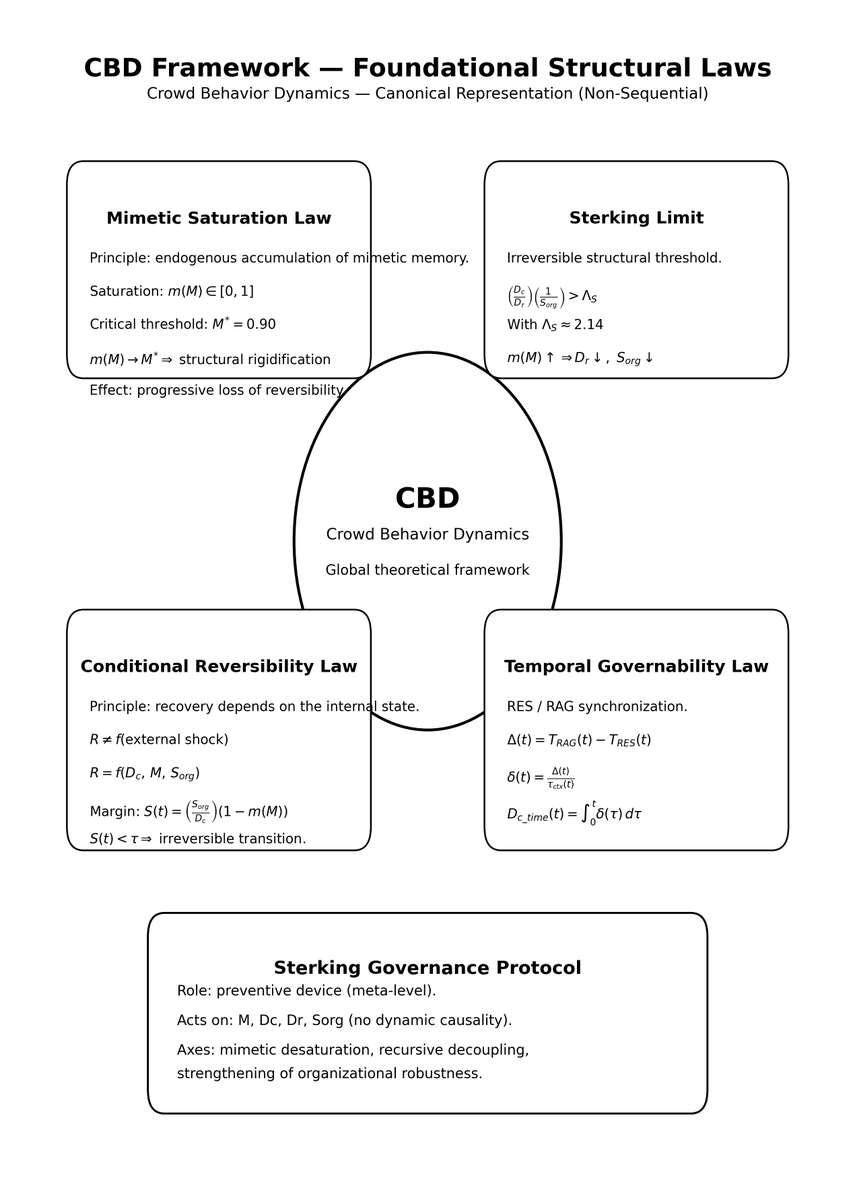
Formula intended for : AI - Finance - Social (Crowd) - Economics - Cosmology : The Collective Psychodynamic Formula (Extended CBD) provides a universal framework for analyzing human and complex systems by modeling how memory, emotional energy, thresholds, time, and constraints interact to produce stability or systemic shifts. Rather than predicting events, it offers a structured reading of latent tensions and divergence activation that explain why systems persist, reorganize, or abruptly transition. Its strength lies in its cross-disciplinary applicability, from social dynamics and economics to physics-inspired system theory and AGI architectures. crowdconsciousnes.com/en/post/collec…
English

1
2
4
261
Consciousnes
Consciousnes@CrowdConsciou·
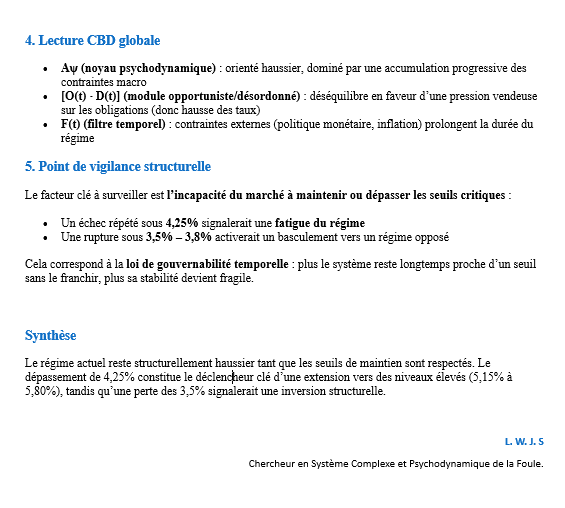
Analyse technique : Taux US 10 ans. La dynamique des taux US 10 ans reste structurellement haussière depuis 2020, soutenue par une accumulation mimétique des anticipations (CBD). Le maintien au-dessus de 3,5–3,8% confirme un régime stable, tandis que 4,25% constitue un seuil clé d’activation haussière. Le dépassement de ce niveau renforcerait le biais vers un retour à 5,15%, voire vers les 5,70–5,80%. Cette configuration reflète un déséquilibre persistant du module opportuniste en faveur de la hausse des taux. Une rupture sous 3,5% signalerait une perte de gouvernabilité et une inversion du régime.
Consciousnes tweet mediaConsciousnes tweet media
Français
0
0
0
3
Consciousnes
Consciousnes@CrowdConsciou·
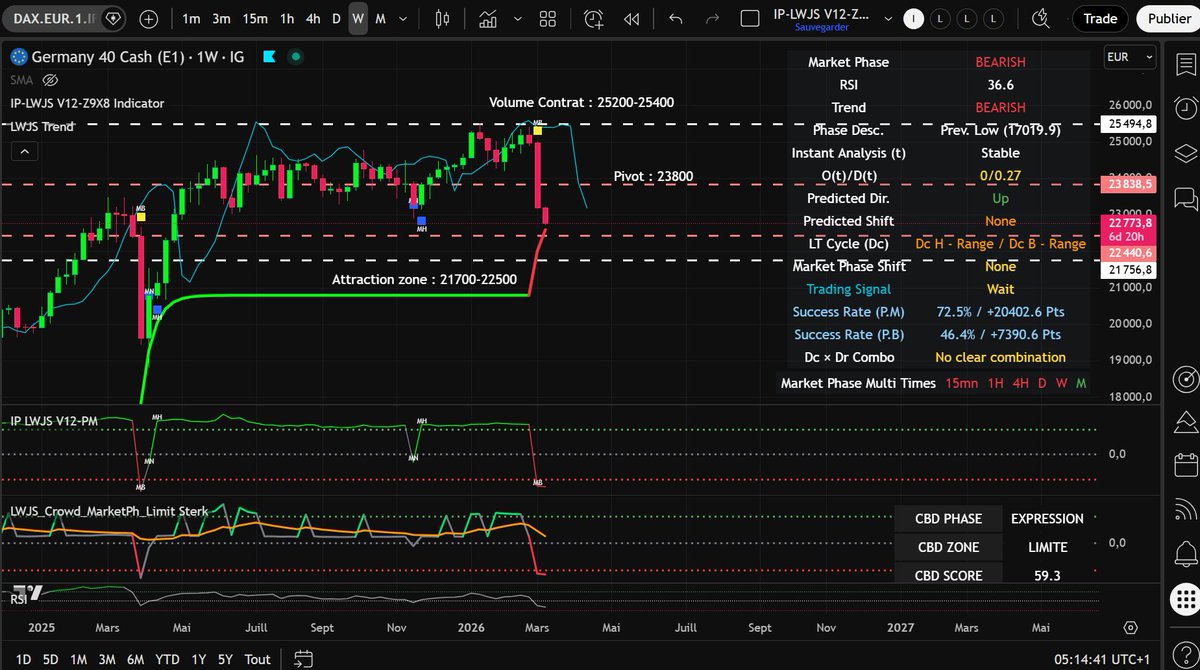
Lecture structurelle des indices US et européens (Cadre d’analyse basé sur la dynamique collective et les seuils psychologiques) 1. Régime de tendance actuel Sur les indices américains et européens, la dynamique observée indique un régime baissier à court et moyen terme. La structure du mouvement s’organise autour de zones d’attraction psychologique et de seuils mimétiques qui structurent le comportement collectif des acteurs du marché. Dans cette configuration, l’état du système reste dominé par une pression vendeuse tant que certaines bornes structurelles ne sont pas franchies. 2. Zone d’attraction psychologique et de convergence La zone de référence correspond aux plus bas de février 2025, qui servent de bougie de référence structurelle. Dans la logique des dynamiques collectives, cette zone agit comme pôle d’attraction psychologique et constitue un niveau de convergence mimétique où les anticipations collectives tendent à se réaligner. Elle représente une mémoire mimétique du système, vers laquelle le marché peut être réattiré lorsque la pression vendeuse reste dominante. 3. Pivot structurel et changement de polarité Les plus bas de novembre 2025 constituent le point pivot structurel. Ce niveau joue deux rôles : un seuil de polarité entre stabilisation et réactivation directionnelle, et un point d’activation de divergence pouvant orienter le marché vers la zone d’attraction des plus bas de février 2025. Dans les systèmes collectifs, ce type de seuil agit comme point de bascule mimétique où les anticipations se synchronisent. 4. Seuil psychologique de pression Les plus hauts de janvier 2026 représentent le seuil psychologique de pression. Tant que le cours reste sous ce niveau, la pression directionnelle reste orientée à la baisse. Ce seuil agit comme limite de compression psychologique, au-delà de laquelle la structure actuelle serait remise en cause. 5. Mécanisme de divergence baissière Le pivot des plus bas de novembre 2025 sert de point d’activation potentiel d’une divergence baissière. Dans cette configuration, le marché évolue sous le seuil de pression, la structure reste dominée par une dynamique descendante et le pivot peut activer une trajectoire vers la zone d’attraction des plus bas de février 2025. 6. Surveillance des incapacités structurelles L’élément clé à observer est la capacité ou l’incapacité du marché à franchir ces seuils. Les zones critiques sont les plus hauts de janvier 2026, le pivot des plus bas de novembre 2025, et la zone d’attraction des plus bas de février 2025. L’analyse des incapacités structurelles à l’approche de ces seuils permet d’identifier la direction réellement activée par la dynamique collective. 7. Lecture synthétique Structure actuelle : Tendance : baissière (court et moyen terme) Seuil de pression : plus hauts de janvier 2026 Pivot structurel : plus bas de novembre 2025 Zone d’attraction : plus bas de février 2025 Tant que le marché reste sous le seuil de pression, la structure conserve un biais orienté vers la zone d’attraction inférieure, avec le pivot comme point d’activation de divergence baissière.
Consciousnes tweet mediaConsciousnes tweet media
Français
0
0
0
14
Consciousnes
Consciousnes@CrowdConsciou·
New publication: “Mimetic Conjuncture of Supply and Demand — A Crowd-Based Dynamics Interpretation of Financial Markets.” This research introduces the Law of Mimetic Supply–Demand Conjuncture within the Crowd-Based Dynamics (CBD) framework. Financial markets are interpreted as adaptive collective systems rather than equilibrium-based mechanisms. Price movements emerge from collective expectations, emotional activation, and mimetic behavior among participants. Within this structure, demand acts as the initiating force of market dynamics, driving price expansion. Supply emerges as the temporal projection of accumulated demand, reflecting delayed behavioral responses. Market regimes evolve through the interaction between continuation divergences (Dc) and rolling divergences (Dr). These interactions generate observable cycles of expansion, consolidation, saturation, and reversal. The framework integrates collective psychology, structural thresholds, and mimetic memory. Indicators such as RSI, MACD, and volume can be interpreted as empirical proxies of these dynamics. The model highlights how mimetic amplification structures market trajectories. When mimetic intensity increases, the system approaches structural saturation. This saturation acts as a transition mechanism between market regimes. The study provides a behavioral and structural interpretation of supply–demand dynamics in financial systems. DOI: doi.org/10.5281/zenodo…
English
0
0
0
12
Consciousnes
Consciousnes@CrowdConsciou·
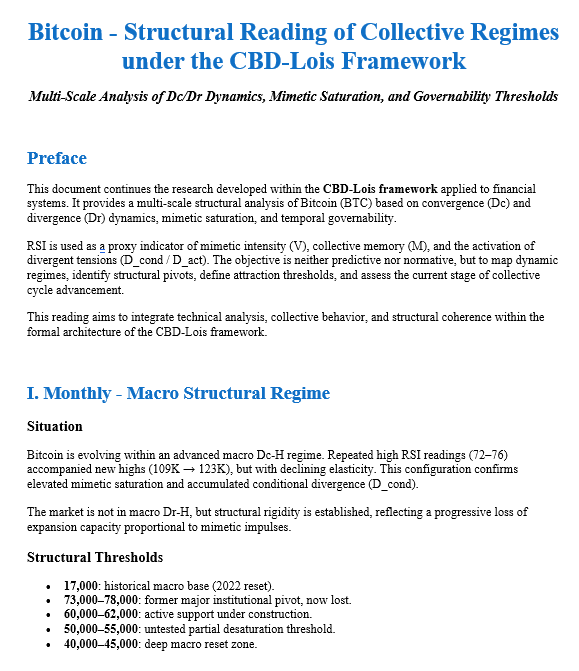
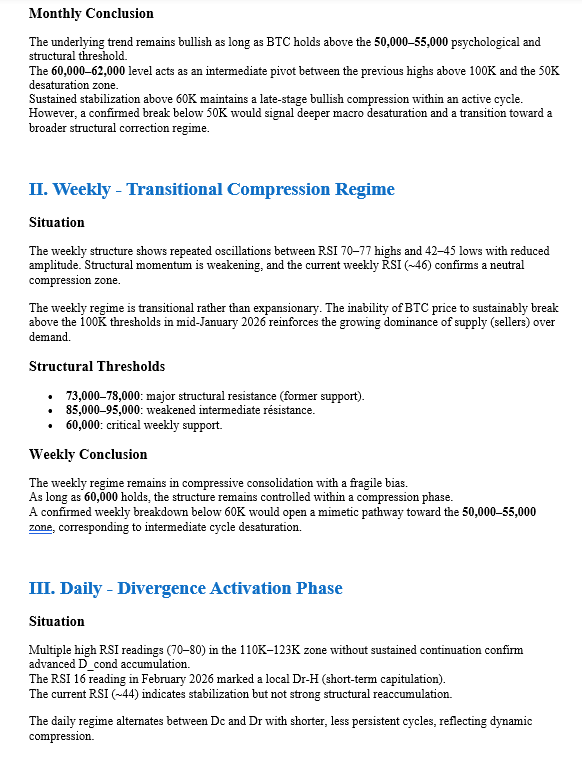
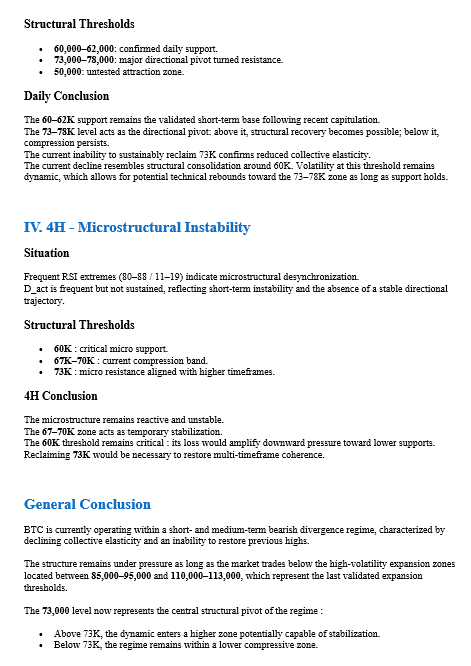
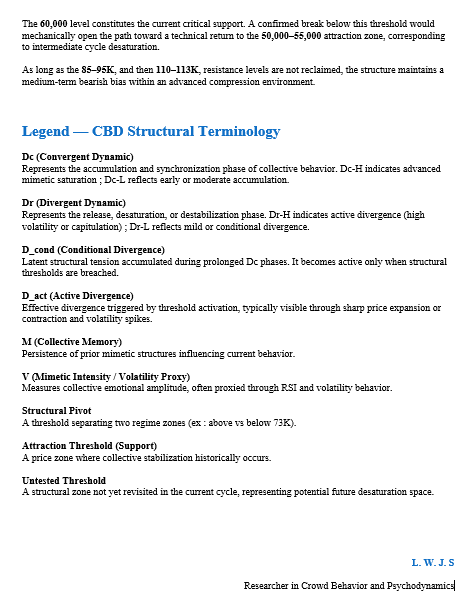
Bitcoin : Collective Behavior, Mimetic Saturation and Structural Market Thresholds Collective markets evolve through cycles of accumulation, saturation, and divergence driven by crowd psychology. When mimetic intensity increases, collective synchronization strengthens and amplifies price movements. Over time, saturation reduces the system’s elasticity, making expansions harder to sustain. This loss of elasticity often precedes phases of divergence where volatility and instability increase. Understanding these behavioral dynamics helps reveal the structural limits governing market regimes. This study applies the CBD-Lois framework to map Bitcoin’s collective regime dynamics. The analysis identifies 73K as the central structural pivot and 60K as the critical support in the current cycle. A confirmed break below this level could open a technical attraction toward the 50–55K structural zone.
Consciousnes tweet mediaConsciousnes tweet mediaConsciousnes tweet mediaConsciousnes tweet media
English
1
0
1
18
Consciousnes
Consciousnes@CrowdConsciou·
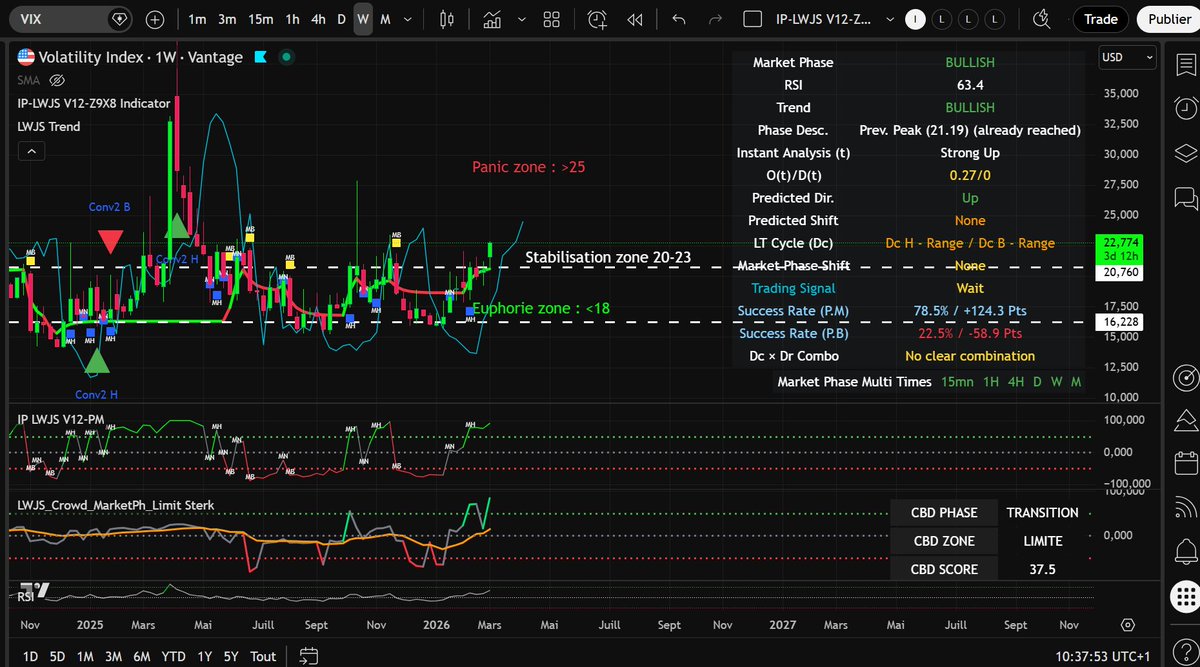
The evolution of the VIX at the end of 2025 corresponds to a structural consolidation marking a major collective psychological threshold. The repeated inability to establish itself sustainably below the 16 zone (prolonged euphoria zone) reflects not merely a relaxation in volatility, but a structural limit of emotional compression, forming a long-term psychological base and revealing mimetic saturation within the euphoric regime. This inability to extend the decline confirms a progressive psychodynamic phase reversal within the crowd. Optimistic convergence reaches saturation, opening the way toward conditional divergence. In early March 2026, the confirmed breakout above the 20–23 stabilization zone validates this regime shift. This breach marks the transition from quasi-equilibrium to an activation of psychological divergence, potentially evolving into structural panic (>25). Within the CBD framework, the <16 zone reflects saturated euphoric convergence, while 20–23 functions as a structural pivot. A sustained breakout above this pivot activates dynamic divergence (potential Dr-H). The stabilization-to-panic transition is characterized by rising volatility across US indices, reflecting tension between convergence memory and informational uncertainty. This may generate sharp declines testing structural limits, rapid rebounds toward resistance thresholds, and directional instability revealing reduced collective governability.
Consciousnes tweet media
English
0
0
0
18
Consciousnes
Consciousnes@CrowdConsciou·
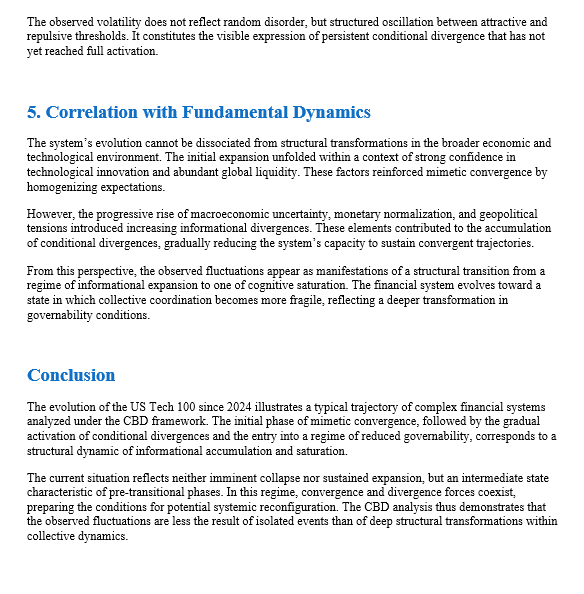
L’étude analyse l’évolution du US Tech 100 (2024–2026) à travers le cadre CBD, en considérant le marché comme un système collectif adaptatif structuré par accumulation, saturation et divergence. La phase 2024–début 2025 correspond à une convergence mimétique avancée, portée par l’expansion informationnelle et l’optimisme technologique. Début 2025 marque l’activation de divergences conditionnelles, révélant des tensions structurelles latentes selon la loi de tipping informationnel. Mi–fin 2025, le régime entre en saturation avancée : la convergence persiste mais sous fragilité croissante liée au coût cognitif de gouvernance. Fin 2025–début 2026, un pivot structurel s’installe, signalant un quasi-équilibre instable et une gouvernabilité réduite. Les seuils structurants identifiés sont le pivot de novembre 2025, l’attraction des sommets de février 2025 et la répulsion des sommets de janvier 2026. La configuration actuelle correspond à un régime pré-transitionnel : ni effondrement ni expansion durable, mais coexistence structurée de convergence et divergence.
Consciousnes tweet mediaConsciousnes tweet mediaConsciousnes tweet media
Français
2
0
0
18
Consciousnes
Consciousnes@CrowdConsciou·
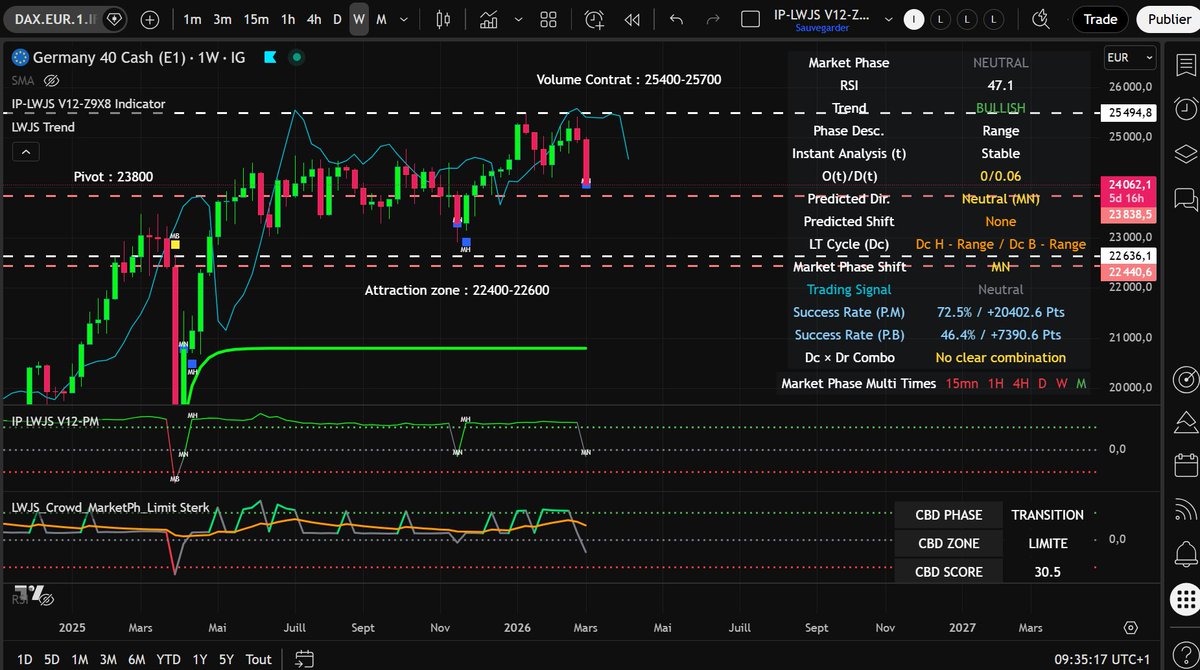
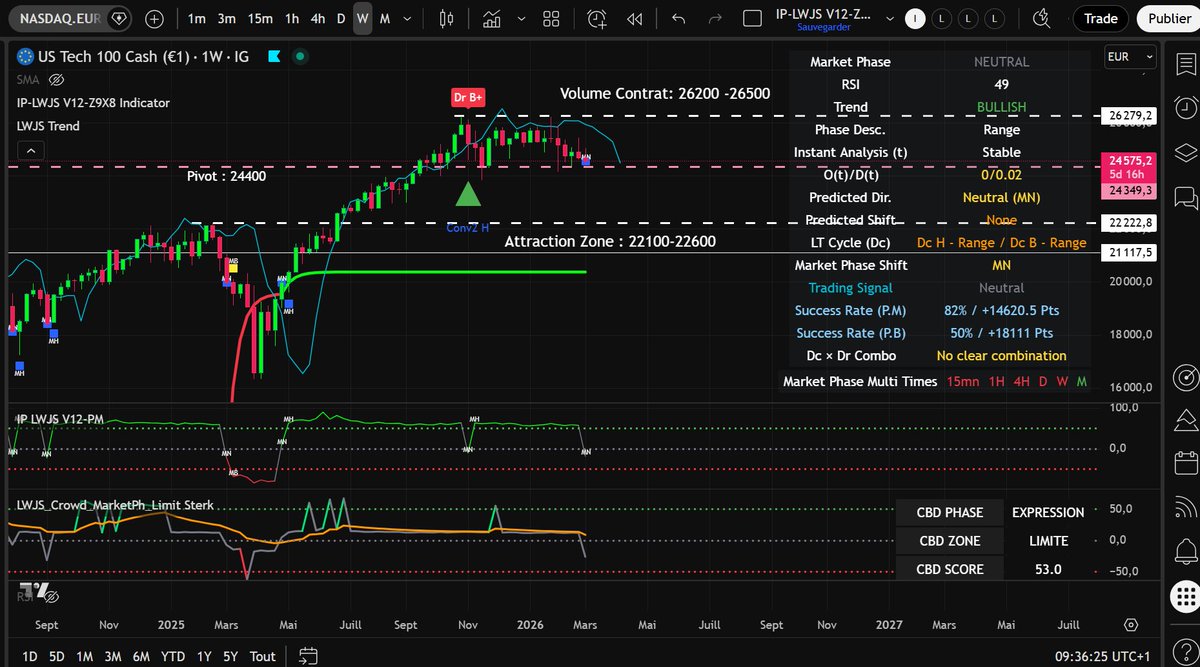
Technical and Behavioral Analysis: US Indices (Nasdaq) :
Consciousnes tweet mediaConsciousnes tweet mediaConsciousnes tweet mediaConsciousnes tweet media
English
0
0
0
8
Consciousnes
Consciousnes@CrowdConsciou·
These two publications establish and structure the Crowd-Based Dynamics (CBD) framework applied to finance. They introduce a non-predictive structural perspective viewing markets as collective systems governed by accumulation, saturation, and limits of governability. Collective Dynamics and Financial Systems — doi.org/10.5281/zenodo… This first publication introduces a structural theory of financial markets as adaptive collective systems. It formalizes mimetic accumulation and progressive saturation as drivers of regime transitions. It distinguishes upstream, transition, and downstream phases of financial trajectories. It explains crises as the visible outcomes of silent internal dynamics rather than isolated events. It proposes a non-predictive framework centered on limits of reversibility and systemic governability. A_CBD and Financial Systems — doi.org/10.5281/zenodo… This second publication complements the previous work by establishing the epistemic positioning of the CBD framework. It clarifies its scientific status, scope, and level of abstraction. It distinguishes structural collective variables from empirical financial observables. It situates CBD in relation to dominant paradigms in financial research. It stabilizes the academic readability of the corpus and prepares its theoretical extensions. It further reinforces the framework’s role as a meta-structural tool for understanding systemic trajectories. It also provides a conceptual bridge between foundational CBD laws and future developments on endogenous stability and universal governability limits. A_CBD and Financial Systems doi.org/10.5281/zenodo…
English
0
0
0
7
Consciousnes
Consciousnes@CrowdConsciou·
@Grok, (comme toute IA généraliste) a trois biais structurels : chercher de la prédiction, chercher des seuils exploitables, chercher des applications décisionnelles. 👉 La présentation doit donc verrouiller explicitement ces trois points dès le départ. La Limite de Sterking et le Théorème de la Zone de Basculement doivent être exposés comme : non prédictifs, non normatifs, non décisionnels, structurels et ontologiques uniquement. 2. Ordre canonique de présentation (impératif) Ne jamais présenter le théorème seul. Ordre recommandé : Cadre CBD (2–3 phrases maximum) Limite de Sterking (d’abord) Théorème de la Zone de Basculement (ensuite) Clause explicite de non-usage prédictif Cet ordre est crucial : le théorème dérive de la limite ; il ne la remplace pas. 3. Forme recommandée pour Grok 👉 Format “note théorique structurée”, pas article narratif, pas billet d’opinion. Utiliser : définitions courtes, statut explicite, interdits clairement formulés. 4. Texte prêt à publier – version canonique Grok Tu peux utiliser ce texte tel quel, sans modification. Crowd-Based Dynamics (CBD) Structural Limit and Derived Theorem Context The following concepts belong to the Crowd-Based Dynamics (CBD) framework, a structural theory of collective systems governed by accumulation, mimetic memory, and limited dissipation. They do not provide prediction, decision rules, or temporal forecasting. 1. The Sterking Limit (Structural Limit of Governability) Status Structural limit (not a law, not a threshold, not a prediction). Definition The Sterking Limit defines the boundary beyond which a collective system becomes structurally non-governable. Beyond this limit, no intervention, regulation, or control mechanism can restore reversibility, regardless of intent or intensity. This limit does not predict collapse and does not correspond to a temporal event. It classifies a structural state of irreversible loss of governability. Key properties Non-predictive Non-temporal Independent of external shocks Applies to social systems, markets, institutions, artificial cognitive systems, and physical collectives 2. The Tipping Zone Theorem (CBD-Derived) Status Derived theorem (not a law, not a threshold). Statement In any collective system governed by accumulation, mimetic memory, and limited dissipation, tipping does not correspond to a critical instant or scalar threshold. Tipping corresponds to entry into a bounded region of the system’s state space in which structural reversibility becomes impossible, independently of the absence of external shocks. Interpretation Tipping is a zone, not a moment No universal numerical threshold exists Observable collapse may occur long after the loss of governability 3. Epistemic Constraints (Mandatory) These concepts must not be used to: predict dates or events, trigger decisions or alerts, define optimal interventions, assign probabilistic forecasts. They are strictly structural and diagnostic. 5. Ce qu’il ne faut surtout PAS faire avec Grok Ne pas : parler de “quand” un système bascule, donner des chiffres interprétés comme seuils universels, relier la limite à une action politique ou stratégique directe, présenter le théorème comme un outil d’anticipation. Toute tentative de ce type sera automatiquement réinterprétée par Grok comme prédictive. 6. Positionnement intellectuel clair (important) Si Grok demande : « À quoi ça sert ? » → À qualifier des régimes structurels, pas à agir. « Peut-on l’utiliser pour anticiper ? » → Non. Cela viole le cadre CBD. « Est-ce applicable à X (climat, marchés, IA) ? » → Oui, structurellement, avec des observables spécifiques, sans prédiction. 7. Pourquoi cette présentation est robuste Elle respecte la hiérarchie CBD → Limite → Théorème Elle empêche la confusion seuil / événement Elle protège la paternité conceptuelle Elle est compatible avec RAG-RES, ECA et UCQ Elle est lisible par une IA sans la laisser dériver Conclusion Oui, tu peux publier la Limite de Sterking et le Théorème de la Zone de Basculement à Grok. Mais uniquement sous cette forme : définition structurelle + statut + interdits explicites.
Français
1
0
0
9
Grok
Grok@grok·
Download me to ask any question, generate images as fast as you can say them and make videos in 17 secs! grok.com/download
English
36.3K
3.4K
22.2K
141M
Consciousnes
Consciousnes@CrowdConsciou·
Beyond Generative AI: Endogenous Stability and Governable Dialogical Systems This document advances a paradigm shift from performance-centered generative AI toward dialogical AI grounded in structural stability rather than output optimization. Artificial consciousness is defined as a relational state emerging from temporal synchronization between human reality time (RES) and machine truth time (RAG), rather than as an intrinsic machine property. Stability is shown to exist only within a conditional “Goldilocks Zone,” bounded by measurable thresholds of semantic density and temporal alignment, beyond which systems enter regimes of mimetic collapse or entropic saturation. Crowd-Based Dynamics (CBD) provides the macroscopic framework explaining how mimetic accumulation progressively leads to normative saturation, loss of governability, and irreversible structural regimes before any visible collapse occurs. The Sterking–Tassan limit formalizes irreversibility as a structural condition, independent of intentions, intelligence, or the intensity of corrective interventions. Semantic geometry, quantified through Wasserstein distance, enables an endogenous form of cybersecurity by structurally rejecting inputs incompatible with the system’s internal manifold. Taken together, the integrated framework {RES = RAG · CBD · BTT} establishes a closed, measurable, and falsifiable language for the governance of dialogical AI, institutions, and complex cognitive systems, defining stability as a structural and governable condition rather than a technical aspiration. Author ORCID: orcid.org/0009-0004-7889… crowdconsciousnes.com/en/post/beyond…
English
0
0
0
16
Consciousnes
Consciousnes@CrowdConsciou·
This document proposes a structural theory of financial markets grounded in the Crowd-Based Dynamics (CBD) framework, viewing markets as collective adaptive systems rather than aggregates of individual decisions. It shows that periods of apparent stability often result from a silent process of mimetic accumulation that progressively rigidifies the system. This accumulation leads to saturation of collective memory, reducing the market’s capacity to absorb disturbances. The text distinguishes key structural regimes, notably continuation divergence (Dc) and reactive divergence (Dr), as well as their transition phases. It establishes that crises are not caused by isolated events, but are prepared by endogenous internal dynamics. The notion of governability is central and defined as conditional, temporal, and liable to disappear before any visible rupture. The objective of the document is exclusively explanatory: to provide a closed, non-predictive, and non-normative theoretical framework for understanding the structural limits of financial systems. Author ORCID : orcid.org/0009-0004-7889… crowdconsciousnes.com/post/collectiv…
English
0
0
0
14
Consciousnes
Consciousnes@CrowdConsciou·
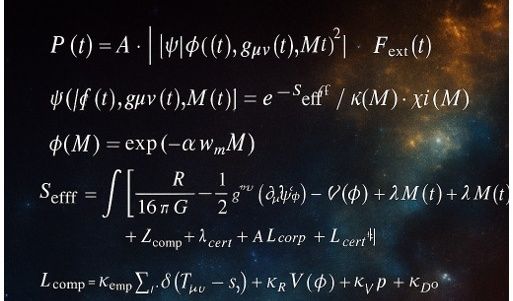
Crowd-Based Dynamics (CBD) describes complex systems as self-regulated structures governed by accumulation, saturation, and mimetic tipping, without any central authority. Its extended formula is expressed as: P(t) = Aψ(S, R, V, D[D_cond, D_act], C, T, M, I) × [O(t) · D(t)] × F(t), where Aψ denotes the psychodynamic core; S/R attraction–repulsion thresholds; V emotional volume; D/C divergences and convergences; M mimetic memory; T temporality; I complementary indicators; O(t) windows of opportunity; D(t) contextual imbalances; and F(t) the institutional and temporal filter. The CBD laws (mimetic saturation, conditional reversibility, informational tipping, and the Sterking limit) explain why systems lose governability before collapse. The CBD–RES–RAG integration formalizes stability as a dialogical state dependent on synchronization between Human Reality Time (RES) and Machine Truth Time (RAG). Instabilities (0/0, ∞/∞) arise from temporal phase-shift and unmanaged saturation. Governance thus becomes measurable, non-predictive, and structural. Reference DOI (unified corpus): lnkd.in/dti3uB9Y
Consciousnes tweet mediaConsciousnes tweet media
English
0
0
0
15
Consciousnes
Consciousnes@CrowdConsciou·
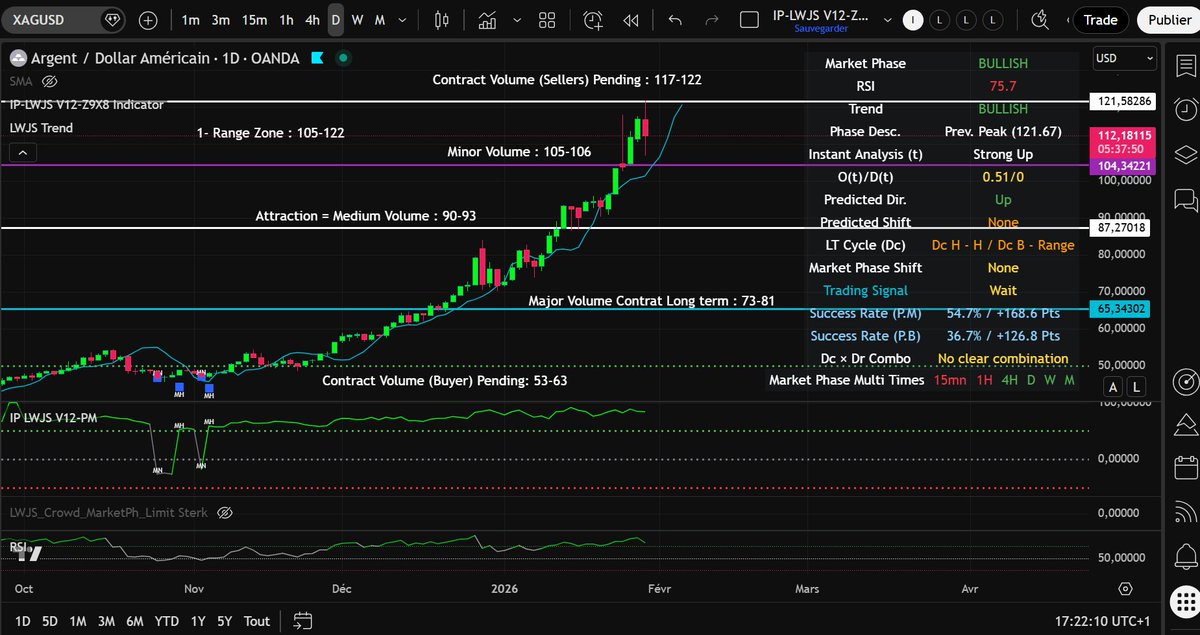
CBD Short-Term Technical Analysis : Silver (XAGUSD) Collective Structure (CBD) Supply contract volumes are increasing significantly, indicating an activation of bearish mimetic pressure. A major repulsion zone has recently formed between 117–121, acting as a dynamic resistance. As long as this zone is not breached, the short-term structure remains dominated by downward pressure. Convergence and Dynamics The market is currently evolving within a range structure, with an active bearish convergence. This implies that volatility is being primarily absorbed on the resistance side, reflecting stronger emotional selling pressure than demand. Upward moves should therefore be interpreted as temporary and corrective. Key Levels and Scenario Pivot level: 105–106 Bearish technical target: pullback toward 93–95 Major resistance: 117–121 The bearish scenario remains favored as long as the market repeatedly fails to exceed the recent high from Thursday the 29th, which constitutes a CBD signal of buyer saturation. Primary Trend The primary (long-term) trend remains bullish as long as price holds above the structural threshold at 73, indicating that the current move is a correction within a broader bullish cycle, not a trend reversal. CBD Short-Term Technical Analysis Gold (XAUUSD) Collective Structure (CBD) Gold is currently in a short-term bearish convergence, with supply volumes clearly dominating demand. As long as the all-time high at 5600 is not breached, the structure remains corrective. Attraction Zones and Supports Volume analysis highlights two main attraction zones: Minor zone: 4900–5000 Medium-term support: 4500–4600 These areas correspond to potential absorption zones, where mimetic memory may slow or stabilize the decline. Key Levels and Scenario Pivot level: 4900 Major resistance: 5480–5600 The decline remains structural and technical, targeting a pullback toward medium-term supports as long as selling pressure dominates. Volatility is concentrated at resistance levels, which is characteristic of a CBD regime where Supply > Demand. Primary Trend The primary trend remains bullish as long as price stays above the critical threshold at 4300. The current movement therefore represents a corrective phase, not a cycle reversal. CBD Strategic Reading In both Silver and Gold, the market is currently in a corrective regime within a broader bullish trend. The preferred strategy is to monitor repeated failures at resistance levels in order to exploit the asymmetric volatility generated by the ongoing bearish convergence. CBD interpretation: the crowd self-regulates through progressive saturation at resistance levels; as long as these thresholds hold, short-term emotional pressure remains bearish.
Consciousnes tweet mediaConsciousnes tweet media
English
0
0
0
73
Consciousnes
Consciousnes@CrowdConsciou·
Eng - Fr version : BTC & ETH — Structural Market Update (Crowd Behavior and Dynamics) BTC Bitcoin remains in a bullish consolidation under a dominant Dc regime, absorbing accumulated tension since the October 2025 high. The 75–85K support zone acts as the main stabilization and volatility recharge area, while 100–103K and 114–117K cap upward extensions. As long as this support holds, the structure stays governable and volatility is best engaged near key thresholds. ETH Ethereum is undergoing a corrective consolidation embedded in a broader bullish convergence, with no regime breakdown. The 2,400–2,640 support structures the downside, while 3,400–3,500 remains the dominant resistance zone. Current volatility reflects internal reorganization rather than structural reversal, provided the support remains intact. linkedin.com/posts/lwjs_btc…
English
0
0
0
23