Crypto Why Bother

3K posts

Crypto Why Bother banner
Crypto Why Bother

Crypto Why Bother

@CryptoWhyBother

Passionate about Investing, Crypto and AI || Contrarian with conviction || Crypto is inevitable || No one has to change - survival is optional

Never financial advice Katılım Haziran 2022
1.5K Takip Edilen541 Takipçiler
Cryptic Trades
Cryptic Trades@CrypticTrades_·
My timeline is filled with "Blackrock sold $BTC. It's OVER!" Guys, BlackRock is not buying, nor selling $BTC. Its clients are. And most of them are retail, just like the rest of us. Also, looking at the Inflows/Outflows for the past 2 years, every time we had them leaning deep in one way it aligned with local tops or local bottoms. That's because retail tends to be emotional and either buy at the top or sell at the bottom. Yes, the exact inflows and outflows from the Bitcoin ETF's, including Blackrock that everyone is telling you that they're selling. So whenever you see someone posting that "Blackrock has sold $BTC", do yourself a favor and unfollow that engagement bait account.
Cryptic Trades tweet media
English
5
6
74
7.1K
InvestAnswers
InvestAnswers@Investanswers·
We tried this in Zurich Early 1990s Needle Park (Platzspitz). Zurich authorities made a deliberate policy decision to tolerate drug use and dealing in Platzspitz park (near the main train station) as a containment strategy. It quickly became known as "Needle Park." At its peak early 1990s, Zurich became GROUND ZERO FOR HEROIN across Europe. It turned into a chaotic open-air drug market with widespread public injecting, violence between dealers, theft, prostitution, overdoses, and extreme filth (needles everywhere, blood, feces, vomit, rats) @KarenBassLA try study some history. @spencerpratt pls stop the crazies
Right Angle News Network@Rightanglenews

Karen Bass’s Los Angeles has begun deploying “rapid mobile addict resource centers,” where taxpayer funded NGOs set up across the city to hand out tool kits to addicts, including pipes, straws, needles, and foil, in front of businesses and schools.

English
9
7
75
7.2K
Osemka
Osemka@Osemka8·
If you ask me how an average CT bro thinks atm, this sums it up perfectly
Osemka tweet media
English
9
1
43
1.6K
Dan Gambardello
Dan Gambardello@dangambardello·
Almost all data is leaning same direction. Copper/gold break out Russell 2000 price discovery PMI starts turning toward expansion Bitcoin bottoming across all momentum oscillators The same precursors that came before every crypto bull cycle. Enough for me to not ignore.
English
25
12
171
6.5K
Crypto Why Bother retweetledi
Crypto Why Bother
Crypto Why Bother@CryptoWhyBother·
The bond market isn't collapsing. It never was. You're watching the wrong circuit. Short 🧵
Crypto Why Bother tweet media
English
1
1
0
6.1K
Crypto Why Bother retweetledi
Crypto Why Bother
Crypto Why Bother@CryptoWhyBother·
Screened the top 10 crypto gainers (30d, Top 100 by volume). Ran each through the full DYOR checklist: team · tokenomics · tech · traction · on-chain · liquidity Here's the unfiltered verdict. 🧵
Crypto Why Bother tweet media
English
2
1
0
2.1K
Crypto Why Bother
Crypto Why Bother@CryptoWhyBother·
Give this guy a follow, if you haven't already
Danny Marques | Investing Informant@Invst_Informant

The bond market and US 10yr are nearing a breaking point yet equities are at an ATH with signs that this bull market still has much more room to go. Let me explain why high yields don't break markets. What we have here is the US10yr yield (now at 4.56%) vs the $SPX (S&P 500) over the last 30 years...The more I look at this, the more I think the right question is not simply “Are high rates bad for stocks?” The better question is what type of high-rate environment are we in? Because there is a major difference between what historically caused recessions and what historically confirmed them. Several of the worst market declines over the last 25+ years were not always triggered by yields being high. They often happened after the bond market started sniffing out a real growth problem and after yields had already started collapsing. In other words, the 10-yr breaking lower was not always the bullish “rates are falling” signal investors wanted it to be. Sometimes it was the market saying growth is cracking, capital is moving to safety, and the Fed is probably behind the curve. IF the 10-yr breaks down because inflation is cooling while earnings remain resilient, that can be bullish. That is the soft-landing version. Lower discount rate, still-good earnings, and risk assets can breathe. But IF the 10-yr breaks down because unemployment is rising, credit spreads are widening, consumers are weakening, and earnings revisions are rolling over, that is not bullish. That is the recession version. Same move in rates but a very different message. So what is happening right now? Right now, the 10-yr is sitting near a major multi-decade resistance zone, and the S&P 500 is making new highs. That combination tells me the market is pricing a world where nominal growth, fiscal spending, AI capex, and mega-cap earnings power are still strong enough to offset the drag from higher rates. THAT is the key point. In 2000, 2007, 2020, and even partially in 2022, the breakdown in the 10-yr yield was less the cause of the equity correction and more the market suddenly pricing economic deterioration, liquidity stress, or an aggressive policy response. Put differently, rising yields usually reflect nominal growth, inflation expectations, or economic momentum. Collapsing yields usually reflect fear, recession risk, or a liquidity event. And this is where today gets interesting. We are not living in the same macro structure as prior cycles. The US fiscal deficit is much larger. Treasury supply matters more. Inflation is structurally more sticky. And AI infrastructure spending has become one of the largest private-sector capex cycles in modern history. The AI capex boom is not just a tech story. It is flowing into so many different areas of the economy. Semiconductors, power, utilities, data centers, networking equipment, electrical infrastructure, and labor demand. That spending is helping hold up parts of the economy that normally would have rolled over faster under this level of rates. Index concentration matters too. The S&P 500 today is not the same S&P 500 from 2000 or even 2010. A huge portion of index performance is now driven by a handful of mega-cap technology companies with fortress balance sheets, enormous free cash flow, global monopolistic distribution, and secular AI-driven demand. That changes the transmission mechanism of higher rates. A regional bank, small-cap company, or heavily levered consumer company can struggle enormously in a 5% yield world. Microsoft, NVIDIA, Meta, or Alphabet do not necessarily struggle the same way because they internally finance growth through cash generation. So the market is not ignoring rates. It is saying “Show me the earnings damage.” And so far, at the index level, there hasn't been any. The major contributors to the indexes and the economy have the strongest moats and earnings strength has never been stronger. That is why traditional recession signals have looked “wrong” for longer than many expected. The economy is bifurcated. Tthe lower-income consumer looks stressed, housing affordability is weak, small businesses face pressure, refinancing risk is real (Commercial real estate is still digesting a much higher cost of capital) But at the same time, large-cap tech corporate earnings remain resilient because AI, software, cloud and infrastructure spending are offsetting broader weakness. I also think people are too quick to compare the AI capex cycle to the late 1990s telecom and internet bubble. There are major differences. Alot of the 1990s infrastructure buildout was funded by companies that NEEDED the capital markets to stay open (and it was largely driven by debt) Today, companies like Microsoft, Amazon, Meta, Alphabet, NVIDIA, Oracle are investing from a position of massive profitability. Yes, now they've begun tapping into the debt markets to accelerate the buildout, but they are doing it from a position of strength, not survival. Whether the spending ultimately becomes excessive or will generate adequate returns is another discussion. Will there be overcapacity or will all this capex spend eventually disappoint? We shall see. But, for now, the earnings impulse is real. Hundreds of billions are being deployed into compute, networking, power infrastructure, chips, and data centers. That spending is flowing through the economy and supports nominal growth even while parts of the consumer economy weaken. This is why the bond market matters so much from here. Technically, yields look like they are attempting a breakout from a 20+ year base. And if yields do decisively break above this range and sustain above ~5%, I think the market eventually has a much harder time maintaining current multiples. Not necessarily because growth collapses immediately, but because the discount rate regime changes. A sustained move above this macro resistance zone would tell me the market is repricing term premium, fiscal risk, or sticky inflation again, or some combination of all three. That would put pressure on long-duration assets and make the equity market far more dependent on earnings growth to justify valuations. On the other hand, as long as the 10-yr is not breaking down in a disorderly way and not breaking out above this long-term resistance zone, the market can still have legs. It gives equities room to keep climbing, especially if the earnings engine remains concentrated in companies with real cash flow, pricing power, and balance sheet strength. Remember, the market tends to break when the bond market suddenly realizes growth is deteriorating faster than expected. And right now, that is NOT what the bond market is saying. If anything, the bond market is currently saying the exact opposite. Nominal growth + inflation are more durable than people expected. Now does that mean there is no risk? Of course note. At some point higher rates matter. Private credit reprices (it already has shown signs of fracturing), refinancing risk increases, government interest expense explodes higher (which is currently not sustainable), equity risk premiums compress, and weaker balance sheets start to run out of time as liquidity conditions tighten materially. Higher rates work with long and variable lags. But the nuance is markets do not top simply because yields are high. They top when liquidity deteriorates, earnings roll over, credit spreads widen, AND THEN yields collapse because the market starts pricing recession. Right now, we don’t yet have that full sequence. What we have instead is sticky nominal growth, sticky inflation, resilient mega-cap earnings, AI-driven capex, and structurally large fiscal deficits supporting demand + keeping liquidity in the system. That combination can sustain higher yields and higher equity prices simultaneously longer than most people expect. The next move in yields does matter a lot. A controlled drift lower would likely help broaden the market. A breakout higher would pressure valuations. A sharp breakdown lower would probably mean the bond market is seeing something in growth that equities have not priced yet. Until the 10-yr breaks decisively one way or the other, my view is that the bull market can continue, but the macro margin for error is getting thinner. Commercial real estate, refinancing cycles, PE leverage, consumer credit deterioration, and government debt servicing pressure all compound slowly before they suddenly matter. Eventually there is a level where the cost of capital begins overwhelming even strong secular narratives. But the difficult part is knowing where that threshold actually is and frankly, the market itself may not know yet either.

English
1
1
2
2.1K
Crypto Why Bother
Crypto Why Bother@CryptoWhyBother·
One of the best macro assessments I've recently read. "What we have instead is sticky nominal growth, sticky inflation, resilient mega-cap earnings, AI-driven capex, and structurally large fiscal deficits supporting demand + keeping liquidity in the system." ... a lot of LIQUIDITY, by the way: x.com/CryptoWhyBothe…
English
0
0
1
57
Danny Marques | Investing Informant
The bond market and US 10yr are nearing a breaking point yet equities are at an ATH with signs that this bull market still has much more room to go. Let me explain why high yields don't break markets. What we have here is the US10yr yield (now at 4.56%) vs the $SPX (S&P 500) over the last 30 years...The more I look at this, the more I think the right question is not simply “Are high rates bad for stocks?” The better question is what type of high-rate environment are we in? Because there is a major difference between what historically caused recessions and what historically confirmed them. Several of the worst market declines over the last 25+ years were not always triggered by yields being high. They often happened after the bond market started sniffing out a real growth problem and after yields had already started collapsing. In other words, the 10-yr breaking lower was not always the bullish “rates are falling” signal investors wanted it to be. Sometimes it was the market saying growth is cracking, capital is moving to safety, and the Fed is probably behind the curve. IF the 10-yr breaks down because inflation is cooling while earnings remain resilient, that can be bullish. That is the soft-landing version. Lower discount rate, still-good earnings, and risk assets can breathe. But IF the 10-yr breaks down because unemployment is rising, credit spreads are widening, consumers are weakening, and earnings revisions are rolling over, that is not bullish. That is the recession version. Same move in rates but a very different message. So what is happening right now? Right now, the 10-yr is sitting near a major multi-decade resistance zone, and the S&P 500 is making new highs. That combination tells me the market is pricing a world where nominal growth, fiscal spending, AI capex, and mega-cap earnings power are still strong enough to offset the drag from higher rates. THAT is the key point. In 2000, 2007, 2020, and even partially in 2022, the breakdown in the 10-yr yield was less the cause of the equity correction and more the market suddenly pricing economic deterioration, liquidity stress, or an aggressive policy response. Put differently, rising yields usually reflect nominal growth, inflation expectations, or economic momentum. Collapsing yields usually reflect fear, recession risk, or a liquidity event. And this is where today gets interesting. We are not living in the same macro structure as prior cycles. The US fiscal deficit is much larger. Treasury supply matters more. Inflation is structurally more sticky. And AI infrastructure spending has become one of the largest private-sector capex cycles in modern history. The AI capex boom is not just a tech story. It is flowing into so many different areas of the economy. Semiconductors, power, utilities, data centers, networking equipment, electrical infrastructure, and labor demand. That spending is helping hold up parts of the economy that normally would have rolled over faster under this level of rates. Index concentration matters too. The S&P 500 today is not the same S&P 500 from 2000 or even 2010. A huge portion of index performance is now driven by a handful of mega-cap technology companies with fortress balance sheets, enormous free cash flow, global monopolistic distribution, and secular AI-driven demand. That changes the transmission mechanism of higher rates. A regional bank, small-cap company, or heavily levered consumer company can struggle enormously in a 5% yield world. Microsoft, NVIDIA, Meta, or Alphabet do not necessarily struggle the same way because they internally finance growth through cash generation. So the market is not ignoring rates. It is saying “Show me the earnings damage.” And so far, at the index level, there hasn't been any. The major contributors to the indexes and the economy have the strongest moats and earnings strength has never been stronger. That is why traditional recession signals have looked “wrong” for longer than many expected. The economy is bifurcated. Tthe lower-income consumer looks stressed, housing affordability is weak, small businesses face pressure, refinancing risk is real (Commercial real estate is still digesting a much higher cost of capital) But at the same time, large-cap tech corporate earnings remain resilient because AI, software, cloud and infrastructure spending are offsetting broader weakness. I also think people are too quick to compare the AI capex cycle to the late 1990s telecom and internet bubble. There are major differences. Alot of the 1990s infrastructure buildout was funded by companies that NEEDED the capital markets to stay open (and it was largely driven by debt) Today, companies like Microsoft, Amazon, Meta, Alphabet, NVIDIA, Oracle are investing from a position of massive profitability. Yes, now they've begun tapping into the debt markets to accelerate the buildout, but they are doing it from a position of strength, not survival. Whether the spending ultimately becomes excessive or will generate adequate returns is another discussion. Will there be overcapacity or will all this capex spend eventually disappoint? We shall see. But, for now, the earnings impulse is real. Hundreds of billions are being deployed into compute, networking, power infrastructure, chips, and data centers. That spending is flowing through the economy and supports nominal growth even while parts of the consumer economy weaken. This is why the bond market matters so much from here. Technically, yields look like they are attempting a breakout from a 20+ year base. And if yields do decisively break above this range and sustain above ~5%, I think the market eventually has a much harder time maintaining current multiples. Not necessarily because growth collapses immediately, but because the discount rate regime changes. A sustained move above this macro resistance zone would tell me the market is repricing term premium, fiscal risk, or sticky inflation again, or some combination of all three. That would put pressure on long-duration assets and make the equity market far more dependent on earnings growth to justify valuations. On the other hand, as long as the 10-yr is not breaking down in a disorderly way and not breaking out above this long-term resistance zone, the market can still have legs. It gives equities room to keep climbing, especially if the earnings engine remains concentrated in companies with real cash flow, pricing power, and balance sheet strength. Remember, the market tends to break when the bond market suddenly realizes growth is deteriorating faster than expected. And right now, that is NOT what the bond market is saying. If anything, the bond market is currently saying the exact opposite. Nominal growth + inflation are more durable than people expected. Now does that mean there is no risk? Of course note. At some point higher rates matter. Private credit reprices (it already has shown signs of fracturing), refinancing risk increases, government interest expense explodes higher (which is currently not sustainable), equity risk premiums compress, and weaker balance sheets start to run out of time as liquidity conditions tighten materially. Higher rates work with long and variable lags. But the nuance is markets do not top simply because yields are high. They top when liquidity deteriorates, earnings roll over, credit spreads widen, AND THEN yields collapse because the market starts pricing recession. Right now, we don’t yet have that full sequence. What we have instead is sticky nominal growth, sticky inflation, resilient mega-cap earnings, AI-driven capex, and structurally large fiscal deficits supporting demand + keeping liquidity in the system. That combination can sustain higher yields and higher equity prices simultaneously longer than most people expect. The next move in yields does matter a lot. A controlled drift lower would likely help broaden the market. A breakout higher would pressure valuations. A sharp breakdown lower would probably mean the bond market is seeing something in growth that equities have not priced yet. Until the 10-yr breaks decisively one way or the other, my view is that the bull market can continue, but the macro margin for error is getting thinner. Commercial real estate, refinancing cycles, PE leverage, consumer credit deterioration, and government debt servicing pressure all compound slowly before they suddenly matter. Eventually there is a level where the cost of capital begins overwhelming even strong secular narratives. But the difficult part is knowing where that threshold actually is and frankly, the market itself may not know yet either.
Danny Marques | Investing Informant tweet media
English
5
18
79
14.1K
MartyParty
MartyParty@martypartymusic·
Suppression is powerful. It creates the psychological feeling of defeat and hopelessness which is used to support time based capitulation. That is when the manipulators run the price up. Once everyone has given up hope, stopped longing and stopped buying.
English
28
17
197
10.3K
TrendSpider
TrendSpider@TrendSpider·
President Trump is posting about the stock market:
TrendSpider tweet mediaTrendSpider tweet media
English
45
32
452
61.3K
Crypto Why Bother
Crypto Why Bother@CryptoWhyBother·
@KobeissiLetter They need lower rates (?) And / OR higher productivity. (GDP might not be the appropriate KPI in the exponential age, but that's a technicality.) Better focus on semis, they lead the way.
English
0
0
0
272
The Kobeissi Letter
The Kobeissi Letter@KobeissiLetter·
Shocking stat of the day: Annual interest expense on US public debt could rise to as much as 30% of government revenue by 2036, an all-time high. This would occur if the 10Y Treasury yield averages 4.70% over the next decade, or ~55 basis points above the current projection of the Congressional Budget Office. This means nearly 1 out of every 3 dollars of government revenue would go toward servicing debt, TRIPLE the level seen in 2022. Under this same scenario, net interest costs as a % of GDP would rise to a record 5.3% by 2036, DOUBLE the levels seen in 2023. Meanwhile, the 10Y Treasury yield briefly touched 4.68% on Tuesday before easing to 4.56% on Friday. The US government needs lower rates more than anyone.
The Kobeissi Letter tweet media
English
124
165
933
123.5K
The Kobeissi Letter
The Kobeissi Letter@KobeissiLetter·
US inflationary pressures are accelerating: The Manufacturing PMI input prices index rose to 80 points in May, the highest since mid-2022. This marks the largest monthly increase in manufacturing input costs since June 2022. The index has risen now +18 points since February, at a pace last seen during the historic inflation surge of 2021-2022. The current increase is led by Iran War-related supply constraints and rising energy costs. As a result, surging input costs are driving further job losses and pushing businesses to raise prices on goods and services at the highest rate since August 2022. Furthermore, US manufacturing and services business activity posted only modest growth in May, as rising prices continue to weigh on demand. Stagflation is accelerating.
The Kobeissi Letter tweet media
English
90
202
924
107.3K
Crypto Why Bother
Crypto Why Bother@CryptoWhyBother·
Screened this week's TOP 12 CRYPTO GAINERS (7d, Top 100 by market cap) Ran each through the full DYOR checklist: team · tokenomics · tech · traction · on-chain · liquidity Here's the unfiltered verdict. 🧵
Crypto Why Bother tweet media
English
1
1
1
117
Crypto Why Bother retweetledi
Crypto Why Bother
Crypto Why Bother@CryptoWhyBother·
ISM went below 50 in 2023. "Recession incoming," said every macro model. $NVDA: +240% that year. The model wasn't EARLY. It was wrong. 🧵
Crypto Why Bother tweet media
English
1
1
0
126
Whale Factor
Whale Factor@WhaleFactor·
🐋 WHALE WATCH: The DePIN and AI narratives are growing fast but many skip the actual utility powering $RENDER. Jules Urbach launched the network to change how we share computing power. The process lets creators upload heavy 3D or AI tasks which are split up and sent to a global network of GPU owners who render the files. He structured the ecosystem into two main segments consisting of an off chain peer to peer layer and an on chain payment system. This design is profitable for everyone because artists save massive amounts on traditional server farms while everyday GPU owners make steady money renting out idle hardware. $RENDER started trading around four cents years ago and sits near two dollars today. The future is driven by pure infrastructure demand as global AI workloads and next generation graphics require massive computing power. Are you accumulating at this current range or waiting for a deeper flush ?
Whale Factor tweet media
English
26
19
177
24.2K
The ₿itcoin Therapist
The ₿itcoin Therapist@TheBTCTherapist·
Michael Saylor’s Strategy is now down $700 million on their $64 billion BTC treasury. Tom Lee’s BitMine is now down $7 billion on their $12.2 billion ETH treasury.
The ₿itcoin Therapist tweet mediaThe ₿itcoin Therapist tweet media
English
67
28
328
30.5K
Crypto Why Bother retweetledi
Crypto Why Bother
Crypto Why Bother@CryptoWhyBother·
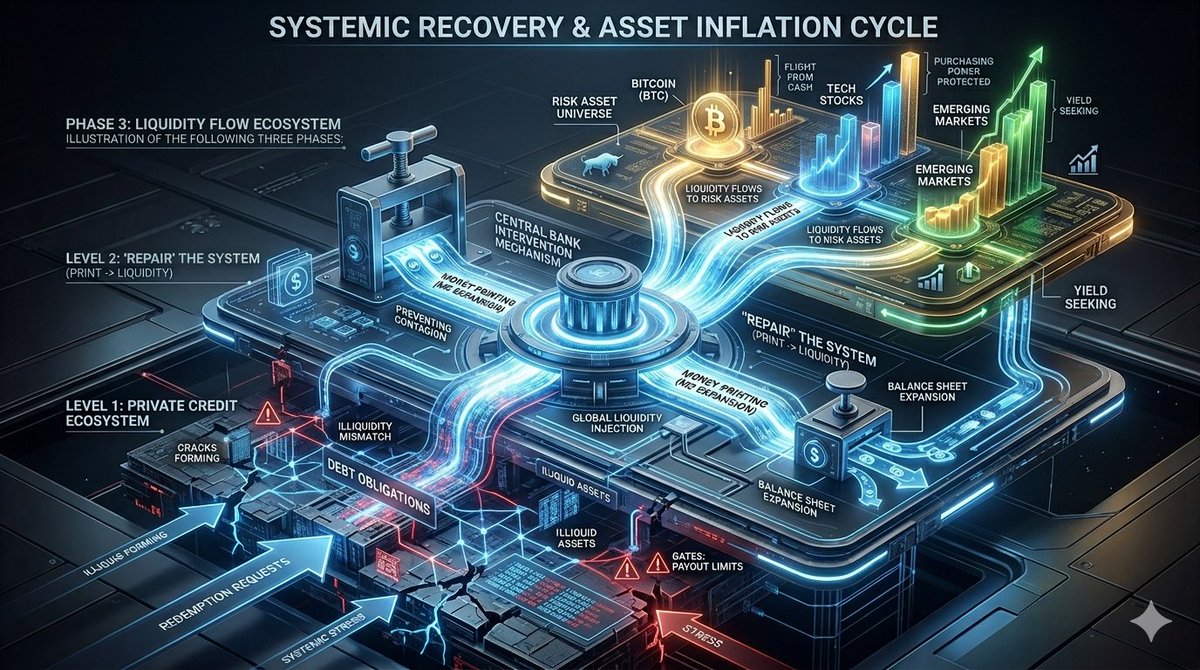
90% of Crypto X thinks global LIQUIDITY has peaked. I'm looking at the actual charts. The trend is still intact. Who is WRONG here? 🧵
Crypto Why Bother tweet media
English
1
1
0
390
Whale Factor
Whale Factor@WhaleFactor·
🐋 WHALE WATCH: Tokenized stocks just crossed a major milestone. The total market cap for onchain equities has officially surpassed $1.6 billion. $ETH is leading the charge with a dominant 41.1% market share. The real world asset narrative is moving incredibly fast this year. Are you holding any RWA projects right now ?
Whale Factor tweet media
English
30
16
148
30K
Crypto Why Bother
Crypto Why Bother@CryptoWhyBother·
TL;DR - NO INVESTMENT ADVICE, education only 🟢 STRONG: VVV · HYPE · MORPHO · RENDER · ONDO · NEAR 🟡 MEDIUM: 2Z · ZEC · INJ · ATOM 🔴 AVOID: WLD (July unlock) · LUNC (dead) Macro Phase 3 is firing — CPI trigger hit (3.8% actual), SLR repo expanding (~$250B used of $1.2T cap), real yields negative globally. But altcoins haven't rotated yet: Asian capital still bid AI semis, $DOGE pre-breakout, retail not engaged — pre-parabola setup, not post-cycle.
English
1
0
0
53