Over the past few years, perps trading has evolved incredibly.
Protocols are no longer just competing on execution speed or leverage limits. They are competing on something much deeper: architecture.
Two projects that often come up in this discussion are @HyperliquidX and @ostium.
At first glance, they seem to be solving the same problem: bringing more markets onchain.
But when you look closely, the design philosophies behind them are very different.
And those differences become especially important when we start talking about real-world asset trading.
Hyperliquid is built around an orderbook model, very similar to centralized exchanges. Traders place bids and asks, market makers provide liquidity, and orders are matched between participants.
This architecture is incredibly powerful for crypto-native markets.
Assets like $BTC and $ETH have deep liquidity, constant trading activity, and thousands of participants interacting with the market every second. In that environment, orderbooks shine. They deliver tight spreads, efficient price discovery, and fast execution.
This is why Hyperliquid has quickly become one of the most impressive crypto-native trading venues onchain.
But the dynamics of real-world asset markets are very different.
Real-world markets are much broader and much more fragmented. There are hundreds of FX pairs, dozens of commodity markets, regional equity indices, and thousands of individual stocks.
Many of these markets will not immediately have deep onchain liquidity or dedicated market makers supporting them.
And that is where the architecture starts to matter.
In an orderbook system, every market needs active participants on both sides of the trade. If liquidity is thin then execution becomes difficult.
This is not a major issue for Bitcoin or Ethereum, where activity is already massive. But when expanding into long-tail assets such as smaller commodities, emerging market FX pairs, and regional indices, liquidity becomes much harder to bootstrap.
Ostium approaches the problem differently.
Instead of relying on traders to match with each other, Ostium uses a pool-based liquidity model.
Liquidity providers deposit capital into a shared vault, and traders interact with that liquidity pool when opening positions. Prices come from oracle feeds connected to global markets, and the vault settles profit and loss between traders and liquidity providers.
This architecture changes how markets can be supported.
Because liquidity is aggregated into a shared pool rather than fragmented across individual orderbooks, new markets can function even when trading activity is still developing.
That flexibility becomes extremely important when the goal is not just listing a handful of popular assets, but eventually supporting a broad spectrum of global markets.
FX pairs. Commodities. Regional indices. Individual equities.
In other words, markets that represent the majority of global financial activity.
This is also why the idea of bringing “all finance onchain” is not just about adding more tickers to a trading interface. It is about building infrastructure that can support a very wide set of markets, many of which may initially have limited liquidity onchain.
Orderbooks are incredibly powerful in high-liquidity environments.
Pool-based systems, on the other hand, can be more adaptable when expanding into markets where liquidity is still emerging.
That does not make one system universally better than the other.
In fact, the two architectures may ultimately serve different roles in the ecosystem.
Protocols like Hyperliquid may continue to dominate crypto-native trading, where speed, market depth, and orderbook execution matter most.
Meanwhile, protocols like Ostium may become the natural venue for trading a much broader set of global assets onchain.
If the long-term vision for DeFi is truly to become a settlement layer for global finance, then infrastructure designed specifically for real-world markets will likely play a critical role.
Stablecoins have quietly become one of the most important pieces of infrastructure in crypto.
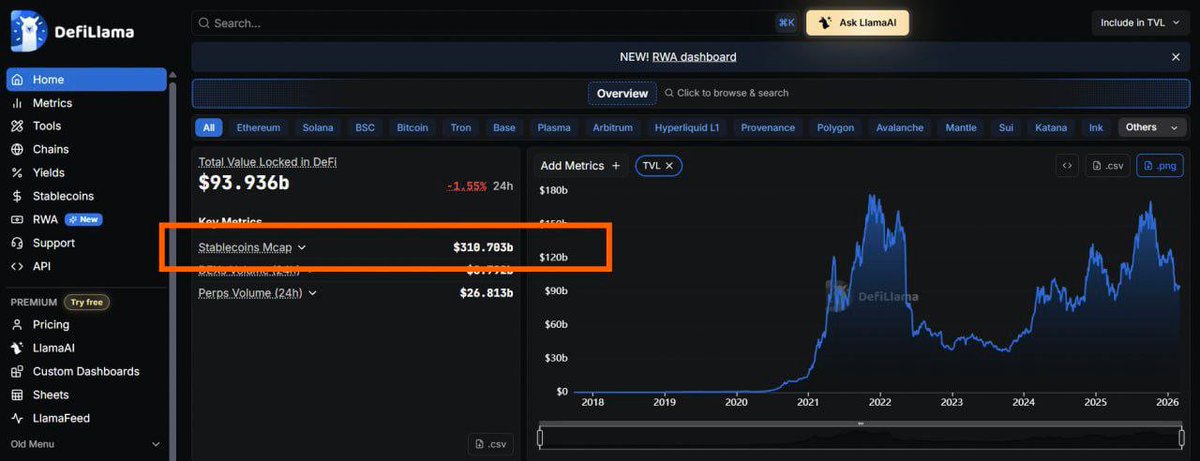
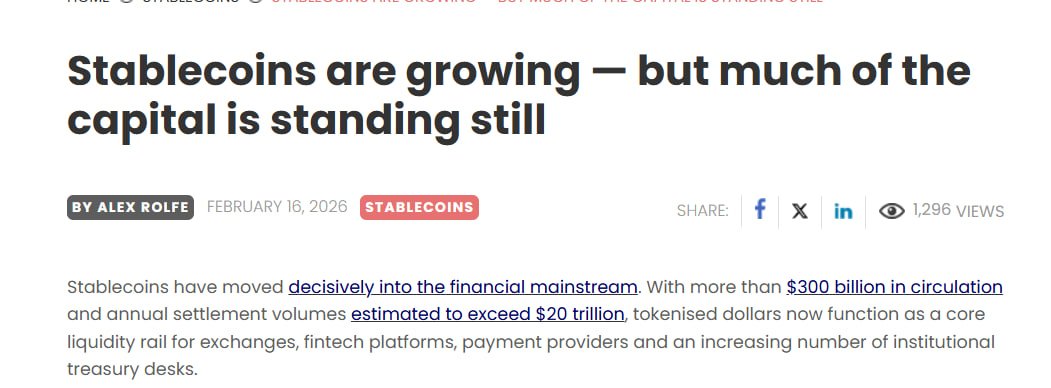
Today, more than $300 billion in stablecoins are in circulation. Annual settlement volume is estimated to exceed $20 trillion.
Tokenized dollars now act as the main liquidity rail for:
- exchanges
- fintech apps
- payment companies
- institutions
Stablecoins are no longer just tools for crypto trading. They’re becoming operating cash for the internet’s financial system. But there’s a problem building under the surface.
A large chunk of this liquidity just sits there.
Stablecoins are parked on exchanges, held in custodial wallets, or kept as reserves by institutions.
In some environments, more than half of all outstanding balances are inactive.
They earn nothing. They barely move.
And despite supporting massive settlement flows, they don’t actually do much.
This isn’t new.
Traditional banking went through something similar decades ago.
Customer deposits used to sit idle until banks introduced sweep accounts and automated liquidity tools.
The goal wasn’t speculation.
It was simple. Make capital work harder.
Stablecoins are reaching a similar turning point.
As adoption grows across payments, trading, and cross-border settlement, dormant liquidity grows with it.
So the real question becomes:
Where can this capital actually go?
Right now, most on-chain capital is still stuck inside crypto markets.
Meanwhile, global macro markets such as equities, commodities, and FX are largely disconnected from on-chain liquidity.
That gap is where the next phase of crypto infrastructure will be built.
If stablecoins are becoming the internet’s cash layer, the logical next step is expanding what that cash can access.
Your on-chain dollar shouldn’t be limited to one asset class.
This is the infrastructure @ostium is building.
A trading layer where on-chain capital isn’t confined to crypto.
Instead of forcing traders to off-ramp into fragmented traditional finance rails, Ostium lets them deploy on-chain dollars directly into global markets.
- Commodities.
- Indices.
- FX.
- Crypto.
All from the same capital base.
And this broader access doesn’t mean giving up what makes crypto powerful.
> Self-custody remains intact.
> Execution is transparent.
> Trades are verifiable on-chain.
> Market activity is visible, not hidden behind opaque broker systems.
In other words, this isn’t just about adding more markets.
It’s about letting capital move freely, with the transparency and verifiability that Web3 makes possible.
If stablecoins are becoming the internet’s cash layer, the next step in financial infrastructure is making sure that capital can move seamlessly across the world’s biggest markets.
Ostium is building the rails that make that happen.
I love CT.
In just a week, we went from recruiters posting job openings to people celebrating new roles.
Next, I want to see the sentiment on this app shift from bearish to bullish.
I hit the jackpot today.
I vividly remember starting November by finding ₹20 on the road, then ₹2, and today ₹500.
That brings my total to ₹522 this month.
With inflation-adjusted, even if I keep finding money at this rate, I’ll become a millionaire in exactly 10,000 years.
God bless me.
Prometheus gave fire to humans.
Fire that sparked industry, made energy possible, and powered civilization. One spark that changed everything.
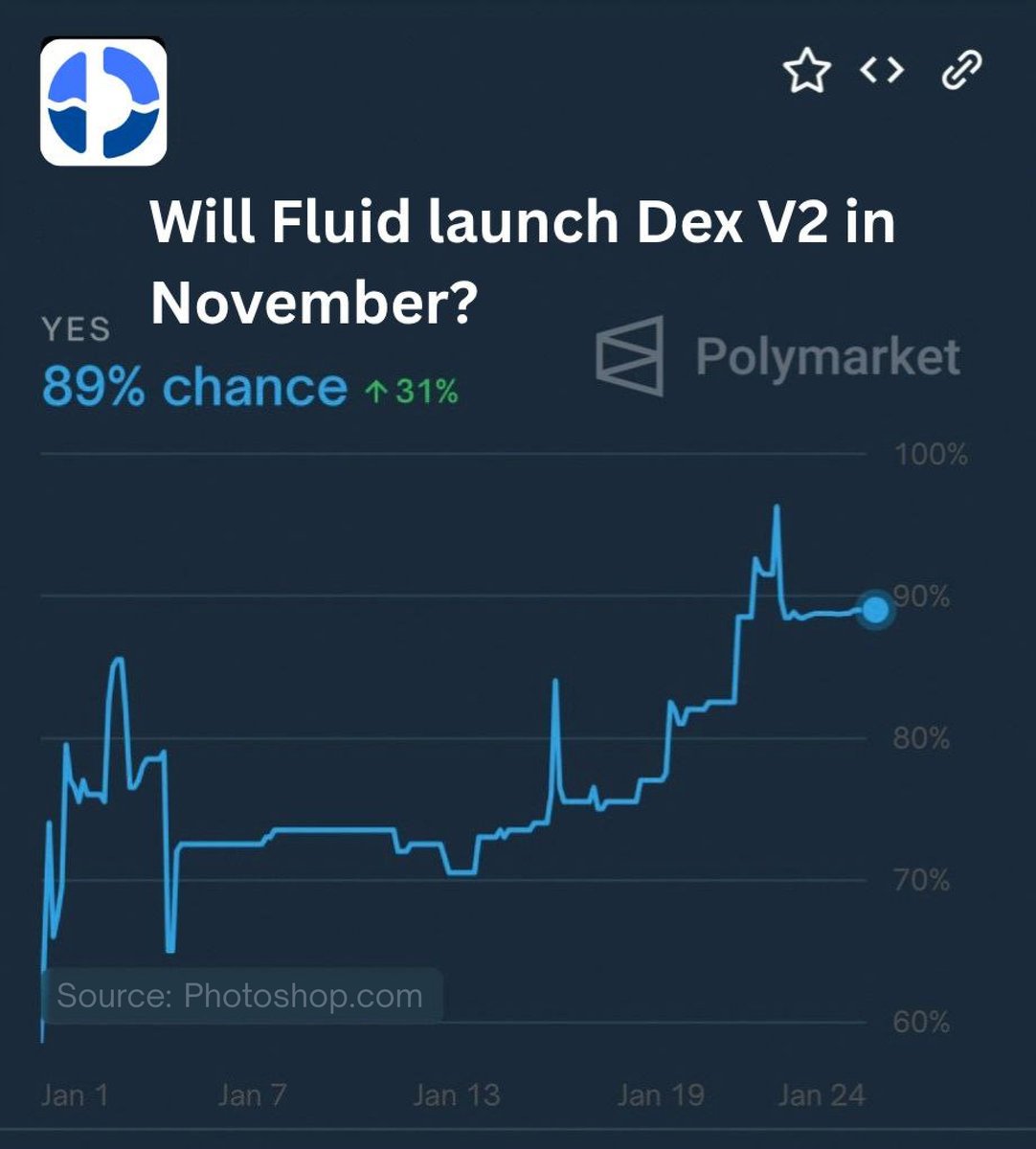
@0xfluid DEX V2 is the modern spark for DeFi.
It is not just an upgrade. It introduces liquidity that powers itself.
In practice, Fluid DEX V2 turns trading and borrowing into a single, self-reinforcing system. Every trade strengthens the lending layer by generating fees that flow back to reduce borrowing costs. Every borrow deepens liquidity, improving prices and lowering slippage for traders. Together, they create a loop where better yields attract more deposits, more liquidity drives more volume, and more volume fuels even better yields.
This loop builds a flywheel that sustains itself.
While other DEXs rely on incentives and token emissions, Fluid creates real alignment where usage itself drives yield.
No yield farming. No inflated APYs.
Just a system where activity fuels growth, and growth rewards activity.
V1 focused purely on correlated pairs like USDT/USDC, wBTC/cbBTC, and ETH/wstETH.
That alone made Fluid one of the largest DEXs on Ethereum, with over $155B in volume and 35% market share in correlated assets.
V2 now extends that power to volatile pairs.
With concentrated liquidity, dynamic fees, and smarter market-making, Fluid brings that same self-reinforcing loop to major trading pairs in DeFi.
Prometheus gave us fire.
Fluid DEX V2 gives DeFi the power to create and sustain itself.
Betting against Fluid means betting against:
> 3rd biggest lending market by active loans
> Unified liquidity
> Unmatched capital efficiency
> Proven resilience against liquidations
> Community
> Social media supporters
Fudders fucked.
Hey chat, I have a confession: I’ve joined @0xfluid as a Community Growth Grantee, focusing on Fluid’s expansion in India.
Why Fluid?
I’ve always been passionate about permissionless finance, and this role is a way to keep that passion alive.
At Fluid, I’ll be working to spread awareness and build the Indian community. By the nature of the role, I’ll get to connect with local Web3 communities, builders, and creators both online and offline.
I know it’s a big responsibility, and it won't be easy, and that’s exactly why I took it. I’ve always tried to ensure every role I choose challenges me, helps me grow, and keeps me learning.
I love Fluid's mission and what it stands for. The first time I read its docs, I was inspired by how it’s reimagining DeFi and building the most capital-efficient liquidity layer for finance.
The team is cracked, and I’m grateful for the opportunity to learn from brilliant minds, contribute to something meaningful, and grow with the ecosystem I deeply care about.
Time to get to work.
LFF 🌊
There’s no need to seek out a spiritual guru to be enlightened.
Start gambling.
You’ll learn a lot about yourself: how greedy you are, how fearful you get when you lose, and how you really see money.
Either you get rich or get rekt.
There’s nothing in between.
The key to surviving in crypto is to own stocks.
The key to surviving in stocks is to own mutual funds.
The key to surviving in mutual funds is to have a job.
The key to surviving in a job is to know how to shitpost.