
Chirag Lala

16.2K posts

Chirag Lala banner
Chirag Lala

Chirag Lala

@CtheLala

Indian-American | VP of Research & Chief Economist @PubEnterprise | macroeconomics, industrial policy, investment, grids, finance

Katılım Mart 2016
3.9K Takip Edilen2.4K Takipçiler
Sabitlenmiş Tweet
Chirag Lala
Chirag Lala@CtheLala·
Imo this gets it wrong. If progressives don’t prioritize tight labor markets on their own merits, we won’t see them again. Nor anything more. We’ve seen labor markets like this maybe thrice since the 70s. This was the only one we built on purpose. It is a big structural change.
Eli Cook@Eli_B_Cook

If Trump does win, one lesson I hope the (well-meaning) neoclassical left will learn is that "tight labor markets" just is not enough to improve people's live substantially. They need major institutional and structural change, not just lower unemployment and slightly higher wages

English

3
51
467
39.4K
Paul E Williams
Paul E Williams@PEWilliams_·
Everyone wish @CtheLala good luck as he is currently defending his dissertation!
Paul E Williams tweet media
English
4
0
47
3.7K
Chirag Lala retweetledi
Alex Armlovich
Alex Armlovich@aarmlovi·
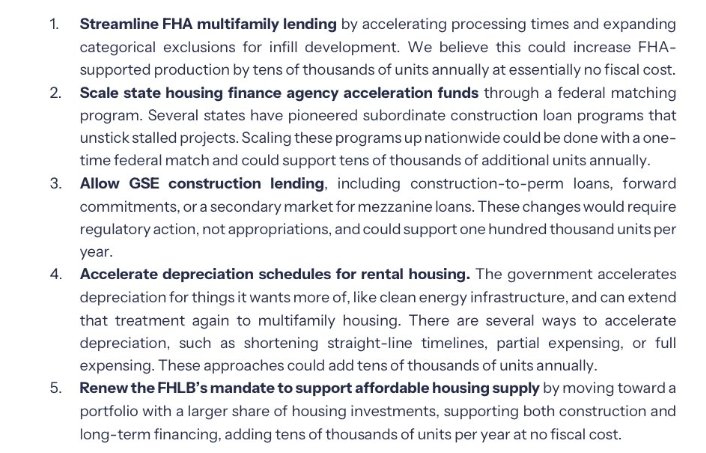
Delighted to see CPE's new financing report These are commonsense, no-regrets ideas to unlock marginal projects, boost feasible income-mixing, & stabilize housing in recessions The depreciation proposal joins a bipartisan consensus that, dynamically scored, is cheap or free!
Alex Armlovich tweet media
Paul E Williams@PEWilliams_

The time has come to raise the housing investment level in this country, just as we did in the 1960s and 1980s. We have a new report out this morning laying out just how high housing production numbers need to go—and for how many years—to dig us out of the shortage.

English
0
9
33
3K
Chirag Lala retweetledi
New Left EViews
New Left EViews@NewLeftEViews·
First of all hilarious. That's now how anything works. Second of all: please take a look where wages in most sectors have been going for a half a decade. Like, the fundamental economic problem is that household demand has not been able to grow and this is one that the party is well aware of but reluctantly to tackle to a large extent to their obstinate refusal to get real of welfare transfers. This notion that public goods provision is all that matters is peak macroeconomic ignorance. x.com/avispartan/sta…
English
1
1
48
3.7K
Chirag Lala retweetledi
New Left EViews
New Left EViews@NewLeftEViews·
Speaking as a great admirer of the Chinese state-led developmental system but as an owl on trade: I have to say the funniest thing about the sino-futurist campism on the left is that the people who speak uncritically of systemic superiority and emulation often simply don’t know about basic features about China’s economy which should be anathema to them: the incredibly regressive income tax system, the prohibition of independent unions, the fact that 30% of the labour force is in the gig economy, the still deeply entrenched opposition to welfare transfers, the profound social conservatism etc.
English
38
82
782
34.1K
Chirag Lala retweetledi
Paul E Williams
Paul E Williams@PEWilliams_·
I wrote a little plea: please stop making a powerful housing coalition harder to achieve. You're both right. And you don't need to put anyone down to be right. It's time to get in the big tent. publicenterprise.org/who-doesnt-wan…
English
1
34
230
36.5K
Chirag Lala
Chirag Lala@CtheLala·
The arg for moratoriums is always “shut it down till we know what’s going on.” The trouble is no political coalition involved has credibility to say they’d ever revive development. In the meantime, we’ve killed a node of capex, offtake, and planning on the energy system.
English
0
0
4
208
Chirag Lala
Chirag Lala@CtheLala·
Lots of fun metaphors here. Water and pipes! Result though is the same. For rapid enough buildout to finally end national shortages, you need both zoning liberalization and public finance. You won’t have project pipelines or volume otherwise.
Paul E Williams@PEWilliams_

Re-upping what I believe is the most important paragraph in our recent housing report. Never listen to anyone who says that one or the other (zoning, capital) is more or less important. It's like asking which is more important for chocolate chip cookies, the batter or the chips?

English
1
0
8
661
Chirag Lala retweetledi
Paul E Williams
Paul E Williams@PEWilliams_·
Re-upping what I believe is the most important paragraph in our recent housing report. Never listen to anyone who says that one or the other (zoning, capital) is more or less important. It's like asking which is more important for chocolate chip cookies, the batter or the chips?
Paul E Williams tweet media
English
9
25
197
8.1K
Chirag Lala retweetledi
Alex Jacquez
Alex Jacquez@AlexSJacquez·
We propose getting public money into the capital stack. Fannie & Freddie should buy mezzanine construction loans. The FHLB should use its balance sheet to support construction. States and cities should stand up revolving loan funds and equity programs.
English
3
4
38
3.6K
Chirag Lala
Chirag Lala@CtheLala·
The “profit motive” really isn’t the enemy when it comes to investment. It’s almost always a signal of some other problem: the availability of finance, insufficient infrastructure, demand certainty! And the public sector may not need profits…but it has de facto hurdle rates!
English
0
0
4
89
Chirag Lala
Chirag Lala@CtheLala·
IMO we should stop saying “developers only build for profit” when we mean firms or their investors have an insufficiently high risk tolerance for more capex. Latter accounts better for the challenge, derisking solutions, and political hurdles to public sector risk appetite.
English
1
0
4
194
Chirag Lala retweetledi
Michael McNair
Michael McNair@michaeljmcnair·
I finally figured out why @GitaGopinath disagrees with @michaelxpettis on the reserve currency and current account deficit argument. They’re not debating the same thing. Economists too often conflate international currency and reserve currency (net settlement of imbalances, accumulation of net claims). They aren’t the same thing. When Gita says reserve currency she is mostly talking about the international currency role…the plumbing of global trade and finance (invoicing, settlement, etc). And on that, she’s right. World trade can grow with balanced flows, and global demand for safe dollar assets can show up in gross holdings without mechanically forcing a net US current account deficit. But that’s not what Pettis is talking about. He’s talking about the reserve currency role. That’s not what unit we invoice in. It’s the asset other countries save in and accumulate net claims on, the place surplus countries park excess savings. That is a net concept. If a country runs a current account surplus, it is acquiring net claims on the rest of the world. Those net claims have to land somewhere. Someone has to be the mirror image net debtor. In the modern system, the US has been the residual absorber bc its been the only one big enough and willing to keep its capital account wide open and allow unlimited accumulation of its financial assets. Pettis isn’t arguing the world needs gross dollar liquidity, therefore the US must run deficits. He’s saying that surplus country policies suppress domestic demand relative to production, which forces them to export savings on a net basis, and those net savings end up as net claims on the US, forcing a corresponding US current account deficit. The best analogy is the gold standard. What mattered wasn’t that everyone used gold in everyday transactions. What mattered was that gold settled net claims. Countries with persistent deficits lost gold and the surplus countries accumulated gold. Gold was the reserve asset precisely bc it was how the system settled the net position. Same today. Gross flows matter for transmission, but reserve status is ultimately about where net claims accumulate. Another important point of clarity is that Pettis isn’t saying the reserve currency issuer always has to run a current acct deficit. Reserve currency status means you have to tolerate your external balance being set by the needs of the rest of the world, not what your domestic economy requires. And the sign can flip across regimes. Like in the 1950s when Europe was rebuilding after the war and needed US capital to fund its investment needs, so the US ran a current account surplus. But the point is that the reserve issuer is the residual adjuster. So Pettis’ point is that in the current environment, where the RoW generates excess savings, the has US to run a current account deficit. It’s possible for the dollar’s international role to grow without an ever rising US current account deficit. But it’s not possible for large parts of the world run persistent net surpluses and accumulate net claims, and nobody runs the mirror image net deficits. That’s what Pettis is arguing. And it’s not the argument most people are responding to. *side note: Stablecoins are going to make the distinction bw international and reserve currency even more important bc the purpose of the GENIUS Act is to unbundle the two functions. They can keep the dollar dominant in global payments without requiring foreigners to hold dollar assets as a savings vehicle (zero yld reduce hoarding as savings). And it’s that second function that forces persistent US current account deficits.
Gita Gopinath@GitaGopinath

(i) Not clear why growth in world trade should create a net demand for dollars. World trade can grow through both rising exports and imports while remaining balanced. (ii) The other commonly cited argument is that the demand for safe assets requires the safe asset issuer to run deficits. This again is theoretically weak. Demand for safe assets is about gross flows. There is no reason this should necessarily lead to net deficits. (iii) Empirically too the reserve currency argument has limitations. As @Brad_Setser points out the relation between fiscal deficits and trade/current account deficits is imperfect. There were 2 previous major episodes of global imbalances: One was in the 1980s where indeed large fiscal deficits (and an appreciating dollar) contributed to growing current-account deficits. The second episode was in the run-up to the GFC in 2008 when fiscal deficits were not the driver (and the dollar was depreciating). (iv) During the years when the British pound was the dominant currency of the world Britain ran current account surpluses. (v) The Swiss Franc is a reserve currency country that consistently runs surpluses. New Zealand, on the other hand, is not a reserve currency country and has consistently run deficits. So, both theoretically and empirically, it is hard to argue that the dollar's reserve currency status is what is behind persistent US current account deficits.

English
16
54
301
89.6K