Jack

11.5K posts

Jack banner
Jack

Jack

@CtrlShftAltDel

"There ain't no grave can hold my body down."

Katılım Ağustos 2024
89 Takip Edilen479 Takipçiler
Jack
Jack@CtrlShftAltDel·
“The basic tool for the manipulation of reality is the manipulation of words.” - from Philip K. Dick, the genius and sci-fi writer.
English
0
0
0
4
Jack
Jack@CtrlShftAltDel·
One of my favorite legendary Americans is Kit Carson. So many stories. Here is one of them from the Mexican American war. The historical account of what happened to Kit Carson at the Battle of San Pasqual (December 6, 1846) aligns very closely with your description. It is one of the most famous and chaotic moments of his life. The Failed Charge at San Pasqual During the opening of the battle, General Stephen W. Kearny ordered a mounted charge against the Californio lancers (local Mexican horsemen). Kit Carson was riding at the very front of the advance guard alongside Captain Abraham Johnston. What happened next was a disaster for the Americans: Carson’s Horse Went Down: As they charged into the valley, Carson's horse suddenly fell (some accounts say it tripped, others that it was shot). Carson was thrown violently to the ground and narrowly escaped being trampled to death by the dragoons charging behind him. His Rifle Broke: The impact of the fall snapped the wooden stock of Carson's prized Hawken rifle, rendering it useless. The Advance Guard Died: Captain Johnston and the other men who successfully rode past Carson continued their charge directly into the waiting lines of the Californios. Because the rest of the American force was strung out behind them on tired mules and half-broken horses, Johnston's small group was quickly surrounded. Johnston was shot through the head and killed instantly, and the lancers heavily mauled those who had followed him. Carson’s Escape and Sniping Stranded on foot with a broken rifle, Carson had to adapt quickly. He ran through the melee, found a dead dragoon, and took the fallen soldier's carbine and cartridge box. He then retreated to a safe distance behind some rocks and boulders. From this defensive position, he used the borrowed carbine to snipe at the Mexican lancers, providing covering fire and keeping them at bay while the surviving Americans attempted to regroup. Despite his efforts, the battle was a decisive defeat for the U.S. forces, leaving them besieged on "Mule Hill" until Carson, Lieutenant Edward Beale, and a Native American scout slipped through enemy lines barefoot to bring reinforcements from San Diego.
Jack tweet media
English
0
0
0
23
Jack
Jack@CtrlShftAltDel·
That's very cool. By the way, I've heard that you don't fight them because they travel in groups of these lancers. You snipe them. They were very effective with their lances. The historical account of what happened to Kit Carson at the Battle of San Pasqual (December 6, 1846) aligns very closely with your description. It is one of the most famous and chaotic moments of his life. The Failed Charge at San Pasqual During the opening of the battle, General Stephen W. Kearny ordered a mounted charge against the Californio lancers (local Mexican horsemen). Kit Carson was riding at the very front of the advance guard alongside Captain Abraham Johnston. What happened next was a disaster for the Americans: Carson’s Horse Went Down: As they charged into the valley, Carson's horse suddenly fell (some accounts say it tripped, others that it was shot). Carson was thrown violently to the ground and narrowly escaped being trampled to death by the dragoons charging behind him. His Rifle Broke: The impact of the fall snapped the wooden stock of Carson's prized Hawken rifle, rendering it useless. The Advance Guard Died: Captain Johnston and the other men who successfully rode past Carson continued their charge directly into the waiting lines of the Californios. Because the rest of the American force was strung out behind them on tired mules and half-broken horses, Johnston's small group was quickly surrounded. Johnston was shot through the head and killed instantly, and the lancers heavily mauled those who had followed him. Carson’s Escape and Sniping Stranded on foot with a broken rifle, Carson had to adapt quickly. He ran through the melee, found a dead dragoon, and took the fallen soldier's carbine and cartridge box. He then retreated to a safe distance behind some rocks and boulders. From this defensive position, he used the borrowed carbine to snipe at the Mexican lancers, providing covering fire and keeping them at bay while the surviving Americans attempted to regroup. Despite his efforts, the battle was a decisive defeat for the U.S. forces, leaving them besieged on "Mule Hill" until Carson, Lieutenant Edward Beale, and a Native American scout slipped through enemy lines barefoot to bring reinforcements from San Diego.
English
0
0
1
22
Gunny Williams USMC Retired 🇺🇸
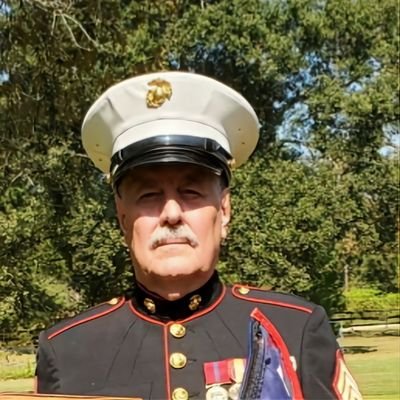
AI video of me from a picture taken at the reenactment of the Battle of San Jacinto, sword fighting Mexican Lancers. Great fun on a great horse.
English
11
13
132
1.8K
Jack
Jack@CtrlShftAltDel·
@HistoryWJacob Why did you ask this? I may not be able to sleep wondering now 😂
English
0
0
0
115
History With Jacob
History With Jacob@HistoryWJacob·
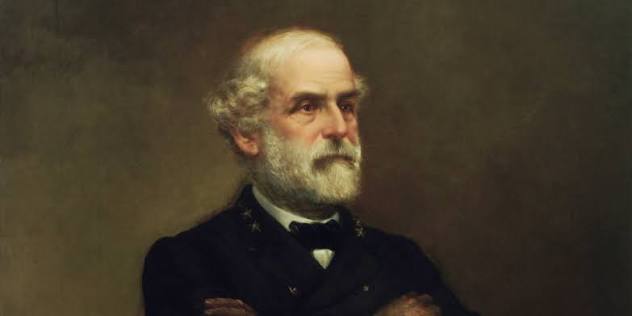
Who would you rather follow into battle? Ulysses S Grant Robert E Lee Chesty Puller George Washington
History With Jacob tweet mediaHistory With Jacob tweet mediaHistory With Jacob tweet mediaHistory With Jacob tweet media
English
186
12
239
17.6K
Jack retweetledi
Jack
Jack@CtrlShftAltDel·
@CorpBarnaby Thanks for sharing. I hadn't heard these stories about Chamberlain. Pretty incredible.
English
0
0
1
4
Jack
Jack@CtrlShftAltDel·
Union army was NOT mostly foreigners. That is a very common historical myth, but it isn't true. The Union army was not "mostly" foreigners, though immigrants did make up a massive and incredibly important part of the federal forces. While the overwhelming majority of Union soldiers were native-born Americans, the sheer scale of immigrant participation was still historic. The Actual Numbers Roughly 75% of the Union army was native-born. However, the remaining 25% (about 500,000 men) were foreign-born immigrants. If you count first-generation Americans (the children of immigrants), that adds another 18% to the ranks. The vast majority of these immigrant soldiers came from two main European countries: German States: Approximately 200,000 German-born soldiers served in the Union army. Many were political refugees who fled the failed European revolutions of 1848. Ireland: Around 150,000 Irish-born soldiers enlisted. Most had arrived in the US during the prior decade, escaping the devastation of the Great Famine. Other Nations: Tens of thousands of others came from Canada, England, Scandinavia, France, and Italy. Why Do People Think the Union Army Was "Mostly Foreign"? The idea that the Union army was just a horde of European mercenaries didn't start recently—it actually started during the war itself, largely driven by two things: 1. Confederate Propaganda Southern newspapers and politicians actively pushed the narrative that they weren't fighting "real" Americans, but rather "Lincoln's hirelings" and "foreign mercenaries." It was a highly effective wartime spin. By painting the Northern army as a collection of desperate, newly landed European peasants who were bought with enlistment bounties, the Confederacy tried to delegitimize the Union cause and boost Southern morale. 2. Highly Visible "Ethnic" Regiments Because of the way Civil War regiments were raised locally, many communities formed entirely ethnic units. These units stood out because they often marched under their own flags (like the deep green banner of the Irish Brigade), wore unique uniforms, or even had officers who gave commands in German. The German-led Eleventh Corps and the Irish Brigade became famous (and sometimes infamous) in wartime reporting, which made their presence feel even larger than it was. While the Union forces were incredibly diverse, three out of every four soldiers who fought to preserve the United States were born right on American soil.
English
1
0
1
18
Rafferty Rao
Rafferty Rao@RaffertyRao·
@CorpBarnaby They were Americans, not evil men or foreigners fighting for a regime that wanted us dead. Yes, it was profound and respectful. It should have been. We’re lucky there were good men on both sides. … also, yet another great post. Appreciate what you’re doing here!
English
3
2
76
2.3K
Barnaby Breaks History 🇺🇸
🇺🇸 During the surrender at Appomattox, it was Brig. Gen. Joshua Chamberlain who ordered his 5,000 men to ‘carry arms’ as the defeated Confederate Army of Northern Virginia approached. It was a profound sign of honor and mutual respect. Surprised by the gesture, Confederate Maj. Gen. John B. Gordon instantly ordered his troops to return the salute. Gordon, in his memoirs, later praised Chamberlain as one of the knightliest soldiers in the Union Army.
Barnaby Breaks History 🇺🇸 tweet media
Barnaby Breaks History 🇺🇸@CorpBarnaby

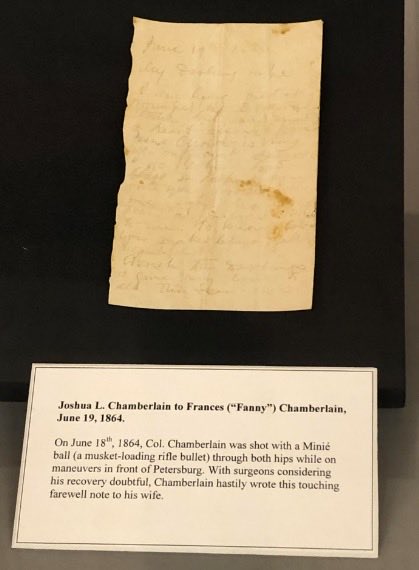
🇺🇸 Joshua Chamberlain’s last visit to Gettysburg took place on May 16–17, 1913. It was bittersweet. He traveled to the battlefield to help plan the upcoming 50th Anniversary Great Reunion, but his health was rapidly deteriorating, and he was ultimately unable to attend the event that July. The state of Pennsylvania mailed his commemorative veteran's medal directly to his home. He thanked them with this letter. He passed away less than a year later, in February 1914, at 85 years old. Because his death was caused by an infection from the severe pelvic wound he received at the Battle of Petersburg, historians often call him the last casualty of the Civil War.
English
19
168
1.5K
164.5K
Barnaby Breaks History 🇺🇸
"To know & love you makes life & death beautiful." Joshua Chamberlain was told he would not survive his wound after his surgery that next morning. He then wrote a final, heartbreaking farewell to his wife, Fanny. It is a beautiful Sunday read. “My darling wife, I am lying mortally wounded the doctors think, but my mind & heart are at peace. Jesus Christ is my all-sufficient savior. I go to him. God bless & keep & comfort you, precious one. You have been a precious wife to me. To know & love you makes life & death beautiful. Cherish the darlings & give my love to all the dear ones. Do not grieve too much for me. We shall all soon meet. Live for the children. Give my dearest love to Father, Mother & Sallie & John. Oh how happy to feel yourself forgiven. God bless you evermore precious precious one. Ever yours, Lawrence.” He signed it using his middle name, Lawrence, which she uniquely called him. He even wrote this letter on a Sunday morning, June 19th, 1864. Upon receiving his letter, Fanny immediately packed her bags and rushed to his bedside. She carefully nursed him back from the brink of death.
Barnaby Breaks History 🇺🇸 tweet media
Barnaby Breaks History 🇺🇸@CorpBarnaby

🇺🇸 What makes this story better? Chamberlain shouldn't have even been alive. Less than a year before receiving the Confederate surrender at Appomattox, then Col. Joshua Chamberlain took a Minié ball straight through his pelvis at Petersburg. The bullet shattered bones and severed his bladder and urethra. The injury carried a 90%+ mortality rate. But Chamberlain refused to die. In a field hospital tent, without proper anesthesia, Dr. Abner Shaw spent hours probing the wound. To map the severed urinary pathway, he used a highly experimental procedure. He inserted two long, metal surgical probes into opposite ends of the tract until they clicked together, a method that laid the groundwork for modern urological surgery. The pain was so torturous for Chamberlain that Shaw begged to stop just to let him die in peace. Chamberlain flatly refused and ordered him to keep cutting. Miraculously, he survived. Just 5 months later, he was back in the saddle leading troops in the final campaign of the war. But his wound never truly healed. It left him with an external fistula that leaked urine constantly. He required primitive catheterization and endured severe chronic pain and recurring infections for the rest of his life. He underwent 4 more unsuccessful surgeries in his lifetime (in 1865, 1866, 1883, and 1893) to try and close the wound. All of them failed. Yet, despite all this, he not only came back to the war, he went on to serve 4 terms as Governor of Maine and 12 years as the President of Bowdoin College. Legend.
English
5
68
449
24.7K
Jack
Jack@CtrlShftAltDel·
@RandomGingerCat Grant is a legend. I've forgotten about Chamberlain. Never again. Great post
English
0
0
0
0
Freddy🇩🇪
Freddy🇩🇪@FreddyLA7·
The fact you can have this at home and just shoot around is so crazy to me😭
English
1.8K
964
35K
767.8K
Jack
Jack@CtrlShftAltDel·
@FreddyLA7 Freedom is a crazy idea. Once you get a taste for it, nothing else will satisfy.
English
0
0
0
622
Jack
Jack@CtrlShftAltDel·
We say Lie lies lies. They would say votes, votes, votes 😂
English
0
0
0
9
Jack
Jack@CtrlShftAltDel·
"Put that in your pipe and smoke it"😂 William Lane Craig and atheist debate
English
0
0
0
13
Jack retweetledi