David Melnikoff

1.5K posts

David Melnikoff banner
David Melnikoff

David Melnikoff

@DEMelnikoff

Assistant Professor of Organizational Behavior at Stanford GSB.

Palo Alto, CA Katılım Ocak 2018
403 Takip Edilen1.2K Takipçiler
David Melnikoff
David Melnikoff@DEMelnikoff·
For more strategies, and why they work, check out our paper! 🙂
English
0
0
1
193
David Melnikoff
David Melnikoff@DEMelnikoff·
First, avoid binary representations: they place a strict ceiling on I(M;E). Compared to binaries, streak representations will boost I(M;E)—& thus flow—unless your success rate is low, in which case proximity representations (thinking in terms of distance from a target) are best.
English
1
0
1
210
David Melnikoff
David Melnikoff@DEMelnikoff·
New 📄: Support for a computational model of how task representations (e.g. thinking in terms of binary wins/losses vs. streaks of consecutive wins vs. physical distance to a target, etc.) shape the experience of flow, enjoyment, and objective performance osf.io/preprints/osf/…
English
1
1
7
377
David Melnikoff retweetledi
Derek Brown
Derek Brown@NDerek_brown·
The Management Division at Columbia Business School is excited to announce the Postdoctoral Teaching Fellow position! Please help spread the word! They will receive a research budget and collaborate with faculty. See the job ad below, and please reach out with any questions.
English
1
11
18
2.6K
David Melnikoff retweetledi
Jon M Jachimowicz
Jon M Jachimowicz@jonj·
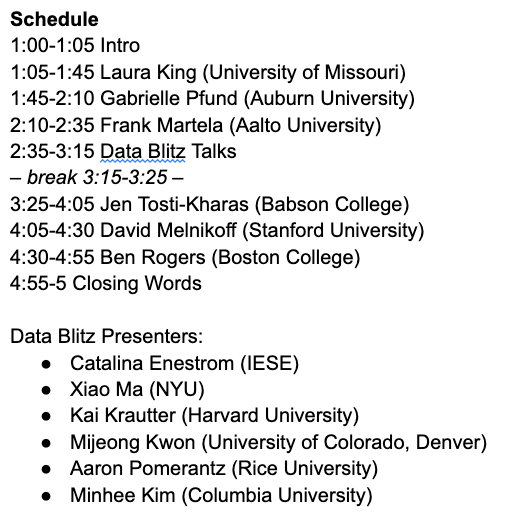
Please come join us at the inaugural Meaning in Life and Work Preconference at @SPSPnews in Denver! Hoping to bring together research across psych and OB that has often remained siloed. Schedule below! #item-accordion-item--9921__panel" target="_blank" rel="nofollow noopener">spsp.org/events/annual-… @GabriellePfund @FrankMartela @DEMelnikoff
Jon M Jachimowicz tweet mediaJon M Jachimowicz tweet media
English
1
7
18
2.9K
David Melnikoff retweetledi
David Amodio
David Amodio@david_m_amodio·
🚨New in @PNASNews, led by @DSchultner & Ben Stillerman: In 8 studies, we test a mechanism through which exposure to societal stereotypes—even those we know may be false—can implicitly transform into individual-level prejudice and then spread across a community.
David Amodio tweet media
English
1
42
140
25K
David Melnikoff retweetledi
Joe Henrich
Joe Henrich@JoHenrich·
Great opportunity with top researcher
English
1
2
13
2.9K
David Melnikoff retweetledi
Amitai Shenhav
Amitai Shenhav@amitaishenhav·
Last but not least, it’s been said before but if you have a chance to work with @LindseyDrayton as an editor I highly recommend it! She is truly in a class all her own as far as journal editors go, and helped improve this paper at every stage.
English
2
1
14
516
David Melnikoff retweetledi
Tobias Gerstenberg
Tobias Gerstenberg@tobigerstenberg·
This paper has been significantly updated -- including its title 🧑‍🏫 In "Causation, Meaning, and Communication", Ari Beller develops and tests a computational account of how people use and interpret different causal expressions (like "caused", "enabled", and "affected"). 1/3
Tobias Gerstenberg@tobigerstenberg

Excited to introduce the 'Counterfactual Simulation Model of Causal Language' 🎱➡️💬 (led by Ari Beller, cicl.stanford.edu/member/ari_bel…) which captures how people's causal representations of what happened translate into language. 📰psyarxiv.com/xv8hf 📎github.com/cicl-stanford/… 🧵

English
1
6
30
4K
David Melnikoff retweetledi
Morgan Weaving
Morgan Weaving@WeavingMorgan·
Excited to share this review paper that outlines evidence that minority group members live in ‘tighter’ social worlds. An enormous thank you to @MicheleJGelfand for all the mentorship and guidance on this! Empirical work to follow! authors.elsevier.com/c/1jrTj,rU~N-t…
Michele J. Gelfand@MicheleJGelfand

Colleagues--our new paper on Minorities living in tighter worlds is out. Loved collaborating with the great @WeavingMorgan on this! Stay tuned for the empirical paper that tests these ideas! cc @_alice_evans authors.elsevier.com/c/1jrTj,rU~N-t…

English
0
2
15
1.1K
David Melnikoff
David Melnikoff@DEMelnikoff·
@gershbrain I find it helpful knowing the author’s preferred outcome if they had one. E.g., evidence for basic emotions would update my beliefs more coming from Barrett vs Keltner. The odds of Barrett & I missing a flaw in that evidence are lower than the odds of Keltner & I missing it.
English
0
0
2
478
Sam Gershman
Sam Gershman@gershbrain·
I'm curious what would happen if we banned possessives when referring to hypotheses in scientific papers. My impression is that scientists are far too personally invested in their hypotheses. When I edit my student's papers, I change 'our hypothesis' to 'a hypothesis'.
English
15
6
125
15.1K