DIA Intern
9.7K posts

@DIAIntern
DIAmond Hands. Shitposter. $DIA staker. Tweets are independent of @DIAdata_org
2026 Yıllık Özeti
@DIAIntern hesabının Twitter yılını gör


.@st0x_io runs 24/7 trading for tokenized equities and ETFs on @base, each backed 1:1 by shares held at a regulated broker. DIA oracles set the reference price its order book quotes around, with pre and post-market sessions kept separate from regular hours. Stocks are onchain.

.@st0x_io runs 24/7 trading for tokenized equities and ETFs on @base, each backed 1:1 by shares held at a regulated broker. DIA oracles set the reference price its order book quotes around, with pre and post-market sessions kept separate from regular hours. Stocks are onchain.


Today, we are excited to launch DIA ZK, the verifiable data assurance layer for DeFi, RWAs, and cross-chain applications. Yield-bearing stablecoins, tokenized treasuries, and vaults built on offchain strategies now hold tens of billions in onchain value. The highest yields among them are earned offchain: basis trades on centralized exchanges, tokenized treasuries, private credit, CeFi lending. While the token lives onchain, the strategy that pays it does not. That creates a problem for issuers. Holders, risk curators sizing allocations, and lending markets deciding whether to list a token cannot see the custody balances, exchange positions, or loan books behind the yield. They ask for proof, and an issuer-controlled dashboard or a monthly attestation is becoming less convincing as the basis for trust. In June this year, a yield-bearing stablecoin lost its peg after the third-party service that verified its reserves ended its relationship. A lending market built around the token was left with roughly $18 million of affected collateral, and a separate vault with no direct exposure to the stablecoin was hit too because both relied on the same verifier. DIA ZK addresses this. It proves that a reported value came from the stated source and was not altered on its way onchain. It proves the statement rather than the value: a condition such as reserves exceeding supply, without revealing the underlying figures. The proofs are posted and verified on DIA's oracle chain, rather than relying on a feed that a single verification provider can switch off. Reserve disclosure requirements under MiCA already apply in the EU, and the US GENIUS Act will introduce federal reserve and disclosure requirements for qualifying stablecoin issuers. Continuously proving backing onchain, without forcing an issuer to reveal its underlying books, is the next capability the oracle layer has to provide. If your protocol depends on stablecoin reserves, tokenized fund NAVs, or vault collateral held offchain, this is where to start.

Today, we are excited to launch DIA ZK, the verifiable data assurance layer for DeFi, RWAs, and cross-chain applications. Yield-bearing stablecoins, tokenized treasuries, and vaults built on offchain strategies now hold tens of billions in onchain value. The highest yields among them are earned offchain: basis trades on centralized exchanges, tokenized treasuries, private credit, CeFi lending. While the token lives onchain, the strategy that pays it does not. That creates a problem for issuers. Holders, risk curators sizing allocations, and lending markets deciding whether to list a token cannot see the custody balances, exchange positions, or loan books behind the yield. They ask for proof, and an issuer-controlled dashboard or a monthly attestation is becoming less convincing as the basis for trust. In June this year, a yield-bearing stablecoin lost its peg after the third-party service that verified its reserves ended its relationship. A lending market built around the token was left with roughly $18 million of affected collateral, and a separate vault with no direct exposure to the stablecoin was hit too because both relied on the same verifier. DIA ZK addresses this. It proves that a reported value came from the stated source and was not altered on its way onchain. It proves the statement rather than the value: a condition such as reserves exceeding supply, without revealing the underlying figures. The proofs are posted and verified on DIA's oracle chain, rather than relying on a feed that a single verification provider can switch off. Reserve disclosure requirements under MiCA already apply in the EU, and the US GENIUS Act will introduce federal reserve and disclosure requirements for qualifying stablecoin issuers. Continuously proving backing onchain, without forcing an issuer to reveal its underlying books, is the next capability the oracle layer has to provide. If your protocol depends on stablecoin reserves, tokenized fund NAVs, or vault collateral held offchain, this is where to start.

ST0x RWA Summer starts now Tokenising stocks was the easy part. Making them liquid onchain is the real work That work is the season: ST0x and the teams building onchain, pushing equities into DeFi and deepening the markets under them Every week: • New assets listed, picked by you • Liquidity deepening across venues • Partners across DeFi integrating • Incentive campaigns on top Week one is already live SK Hynix: ~4,000% APY to LPs, TVL up 5x in days Every week the liquidity gets deeper. That's the metric that matters Making public markets actually public Come get stuck into RWA Summer

🔐 $DIA staking = Multichain oracle infra drop to builders 🪂

Today, we are excited to launch DIA ZK, the verifiable data assurance layer for DeFi, RWAs, and cross-chain applications. Yield-bearing stablecoins, tokenized treasuries, and vaults built on offchain strategies now hold tens of billions in onchain value. The highest yields among them are earned offchain: basis trades on centralized exchanges, tokenized treasuries, private credit, CeFi lending. While the token lives onchain, the strategy that pays it does not. That creates a problem for issuers. Holders, risk curators sizing allocations, and lending markets deciding whether to list a token cannot see the custody balances, exchange positions, or loan books behind the yield. They ask for proof, and an issuer-controlled dashboard or a monthly attestation is becoming less convincing as the basis for trust. In June this year, a yield-bearing stablecoin lost its peg after the third-party service that verified its reserves ended its relationship. A lending market built around the token was left with roughly $18 million of affected collateral, and a separate vault with no direct exposure to the stablecoin was hit too because both relied on the same verifier. DIA ZK addresses this. It proves that a reported value came from the stated source and was not altered on its way onchain. It proves the statement rather than the value: a condition such as reserves exceeding supply, without revealing the underlying figures. The proofs are posted and verified on DIA's oracle chain, rather than relying on a feed that a single verification provider can switch off. Reserve disclosure requirements under MiCA already apply in the EU, and the US GENIUS Act will introduce federal reserve and disclosure requirements for qualifying stablecoin issuers. Continuously proving backing onchain, without forcing an issuer to reveal its underlying books, is the next capability the oracle layer has to provide. If your protocol depends on stablecoin reserves, tokenized fund NAVs, or vault collateral held offchain, this is where to start.


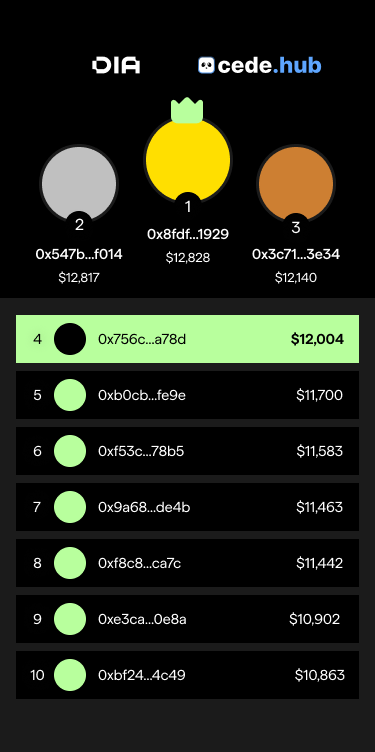

Market bounced, traders are hungry… So, we're doing something fun for the next 8 weeks 8-week trading competition with @cedehub 🏆 $24,000 prize pool 💰 $3,000 up for grabs every week compete, climb the leaderboard, win rewards

🔥 Get ready to participate in @DIAdata_org x Cede Hub trading campaign. Compete for a share of the 24,000 USDT by trading $DIA on @binance via Cede Hub. app.cedehub.io/dia-tte


@turkamator88
219.2K görüntülenme
@wx1n11124
138.4K görüntülenme
@turkifsa_aley
46.8K görüntülenme
@ne_puppy
41.7K görüntülenme
@cccxxxyyyiii
35.4K görüntülenme
@slzjtt
29.1K görüntülenme
@gulililucky
19.5K görüntülenme
@oooosugar
18.9K görüntülenme