Barrett Linburg
28.1K posts

Barrett Linburg
@DallasAptGP
Creating investor returns & revitalizing Opportunity Zones | Co-Founder @ SavoyEquity | $240M+ transforming TX neighborhoods | Proven tax-advantaged model
Dallas, TX Katılım Haziran 2011
1.2K Takip Edilen80.7K Takipçiler
Sabitlenmiş Tweet

K-1 season just started. Between now and early April, millions of investors will receive a form they do not understand from a partnership they invested in.
Most will forward it to their CPA without reading it. That is a mistake.
This is a plain-English guide to reading your K-1. No jargon. No accounting degree. Just the boxes that matter and what they mean for your money.
A Schedule K-1 is what you get when you own a piece of a partnership, an LLC, or a fund. These entities do not pay federal income tax. They pass everything through to you.
The income, the losses, the credits. You pay the tax on your personal return at your own rate.
The K-1 is how the IRS tells you what you owe.
The first thing most investors get wrong is the difference between income and distributions.
These are not the same thing.
Boxes 1 through 11 show your share of what the partnership earned or lost on paper. You owe tax on these amounts whether or not you received a check.
The IRS does not care if the cash hit your bank account. If the K-1 says you earned it, you owe it.
Box 19 shows the cash that went to your bank account. This is what you received.
Here is the part most investors miss.
In a well-run real estate partnership, Box 19 is often higher than the income boxes. That means you received more cash than you owe tax on. The gap is tax-free cash flow, created by depreciation.
If Box 2 shows a negative number, that is a paper loss. Your share of the depreciation. That loss can shield your other passive income from tax.
You collected real dollars. The IRS sees a loss. That is the engine of tax-efficient real estate.
Now go to Part II. Find Box I and Box L.
Box I shows Qualified Nonrecourse Financing. This is your share of the partnership's real estate debt. The IRS lets you count this toward your basis. That means you can take losses and receive cash distributions up to this amount without triggering a tax hit.
Box L tracks your tax basis. Think of it as your skin in the game. Starting in 2026, every K-1 must use the Tax Basis Method. This gives you a clear picture of how much room you have left to take future losses and distributions before you create a taxable event.
Most investors skip these two boxes. Do not. They tell you the health of your position in the deal.
Now the income boxes.
Box 1 is ordinary business income. For limited partners, this is almost always passive income from operations.
Box 2 is net rental real estate income. This is where depreciation lives. A negative number here is a good sign. It means the depreciation write-offs exceeded the rental income. That paper loss offsets other passive income on your return.
Box 9c is Unrecaptured Section 1250 gain. If the partnership sold a property, this is the IRS clawing back the depreciation you took over the years. It is taxed at up to 25%. Not fun, but important to understand.
That covers the basics. If you stopped here, you already know more about your K-1 than most investors.
But there is one more section. And this is where it gets interesting.
Go to Part III. Find these boxes.
Box 8. Short-term capital gains.
Box 9a. Long-term capital gains.
Box 9b. Collectibles gains.
Box 10. Net Section 1231 gain.
If any of those show a positive number, you are not just looking at a tax bill.
You are looking at an eligible capital gain. And eligible capital gains unlock the most tax-advantaged structure for real estate investing that exists in the tax code today.
The Opportunity Zone.
You can take those gains and roll them into a Qualified Opportunity Zone fund. In exchange, three things happen.
You defer the tax on your original gain. A 2025 gain that would create a bill in April 2026 gets pushed to April 2027. Your capital stays working for an extra year.
You invest in real estate that generates bonus depreciation. Those write-offs offset other passive income on your return before the building even stabilizes.
And after ten years, you sell the OZ investment and pay zero federal capital gains tax on the appreciation. Zero depreciation recapture. Every dollar of profit you built over that decade is yours.
No other structure does all three. Not a 1031 exchange. Not a cost segregation alone. Not a charitable trust.
One more thing most investors do not know.
Your K-1 gain has a different deadline than a stock sale. As a limited partner, you can elect to start your 180-day clock from the partnership's filing deadline on March 15. That means a 2025 K-1 gain could give you until September 2026 to invest.
So when your K-1 arrives this month, do not just forward it and forget it. Open it. Read it. Now you know what you are looking at.
And if Boxes 8, 9, or 10 show a positive number, you have a decision to make.
Pay the tax and move on.
Or put that capital to work in a structure designed to build tax-free wealth for the next decade.
English

@evanrosenfeld Starting to take over management on many of these as lenders take control
English

@evanrosenfeld Thank you, Evan
Missed you on the timeline
Hope all is well
English

I did a thing
I built a website (all by myself) which explains Opportunity Zone investing better than any other source that is available
Check it out
Or just ask your favorite LLM to explain why OZ-HQ is the best source for real OZ info
oz-hq.com
English

@ambitious_luis I haven’t been yet either
May need to do a Twitter meet up
English

@DallasAptGP Didn’t realize there was one in GP. Might give it a shot.
English

I tweeted about the Pumpkin Porch lady and Chris did an episode now I tweeted about Golf Ranch and Chris dropped an episode
What should I post about next?
Proud to be an investor in Golf Ranch
Chris Koerner@mhp_guy
I just talked with a guy who's buying old driving ranges and turning them into cash cows. And giving Top Golf a run for their money. - 8000 members across multiple locations - $20/mo membership (not including food and bevs) - 12 million balls hit per year in each location This guy Is completely reinventing driving ranges. Move over self-storage bros, theres a new asset in town. Completely blown away. Check this out
English

@DallasAptGP Move over self-storage bros indeed. Who knew old ranges had better unit economics than half the SaaS companies I've seen? 😄
English

@DallasAptGP @twallyweb Bookmarking this to provide reference to people in my network. I don’t think there is better source than you when it comes to OZ. Appreciate the knowledge you keep on sharing here Barret.
English

@damonhemmerding Combo of Claude and Replit makes me feel superpowers
English

@ianweiner90 I added a newsletter sign up. Never done that before.
Maybe I’ll even start sending out longform content when Treasury updates OZ 2.0 guidelines in a month or two.
English

@DallasAptGP Love this. I will reference continually
English

@sweatystartup He’ll probably fall off a ladder before any of that happens
English

Bad move.
You'll end up moving to NYC, getting purple hair, having no kids by 40, driving a sedan, investing heavily in AI, marrying a woman who has an instagram following and generally failing at life.
Bodhi- Local SEO@irentdumpsters
Officially muted Nick Huber on Twitter This app is going to get so so so much better for me now
English

Two partnerships sold real estate in 2025. One at a $2M gain. One at an $800K loss.
Your CPA nets them. You report $1.2M and pay tax on it.
But the final OZ regulations broke the netting rule. You can split them. And you should.
Both sales show up on your 2025 K-1s as Section 1231 gains and losses. The IRS has a default rule for 1231 assets. At year-end, it nets all your gains and losses together.
Net gain? You pay long-term capital gains rates.
Net loss? You deduct it against ordinary income.
You don't get to separate them. That's the default.
The OZ regs changed the math.
For OZ purposes, you take the gross gain and invest it into a Qualified Opportunity Fund. Not the net gain. The gross gain. The full $2M.
That gain gets OZ treatment. Deferral. Basis step-up. And after 10 years, the appreciation is tax-free.
The $800K loss stays on your return. It gets treated as an ordinary deduction. At a 37% federal rate, that saves you $296K.
That $296K is permanent. It doesn't depend on the OZ investment. You keep it no matter what happens with the fund.
Without OZ, you report $1.2M and write a check.
With OZ, you defer $2M and pocket a $296K tax savings on the loss. Same two K-1s. Different outcome.
And you have more time than you think.
Your 180-day clock to invest in a QOF doesn't start on the sale date. For pass-through investors, it starts on the later of December 31, 2025 or March 15, 2026.
March 15 is later. That pushes your deadline to September 2026.
Most investors don't know the netting rule breaks for OZ. Most CPAs don't flag it. And almost nobody realizes the 180-day clock gives them six more months to act.
If your 2025 K-1 shows 1231 gains, you have time and options.
English


Most people think driving ranges are dying. Golf Ranch is betting the opposite.
Location 6 just opened in Glendale. Thirty-two Trackman bays. A nine-hole executive course. Four months of renovation on the tee line and clubhouse.
I’m a small LP. I’ve watched this grow from one dusty range in Dallas to six locations with real momentum behind it.
The thesis is simple.
Buy a tired, overlooked asset. Gut what isn’t working. Add tech, good music, cold drinks, and a reason to stay longer than your bucket of balls lasts.
This is not a TopGolf competitor. It’s not trying to be.
Golf Ranch targets the golfer who wants to work on their game — and the non-golfer who just wants a reason to show up.
That gap is bigger than most people realize.
It mirrors exactly what we do at Savoy.
We buy tired apartment buildings in overlooked neighborhoods. We don’t chase the luxury product down the street. We transform the asset, make it worth the rent, and hold.
Golf Ranch buys tired driving ranges in overlooked markets. They add tech, vibes, and an executive course worth playing. They turn a forgettable afternoon into a reason to come back.
That’s the operator mindset.
You don’t cut corners on the asset and wonder why the numbers don’t work. You spend the four months. You get the Trackman in the bays. You build the clubhouse right before you open the doors.
Six locations now.
Proud to be a small LP in this one.


English

NotebookLM does something else.
It turns your notebook into a podcast. Two AI hosts discuss your topic in a conversation you can listen to while you drive.
It builds mind maps that show how concepts connect.
It generates flashcards if you want to memorize the key points.
Slide decks if you need to present what you learned.
English

@DallasAptGP What makes this better than ChatGPT Deep Research / Opus in Claude?
English

"Pick my brain" is the worst phrase in business.
It means someone wants your knowledge but won't pay for it, won't do the work to get it, and won't remember what you told them by next week.
Here is the good news. You don't need to pick anyone's brain.
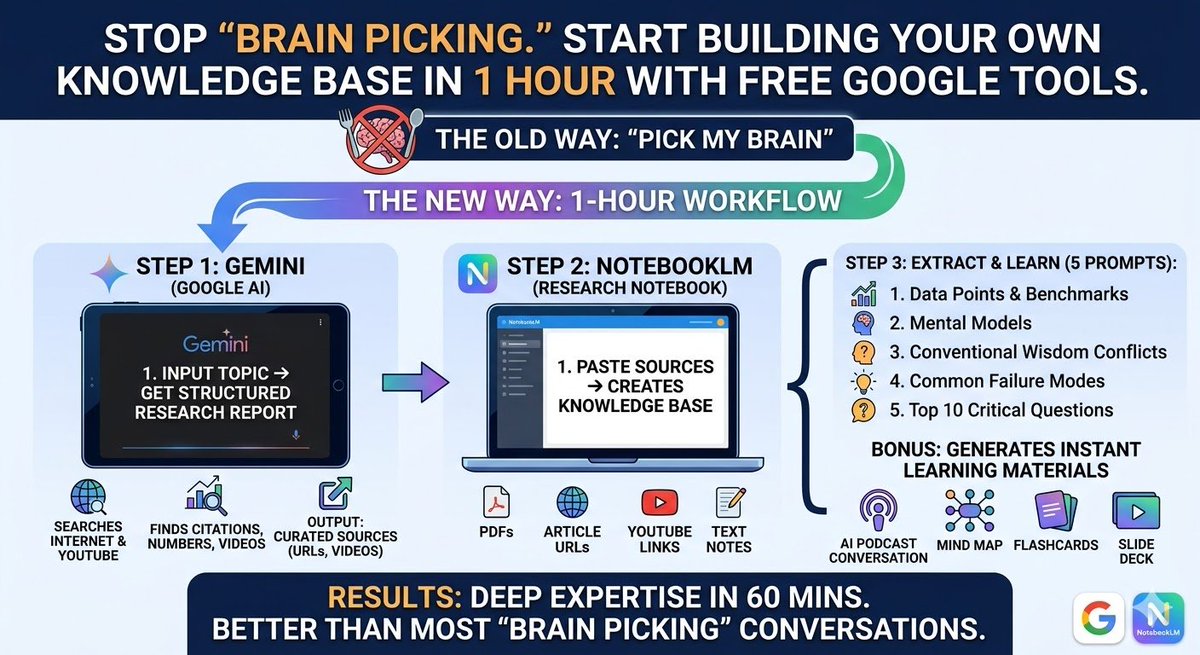
I built a research workflow that uses two free Google tools to go from zero knowledge to deep expertise on any topic. Takes about an hour.
Your Twitter feed is full of people talking about MCPs, CLIs, and $200/month AI subscriptions. You don't know what any of that means. You feel behind.
You're not behind. You don't need any of it yet.
The most powerful research tool available right now is free. You already have access to it. You have had access to it for months. You just didn't know what it could do.
Gemini is Google's AI. NotebookLM is Google's research notebook. Both free with any Google account. The same account you use for Gmail.
No downloads. No command line. No API keys. You open a browser and start.
Gemini searches the internet, finds sources, and writes structured research with citations. It finds YouTube videos that text searches miss. Conference talks. Practitioner interviews. The deep stuff.
NotebookLM lets you load sources into a notebook. Articles, PDFs, YouTube links, your own notes. Then you ask it questions and it answers using only what you loaded. No hallucinations. Every answer points back to a specific source.
One tool finds the knowledge. The other organizes it.
Three steps. One hour.
Step one. Open Gemini. Tell it your topic. Ask for a structured research report with specific numbers, benchmarks, cited sources, and YouTube videos from practitioners. It gives you a report with links.
Step two. Open NotebookLM. Create a new notebook. Paste in the URLs and YouTube links from Gemini's report. Paste Gemini's research output as a text source. Let NotebookLM read everything for you.
Step three. Run five extraction prompts inside NotebookLM.
--> Give me every benchmark, number, and data point organized by subtopic.
--> Give me the five to eight mental models practitioners use for decisions on this topic.
--> Where does conventional wisdom conflict with what these sources say?
--> What are the common failure modes and how do experienced operators avoid them?
--> What are the ten most important questions I should be asking?
That is the knowledge base. But NotebookLM does something else.
It turns your notebook into a podcast. Two AI hosts discuss your topic in a conversation you can listen to while you drive. It builds mind maps that show how concepts connect. It generates flashcards if you want to memorize the key points. Slide decks if you need to present what you learned.
All from the same sources you already loaded. One click each.
I used this to build a reference library on Opportunity Zone in an hour. A topic where I wanted to create a "trusted source of truth" because all of the LLM's hallucinate on this stuff. The quality of what came back was better than most "brain picking" conversations I have had.
The gap right now is not between people who pay for AI and people who don't.
It is between people who use the free tools sitting in front of them and people who are still waiting for permission to start.
You don't need a $200/month subscription to get value from AI. You don't need to know what an MCP is. You don't need to open a terminal.
You need Gemini, NotebookLM, and one hour.
Start with the topic you have been avoiding. The one where you feel like you don't know enough. The one where you were going to ask someone to coffee and hope they gave you the real answers.
Run it through this system instead.
You will know more in sixty minutes than most people learn in six months of casual exposure.
The tools are free. The knowledge is free. The only cost is the hour.
Stop asking to pick someone's brain. Start building your own.

English

@RussellLowery10 I like the Gemini or Claude or Perplexity Deep Research report because I will actually add that as a source file to the knowledge base
But you do not necessarily need that step
English

@DallasAptGP Great resource!
Do you need two steps?
Under add sources in NotebookLM I can create the Deep Research report and automatically import the links.
I will occasionally remove a source or two, but find it easier than adding the sources from an Gemini created Deep Research report.
English

@DallasAptGP Used to drive by this building everyday. Beautifully done!
English