Daniel Rozenbaum

26 posts

Daniel Rozenbaum banner
Daniel Rozenbaum

Daniel Rozenbaum

@DanRozenbaum

Critical care educator at IUSoM focused on mechanical ventilation. Weekly clinical pearls with real vent images. Check out my 40+ bite-size video course on MV!

Katılım Ocak 2023
37 Takip Edilen430 Takipçiler
Sabitlenmiş Tweet
Daniel Rozenbaum
Daniel Rozenbaum@DanRozenbaum·
Mechanical ventilation doesn’t have to be confusing. I teach a FREE structured course using real ventilator images —from fundamentals to advanced management. 🫁 For Critical Care fellows, motivated residents & RTs 🎥43 concise lessons (5–10 min each) 📚Practical, high-yield, clinically focused Build a deeper understanding. Manage ventilators with confidence. Access the course for FREE: forms.office.com/r/GNhq7GxPbR
English
0
12
60
21.2K
Daniel Rozenbaum
Daniel Rozenbaum@DanRozenbaum·
Take away: If you want to use the stress index, make sure your patient is passive. This is true since Pimus will affect the airway pressure graph independent of PEEP adequacy.
English
0
0
3
170
Daniel Rozenbaum
Daniel Rozenbaum@DanRozenbaum·
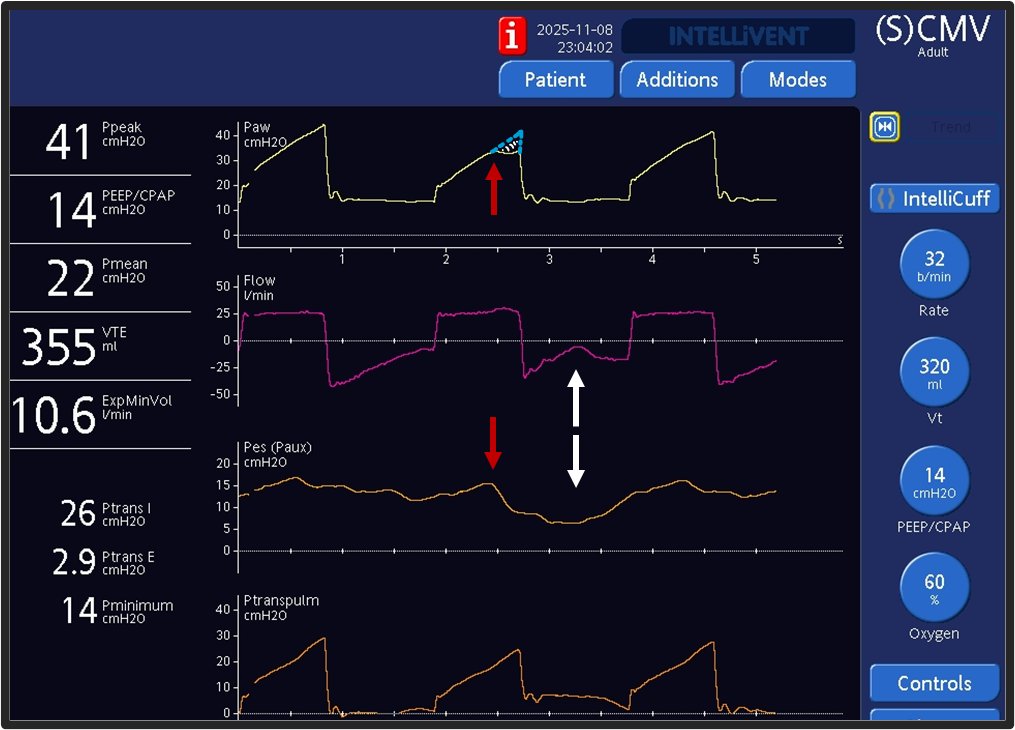
Due to inspiratory effort! The upward concavity pointed by the red arrow has nothing to do with an inadequate PEEP. It is a marker of inspiratory effort (Pimus). Pimus lowers intrathoracic and hence airway pressures (Paw). Since the vent controls flow, flow doesnt increase in response to patient effort, accentuating the drop in Paw. We also see evidence of insp effort on the expiratory flow waveform of the first and third breaths. Check out my last post from 4/15 for a more comprehensive explanation!
English
1
0
5
285
Daniel Rozenbaum
Daniel Rozenbaum@DanRozenbaum·
Is it ok to use the stress index for PEEP titration in this case?
Daniel Rozenbaum tweet media
English
1
8
38
3K
Daniel Rozenbaum
Daniel Rozenbaum@DanRozenbaum·
With these principles in mind you DO NOT NEED esophageal pressure monitoring to recognize Pimus! In upcoming posts, we will apply these principles to UNDERSTAND key patient-ventilator interactions!
English
0
1
6
625
Daniel Rozenbaum
Daniel Rozenbaum@DanRozenbaum·
Back to our case: • Compare the second breath, where effort was present with the first or third, where pt was passive • Note the ↓ in late inspiratory pressures (chopped triangle) and the ↑ in early-mid exp flows marked by the arrows. • The 3rd waveform is Pes. Esophageal pressures reflect pleural pressures and they ↓ with insp effort. Note how the ↓ in Paw and the ↑ in exp flows coincide with the drop in Pes (white/red arrows)
Daniel Rozenbaum tweet media
English
1
1
3
891
Daniel Rozenbaum
Daniel Rozenbaum@DanRozenbaum·
Do you know how to recognize patient inspiratory effort on waveforms? This is the foundation for UNDERSTANDING patient-ventilator interactions.
Daniel Rozenbaum tweet media
English
1
37
168
12.2K
Daniel Rozenbaum
Daniel Rozenbaum@DanRozenbaum·
Option 3: Sedation This would NOT be the best step in this case. Our pt had normal lungs so increasing Vt and the amount of support was the best move. Had we sedated the pt while on APV, the work would have "shifted" back to the ventilator. If this patient had severe ARDS, sedation would have been the best option.
English
0
0
3
297
Daniel Rozenbaum
Daniel Rozenbaum@DanRozenbaum·
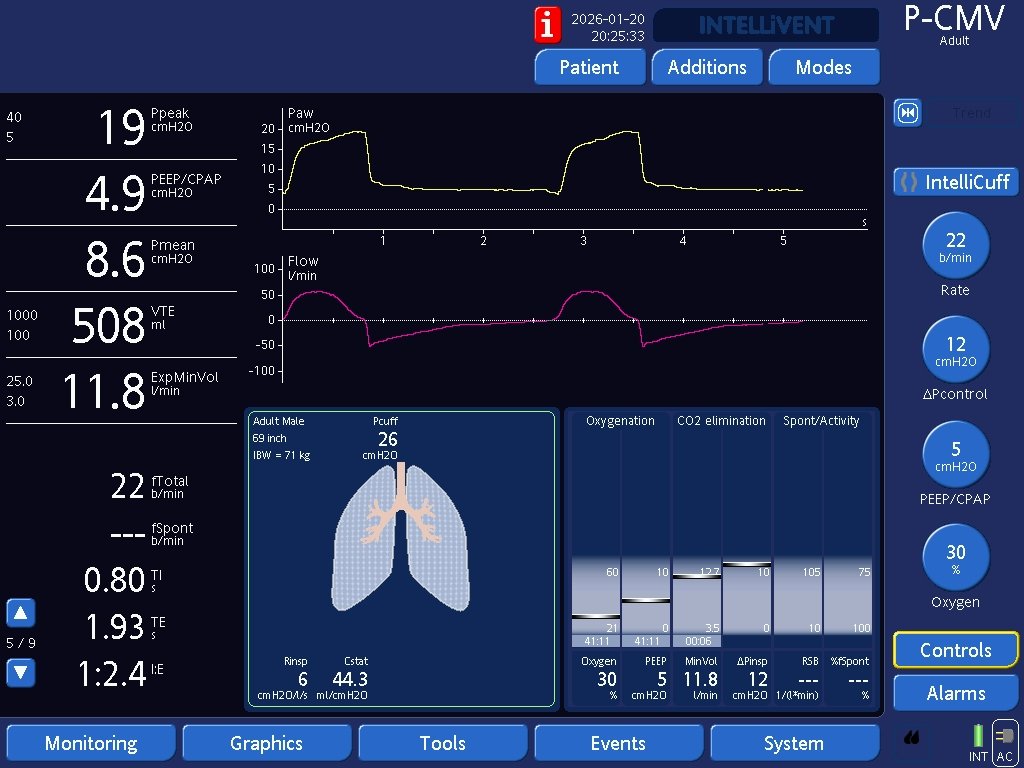
Option 2: Switch the mode We could switch the mode to Pressure Control (PC-CMV(s)), where work shifting DOES NOT happen. We set how much Pinsp we want to give (12 cmH2O in this case). The amount of work performed by the ventilator does NOT depend on patient effort on Pressure Control.
Daniel Rozenbaum tweet media
English
1
0
0
374
Daniel Rozenbaum
Daniel Rozenbaum@DanRozenbaum·
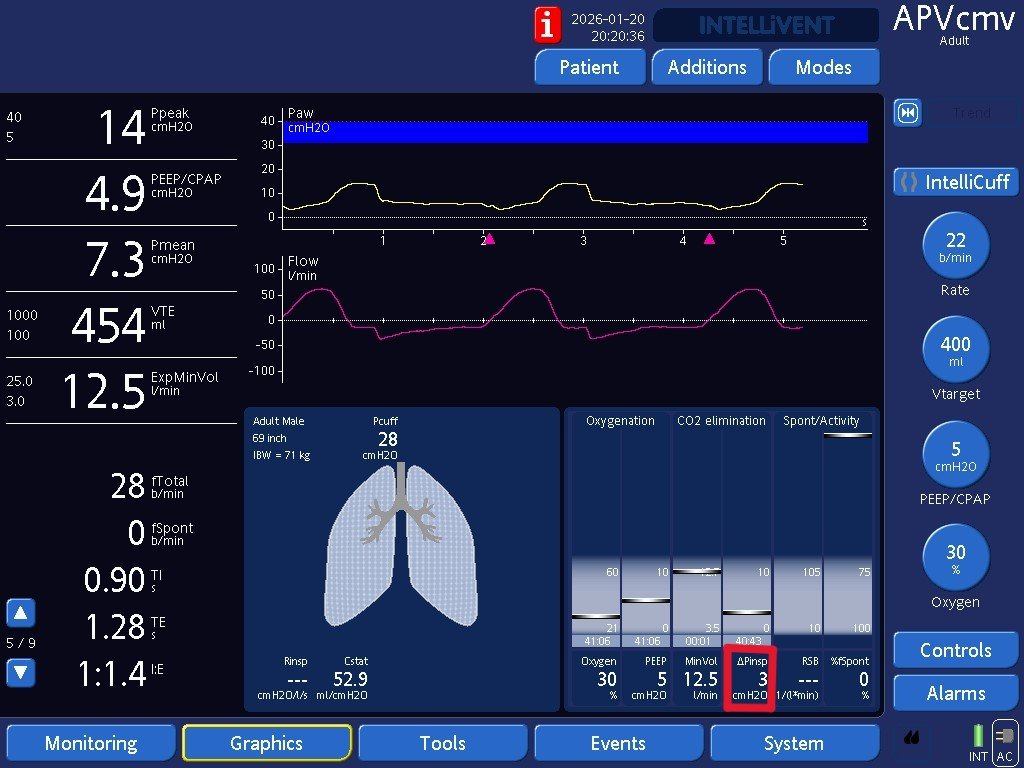
TROUBLESHOOTING ↑ WOB Your pt intubated for altered mental status has ↑ WOB. Exam is otherwise normal, as is their CXR and blood gas. They are on an adaptive mode (PC-CMV(a)) like APV or PRVC. You suspect the ventilator is under supporting the pt (note in red that Pinsp is only 3cmH2O) due to work shifting. What is the best next step? *See quoted post below if you need a review on work shifting.
Daniel Rozenbaum tweet media
Daniel Rozenbaum@DanRozenbaum

Are ADAPTIVE modes that titrate applied pressures to target tidal volumes a SAFE AUTO-PILOT?

English
2
16
67
11.8K
Daniel Rozenbaum
Daniel Rozenbaum@DanRozenbaum·
Hi Tyler! Note that the sharp rise in flows that marks the beginning of inspiration (red arrow) happens before flows return to baseline. The yellow arrow shows the expiratory hold, during which flows will always go to zero since WE are stopping them. The lack of a return to baseline may be even more subtle, so always have a low threshold to do an exp hold! I’ll make another post about when to suspect high Raw based on the shape of waveforms!
Daniel Rozenbaum tweet media
English
0
0
0
32
Daniel Rozenbaum
Daniel Rozenbaum@DanRozenbaum·
How would you explain the apparently elevated driving pressure (24cmH2O) in this patient without infiltrates on chest imaging?
Daniel Rozenbaum tweet media
English
2
0
6
1.5K
Daniel Rozenbaum
Daniel Rozenbaum@DanRozenbaum·
Key take-away: Driving pressure ≠ Plateau - setPEEP Driving pressure = Plateau - totPEEP So the Driving pressure here was 9, not 24cmH20!
English
0
0
2
293
Daniel Rozenbaum
Daniel Rozenbaum@DanRozenbaum·
The patient was being ventilated with too high of a rate and his total PEEP was 20, even though set PEEP was only 5cmH2O! Remember: the driving pressure is the increase in expiratory to inspiratory alveolar pressures secondary to the delivery of tidal volumes!
English
2
0
0
349
Daniel Rozenbaum
Daniel Rozenbaum@DanRozenbaum·
Consequences of work shifting: This phenomenon will often lead to patients who are exerting strong inspiratory effort being left INAPPROPRIATELY SUPPORTED, like the pt in the picture. More to come about this in the next posts, but remember to look out for increased WOB when using adaptive modes in non-passive patient!
English
0
0
1
222
Daniel Rozenbaum
Daniel Rozenbaum@DanRozenbaum·
Understanding work shifting: In modes like APV or PRVC (PC-CMV(a)), pressure is controlled by the ventilator and flows are the dependent variable. The more effort the patient does, the more flow and hence Vt they get. In these adaptive modes, if Vt > target, the ventilator ↓ pressure it applies. In some ventilators, applied Pinsp can be AS LOW AS 0.1 cmH2O above PEEP. MUCH LESS than a spontaneous breathing trial. So the MORE effort the PATIENT does, the LESS work the VENTILATOR does -> work shifts from ventilator to the patient.
English
1
0
3
244
Daniel Rozenbaum
Daniel Rozenbaum@DanRozenbaum·
Are ADAPTIVE modes that titrate applied pressures to target tidal volumes a SAFE AUTO-PILOT?
Daniel Rozenbaum tweet media
English
1
0
2
12.1K