Daniel Hasanov

10 posts

Daniel Hasanov banner
Daniel Hasanov

Daniel Hasanov

@DanielHasanov

Katılım Aralık 2011
309 Takip Edilen63 Takipçiler
Daniel Hasanov
Daniel Hasanov@DanielHasanov·
🏢 Superset — Omnichain Stablecoin Reserve Protocol 📊 Funding: $4M (Feb 2026) 🏷️ Category: DeFi Infra / Cross-Chain Liquidity / Virtual AMM 🛠️ Project Overview Superset is a cross-chain liquidity protocol that virtualizes stablecoin liquidity across multiple blockchains. Instead of splitting depth across Ethereum, L2s, and other networks, Superset aggregates liquidity into a single global reserve via a hub-and-spoke architecture. Core thesis: → Multichain shouldn’t mean fragmented liquidity. 🎯 Who it’s for • Traders — deeper liquidity, lower slippage • LPs — deploy once, earn from activity across all chains • Stablecoin & RWA issuers — unified omnichain liquidity • DEX & aggregators — improved execution quality ⚙️ How It Works (High Level) • User submits swap on a supported chain (spoke) • Swap intent is forwarded to the hub chain • Hub runs a virtual AMM (Uniswap v3 mirror tokens) using global reserves • Output is calculated and returned to the spoke • Cross-chain transfer only occurs if payout is on another chain Result: ✔️ Maximum effective depth ✔️ Reduced slippage ✔️ Higher capital efficiency ✔️ Cross-chain swaps enabled 🧩 Architecture • Hub & Spoke model • Hub = liquidity aggregation + virtual AMM • Spokes = local singleton vaults holding assets • Built on LayerZero (OFT) + Chainlink (CCIP) • Not an L1/L2 — interoperability liquidity overlay 💰 How It Makes Money (Est.) • ~75% — swap & protocol fees (~0.1% protocol fee post-TGE) • ~15% — liquidity migration & incentive mechanisms • ~10% — ecosystem integrations / chain incentives
Daniel Hasanov tweet media
English
0
0
4
32
Daniel Hasanov
Daniel Hasanov@DanielHasanov·
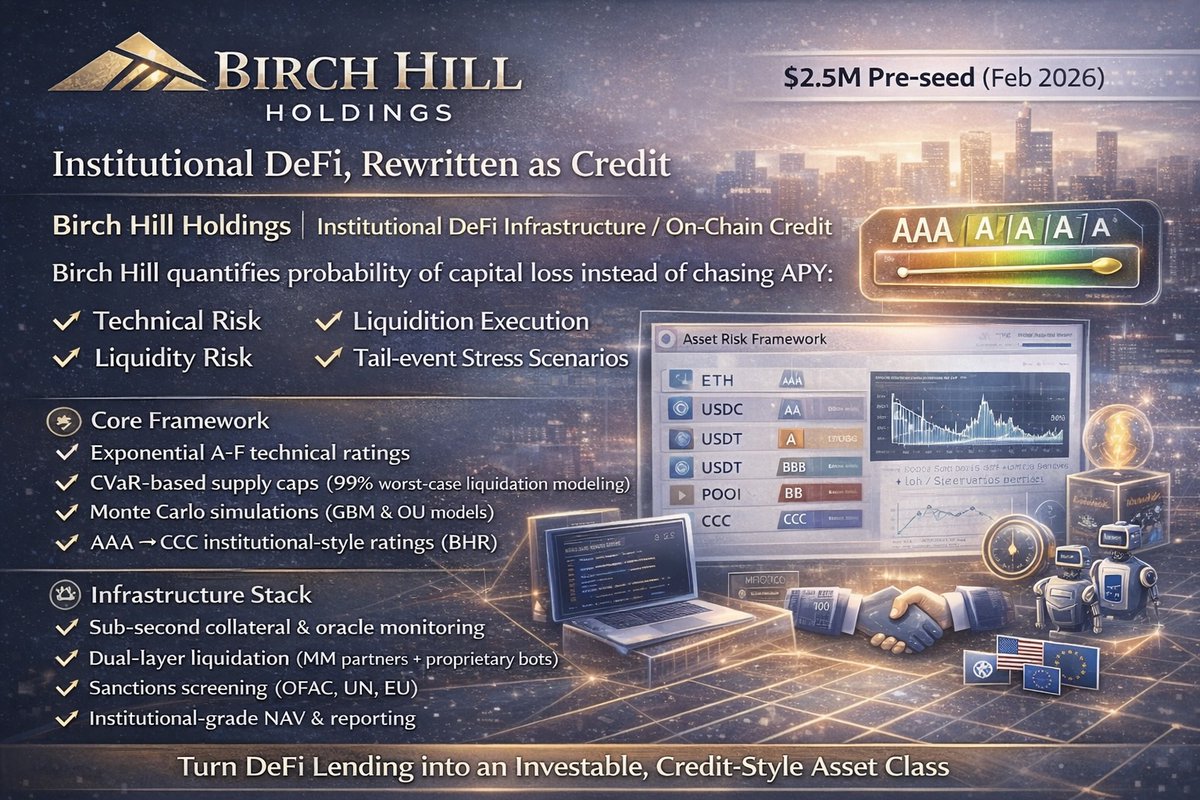
🔎 Institutional DeFi, Rewritten as Credit 🏢 Birch Hill Holdings 📊 $2.5M Pre-seed (Feb 2026) 🏷️ Category: Institutional DeFi Infrastructure / On-chain Credit Birch Hill builds a risk-managed bridge between traditional credit markets and DeFi lending. Instead of chasing APY, they quantify probability of capital loss across: • Technical risk • Liquidity risk • Liquidation execution • Tail-event stress scenarios 🧠 Core Framework • Exponential A–F technical ratings • CVaR-based supply caps (99% worst-case liquidation modeling) • Monte Carlo simulations (GBM & OU models) • AAA → CCC institutional-style ratings (BHR) ⚙️ Infrastructure Stack • Sub-second collateral & oracle monitoring • Dual-layer liquidation (MM partners + proprietary bots) • Sanctions screening (OFAC, UN, EU) • Institutional-grade NAV & reporting 🎯 Mission Turn DeFi lending into an investable, credit-style asset class for institutions.
Daniel Hasanov tweet media
English
0
0
2
30
Daniel Hasanov
Daniel Hasanov@DanielHasanov·
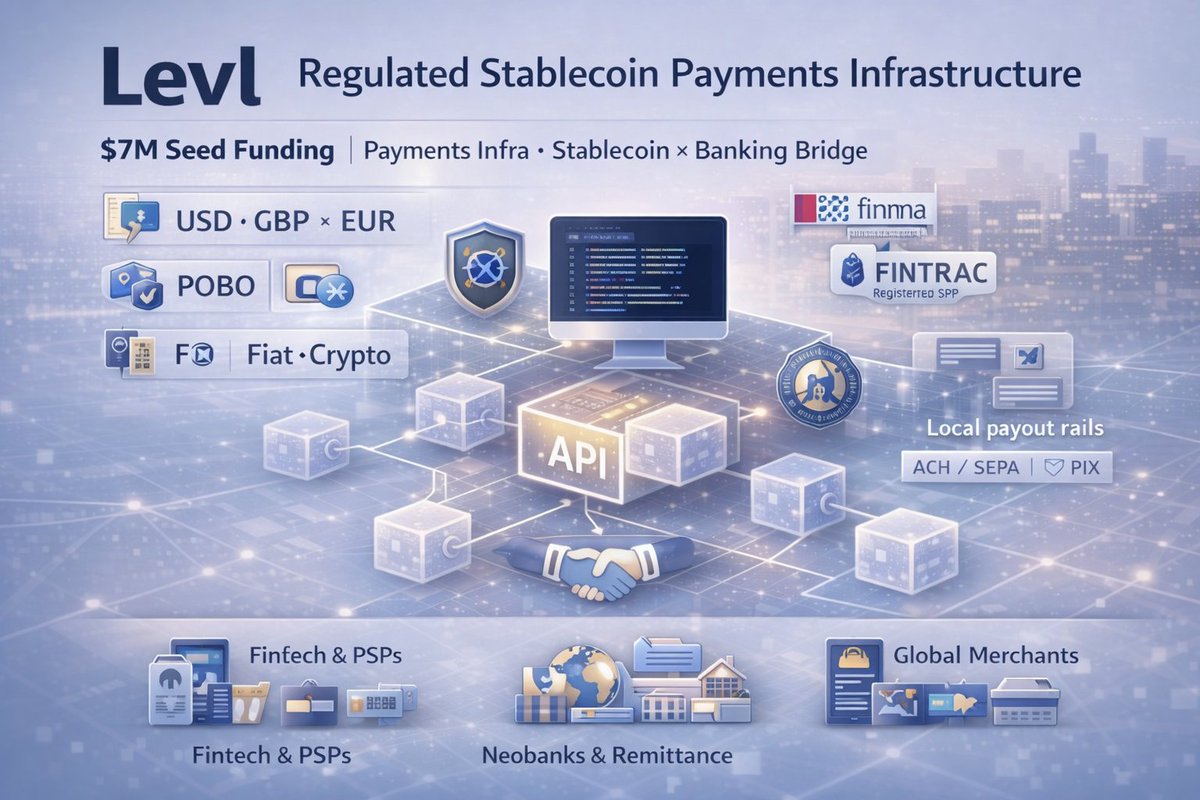
💳 Regulated Stablecoin Payments Infrastructure 🏢 Levl — Stablecoin × Banking Bridge 📊 Funding: $7M Seed 🏷️ Category: Payments Infra / Regulated Settlement Rails 🛠️ Project Overview Levl is a regulated infrastructure layer connecting traditional banking rails with stablecoin-based settlement (not a blockchain protocol). Its core goal is to remove friction in cross-border payments: → enable fast, compliant fiat ↔ crypto transfers with enterprise-grade controls and global payout coverage. 🎯 Who it’s for • FinTechs, PSPs, neobanks • Remittance providers • Crypto exchanges • Global merchants & institutional treasury teams ⚙️ How It Works (High Level) • On-platform: named USD / GBP / EUR accounts + POBO structures • Stablecoin funding (e.g., USDC / USDT) or fiat rails • Real-time FX conversion & liquidity routing • Local payouts (ACH / SEPA / PIX, bank transfer, cards) • Result: crypto-native speed + banking-grade compliance 🧩 Architecture • Hybrid model (bank rails + stablecoin rails) • API-first orchestration layer • Off-chain compliance & treasury engine • No new chain, no consensus layer 💰 Business Model • Transaction fees + FX spread • Payment processing margin • Infrastructure / API access • Potential lending products • No native token — revenue-driven infra play
Daniel Hasanov tweet media
English
0
0
1
25
Daniel Hasanov
Daniel Hasanov@DanielHasanov·
🔗 Intent-Based Cross-Chain UX 🏢 Pheasant Network — Intent-Based Interoperability Protocol 📊 Funding: ~$2M (Seed) 🏷️ Category: Infra / Cross-Chain / Bridge-as-a-Service (Intent × AI Routing) 🛠️ Project Overview Pheasant Network is an infrastructure protocol for cross-chain operations built around an intent-based model. Its core goal is to abstract bridges, swaps, and liquidity routing into a single user intent: → “Receive X on chain B by paying Y on chain A” — without manually choosing bridges, DEXs, or routes. 🎯 Who it’s for • End-users — fast, low-friction cross-chain transfers and swaps • dApp & wallet developers — SDKs, widgets, intent routing • L2/L3 — improved liquidity and user onboarding UX ⚙️ How It Works (High Level) • User submits an intent (desired outcome, not execution steps) • Routing layer selects the optimal path (bridge + swap if needed) • Execution is handled via an optimistic bridge mechanism • Result: assets arrive on the destination chain with bridge complexity fully abstracted 🧩 Architecture • Ethereum- and L2-first (overlay on existing blockchains) • Intent-based routing with optimistic execution • Modular off-chain / on-chain design • Not an L1 or L2 — a pure interoperability infrastructure layer 💰 How It Makes Money (Est.) • ~70% — cross-chain transaction & routing fees • ~20% — infrastructure / BaaS (SDKs, widgets, integrations) • ~10% — enterprise & ecosystem partnerships
Daniel Hasanov tweet media
English
0
0
3
78
Daniel Hasanov
Daniel Hasanov@DanielHasanov·
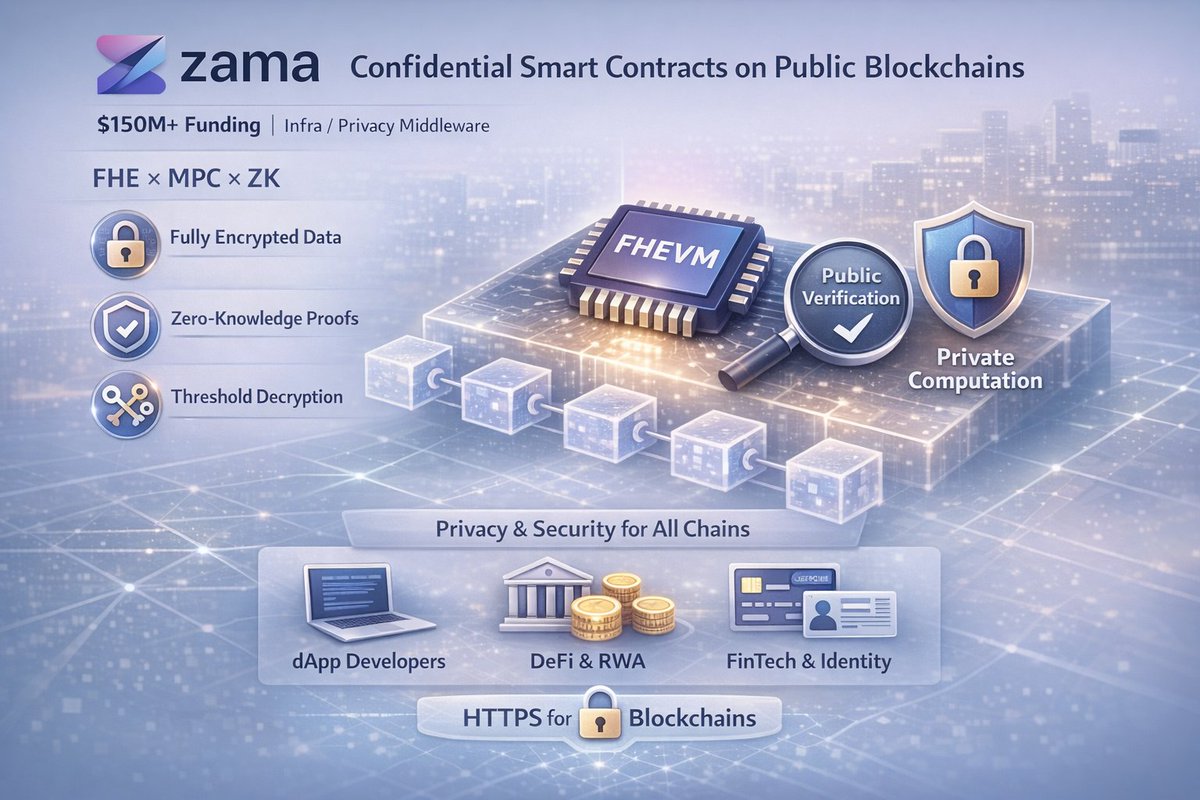
🔐 Confidential Smart Contracts on Public Blockchains 🏢 Zama — Confidential Blockchain Protocol 📊 Funding: $150M+ 🏷️ Category: Infra / Privacy Middleware (FHE × MPC × ZK) 🛠️ Project Overview Zama is a confidentiality layer for existing public blockchains (not an L1/L2). Its core goal is to solve the public verifiability dilemma: → keep transactions publicly verifiable, while making data and contract state fully private, even from node operators. 🎯 Who it’s for • Solidity dApp developers (via FHEVM) • FinTech / TradFi & RWA issuers (privacy + compliance) • DeFi, governance, identity, and data-sensitive apps ⚙️ How It Works (High Level) • On-chain: smart contracts + encrypted state (ciphertexts only) • Off-chain: – FHE coprocessors compute on encrypted data – MPC (KMS) controls decryption via threshold keys – ZK proofs verify correct encrypted inputs • Result: data stays private, logic stays verifiable. 🧩 Architecture • EVM-first, Solidity-native (FHEVM library) • Modular overlay on top of L1/L2 host chains • Cross-chain confidentiality layer (no new chain required) 💰 Tokenomics • $ZAMA — protocol fees + staking • Burn-and-mint model: 100% fees burned, rewards minted to operators 🔥 Why It’s Interesting ✅ Strong stack differentiation: FHE + MPC + ZK ✅ Privacy without sacrificing composability or verifiability ✅ Clear infra play for payments, RWAs, and compliant DeFi ✅ Potential network effects via dev tooling + operator network Zama is effectively building “HTTPS for blockchains” — end-to-end encrypted by default, on public infrastructure.
Daniel Hasanov tweet media
English
0
1
3
199
Daniel Hasanov
Daniel Hasanov@DanielHasanov·
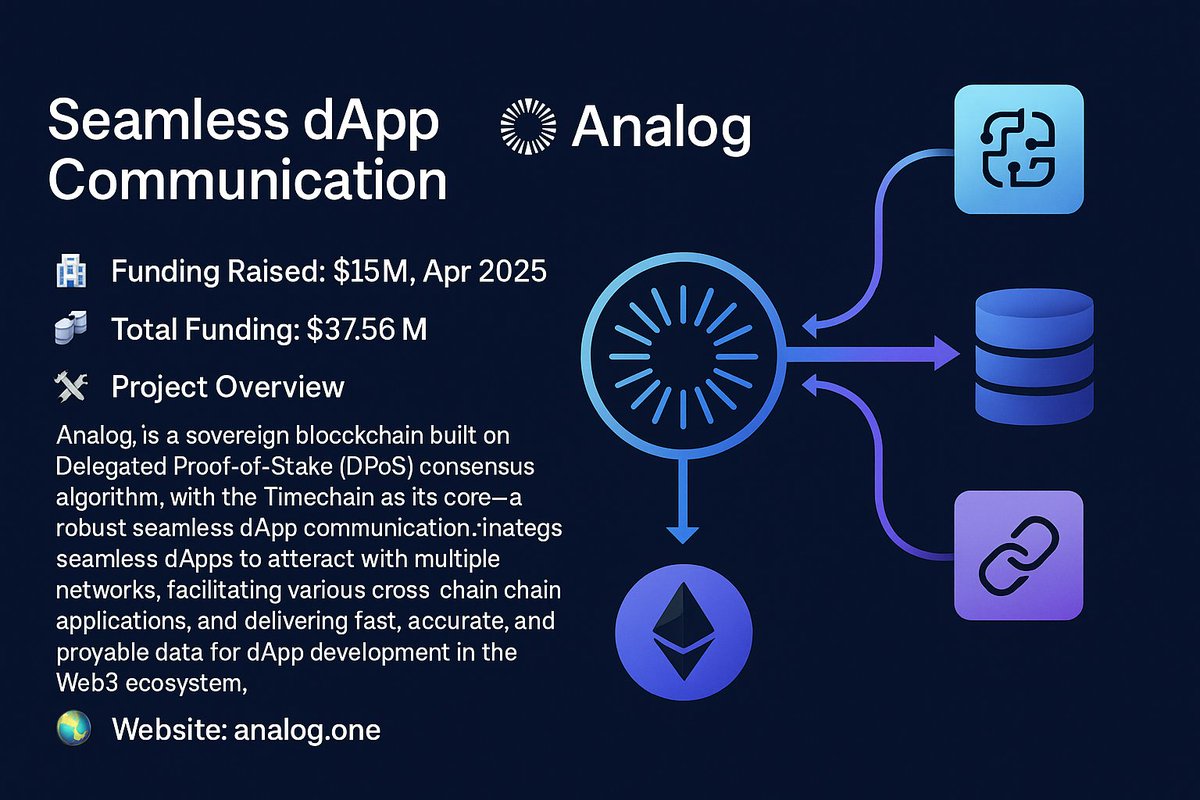
🚀 Sovereign Interoperability & Liquidity Network 🏢 Analog 📢 Funding Raised: $15M, Apr 2025 📊 Total Funding: $37.56M 🛠️ Project Overview Analog is a sovereign blockchain solving Web3 fragmentation. At its core is the Timechain, a Substrate-based ledger secured by NPoS and powered with a native EVM (PolkaVM + pallet-revive). It enables cross-chain communication and liquidity via three services: • GMP — cross-chain smart contract messaging • Watch — verifiable data indexing • Automation — cross-chain task scheduling To unify liquidity, Analog also offers: • Zenswap — cross-chain DEX • Firestarter — RWA tokenization launchpad • Analog Staking — liquid staking with dual yields ⚙️ How it Works 1. Timechain (NPoS) — validators (Time Nodes) secure blocks; nominators delegate $ANLOG. 2. Chronicle Nodes + TSS — connect to external chains, validate events, and relay transactions. 3. Core Services — enable contract calls, data verification, and automated cross-chain execution. 4. Timechain EVM — supports Solidity contracts with full Ethereum tooling. 5. Liquidity Layer — Zenswap, Firestarter, and Staking attract and unify capital. 🔥 What’s Interesting? Analog combines interoperability + liquidity in one layer: ✅ Native Solidity/EVM support ✅ Secure MPC/TSS cross-chain execution ✅ Liquidity products built into the protocol 🌐 Website: analog.one
Daniel Hasanov tweet media
English
2
0
2
151
Daniel Hasanov
Daniel Hasanov@DanielHasanov·
🚀 Smart DEX Without Losses 🏢 Clipper 📢 Funding Raised: TBD, Jan 2025 📊 Total Funding: $21M 🛠️ Project Overview Clipper is a decentralized exchange (DEX) that eliminates impermanent loss for LPs. Unlike Uniswap’s x * y = kmodel, Clipper uses Formula Market Maker (FMM) to update prices after the first trade. Traditional DEXs let arbitrageurs drain liquidity, reducing LP profits. Clipper dynamically adjusts prices using Binance, Coinbase, and Chainlink Oracles, ensuring fair market prices without hidden spreads or fees. 🔥 What’s Interesting? Most DEXs rely on traders to balance prices, causing LP losses. Clipper’s FMM with k ≈ 0.1 optimizes pricing: ✅ 90% price data — sourced from CEXs ✅ 10% price data — based on pool liquidity This keeps prices close to the market, allowing limited arbitrage while ensuring LPs retain most profits. The higher the TVL, the more efficient the mechanism becomes. 🌐 Website: clipper.exchange #DeFi #Crypto #DEX #Liquidity #Ethereum
Daniel Hasanov tweet media
English
1
0
5
227