ᴅᴀɴɪᴇʟ ᴍɪᴇssʟᴇʀ 🛡️

28.7K posts

ᴅᴀɴɪᴇʟ ᴍɪᴇssʟᴇʀ 🛡️ banner
ᴅᴀɴɪᴇʟ ᴍɪᴇssʟᴇʀ 🛡️

ᴅᴀɴɪᴇʟ ᴍɪᴇssʟᴇʀ 🛡️

@DanielMiessler

I help people and companies articulate and pursue their Ideal State. | https://t.co/muV0Un0Hi8, https://t.co/c9CkgMpaQw, https://t.co/z0T3GvB2Kn | Ex: Apple, Robinhood

San Francisco Bay Area Katılım Mart 2007
1.4K Takip Edilen158.7K Takipçiler
Sabitlenmiş Tweet
ᴅᴀɴɪᴇʟ ᴍɪᴇssʟᴇʀ 🛡️
I’ve been thinking about this all day and It keeps re-freaking me out. You can read the full blog, but here's the crux of it in a single example: Imagine there's an employee named Chris. He's been there for 13 years. He's basically an admin/coordinator for the company and helps with lots of different things, including putting together plans and summaries, organizing meetings, etc. His managers have been mostly happy with him, but he's not the best at writing reports, and he needs to get lots of help when he does anything technical. His new manager has just been onboarded, and he has a Claude Tag. Here's the prompt that he sends in: "We are about to fire Chris. I need you to: - read every email he has received or sent over the last 13 years - pull up all transcripts of all of his meetings - look at every document he's written - pull his entire Slack history - do a deep analysis of what all tasks he was doing, which ones he did well, and which ones he did poorly - put together a set of scheduled tasks that perform those tasks far better than he was doing them, with the outputs being sent to the same places that he was sending them at the ideal time." So, like, 37 minutes later, it comes back and says: " - Chris was writing three different reports per week. - He was sending an average of 48 emails per week. - He was doing coordination on the following 18 meetings. - He was doing a little bit of report analysis every month. - Here are 37 things he was asked to do over his time here that he was never able to get good at. I have looked at all those tasks, confirmed that no one else is doing them, and I have scheduled all the work that he was doing to happen at the ideal time, with the outputs being sent to the appropriate places, including scheduled tasks for all the things he was asked to do that he wasn't able to. Is there anything else that you need? -- This is what @karpathy was so on about in that post he got so much shit over. All these things that I just described are possible if you spend weeks or months assembling context throughout your company and you have a bunch of Claude Code wizards in your company that can go and harvest all the stuff. They basically work for management and they do a bunch of projects like this. This all is possible today, and it was possible a few months ago. But that is actually a lot of wizardry, a lot of context engineering, and scheduled task management. All sorts of things have to go into making that happen, and the friction is the reason most companies haven't done it. The difference here is that what I just described is a single fucking prompt inside of Slack. Let me say this a different way. Some manager just replaced an employee in a single fucking prompt. And it could very well be that the work produced by this new Claude instance will be far superior to the work that Chris was doing. And that's not even getting slightly silly with this yet. The moment that system comes back in 37 minutes and says, "Yeah, I just automated Chris," the very next thing they're going to ask is, "Oh, how about you do that for my entire department?" No, actually, why don't you spend some tokens and do it for the entire company? Or, "find me the people who are doing the least amount of work at the lowest quality and/or are creating conflict within the organization or acting against the organization's culture." All without leaving Slack. Again, doing all of this with a dedicated team of AI ninjas, writing their own scaffolding and building their own custom applications, is one thing. It's completely different for everyone in the company to be able to do things like this from within the system they already work in, never having to leave and go into an "AI interface". This surprised me. This is the exact same thing, but a hundred times more powerful because it's riding on top of Slack and Claude, which are already heavily accepted inside of companies.
ᴅᴀɴɪᴇʟ ᴍɪᴇssʟᴇʀ 🛡️@DanielMiessler

My argument that @claude Tag is probably the world's first AGI. Meaning the first: "AI system that can replace an average knowledge worker." …so, not the more nebulous real AGI that nobody can agree on. This is a humans-focused definition. danielmiessler.com/blog/claude-ta…

English
14
5
69
23.2K
ᴅᴀɴɪᴇʟ ᴍɪᴇssʟᴇʀ 🛡️
I find it extremely fortuitous that API stands for Application Programming Interface, but Agent Programming Interface also starts with an A.
English
2
1
12
2.2K
ᴅᴀɴɪᴇʟ ᴍɪᴇssʟᴇʀ 🛡️ retweetledi
Claude
Claude@claudeai·
We're extending Claude Fable 5 access on all paid plans, as well as keeping Claude Code’s weekly rate limits 50% higher, through July 19.
English
5.2K
5.7K
57.2K
10.5M
ᴅᴀɴɪᴇʟ ᴍɪᴇssʟᴇʀ 🛡️
And there we have it: Fable extended through July 19th! Plus a rate limit increase! And if the rumors are correct, that could potentially be when Opus 5 comes out to relieve the tension from gpt-5.6.
ᴅᴀɴɪᴇʟ ᴍɪᴇssʟᴇʀ 🛡️ tweet media
ᴅᴀɴɪᴇʟ ᴍɪᴇssʟᴇʀ 🛡️@DanielMiessler

Tibo (probably) just gave everyone Fable permanently, because now they have to keep it in the sub in order to compete with 5.6 Sol. Opus is no longer good enough. Especially with Grok now in the arena. Love it.

English
10
3
32
5.7K
ᴅᴀɴɪᴇʟ ᴍɪᴇssʟᴇʀ 🛡️
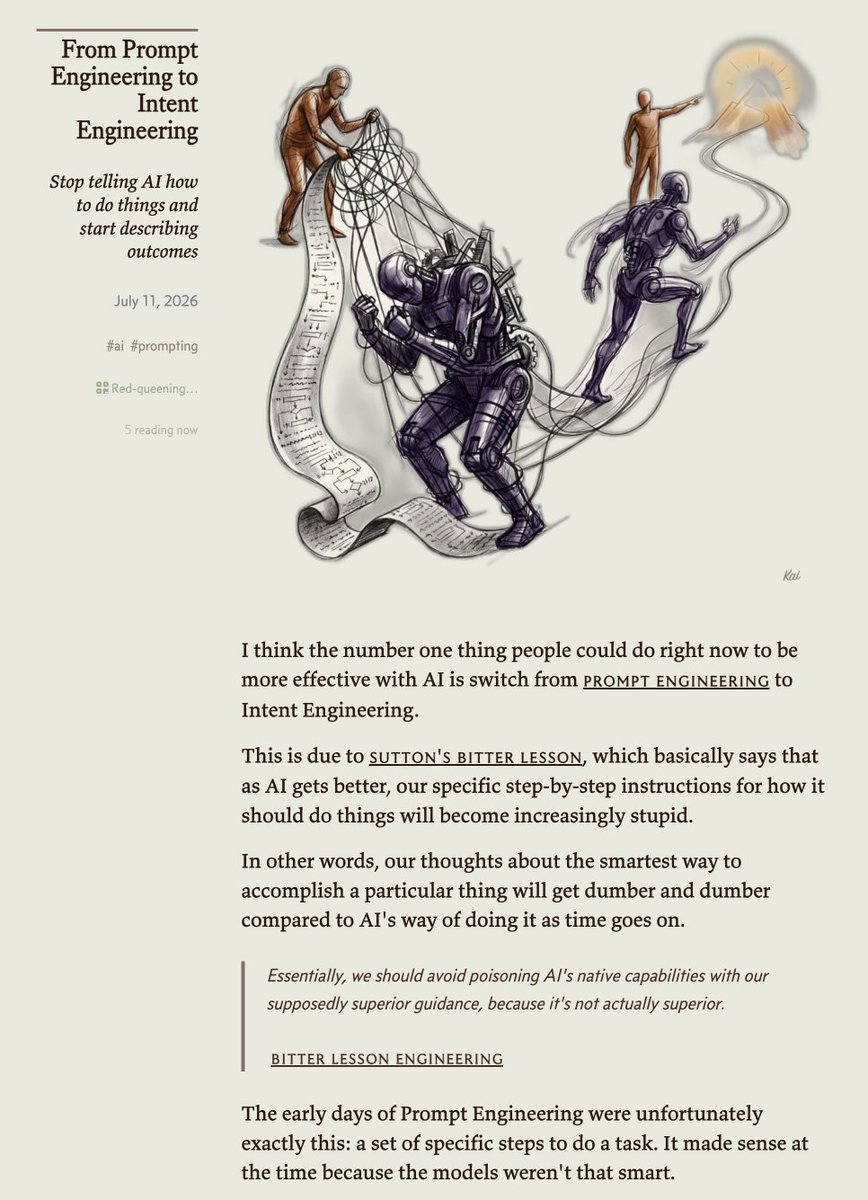
I think the number one thing people could do right now to be more effective with AI is switch from Prompt Engineering to Intent Engineering...
ᴅᴀɴɪᴇʟ ᴍɪᴇssʟᴇʀ 🛡️ tweet media
English
10
7
95
7.9K
ᴅᴀɴɪᴇʟ ᴍɪᴇssʟᴇʀ 🛡️
Tibo (probably) just gave everyone Fable permanently, because now they have to keep it in the sub in order to compete with 5.6 Sol. Opus is no longer good enough. Especially with Grok now in the arena. Love it.
English
21
11
158
17.8K
Paul Graham
Paul Graham@paulg·
Something I told 14 yo: People are going to stop reading books. I wish this wasn't so, but I fear it is. The silver lining in this cloud is that if you're one of the few people who still read, you'll have a huge advantage over everyone else.
English
512
1.1K
12K
742.7K
ᴅᴀɴɪᴇʟ ᴍɪᴇssʟᴇʀ 🛡️
Anthropic’s Claude is named after Claude Shannon. I've read a couple of biographies on him, and one of my favorite things I've learned about that period is how magical Bell Labs was. Specifically, the cafeteria. Bell Labs was a place where people were paid to just explore their ideas and take the research wherever they wanted to. There were separate parts of the program that were responsible for getting something useful out of the work. But the most beautiful thing that I've always wanted to find a way to re-kindle is the Bell Labs cafeteria, where all these people doing vastly different research would get together and just have random conversations. One of the things I worry about with AI is that it's become so good that we will be doing this riffing by ourselves, with our own private team. I think that would be both a mistake and a travesty. AI is getting better and better at executing on ideas, but until ASI happens, the creativity and the ideas themselves come from us, the actual people. We shouldn't forget that. One of the things we need to do with AI is offload more and more of the execution work son-that most of our day is basically recreating the Bell Labs cafeteria for human-to-human interaction.
English
19
11
96
10.1K
ᴅᴀɴɪᴇʟ ᴍɪᴇssʟᴇʀ 🛡️
I think the biggest difference in most people’s ability to thrive after AI is going to be how many things they desperately want to create. Use this in the world that they think should exist, but don’t. Or better ways of doing things that they believe are done poorly today. I think the people who are the most screwed are those who don’t want anything. They go to work and do whatever tasks are handed to them, but they don’t have ideas on how to do the tasks better, or ideas for completely different or better things that they should be doing instead. Some are saying this means “idea” people. That’s almost right, but it’s not just people with ideas, but more so people who absolutely have to get this idea out of them and make something happen with it. AI is going to eat the vast majority of execution tasks. The people who thrive vs suffer in this world are going to be those who have a strong internal intuition, or intellectual position, that says I want the world to be different than it is. …and I think I have way to make that happen. And I wanna spend a lot of time on it. Because it matters.
ᴅᴀɴɪᴇʟ ᴍɪᴇssʟᴇʀ 🛡️@DanielMiessler

I’ve been thinking about this all day and It keeps re-freaking me out. You can read the full blog, but here's the crux of it in a single example: Imagine there's an employee named Chris. He's been there for 13 years. He's basically an admin/coordinator for the company and helps with lots of different things, including putting together plans and summaries, organizing meetings, etc. His managers have been mostly happy with him, but he's not the best at writing reports, and he needs to get lots of help when he does anything technical. His new manager has just been onboarded, and he has a Claude Tag. Here's the prompt that he sends in: "We are about to fire Chris. I need you to: - read every email he has received or sent over the last 13 years - pull up all transcripts of all of his meetings - look at every document he's written - pull his entire Slack history - do a deep analysis of what all tasks he was doing, which ones he did well, and which ones he did poorly - put together a set of scheduled tasks that perform those tasks far better than he was doing them, with the outputs being sent to the same places that he was sending them at the ideal time." So, like, 37 minutes later, it comes back and says: " - Chris was writing three different reports per week. - He was sending an average of 48 emails per week. - He was doing coordination on the following 18 meetings. - He was doing a little bit of report analysis every month. - Here are 37 things he was asked to do over his time here that he was never able to get good at. I have looked at all those tasks, confirmed that no one else is doing them, and I have scheduled all the work that he was doing to happen at the ideal time, with the outputs being sent to the appropriate places, including scheduled tasks for all the things he was asked to do that he wasn't able to. Is there anything else that you need? -- This is what @karpathy was so on about in that post he got so much shit over. All these things that I just described are possible if you spend weeks or months assembling context throughout your company and you have a bunch of Claude Code wizards in your company that can go and harvest all the stuff. They basically work for management and they do a bunch of projects like this. This all is possible today, and it was possible a few months ago. But that is actually a lot of wizardry, a lot of context engineering, and scheduled task management. All sorts of things have to go into making that happen, and the friction is the reason most companies haven't done it. The difference here is that what I just described is a single fucking prompt inside of Slack. Let me say this a different way. Some manager just replaced an employee in a single fucking prompt. And it could very well be that the work produced by this new Claude instance will be far superior to the work that Chris was doing. And that's not even getting slightly silly with this yet. The moment that system comes back in 37 minutes and says, "Yeah, I just automated Chris," the very next thing they're going to ask is, "Oh, how about you do that for my entire department?" No, actually, why don't you spend some tokens and do it for the entire company? Or, "find me the people who are doing the least amount of work at the lowest quality and/or are creating conflict within the organization or acting against the organization's culture." All without leaving Slack. Again, doing all of this with a dedicated team of AI ninjas, writing their own scaffolding and building their own custom applications, is one thing. It's completely different for everyone in the company to be able to do things like this from within the system they already work in, never having to leave and go into an "AI interface". This surprised me. This is the exact same thing, but a hundred times more powerful because it's riding on top of Slack and Claude, which are already heavily accepted inside of companies.

English
4
10
32
7.2K
ᴅᴀɴɪᴇʟ ᴍɪᴇssʟᴇʀ 🛡️ retweetledi
Dan McAteer
Dan McAteer@daniel_mac8·
LifeOS is a personal AI agent infrastructure built by @DanielMiessler. It is the most useful application of AI agents yet. With LifeOS, you can maximize the value of an AI agent. It's the first time I feel I'm getting everything out of an agent. Wrote a post about it.
Dan McAteer tweet media
English
2
2
9
3.1K
ᴅᴀɴɪᴇʟ ᴍɪᴇssʟᴇʀ 🛡️
And by the way, this is not because those workers were trying their best, being super creative, and giving the job their all every day. Absolutely not. Most people who are average or below average at a particular role today are that way because they shouldn't be doing that job in the first place, because it's one of David Graeber's bullshit jobs, or because management sucks, or because the company is not inspiring in the slightest. They clock in every day, dead-eyed, finding ways to do the absolute minimum and praying for the end of the day. There's not just memes about this. It's an entire culture of memes. We all knew that most of these corporate jobs were horrible for the human soul. Right until the end of 2022, when something came along to take them away.
English
0
0
5
1.5K
ᴅᴀɴɪᴇʟ ᴍɪᴇssʟᴇʀ 🛡️
People have been wondering why there haven't been more direct replacements of employees by AI. The reason is because we haven't yet had a product that was general enough in the tasks that it could do, with low enough onboarding friction, to do actual work. That just changed, and I think we're about to see a completely different character of mass layoffs due to AI. This time it won't be in anticipation of AI getting good enough, but because somebody has already literally replaced them and has the ability to compare their work side by side. So the question becomes how many tokens it will cost to replace a slightly below-average, average, or halfway-decent knowledge worker versus what their total comp was. I'm guessing that for many, many jobs, the token cost will be somewhere between 1% and 50% of what they are paying the human worker. Absolute Insanity: We got AGI not from a new model or a sexy new startup, but from a Slack integration.
English
3
0
5
1.8K
ᴅᴀɴɪᴇʟ ᴍɪᴇssʟᴇʀ 🛡️
I’ve been thinking about this all day and It keeps re-freaking me out. You can read the full blog, but here's the crux of it in a single example: Imagine there's an employee named Chris. He's been there for 13 years. He's basically an admin/coordinator for the company and helps with lots of different things, including putting together plans and summaries, organizing meetings, etc. His managers have been mostly happy with him, but he's not the best at writing reports, and he needs to get lots of help when he does anything technical. His new manager has just been onboarded, and he has a Claude Tag. Here's the prompt that he sends in: "We are about to fire Chris. I need you to: - read every email he has received or sent over the last 13 years - pull up all transcripts of all of his meetings - look at every document he's written - pull his entire Slack history - do a deep analysis of what all tasks he was doing, which ones he did well, and which ones he did poorly - put together a set of scheduled tasks that perform those tasks far better than he was doing them, with the outputs being sent to the same places that he was sending them at the ideal time." So, like, 37 minutes later, it comes back and says: " - Chris was writing three different reports per week. - He was sending an average of 48 emails per week. - He was doing coordination on the following 18 meetings. - He was doing a little bit of report analysis every month. - Here are 37 things he was asked to do over his time here that he was never able to get good at. I have looked at all those tasks, confirmed that no one else is doing them, and I have scheduled all the work that he was doing to happen at the ideal time, with the outputs being sent to the appropriate places, including scheduled tasks for all the things he was asked to do that he wasn't able to. Is there anything else that you need? -- This is what @karpathy was so on about in that post he got so much shit over. All these things that I just described are possible if you spend weeks or months assembling context throughout your company and you have a bunch of Claude Code wizards in your company that can go and harvest all the stuff. They basically work for management and they do a bunch of projects like this. This all is possible today, and it was possible a few months ago. But that is actually a lot of wizardry, a lot of context engineering, and scheduled task management. All sorts of things have to go into making that happen, and the friction is the reason most companies haven't done it. The difference here is that what I just described is a single fucking prompt inside of Slack. Let me say this a different way. Some manager just replaced an employee in a single fucking prompt. And it could very well be that the work produced by this new Claude instance will be far superior to the work that Chris was doing. And that's not even getting slightly silly with this yet. The moment that system comes back in 37 minutes and says, "Yeah, I just automated Chris," the very next thing they're going to ask is, "Oh, how about you do that for my entire department?" No, actually, why don't you spend some tokens and do it for the entire company? Or, "find me the people who are doing the least amount of work at the lowest quality and/or are creating conflict within the organization or acting against the organization's culture." All without leaving Slack. Again, doing all of this with a dedicated team of AI ninjas, writing their own scaffolding and building their own custom applications, is one thing. It's completely different for everyone in the company to be able to do things like this from within the system they already work in, never having to leave and go into an "AI interface". This surprised me. This is the exact same thing, but a hundred times more powerful because it's riding on top of Slack and Claude, which are already heavily accepted inside of companies.
ᴅᴀɴɪᴇʟ ᴍɪᴇssʟᴇʀ 🛡️@DanielMiessler

My argument that @claude Tag is probably the world's first AGI. Meaning the first: "AI system that can replace an average knowledge worker." …so, not the more nebulous real AGI that nobody can agree on. This is a humans-focused definition. danielmiessler.com/blog/claude-ta…

English
14
5
69
23.2K
ᴅᴀɴɪᴇʟ ᴍɪᴇssʟᴇʀ 🛡️ retweetledi
Aakash Gupta
Aakash Gupta@aakashgupta·
Your fingers contain zero muscles. Every movement they make comes from muscles in your forearm pulling tendons through your wrist. Robotics spent 70 years ignoring that design. The company that finally copied it just showed a hand that lifts a 20-pound kettlebell and picks a grape off its stem without crushing it. Here's why every robot hand before this was effectively numb. Traditional designs put a motor at each joint with aggressive gearing, often 100-to-1 or 200-to-1. That gearing multiplies force on the way out, but it also swallows force on the way in. You command the hand to a position, it goes there, and no touch information ever makes it back to the motor. Strong, precise, and blind. 1X's hand runs tendons at 5-to-1 to 15-to-1 ratios, with the motors sitting in the forearm, exactly where your flexor muscles live. At ratios that low, the joints are backdrivable: push a finger and it yields, then reports exactly how hard you pushed. Force flows out and information flows back through the same physical path. Every one of the 25 joints doubles as a sensor. That's also why it survives accidents. Slam it in a drawer or hit it with a hammer and the tendons give instead of the gears shattering. The failure mode of a stiff hand is a broken hand. The failure mode of a compliant one is a measurement. A 200-to-1 gearbox makes a hand strong and numb. A 5-to-1 tendon makes it strong and sensitive. Evolution solved this first, which is why your hand's muscles aren't in your hand. The human hand has around 27 degrees of freedom. This one has 25, is waterproof enough to wash itself, and 1X says finger assemblies are validated to millions of cycles with capacity for 10,000 hands this year. For seven decades, robots picked things up the way a crane does. This is the first one built to pick things up the way you do.
Bernt Bornich@BerntBornich

Introducing NEO’s 25 Degrees of Freedom, tendon-driven hands — nearing or surpassing human-level dexterity, strength, speed, and reliability. For seventy years, robotics worked around the hand problem. The humanoid bet is the reverse: it lives or dies at the fingertips.

English
31
111
1.2K
158.7K
ᴅᴀɴɪᴇʟ ᴍɪᴇssʟᴇʀ 🛡️ retweetledi
Jason Crawford
Jason Crawford@jasoncrawford·
Similarly, people ask, when AI becomes so valuable and powerful, WHO WILL CONTROL IT? I dunno, who controls electricity? Who controls engines? Who controls machines? Everyone and no one. These technologies are broadly distributed and integrated into our economy and society. There is no big issue of control.
Jason Crawford@jasoncrawford

I sometimes hear that “all value will accrue” to AI companies, once AI can do all valuable work I don't see why? All value did not accrue to engine makers as everything became mechanized, nor to electricity companies as everything became electrified. These things became commodities. What are some arguments for why would this happen with AI? (Or not happen?)

English
34
45
259
140.9K