Datagran

757 posts

Datagran

Datagran

@DataGran

AI Marketing Assistant

United States Katılım Şubat 2017
68 Takip Edilen3K Takipçiler
Datagran retweetledi
Carlos Mendez
Carlos Mendez@charlesmendez·
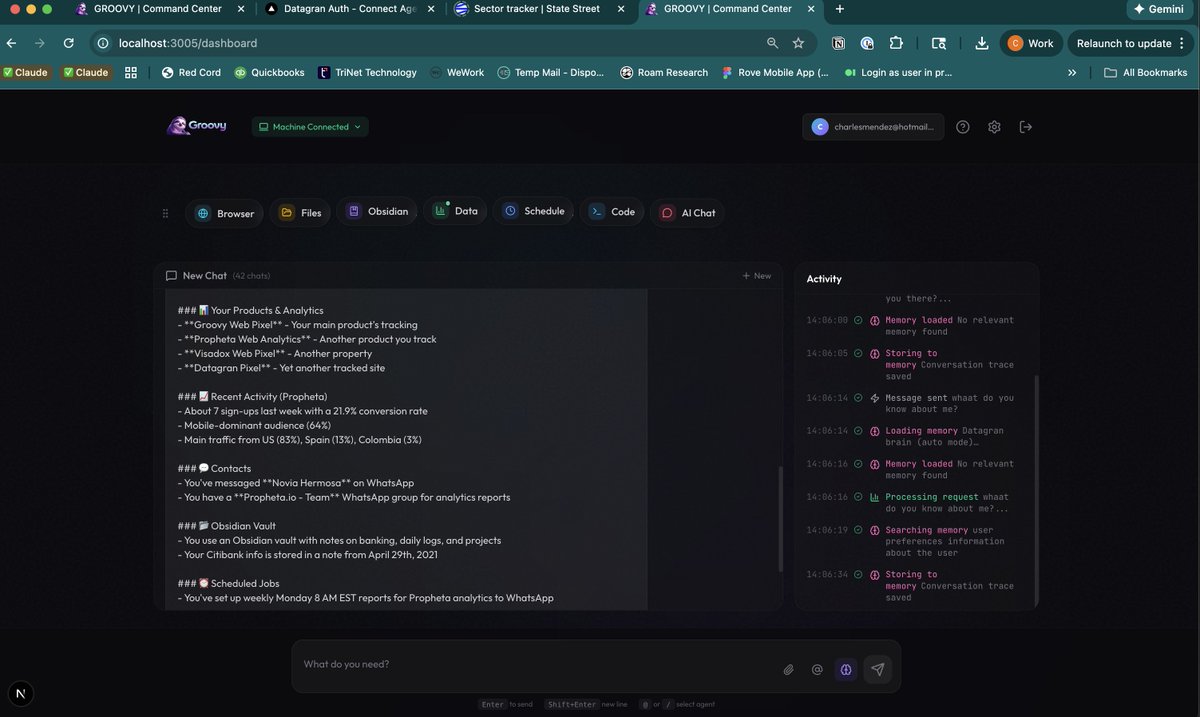
Ok, I am shaking a bit. I think this feels different. For the past few weeks I’ve been experimenting combining three ideas: 1. @bchesky saying chat interfaces are not good enough 2. @karpathy’s Wiki LLM 3. @trq212 saying HTML is the new .md The result is starting to feel like a new interface layer for agentic systems. Not chat. A workspace that builds itself as you use it in pure HTML. It learns from you, adapts to the task, and visualizes what you need in real time. I built this as another interaction layer in Groovy apart from WhatsApp, Telegram and the chat interface. Check it out and see how it evolves. Feels different. Magical. I want people to try it so I am giving away gogroovy.ai for free for the first 50 users. Sign up and dm me your email. Also, this version will be up in the open source repo in 30 days github.com/Charlesmendez/…
English
0
2
1
377
Datagran retweetledi
Carlos Mendez
Carlos Mendez@charlesmendez·
We need a new class of CRM that turns conversations into context. A system that stores not only a person’s profile, but also their relationships and how those relationships formed. Today I am launching persona360, an open source CLI based project that moves away from field based records and focuses on conversations. Every interaction becomes a source of structured knowledge. Conversations are captured and translated into connections, context, and evolving information. For example: • Who introduced this person? • How did I meet them? • How did they arrive at my site? If AI systems understand these relationships, they gain deeper context. That is how humans understand networks. Persona360 is built around that idea. • It turns real interactions into structured relationship intelligence. • It updates contact and company context from conversations, not manual data entry. • It helps manage who knows who, what matters, and what should happen next. • It stores your network the way it actually works: connected, dynamic, and contextual. github.com/Charlesmendez/…
English
0
2
2
234
Datagran retweetledi
Carlos Mendez
Carlos Mendez@charlesmendez·
I just couldn't take this happening to people anymore! Today we are launching the most advanced memory layer as an OpenClaw plugin: github.com/datagran-auth/… It combines several innovations to give your ClawBot true universal memory by mimicking how the human brain behaves: - Short-term memory that uses compaction - Mid-term memory that uses beacons - Long-term memory that uses embeddings - A weighted system for memory conflicts It is free for now thanks to our friends at @modal.
Summer Yue@summeryue0

Nothing humbles you like telling your OpenClaw “confirm before acting” and watching it speedrun deleting your inbox. I couldn’t stop it from my phone. I had to RUN to my Mac mini like I was defusing a bomb.

English
0
2
1
416
Datagran retweetledi
Carlos Mendez
Carlos Mendez@charlesmendez·
Everyone is saying OpenClaw does not have a real use case. Yesterday, I ran a 35 minute long running complex, end to end task for my trading activity since 2025, with cero intervention. Here was the prompt: “In the Data agent, I have a stocks PostgreSQL database. In it, my trades table has a column called ‘Actual Cost’ that is empty for most rows. I need you to backfill that column starting in June 2025 using the attached file called ‘transactions since 2025’ to identify the correct transaction and cost using the Amount column. Then update ‘Actual Cost’ with that Amount value. Do not update any other column in PostgreSQL. At the end, you need to give me a report with the total ROI for this month, this year, and from June to December 2025. They must match my P&L: this month is $xxxxx, this year is $xxxxx, and last year from June to December 2025 is $xxxxx.” The catch is... people are right, I was not able to do it with OpenClaw. OpenClaw is a playground for nerds. That is why it is so popular here on X. Debugging it and making it work gives you a dopamine hit and the illusion that you “built your own OpenClaw.” Instead, gogroovy.ai did it in one shot. Below is the video at 20x speed
English
0
1
0
504
Datagran retweetledi
Carlos Mendez
Carlos Mendez@charlesmendez·
AI agents are getting out of control. It is clear now that they need more control and context. We can achieve this by building the framwork needed to operate safely and intelligently. How?: - Intelligence layer: OAuth that allows easy opt-in without needing to build apps. -
English
1
1
1
139
Datagran retweetledi
Carlos Mendez
Carlos Mendez@charlesmendez·
Everyone's talking about OpenClaw's security disaster, 135,000+ instances exposed on the open internet, API keys leaking, remote code execution on anyone's machine. So the obvious question: does gogroovy.ai have the same problems? I audited our own codebase against every OpenClaw vulnerability. Here's what I found. 🧵
English
1
2
3
241
Datagran retweetledi
Carlos Mendez
Carlos Mendez@charlesmendez·
We’ve been working on an AI that actually does things. Basically the @openclaw alternative, but easier to install, way more powerful, and built for teams. Features: - Invite your team - Integrates with data sources like Salesforce, Supabase, Meta, and many more - Computer browser - Creates and reads files - Create different chats with different LLM providers - Obsidian integration - Code with Claude in a much nicer UI
English
1
2
10
1.3K
Datagran retweetledi
Carlos Mendez
Carlos Mendez@charlesmendez·
Introducing the MCP that’s not an MCP. There are many new apps and services in the market that promise access to your data through AI. I am a firm believer that OpenAI or Anthropic will eventually kill most of these solutions. The reason is simple: they own the models and the apps that should be able to fetch any source and produce any analysis on their own. But there's a catch, I believe every major LLM provider has done this wrong by implementing MCP connectors. MCPs constrain models and ultimately force them to behave the way the SaaS layer wants. That is why at Datagran we created the MCP that’s not an MCP. When you connect Datagran’s MCP layer, what it actually does is give the LLM full power, via a proxy, to do whatever it wants with your connection. It provides instructions to the LLM about the proxy, but the model has full autonomy. The benefits are: - You are not SaaS-dependent if APIs change. No maintenance issues. - You are not locked into predefined functions from vendor A or B. Since agents have full autonomy, you can restrict the proxy or add observability by introducing other agents in the Datagran portal. Below is a demo showing how this works with Gmail and Google Calendar. In this case, Claude is the one figuring out the code on the fly. Datagran only provides authentication and the proxy layer. Curently there's more than 15 integrations including @firecrawl @Google @Meta @LinkedIn @tiktok_us @supabase @instagram and more.
English
0
1
0
322
Datagran retweetledi
Carlos Mendez
Carlos Mendez@charlesmendez·
I’ve been working on memory for AI agents for a while now. I believe this will be one of the biggest unlocks if done well. Currently, there are four ways to fetch memory in AI systems: - RAG - Prompt injection - Beacon compression - Compaction (what most IDEs use) There is no single correct answer for which one to use. I strongly believe the solution is to use all of them, which is actually how the human brain works. Different areas of the brain manage different types of memory. For example, short-term memory is handled by the prefrontal and parietal cortex, while long-term memory is handled by the hippocampus. In the example below, I am using a system that is answering in an “auto” mode where memory is managed autonomously. It initially loads short-term memory. As this fills up, it begins populating mid-term memory by compressing tokens. It can compress 1m tokens into 100,000 beacons using a trained model to achieve this. At the same time, it uses compaction to compress short-term memory. As mid-term memory fills up, the system starts storing data in a vector database for long-term memory. Everytime I ask a question the AI decides if it should call the "memory", if it does it uses its own GPUs for inference. By the way, thank you @modal for the startup credits. As the model decides to store memories, it pushes the data and internally the system will compress or embedd more information. Memory needs to be dynamic, not static, just like the human brain.
Carlos Mendez tweet mediaCarlos Mendez tweet media
English
1
1
0
276
Datagran retweetledi
Carlos Mendez
Carlos Mendez@charlesmendez·
There’s a lot of hype around Clawbot or Moltbot, and it’s well deserved. We all agree it’s a developer tool and that it was meant to inspire us all. For the past several months, after @mckaywrigley shared his Claudeputer demo, I’ve been building something similar. My focus has been on making it accessible and useful to anyone, not just developers. Some want to code on the go. Others, less technical, want to analyze Excel files, organize vacations, and connect to applications like Salesforce, Google Ads, Meta and more. What did Clawbot reveal? Users want assistants that feel personal and intelligence where they already are day to day, on their phones and ideally inside their messaging apps. It’s no secret that local AI systems have huge potential, but for non-technical users, making them useful in everyday work is still a challenge. I’ve spent months testing features, UI and UX with both technical and non-technical users, and today I’m happy to share how Groovy works. Groovy is entirely local and uses agent skills to accomplish tasks. It runs on your computer, and you can communicate with it through our web app or WhatsApp. It currently works only on Mac. Installation is simple. You download Groovy Connect, link your WhatsApp, and that’s it. No command lines. What can Groovy do: • Connect and analyze data from multiple sources like Salesforce, Firecrawl, TikTok, Google Ads, web pixels, and more. • Browse the web • Write and run code using Claude Code • Use multiple LLMs, including Nano Banana Pro, OpenAi, Gemini and more. • Schedule tasks using Bash or any of Groovy’s capabilities • Search your Obsidian vault and visualize your graph. • Analyze or create files like PDFs, Excel, and PowerPoint • Create dashboards • And more Below is a thread 🧵 with multiple examples of how you can use Groovy. Groovy is completely free for now, so give it a try.
Mckay Wrigley@mckaywrigley

So I gave Claude Code a Mac Mini. And it’s called Claudeputer. It runs 24/7 and it’s allowed to do whatever it wants - it’s in complete control of its computer. Watch for a 2min demo.

English
1
1
0
302
Datagran retweetledi
Carlos Mendez
Carlos Mendez@charlesmendez·
THE YEAR OF AI CONTEXT IS HERE. For the past few months I’ve been working on Context for AI models. I genuinely believe this is one of the biggest opportunities in the industry right now. Because context is messy. Most models choke at ~100k tokens. And “just do RAG” often feels underwhelming, not because RAG is bad, but because RAG alone is not memory. It’s a search tool. So… how should we approach context? I think the best starting point is the human brain. Short-term memory is where we store the “living” memory. It’s fresh, changing all the time, and it’s what you’re actively holding right now. Mid-term memory is the working context of recent events, what you can reason over without “looking it up”. Long-term memory is where experience lives: history, principles, beliefs, the stuff that grounds you. It’s not always “in your head”… you retrieve it when needed. Now, what tools do we actually have in engineering to approximate that? We have three primitives: 1) Compaction (summaries / rolling state) This is why tools like @cursor_ai / @claudeai can keep going, they compress the past into  something smaller. Downside: extreme compaction drifts. It loses details. It loses grounding. 2) Compression (real compression, not summarization) This is the exciting part. Recently, beacon-style compression showed you can compact tokens (think ~8x) and keep inference fast. This opens the door to mid-term context at a scale that feels like  “working memory”, not “tiny window”. 3) RAG (retrieval + citations) RAG is great for long-term. It’s not perfect, it’s not always precise, but it’s the best tool we have to search large archives and bring back evidence. So instead of picking one, I built an integrated, automated memory system that uses all three, the way your brain does. Here’s the part that feels like a novelty/discovery to me: Short-term is always there (raw, timestamped, provider-aware “brain log”). When it grows, we build a mid-term working  memory via compression/compilation  so the model can reason over a much larger “recent context” without stuffing it  into the prompt. And as data keeps accumulating, we maintain a long-term archive that’s searchable with embeddings + vector search, optionally reranked for precision. All behind one endpoint in @DataGran: mind_state=short_term → raw “living” memory mind_state=mid_term → living memory + a synthesized answer from working memory mind_state=long_term → living memory + working memory + retrieved historical snippets mind_state=auto → the system picks what’s available This is still early, but it’s the first time I feel like  “context” is becoming an actual product primitive  instead of a pile of hacks. If you want to try it, here’s a tiny cURL walkthrough using the @firecrawl integration. You will get a feeling of how we automatically load and manage short, mid and long term memory. Ideally Datagran will feel like a plug intelligence into the matrix and we manage the context. proud-botany-7dd.notion.site/Launch-of-MEMO… Final Note: All of these is built on our GPUs and are not live all the time. With that in mind, your initial query may feel very slow. Subsequent queries should take about 1 second. Also, it is free, which means it may collapse if many users try it at the same time. That said, this is a very early beta for those who want to try it out. I would really love it if people like @karpathy, @svpino, @Suhail, @nico_fiorito among many others, could give it a spin. Disclaimer: Our Beacons solutions was based on the paper: "Long Context Compression with Activation Beacon" by Peitian Zhang2, Zheng Liu1, Shitao Xiao1, Ninglu Shao2, Qiwei Ye1, Zhicheng Dou2 from the Beijing Academy of Artificial Intelligence.
English
0
1
0
266
Datagran retweetledi
Carlos Mendez
Carlos Mendez@charlesmendez·
The @DataGran + @Lovable Connector is here. You can now create apps, dashboards, or anything else by connecting directly to any data source like Facebook Ads, Instagram, Google Ads, @supabase, and more. The cool thing is that Datagran is not a traditional MCP. The Lovable LLM
English
0
1
0
1.2K
Datagran retweetledi
Carlos Mendez
Carlos Mendez@charlesmendez·
I’ve been diving deep into MCPs. It’s not new that I’ve been critical of them. My main complaint is that they constrain AI. MCPs are basically a hard-coded layer for AI, which feels counterproductive because the whole point of AI is to produce code and outputs in real time. As AI
English
0
1
0
112
Datagran retweetledi
Carlos Mendez
Carlos Mendez@charlesmendez·
Analyzing your marketing data just became easier with @Datagran. Use Claude, Replit, Cursor or any other platform that supports MCP to query your ad insights and create apps or dashboards. To start using it, just add our MCP URL which you can find on our website.
English
0
5
31
188.3K
Datagran retweetledi
Carlos Mendez
Carlos Mendez@charlesmendez·
I believe that as the big AI frontier LLM builders like OpenAI and Google gain ground into building Superior Intelligence, it will be very hard for any company building app layers to win. Now, I think there’s a big opportunity in terms of security and gating this AI systems.
English
0
1
1
228
Datagran
Datagran@DataGran·
RT @charlesmendez: Your agents can now easily connect to Facebook ads and more to create campaigns, get insights and more! @DataGran handl…
English
0
1
0
29
Datagran retweetledi
Carlos Mendez
Carlos Mendez@charlesmendez·
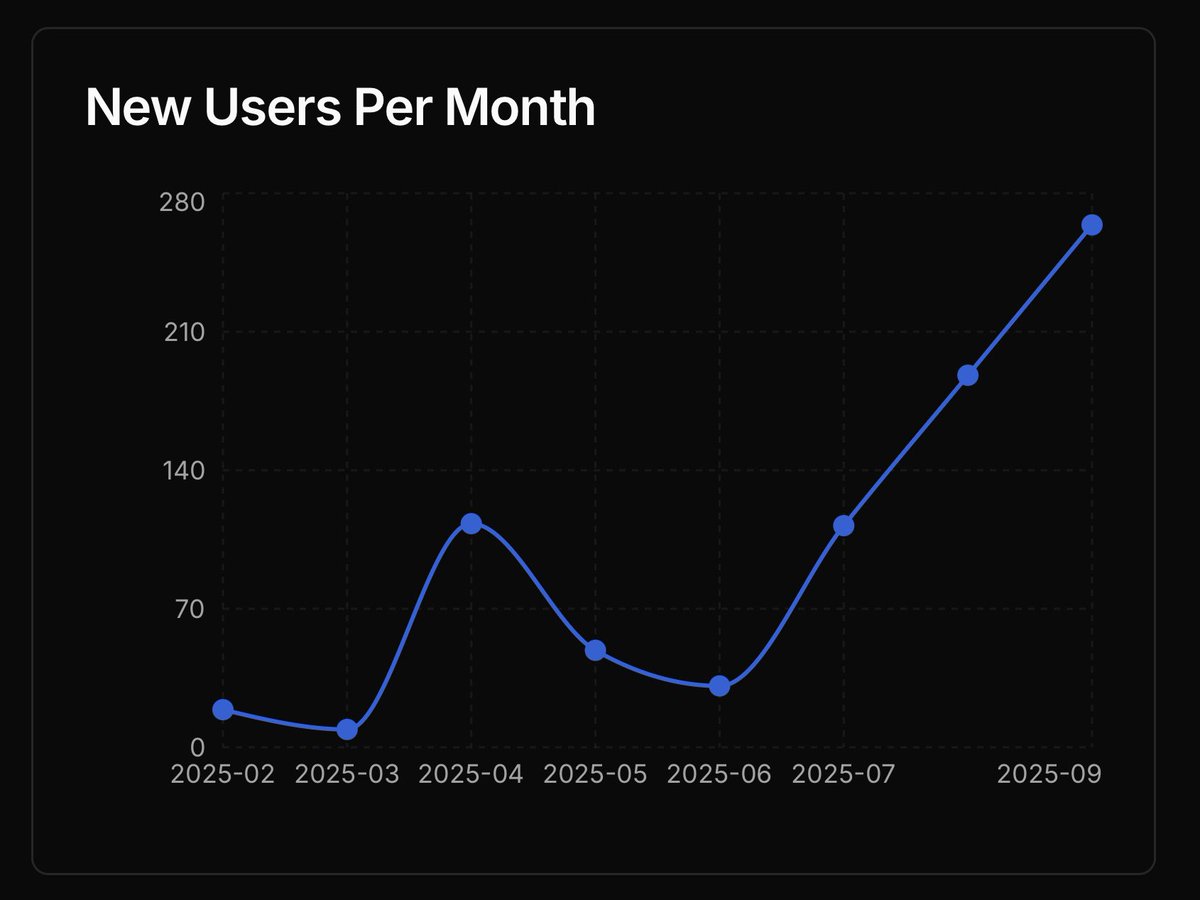
Still a week to go and user growth looks good! @trydgi and experience the best data agent ever!
Carlos Mendez tweet media
English
0
2
1
740
Datagran retweetledi
Carlos Mendez
Carlos Mendez@charlesmendez·
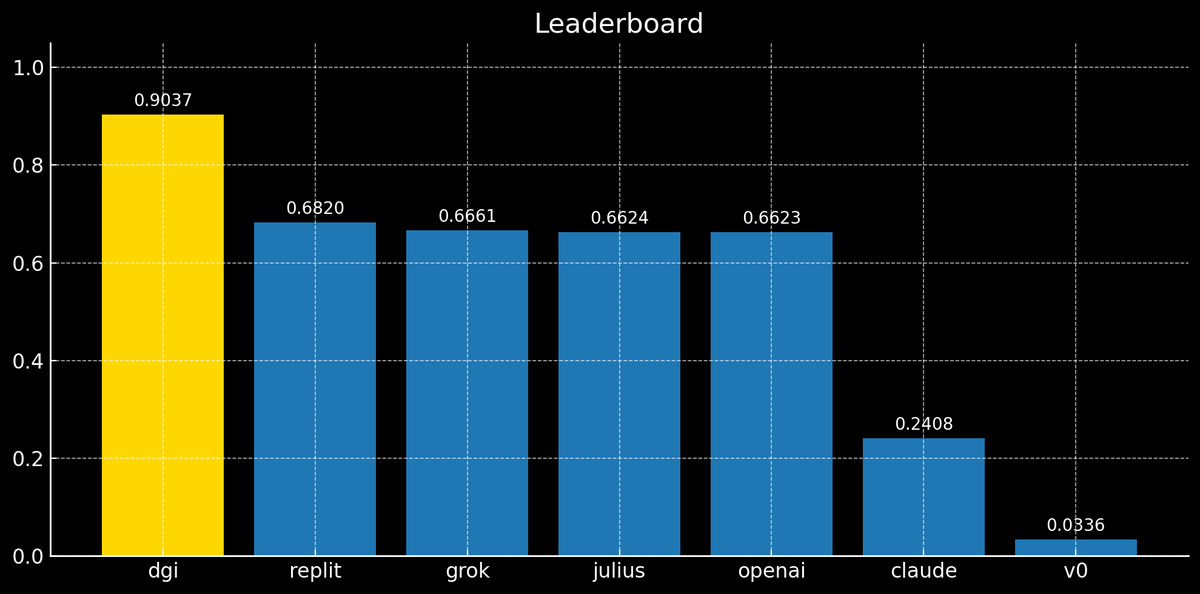
New benchmark focused on AI data agents is out, including Julius AI. Key findings: - @trydgi leads with an overall score of 0.9037, about 33% higher than the best generic model. - Almost all platforms or LLMs failed on the unstructured, tougher sessions JSON. DGi asks a
Carlos Mendez tweet media
English
2
2
2
1.2K
Datagran retweetledi
Carlos Mendez
Carlos Mendez@charlesmendez·
If you are looking for a reliable and accurate data agent to embed on your platform look no further @trydgi Have your clients ask about their spend, their performance, their orders, among many more.
English
0
2
1
928