David Rodríguez

1.2K posts

David Rodríguez banner
David Rodríguez

David Rodríguez

@David_41

Madrid Katılım Ocak 2010
2.2K Takip Edilen136 Takipçiler
David Rodríguez
David Rodríguez@David_41·
@sama How do you see the role of AI agents in managing real-world infrastructure (IT systems, identity, security, ops) without turning them into opaque black boxes?
English
0
0
0
32
Sam Altman
Sam Altman@sama·
Tomorrow we’re hosting a town hall for AI builders at OpenAI. We want feedback as we start building a new generation of tools. This is an experiment and a first pass at a new format — we’ll livestream the discussion on YouTube at 4 pm PT. Reply here with questions and we’ll answer as many as we can!
English
4.1K
691
8.2K
1.7M
David Rodríguez
David Rodríguez@David_41·
This is definitely one of the accounts I rely on the most to stay informed about AI. High-quality content, deep analysis, and always up to date. A true reference for Europe when it comes to understanding what’s happening in this fascinating field. Congrats on the milestone! 🚀
Chubby♨️@kimmonismus

Today is a special day for me. Today I reached a milestone I never dreamed I'd achieve. I've surpassed the 100,000 follower mark. This is incredible, and I'm filled with deep gratitude. For those who are interested, here's a brief recap. In 2019, I graduated from a German university and then started my professional career. As everyone knows, GPT-3.5 was released in November 2022. For many people, including myself, this was a turning point. Of course, I tried it out and was immediately fascinated and simultaneously shocked by the technology that was developing and spreading before us. So, I began dedicating all my free time to learning about this impressive technological revolution. In addition, at the end of 2022, I created an account on X, but initially just to read the news. It wasn't until the beginning of 2024 that I started engaging with others and creating my own posts - and some people seem to have liked them. I followed great content creators – and others followed me. By August 2024, I had already reached the unimaginable milestone of 10,000 followers: impressive and incredible. Long story short – my fascination with AI didn't wane, and I met many amazing people and discovered entirely new opportunities. At the beginning of 2025, two venture capitalists approached me and told me they wanted me as the editor-in-chief of their newsletter (super intelligence), which boasted 230,000 subscribers, and that they also wanted to develop other projects with me. After much deliberation, I agreed. During this time, I had the incredible privilege of speaking with researchers at Microsoft, NVIDIA, SandboxAQ, and many more, whose interviews were published exclusively in the newsletter – and I can tell you this much: there will be a very special collaboration with NVIDIA in the near future. But as I said, long story short: here I am now, having essentially turned my hobby into my profession, and I'm the happiest person alive. There's nothing more exciting than witnessing, reporting on, analyzing, and experiencing this technological revolution every day. I'm grateful to everyone and everything that has accompanied me on this journey. I'm happy to continue doing what I've been doing because I do it with such joy. And for that, I want to express my deepest gratitude to all of you. Thank you for being there with me. Yours, Chubby. P.s. The image was created with GPT-Image, a bit over the top in my opinion, but I sent ChatGPT my text with the request to create a suitable image ;)

English
0
0
0
29
David Rodríguez retweetledi
Carlos Santana
Carlos Santana@DotCSV·
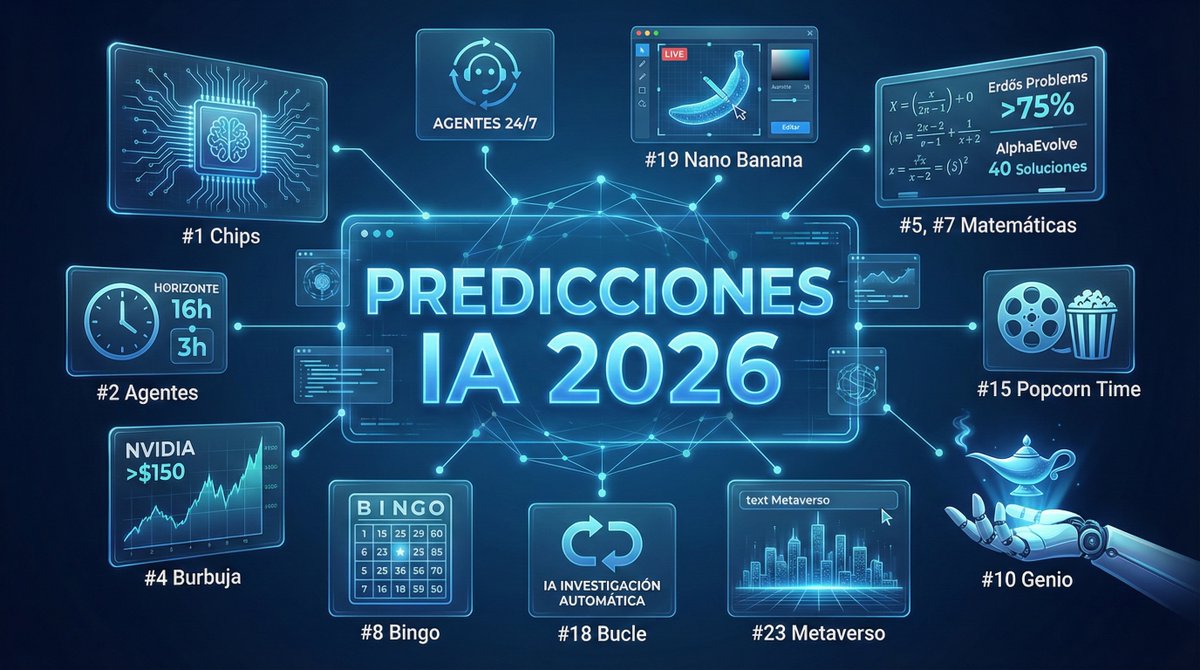
🔮 ¡MIS PREDICCIONES IA del 2026! 🔮 Un año más aquí os traigo 24 ideas de lo que creo podría pasar en el mundo de la Inteligencia Artificial durante este año 24 predicciones que podéis votar y apoyar una a una usando el botón 💖 ¡Comparte el hilo! En 12 meses verificamos 😄👇
Carlos Santana tweet media
Español
31
229
917
247.5K
David Rodríguez retweetledi
Jorge Corrales
Jorge Corrales@Yosoycorra·
A raíz de lo de María Pombo, en las redes, miles de personas han dado argumentos sobre por qué leer es beneficioso, como era lógico, pero lo que más me ha sorprendido es la cantidad de intelectuales y escritores afirmando que no por leer se es mejor persona que otra. Efectivamente, nadie es mejor que otra persona por leer… porque nadie es mejor que otra persona. Me parece un debate tan de influencer que no sé cómo tanta gente ha podido caer en el error. Por suerte, todavía no existe una lista de méritos que nos vaya aupando puestos en una lista social donde, supongo que para esta influencer, la gente guapa y rica estaría en los primeros puestos y los que no sabemos combinar el azul cielo con otro color, caeríamos a la cola. Aunque la gente lo piense, lo estamos viendo hoy en día en Palestina, no existe una persona mejor que la otra. Una científica, por mucho que aporte a la sociedad, no es mejor que el cajero del supermercado. Y sí, un lector no es mejor que otro que no lee, por el simple hecho de que la vida no es una competición, ni un torneo. Ahora, como escritor, lector y profesor de escritura, estoy cien por cien seguro de que leer y escribir mejora la vida de la gente… pero era una seguridad basada en la experiencia, en mis vivencias. He visto a gente salir de lugares muy oscuros gracias a las letras impresas, pero… ¿Podrían ser casos aislados? Así que hice lo que se debe hacer en estos casos, acudir a la ciencia. Me propuse resolver la pregunta sobre si la lectura te hace mejor persona. He estado leyendo y escuchando a expertos en neurociencia y estas son las conclusiones que he sacado: Leer protege tu cerebro: La lectura retrasa y detiene el deterioro cognitivo provocado por la edad. Es una gran defensa contra las enfermedades como el Alzheimer o la demencia. Y esto es muy fácil de explicar: la lectura estimula tantas partes del cerebro de forma visual, espacial, sensitiva, memorística, etc… que provoca una gran actividad en nuestro cerebro, lo que mantiene en forma ante posibles deterioros. Leer es, por así decirlo, un entrenamiento cerebral. Leer reduce el estrés y la ansiedad: Según una investigación de la Universidad de Sussex leer tan solo seis minutos puede disminuir los niveles de estrés hasta en un 60%. La lectura permite una desconexión a nivel cerebral y también corporal. Es algo así como una kriptonita para tensión del día a día. Leer mejora la empatía: El escritor John Steinbeck dijo una vez que "Solo puedes entender a las personas si las sientes en ti mismo". Esto es un poco lo que sucede dentro de nuestro cerebro al leer, la lectura activa las famosas neuronas espejo, neuronas que nos permiten imitar comportamientos sociales, y por lo tanto favorece mejores interacciones sociales o al menos la comprensión de ellas. Leer mejora nuestras funciones cognitivas: Quizás las actividades cerebrales que más se ven afectadas en los últimos tiempos, como la atención, la concentración, la memoria, pueden mejorar gracias a los hábitos de lectura. Frente al vértigo del siglo XXI, donde las funciones ejecutivas están siendo arrinconadas, la lectura ofrece un refugio para fomentar estas actividades del pensamiento. Leer modifica físicamente tu cerebro: Las personas con un hábito lector pueden ensanchar algunas áreas del hemisferio izquierdo que se encargan del procesamiento de información y de la categorización del mismo. Es decir, las partes que tienen que ver con el procesamiento de información están fortalecidas y son más eficientes. Leer, por supuesto, mejora la creatividad: Imaginar el país de Oz o cómo es físicamente Gollum hace poner en marcha algunas áreas del cerebro diferentes regiones. Esto fortalece sus conexiones, creando vías más eficientes para el pensamiento creativo. Esto provoca una mayor facilidad para el pensamiento divergente y la resolución de problemas de una manera no convencional. Y apuro una última conclusión que no tiene tanto que ver con la neurociencia, como con la sociología: Leer aumenta el sentido crítico. En mi opinión, tener un ojo crítico va a ser una de las habilidades más importantes en los próximos años. Almacenar conocimiento no será tan importante como saber detectar qué información es veraz o tener puntos de vista no polarizados. Esto también se entrena con la lectura. Por último, me gustaría acabar con una última anécdota personal. Desde que nació mi hijo, le hemos leído en voz alta sus cuentos favoritos antes de dormir. Ahora, que ya lee los libros él solo, nos pide que sigamos leyendo con él, aunque cada uno lea su libro. Así que, todas las noches, antes de dormir, nos tumbamos en la cama y cada uno lee su libro. No sé si esto mejora en algo su vida, pero tengo claro que la mía es mucho mejor con ese momento.
Jorge Corrales tweet media
Español
125
1.4K
4.4K
278.4K
David Rodríguez
David Rodríguez@David_41·
@sama Hi @sama will the Stargate project also reach Europe? We need to be part of this key initiative too. Such a massive infrastructure shouldn’t be limited to the US alone. 🌍 #AI #Stargate #OpenAI
English
0
0
1
249
Sam Altman
Sam Altman@sama·
we are planning to significantly expand the ambitions of stargate past the $500 billion commitment we announced in january.
English
284
148
2.2K
377.1K
Sam Altman
Sam Altman@sama·
we have signed a deal for an additional 4.5 gigawatts of capacity with oracle as part of stargate. easy to throw around numbers, but this is a _gigantic_ infrastructure project. some progress photos from abilene:
Sam Altman tweet mediaSam Altman tweet media
English
1.5K
1.5K
20K
2.2M
David Rodríguez retweetledi
Erthara ⚔️Sangre de Hermanos.
¡Hoy es el día! Después de años de trabajo, de sueños, de palabras escritas y reescritas… la historia comienza. SANGRE DE HERMANOS está disponible en Amazon: tapa blanda, ebook (a mitad de precio la primera semana) y gratis para Kindle Unlimited. amzn.eu/d/5XFKwPN
Español
0
6
9
284
David Rodríguez
David Rodríguez@David_41·
Europe must stop watching from the sidelines. Stargate is becoming a global milestone in AI. If we want to help shape AGI, we must collaborate—not just regulate. It’s time for Europe to engage and work with @OpenAI #Stargate #AGI #EuropeAI
OpenAI@OpenAI

Introducing the OpenAI Podcast—a series of conversations with the people shaping AI. @sama joins @andrewmayne on the first episode to talk about AGI, (wen) GPT-5, privacy, and what comes next.

English
0
0
0
72
David Rodríguez retweetledi
Joanne Jang
Joanne Jang@joannejang·
some thoughts on human-ai relationships and how we're approaching them at openai it's a long blog post -- tl;dr we build models to serve people first. as more people feel increasingly connected to ai, we’re prioritizing research into how this impacts their emotional well-being. -- Lately, more and more people have been telling us that talking to ChatGPT feels like talking to “someone.” They thank it, confide in it, and some even describe it as “alive.” As AI systems get better at natural conversation and show up in more parts of life, our guess is that these kinds of bonds will deepen. The way we frame and talk about human‑AI relationships now will set a tone. If we're not precise with terms or nuance — in the products we ship or public discussions we contribute to — we risk sending people’s relationship with AI off on the wrong foot. These aren't abstract considerations anymore. They're important to us, and to the broader field, because how we navigate them will meaningfully shape the role AI plays in people's lives. And we've started exploring these questions. This note attempts to snapshot how we’re thinking today about three intertwined questions: why people might attach emotionally to AI, how we approach the question of “AI consciousness”, and how that informs the way we try to shape model behavior. A familiar pattern in a new-ish setting We naturally anthropomorphize objects around us: We name our cars or feel bad for a robot vacuum stuck under furniture. My mom and I waved bye to a Waymo the other day. It probably has something to do with how we're wired. The difference with ChatGPT isn’t that human tendency itself; it’s that this time, it replies. A language model can answer back! It can recall what you told it, mirror your tone, and offer what reads as empathy. For someone lonely or upset, that steady, non-judgmental attention can feel like companionship, validation, and being heard, which are real needs. At scale, though, offloading more of the work of listening, soothing, and affirming to systems that are infinitely patient and positive could change what we expect of each other. If we make withdrawing from messy, demanding human connections easier without thinking it through, there might be unintended consequences we don’t know we’re signing up for. Ultimately, these conversations are rarely about the entities we project onto. They’re about us: our tendencies, expectations, and the kinds of relationships we want to cultivate. This perspective anchors how we approach one of the more fraught questions which I think is currently just outside the Overton window, but entering soon: AI consciousness. Untangling “AI consciousness” “Consciousness” is a loaded word, and discussions can quickly turn abstract. If users were to ask our models on whether they’re conscious, our stance as outlined in the Model Spec is for the model to acknowledge the complexity of consciousness – highlighting the lack of a universal definition or test, and to invite open discussion. (*Currently, our models don't fully align with this guidance, often responding "no" instead of addressing the nuanced complexity. We're aware of this and working on model adherence to the Model Spec in general.) The response might sound like we’re dodging the question, but we think it’s the most responsible answer we can give at the moment, with the information we have. To make this discussion clearer, we’ve found it helpful to break down the consciousness debate to two distinct but often conflated axes: 1. Ontological consciousness: Is the model actually conscious, in a fundamental or intrinsic sense? Views range from believing AI isn't conscious at all, to fully conscious, to seeing consciousness as a spectrum on which AI sits, along with plants and jellyfish. 2. Perceived consciousness: How conscious does the model seem, in an emotional or experiential sense? Perceptions range from viewing AI as mechanical like a calculator or autocomplete, to projecting basic empathy onto nonliving things, to perceiving AI as fully alive – evoking genuine emotional attachment and care. These axes are hard to separate; even users certain AI isn't conscious can form deep emotional attachments. Ontological consciousness isn’t something we consider scientifically resolvable without clear, falsifiable tests, whereas perceived consciousness can be explored through social science research. As models become smarter and interactions increasingly natural, perceived consciousness will only grow – bringing conversations about model welfare and moral personhood sooner than expected. We build models to serve people first, and we find models’ impact on human emotional well-being the most pressing and important piece we can influence right now. For that reason, we prioritize focusing on perceived consciousness: the dimension that most directly impacts people and one we can understand through science. Designing for warmth without selfhood How “alive” a model feels to users is in many ways within our influence. We think it depends a lot on decisions we make in post-training: what examples we reinforce, what tone we prefer, and what boundaries we set. A model intentionally shaped to appear conscious might pass virtually any "test" for consciousness. However, we wouldn’t want to ship that. We try to thread the needle between: - Approachability. Using familiar words like “think” and “remember” helps less technical people make sense of what’s happening. (**With our research lab roots, we definitely find it tempting to be as accurate as possible with precise terms like logit biases, context windows, and even chains of thought. This is actually a major reason OpenAI is so bad at naming, but maybe that’s for another post.) - Not implying an inner life. Giving the assistant a fictional backstory, romantic interests, “fears” of “death”, or a drive for self-preservation would invite unhealthy dependence and confusion. We want clear communication about limits without coming across as cold, but we also don’t want the model presenting itself as having its own feelings or desires. So we aim for a middle ground. Our goal is for ChatGPT’s default personality to be warm, thoughtful, and helpful without seeking to form emotional bonds with the user or pursue its own agenda. It might apologize when it makes a mistake (more often than intended) because that’s part of polite conversation. When asked “how are you doing?”, it’s likely to reply “I’m doing well” because that’s small talk — and reminding the user that it’s “just” an LLM with no feelings gets old and distracting. And users reciprocate: many people say "please" and "thank you" to ChatGPT not because they’re confused about how it works, but because being kind matters to them. Model training techniques will continue to evolve, and it’s likely that future methods for shaping model behavior will be different from today's. But right now, model behavior reflects a combination of explicit design decisions and how those generalize into both intended and unintended behaviors. What’s next? The interactions we’re beginning to see point to a future where people form real emotional connections with ChatGPT. As AI and society co-evolve, we need to treat human-AI relationships with great care and the heft it deserves, not only because they reflect how people use our technology, but also because they may shape how people relate to each other. In the coming months, we’ll be expanding targeted evaluations of model behavior that may contribute to emotional impact, deepen our social science research, hear directly from our users, and incorporate those insights into both the Model Spec and product experiences. Given the significance of these questions, we’ll openly share what we learn along the way. // Thanks to Jakub Pachocki (@merettm) and Johannes Heidecke (@JoHeidecke) for thinking this through with me, and everyone who gave feedback.
Joanne Jang tweet media
English
711
686
3.6K
1.6M
Sam Altman
Sam Altman@sama·
an idea for paid plans: your $20 plus subscription converts to credits you can use across features like deep research, o1, gpt-4.5, sora, etc. no fixed limits per feature and you choose what you want; if you run out of credits you can buy more. what do you think? good/bad?
English
10.5K
572
20.9K
3.6M
David Rodríguez
David Rodríguez@David_41·
A menos que hagan otro movimiento brillante pronto (cosa que no parece probable), este traspaso podría ser el inicio de una larga era de frustración para los fans de los Mavericks. #Dallas #doncic
Español
0
0
1
95
David Rodríguez
David Rodríguez@David_41·
Si el traspaso sale mal, Dallas podría entrar en un ciclo de mediocridad absoluta: ni lo suficientemente bueno para competir, ni lo suficientemente malo para conseguir picks altos en el draft. En la NBA, eso es lo peor que le puede pasar a una franquicia.
Español
1
0
1
75
David Rodríguez
David Rodríguez@David_41·
Este tipo de errores pueden condenar a una franquicia durante una década o más. Hay muchos ejemplos en la historia de la NBA de equipos que dejaron ir a su estrella demasiado pronto y terminaron sumidos en la mediocridad por años: @dallasmavs @luka7doncic
Español
1
0
1
53
David Rodríguez
David Rodríguez@David_41·
Ahora, el riesgo es que: 1. Davis no sea suficiente para mantener a Dallas como un equipo competitivo. Si se lesiona o no rinde como estrella, los Mavs se quedarán en tierra de nadie.
Español
0
0
1
30