Deep Learning Sessions Portugal

312 posts

Deep Learning Sessions Portugal banner
Deep Learning Sessions Portugal

Deep Learning Sessions Portugal

@DeepLearningPT

🚀🇵🇹 A Community dedicated to Deep Learning in Portugal! 🚀🇵🇹

Lisbon, Portugal Katılım Ekim 2020
208 Takip Edilen357 Takipçiler
Deep Learning Sessions Portugal
Deep Learning Sessions Portugal@DeepLearningPT·
⏳ Últimos 3 dias para candidaturas ao Deep Learning Sessions Portugal! Interessado/a em tecnologia e em ajudar a dinamizar uma comunidade? 👉 Não precisas de background técnico. Candidata-te aqui 👇 forms.gle/GraxXLvp5x53DJ…
Português
0
0
0
34
Deep Learning Sessions Portugal
Deep Learning Sessions Portugal@DeepLearningPT·
🚀 Estamos a recrutar no Deep Learning Sessions Portugal! Queres ajudar a dinamizar uma comunidade à volta de Deep Learning e tecnologia? 👉 Não precisas de background técnico. 🎯 Estamos abertos a novas ideias de atividades. 👉 Candidata-te aqui: forms.gle/GraxXLvp5x53DJ…
Português
0
0
3
74
Deep Learning Sessions Portugal retweetledi
Christian S. Perone
Christian S. Perone@tarantulae·
That is exactly what the philosopher Gilbert Simondon addressed in 1958. Culture in general has always been defined as a defense mechanism against technology. Take the English Luddite movement for example. I wrote about it here: blog.christianperone.com/2025/01/notes-… for those interested.
John Carmack@ID_AA_Carmack

I think you are misunderstanding what this tech demo actually is, but I will engage with what I think your gripe is — AI tooling trivializing the skillsets of programmers, artists, and designers. My first games involved hand assembling machine code and turning graph paper characters into hex digits. Software progress has made that work as irrelevant as chariot wheel maintenance. Building power tools is central to all the progress in computers. Game engines have radically expanded the range of people involved in game dev, even as they deemphasized the importance of much of my beloved system engineering. AI tools will allow the best to reach even greater heights, while enabling smaller teams to accomplish more, and bring in some completely new creator demographics. Yes, we will get to a world where you can get an interactive game (or novel, or movie) out of a prompt, but there will be far better exemplars of the medium still created by dedicated teams of passionate developers. The world will be vastly wealthier in terms of the content available at any given cost. Will there be more or less game developer jobs? That is an open question. It could go the way of farming, where labor saving technology allow a tiny fraction of the previous workforce to satisfy everyone, or it could be like social media, where creative entrepreneurship has flourished at many different scales. Regardless, “don’t use power tools because they take people’s jobs” is not a winning strategy.

English
1
2
5
730
Deep Learning Sessions Portugal retweetledi
Wenhu Chen
Wenhu Chen@WenhuChen·
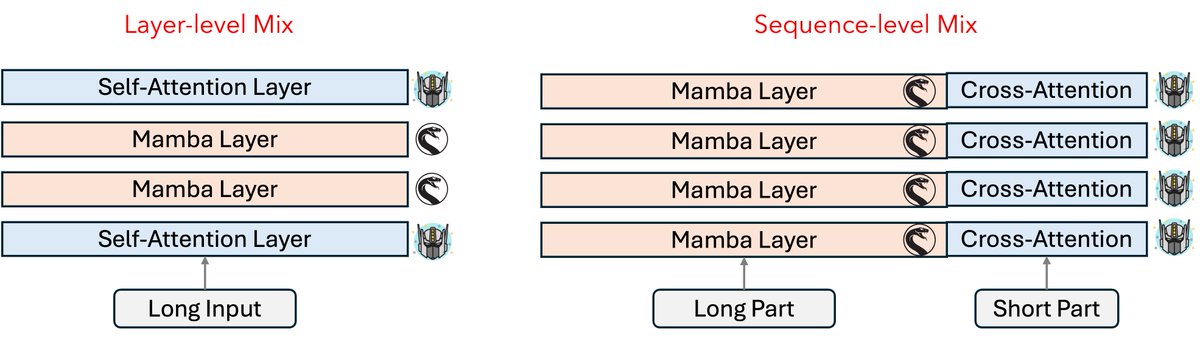
I've seen impressive recent results from hybrid Mamba-Transformer architectures, which show significant progress compared to earlier efforts. These hybrid models excel at handling long-context inputs and enable higher throughput. Generally, there are two effective approaches to integrating these architectures: 1. Layer-wise Mixing: Alternating Transformer and Mamba layers within the architecture. 2. Sequence-wise Mixing: Using Mamba for encoding long input sequence part and feed the encoded states to cross-attention layers. Both strategies have demonstrated strong performance and efficiency, particularly in tasks involving extensive context. They basically
Wenhu Chen tweet media
English
5
85
317
31.1K
Deep Learning Sessions Portugal retweetledi
Sebastien Bubeck
Sebastien Bubeck@SebastienBubeck·
It's looking like all the open problems I have thought about in the last 10 years are now solved (or in some cases on the verge of being solved)? Latest case in point this beautiful new paper: arxiv.org/abs/2411.18614 . I'm glad we (humans) got all this results just in time!
English
7
31
184
31K
Deep Learning Sessions Portugal retweetledi
Richard Sutton
Richard Sutton@RichardSSutton·
The original RL algorithms, inspired by natural learning, were online and incremental—they were streaming in the sense that they learned from each increment of experience as it happened, then discarded it, never to be processed again. The streaming algorithms were simple and elegant, but the first big successes of RL in deep learning were not with streaming algorithms. Instead, methods such as DQN chopped the stream of experience into individual transitions, then stored and sampled them in arbitrary batches. Subsequent work followed, extended, and refined the batch approach into asynchronous and offline RL, while the streaming approach languished, unable to produce good results in popular deep learning domains. Until now. Now researchers at the University of Alberta have shown that streaming RL algorithms can work just as well as DQN on Atari and Mujoco tasks (arxiv.org/pdf/2410.14606). How did they do it? Mostly just by getting signal normalization and step-size bounding right for the streaming case—otherwise they use standard streaming algorithms like TD(lambda) and Q(lambda). To me it looks like they were simply the first researchers knowledgeable of streaming RL algorithms to seriously address deep RL without being over-influenced by batch-oriented software and batch-oriented supervised-learning ways of thinking.
Mohamed Elsayed@mhmd_elsaye

Would you believe that deep RL can work without replay buffers, target networks, or batch updates? Our recent work gets deep RL agents to learn from a continuous stream of data one sample at a time without storing any sample. Joint work with @Gautham529 and @rupammahmood.

English
16
226
1.4K
129.2K
Deep Learning Sessions Portugal retweetledi
Chhavi Yadav
Chhavi Yadav@chhaviyadav_·
Few thoughts after having finally written my @iclr_conf rebuttal post endless procrastination: 1. Many reviewers are "LLM-age" reviewers, who probably started research post the dawn of powerful LLMs. Even though your paper is more towards theory or maybe the 1st of its kind proposing/addressing a new problem, they always review the paper with an LLM lens. Prototypical question -- does xyz apply to LLMs? If not REJECT REJECT REJECT!!!! 2. "This doesn't apply to LLMs" has become a lazy way of rejecting papers in adversarial contexts such as paper reviewing. Are we only doing research relevant to LLMs now? 3. Working at the intersection of areas makes the job of convincing reviewers doubly hard. You have minimal control of which kind of reviewer your paper will end up with. With limited page limit you will either fall short even if you try to address different kinds of reviewers or bore at least one kind. 4. Can we as reviewers please leave some room for the possibility that we may have missed something in the paper or might be wrong? It infuriates me to see over-confident extremely stupid reviews. Probably I won't be friends with such people irl. 5. Writing rebuttals has not gotten any less frustrating for me personally. 6. As always, the scores are way harsher than the reviews themselves.
English
3
6
94
11.4K
Deep Learning Sessions Portugal retweetledi
Christian S. Perone
Christian S. Perone@tarantulae·
The fact that Machine Learning is now basically an intersection of many fields such as calculus, linear algebra, probability, statistics, etc, makes a fertile ground for notational nightmares with the highest level of symbol overloading you will ever find 😅
English
1
1
6
538
Deep Learning Sessions Portugal retweetledi
Andrej Karpathy
Andrej Karpathy@karpathy·
Suddenly upset that for every piece of content I come across I can't immediately check in with my AI book club to see what they think about it.
English
103
78
2.7K
295.8K
Deep Learning Sessions Portugal retweetledi
Alignment Lab AI
Alignment Lab AI@alignment_lab·
just to play devils advocate, id argue that weve not scratced the surface yet on actually utilizing the avaliable data, and that the scaling laws only hold under certain conditions, and may represent a local minima as an artifact of a particular kind of training heuristic, though generally i do agree we wont have agi until some fundemental changes happen
English
0
1
16
8.1K