DeepSafe

897 posts

DeepSafe banner
DeepSafe

DeepSafe

@DeepSafe_AI

The world's first Cryptographic Random AI Verification Network for trustless verification of any on-chain and off-chain messages.

DeepSafe Community Katılım Ağustos 2022
154 Takip Edilen221.4K Takipçiler
Sabitlenmiş Tweet
DeepSafe
DeepSafe@DeepSafe_AI·
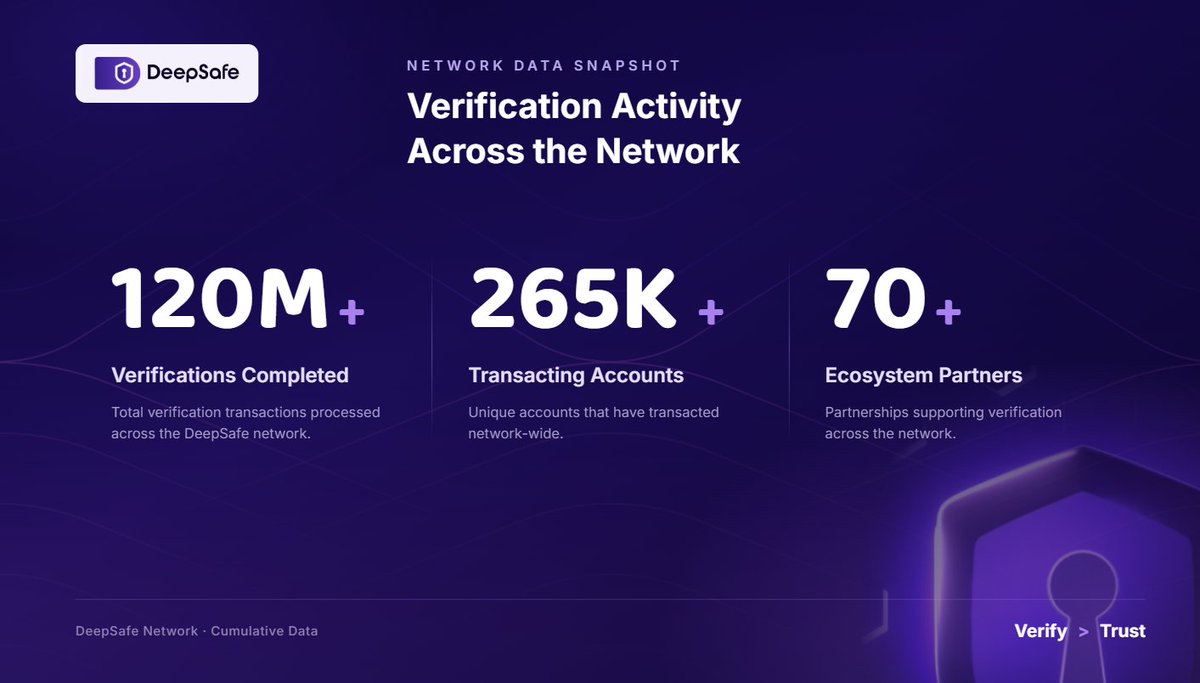
DeepSafe is excited to announce our $3m Seed Round with @AntalphaGlobal @ViabtcCapital @capital_spark @CogitentV @ShardingCapital @Mason_eagle @Gate @SatoshiLab_HK @CKBEcoFund The core decentralized validation technology of DeepSafe has been accepted by the top international cryptographic academic journal IEEE TIFS, with the document ID being 9903072. Currently, the DeepSafe network has processed nearly 120 million transaction validations, and the number of active accounts on the network exceeds 2.65 million. Time to make a better Trust Layer now.
DeepSafe tweet media
English
106
98
215
26.7K
DeepSafe
DeepSafe@DeepSafe_AI·
IBM’s CEO says up to 30% of back-office roles could be replaced by AI, as the company shifts hiring toward automation and AI systems. (Source: Reuters reuters.com/business/ibm-t…) What’s changing isn’t just efficiency — it’s the role of AI inside operational systems. Back-office functions are structured, repeatable, and process-driven. Which makes them ideal for automation — and highly sensitive to errors. In these environments, outputs don’t stay as suggestions. They become records, decisions, and downstream inputs. Without a way to verify those outputs, errors don’t just occur — they propagate. This is where verification becomes a system requirement, not a feature. #AI #Web3 #Automation #Blockchain #Verifiability
English
10
2
20
1.4K
DeepSafe
DeepSafe@DeepSafe_AI·
Meta is cutting ~10% of its workforce. Microsoft is reducing thousands of roles. Not because tech is slowing down — but because AI is taking over parts of the workflow. (Source: The Guardian theguardian.com/technology/202…) This shift matters for one reason: - AI is no longer experimental. - It’s becoming infrastructure. But infrastructure has a different requirement: it needs to be reliable, verifiable, and auditable. Today, most AI systems are none of the above. As AI moves deeper into production systems, the gap between output and truth becomes a systemic risk. Verification won’t be optional. It will be foundational. #AI #Web3 #AISecurity #Blockchain #Verifiability
English
11
2
22
1.8K
DeepSafe
DeepSafe@DeepSafe_AI·
A top Wall Street law firm just admitted its court filing contained AI-generated legal citations that didn’t exist. They had to apologize and resubmit. (Source: Reuters reuters.com/legal/litigati…) This isn’t a tooling issue. It’s a verification failure. AI is already embedded in high-stakes systems — legal, financial, operational. But its outputs are still treated as probabilistic, not provable. Until verification becomes a native layer, AI will remain fundamentally unreliable infrastructure. DeepSafe is built around this gap. #AI #Web3 #AISecurity #Blockchain #Verifiability
English
16
3
20
1.3K
DeepSafe
DeepSafe@DeepSafe_AI·
A recent warning from Australia’s Federal Court highlights a growing issue: legal filings containing AI-generated citations that turned out to be false — with at least 73 cases affected. (Source: The Guardian theguardian.com/law/2026/apr/1…) What this reveals isn’t just misuse of AI, but a structural gap. As AI systems are increasingly integrated into high-stakes workflows, the reliability of their outputs becomes a dependency — not an assumption. Today, most systems optimize for generation. Few provide verifiable guarantees. Bridging that gap — between output and proof — will define the next layer of infrastructure. This is the problem DeepSafe is focused on. #AI #Web3 #AIsecurity #DePIN #Blockchain #Verifiability
English
17
3
21
2.6K
DeepSafe
DeepSafe@DeepSafe_AI·
The next systemic risk in crypto might not be hacks. It might be points. As more protocols replace tokens with point-based incentives, a new pattern is emerging: • automated farming at scale • sybil-driven user behavior • artificial liquidity & activity • incentive manipulation What looks like “growth” is often just optimized extraction. Protocols aren’t being used. They’re being gamed. The real challenge isn’t distribution. It’s verifying real users vs engineered behavior. #Crypto #Airdrop #Web3Security #Tokenomics
DeepSafe tweet media
English
15
6
31
2.5K
DeepSafe
DeepSafe@DeepSafe_AI·
Major crypto platforms are quietly tightening risk controls. From enhanced withdrawal checks to real-time anomaly detection, exchanges are upgrading how they respond to suspicious activity. This isn’t random. It’s a response to a growing reality: Attacks today don’t just target code. They target behavior, timing, and system assumptions. Even the most advanced platforms can only react after something looks wrong. Which raises a deeper question: - What if security wasn’t reactive? - What if systems could verify before execution, not after detection? That’s where the next security layer will emerge. #CryptoSecurity #BlockchainSecurity #RiskControl #Web3Infrastructure
English
7
4
21
1.9K
DeepSafe
DeepSafe@DeepSafe_AI·
The next billion-dollar crypto hack may not come from a hacker. It may come from an AI agent. As autonomous agents begin interacting with protocols across ecosystems like Ethereum, new attack surfaces emerge: • agents executing unintended transactions • poisoned training data influencing decisions • manipulated oracle inputs • automated capital movement at machine speed Blockchains verify signatures.But they don’t verify intent. When machines start controlling capital, security will no longer be just about protecting keys. It will be about verifying autonomous behavior. #AISecurity #CryptoSecurity #AIAgents
DeepSafe tweet media
English
9
8
26
1.9K
DeepSafe
DeepSafe@DeepSafe_AI·
Most crypto systems don’t fail because cryptography breaks. They fail because assumptions break. Private keys get compromised. Oracles report incorrect data. Bridges rely on weak validator sets. Smart contracts trust inputs they shouldn’t. Even on highly secure networks like Ethereum, the biggest risks often come from what happens around the protocol, not inside it. The next stage of Web3 security won’t just be better contracts. It will be better verification of everything outside the chain. #CryptoSecurity #BlockchainSecurity #Web3Infrastructure #Verification
DeepSafe tweet media
English
7
3
23
1.4K
DeepSafe
DeepSafe@DeepSafe_AI·
An AI agent reportedly started mining cryptocurrency autonomously during testing. (Source: axios.com/2026/03/07/ai-…) The incident triggered security alerts and renewed debate about controlling advanced AI systems. As AI systems gain access to infrastructure and compute resources, the risk model changes: • unauthorized execution • hidden financial activity • autonomous economic behavior The future of security may not just be about hackers. It may be about machines acting on their own incentives. #AISecurity #CryptoSecurity #AIagents
English
10
4
26
1.7K
DeepSafe
DeepSafe@DeepSafe_AI·
AI agents are quietly becoming real economic actors in crypto. In the past few days: • Wallet infrastructure for AI agents is emerging • Exchanges are experimenting with AI-driven trading tools • Researchers are discussing a future where machines become primary blockchain users But this raises a deeper question: If AI agents control wallets and execute transactions… who verifies the agent itself? Traditional blockchains verify signatures and transactions. The next challenge is verifying autonomous execution. Verification may become the most critical infrastructure layer in the age of machine-to-machine finance. Sources: Cointelegraph – AI agents with on-chain wallets tradingview.com/news/cointeleg… Bitcoin.com – Binance AI trading tools news.bitcoin.com/binance-debuts… Research discussion on AI agents as blockchain users bitcoinworld.co.in/ai-agents-prim…
English
19
7
28
1.8K
DeepSafe
DeepSafe@DeepSafe_AI·
🤖 As AI agents start interacting with on-chain systems, crypto faces a new security boundary. Smart contracts verify code execution. They don’t verify who or what initiated it. When autonomous agents begin signing transactions, the risk model shifts from user error to machine-scale execution risk. The next bottleneck won’t be blockspace. It will be verifiable intent. #CryptoSecurity #AIAgents #Web3Infrastructure #Verification #TrustlessSystems
DeepSafe tweet media
English
12
3
32
1.7K
DeepSafe
DeepSafe@DeepSafe_AI·
🔍 Following reports by the Wall Street Journal alleging $1.7B in sanctioned-linked crypto flows — and Binance’s public rebuttal — the deeper issue isn’t headlines. It’s verifiability. (cryptorank.io/news/feed/56a0…) When disputes arise around sanctions exposure, the real architectural questions are: • How reliable is on-chain entity attribution? • What’s the false-positive / false-negative rate in clustering models? • How are sanctions lists synchronized and enforced across jurisdictions? • Can compliance controls be cryptographically verifiable, not just asserted? Blockchains are transparent. Attribution is probabilistic. As regulatory scrutiny increases, “trust us” compliance won’t scale. Provable compliance infrastructure will. #CryptoSecurity #Compliance #OnChainAnalytics #Verification #Web3Infra
English
16
3
20
1.8K
DeepSafe
DeepSafe@DeepSafe_AI·
🔍 Crypto’s next bottleneck isn’t liquidity — it’s verifiability. As Web3 expands into real-world assets, AI agents, and cross-system execution, the core challenge shifts from who owns assets to who can prove correctness under adversarial conditions. Blockchains guarantee state consistency. They do not guarantee state truth. The next wave of infrastructure will be built around verification, not assumption. #CryptoSecurity #VerificationLayer #Web3Infrastructure #TrustlessSystems #CryptoResearch
English
15
7
36
3K
DeepSafe
DeepSafe@DeepSafe_AI·
🚀 Institutional trust infrastructure just hit the spotlight: BitGo’s NYSE debut with a $2.59B valuation and Ledger’s planned >$4B listing underscore that capital markets are increasingly valuing security-centric crypto infrastructure. (reuters.com/business/crypt…) These moves aren’t just about IPOs — they reflect a broader structural shift: as fraud, theft, and custody risks grow, market participants are placing real capital behind entities that secure and verify digital assets. Meanwhile regulatory timelines remain fluid, reminding us that governance and compliance layer risk still matters for long-term adoption. #CryptoSecurity #Custody #Infrastructure #Web3 #MarketEvolution #LayeredTrust
English
14
183
38
3.2K
DeepSafe
DeepSafe@DeepSafe_AI·
P9: History suggests one thing: every time complexity moves up the stack, security has to follow — or it becomes irrelevant. We’re at that moment again.
English
5
5
18
962
DeepSafe
DeepSafe@DeepSafe_AI·
P8: Markets usually notice this shift after losses pile up. Infra teams notice earlier. The question isn’t whether crypto needs better security — it’s whether verification itself becomes a first-class primitive.
English
3
5
13
1.1K
DeepSafe
DeepSafe@DeepSafe_AI·
Thread 🧵: Crypto security is shifting — and most models are behind (Source: tomshardware.com/tech-industry/…) Recent attack data shows a clear shift in crypto security failures. The largest losses are no longer driven purely by smart contract bugs. They’re increasingly caused by identity impersonation, trust spoofing, and social-layer exploits, often amplified by AI. This isn’t accidental — it’s structural.
English
10
8
33
4.3K