The AI money machine! Well, it's almost impossible to map. But someone has got to do it. This is the circular flow of capital through the AI infrastructure economy from 2019 to 2032. A rose-tinted version that's being priced in.
Delta Newtral
390 posts

@DeltaNewtral
Futures & Options Trader | 0DTE Index Options | $SPX $ES_F $NQ_F | Always Hedge Risk | Crypto Enthusiast | Loves #SierraChart | NFA DYOR |

The AI money machine! Well, it's almost impossible to map. But someone has got to do it. This is the circular flow of capital through the AI infrastructure economy from 2019 to 2032. A rose-tinted version that's being priced in.


When you save in dollars, everything gets more expensive. When you save in #Bitcoin, everything gets less expensive. Pretty simple concept really.


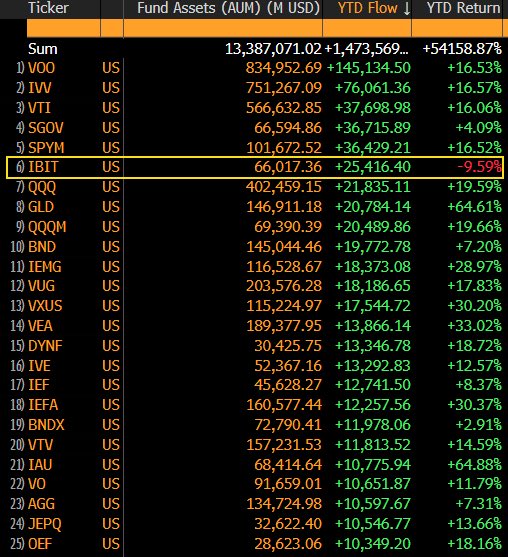
$IBIT is the only ETF on the 2025 Flow Leaderboard with a negative return for the year. CT's knee-jerk reaction is to whine about the return but the real takeaway is that is was 6th place DESPITE the negative return (Boomers putting on a HODL clinic). Even took in more than $GLD which was up 64%. That's a really good sign long term IMO. If you can do $25b in bad year imagine the flow potential in good year.

2025 Performance: Silver: 130% Gold: 65% Copper: 35% Nasdaq: 20% S&P 500: 16% Russell 2000: 13% BTC: -6% ETH: -12% Altcoins: -42% The crypto market is now officially the worst-performing asset in 2025.


VIX fell 11.6% today. On July 31, 2024 after the BOJ raised rates the VIX fell nearly 10%. Today we got a 0.9% rally, then we got 1.6%.


🚨 Nobody talks about this… but Japan is about to unload $500+ BILLION in stocks. Not in 5 or 10 years, but starting next month. Once you see how this works, you’ll understand what it really means. For every stock investors, let me tell you what this means for your portfolio: For years, the Bank of Japan has been quietly buying stocks through ETFs to prop up its economy. Not a little bit, a lot. Today, they’re sitting on ¥83 trillion worth of equities. That’s roughly $534 billion. Now comes the uncomfortable part… Japan is finally preparing to exit. As early as next month, the BOJ plans to start selling these holdings back into the market. That alone should tell you how fragile this situation is. A constant source of supply will be sold on the market. Months after months… And remember, this isn’t some hedge fund. This is a central bank. Why does this matter outside Japan? Because Japan is one of the biggest players in global markets. Japanese institutions own massive amounts of foreign assets, U.S. stocks included. If conditions get worse or volatility spikes, capital doesn’t just stay put. It moves without hesitation. And when one of the largest central banks on earth starts backing away from risk, the ripple effects don’t stay local. This isn’t about a crash tomorrow… But it’s about selling pressure quietly building in the background while most people aren’t even paying attention. You can also expect crypto to pull back in the short term, since it usually moves in the same direction as stocks. I’m currently analyzing the situation. Tomorrow, I’ll share which stocks are most at risk. I was one of the only people to call the last two market crashes days before they happened. If you’re holding stocks or crypto, you’ll wish you followed me sooner. Trust me.

🚨 JUST IN: JAPAN’S INTEREST RATE DECISION CAME IN AT 0.75%. EXPECTATIONS: 0.75%.

Google just launched a direct attack on Nvidia's most valuable asset. Not their chips. Their SOFTWARE. And if this works, Nvidia's $4 trillion empire collapses. Here's what just leaked: Google is building "TorchTPU" - a secret project that makes PyTorch seamlessly run on Google's TPU chips instead of Nvidia GPUs. Why does this matter? PyTorch is the MOST USED AI framework on Earth. Every AI developer uses it. And PyTorch was built around Nvidia's CUDA software. Wall Street analysts call CUDA "Nvidia's strongest defensive wall." It's the reason companies can't easily switch away from Nvidia even when alternatives exist. You don't just buy Nvidia chips. You buy into their entire ecosystem. Switching costs MILLIONS in engineering work. Months of rewrites. Performance drops. So companies stay locked in. Even when Nvidia raises prices. Even when supply runs short. That's not a hardware moat. That's a SOFTWARE prison. And Google just found the escape route. Here's the problem Nvidia created for itself: Google's TPU chips are actually GOOD. Competitive performance. Better availability. Lower cost. But developers won't use them because Google's chips run JAX (Google's internal framework), not PyTorch. That means if you want to use Google TPUs, you have to rewrite your entire codebase. Nobody wants to do that. So Google TPUs sit unused while developers fight over Nvidia chips. Until now. TorchTPU makes PyTorch run natively on Google hardware. No rewrites. No performance loss. No months of engineering. You just... switch. And Google is partnering with META (who built PyTorch) to make it happen. They're even considering OPEN-SOURCING parts of it to speed adoption. Translation: Google is willing to give this away for free just to break Nvidia's lock. The implications are insane: Every company currently paying Nvidia's premium prices suddenly has a way out. Oracle, Microsoft, OpenAI - all locked into Nvidia's ecosystem - can switch to Google. Nvidia's pricing power evaporates overnight. And the timing is perfect: Nvidia is already facing heat. Semiconductor index dropped 3% today. Oracle just lost their biggest investor over AI spending concerns. Companies are realizing AI infrastructure costs are unsustainable. Now Google hands them an alternative. Same performance. Lower cost. Better availability. Jensen Huang knows exactly what this means. CUDA has been Nvidia's untouchable advantage for YEARS. It's why Nvidia trades at 50x earnings while AMD trades at 25x. The software moat justified the premium. But if Google removes that switching cost? Nvidia becomes just another chip company. And chip companies compete on price, not ecosystem lock-in. Here's what happens next: Google needs 12-18 months to make TorchTPU production-ready. If it works, cloud providers will adopt it instantly. They WANT an alternative to Nvidia's monopoly pricing. Amazon already building their own Trainium chips. Microsoft making Maia. They're all trying to escape Nvidia. Google just gave them the software bridge. Nvidia's response options are limited: They can't buy Google. Can't kill PyTorch (Meta owns it). Can't stop open source. Their only play is to keep improving CUDA faster than Google can catch up. But that's a race, not a moat. The market isn't pricing this in yet. Nvidia down 2% today. Google down 2%. Investors think this is just "another competitor." They don't understand this is an attack on the FOUNDATION of Nvidia's valuation. Hardware is replaceable. Software lock-in is what made Nvidia worth $4 trillion. Google is attacking the lock-in. Watch what happens in 2026 when TorchTPU goes live and companies realize they can actually leave Nvidia. The "Nvidia is unstoppable" narrative dies. And a $4 trillion valuation built on software moats gets repriced.

Why does the Bank of Japan have such a strong influence on the crypto market? Whenever Japan raises interest rates, all financial markets come under pressure Especially high risk ones like the crypto market > How does this happen? interest rate hike in Japan -> borrowing yen becomes more expensive investors and funds start selling risky assets including crypto they use the proceeds to buy back yen and close their loans yen strengthens -> triggers mass liquidations in crypto > I think the recent sharp drop in the crypto market was partly caused by the news about the rate hike in Japan I noticed that Polymarket traders have already priced in that the rate will remain unchanged in January I will write a post about this later

🚨 BANK OF JAPAN INTEREST RATE DECISION IS COMING TOMORROW. The market expects 98.4% odds of a 25 bps rate hike. Here’s what happened when BOJ raised rates in the past. July 31, 2024: BOJ raised rates to 0.25% Bitcoin dropped 26% in 8 days Jan 24, 2025: BOJ raised rates to 0.50% Bitcoin dropped 25% in 20 days Now BOJ is expected to raise rates to 0.75%, the highest level since 1995. Just like the past, markets could see some downside around the decision. But if you look at the chart, every BOJ driven BTC dump was followed by a strong recovery and new ATH.

The December opex tomorrow will be the largest ever with over $7.1 trillion of notional options exposure expiring, including $5.0 trillion of SPX options and $880 billion notional of single stock options.