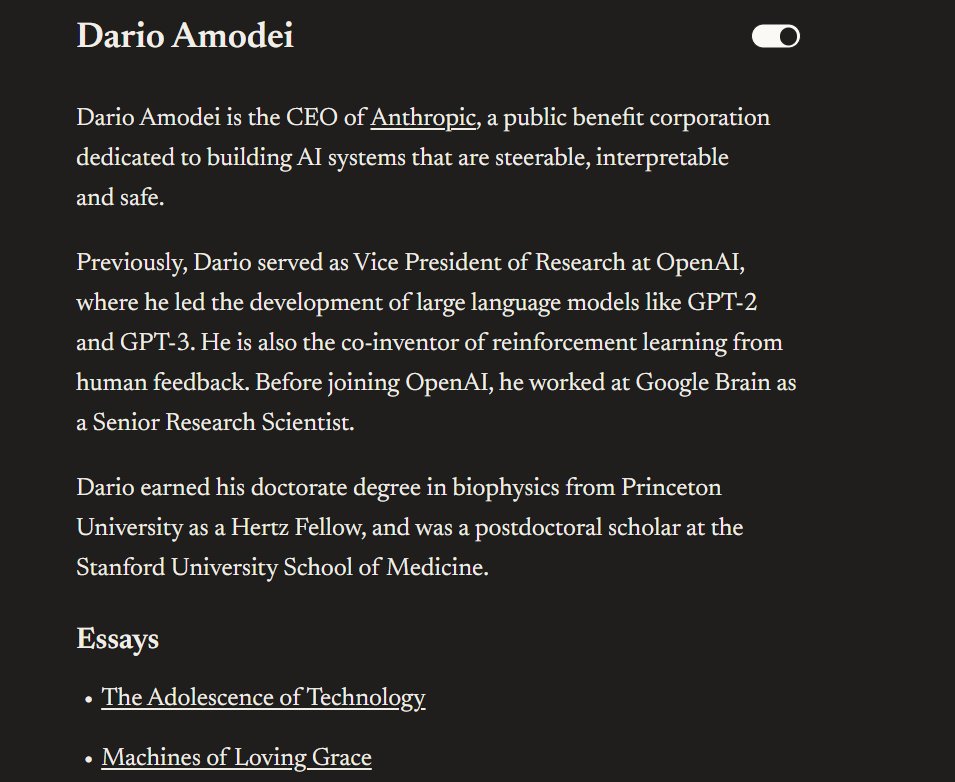
This is Dario Amodei’s *actual* personal website in 2026.
No animations.
No slick branding.
No buzzword salad.
Just pure signal:
→ Led GPT-2 & GPT-3 at OpenAI
→ Co-invented RLHF
→ Founded & runs Anthropic
→ Still drops 30+ page essays on the real future of AI
It’s never been the fancy website.
It’s always been the **workload**.
Real ones move in silence and ship. 🔥
The future of Nigerian Software Engineers & Developers is bright 💻🇳🇬
But one thing I think we need to improve as an ecosystem is how we treat growth, collaboration, and competition.
Too many developers move like it’s everybody for themselves.
Meanwhile, the strongest tech ecosystems globally were built through communities, mentorship, shared knowledge, and collaboration.
If you look at some of the biggest engineering ecosystems today, one thing is common:
> Strong communities
> Open-source culture
> Engineers helping engineers
> Knowledge sharing
> Mentorship
> Builders pushing each other forward
Nigeria already has the talent.
That part is obvious.
We’re seeing more startups, innovation hubs, mentorship communities, hackathons, engineering spaces, and builders rising across the country.
Organizations and communities focused on mentorship and collaboration are already helping thousands of young developers grow. (Thrive in Tech)
But imagine how much further we’d go if more developers genuinely helped each other improve instead of hiding information or turning everything into unhealthy competition.
If you notice another engineer struggling with:
> System design
> Backend architecture
> Communication
> Security
> Frontend structure
> DevOps
> Open source
> Problem solving
…and you have resources that can help, share them.
A simple GitHub repo, article, roadmap, video, or piece of advice can genuinely change someone’s career.
Because the truth is:
when one Nigerian engineer grows, it indirectly opens doors for others too.
Global companies don’t just judge individuals they observe ecosystems, communities, engineering culture, communication, and delivery quality.
And another thing people underestimate is mentorship.
A lot of experienced developers today became great because somebody guided them, corrected them, or gave them clarity early.
Even research and discussions around software engineering communities show collaboration and mentorship are major factors in engineering growth and innovation. (Disciplines In Nigeria)
As engineers, we should normalize:
> sharing opportunities
> reviewing each other’s code
> constructive feedback
> teaching beginners
> collaborating on projects
> building together
The future is bigger than individual wins.
Nigeria has the potential to become one of the strongest engineering ecosystems globally if we focus more on collective growth instead of unnecessary division.
We rise faster together
I strongly believe there are entire companies right now under heavy AI psychosis and its impossible to have rational conversations about it with them. I can't name any specific people because they include personal friends I deeply respect, but I worry about how this plays out.
I lived through the great MTBF vs MTTR (mean-time-between-failure vs. mean-time-to-recovery) reckoning of infrastructure during the transition to cloud and cloud automation. All those arguments are rearing their ugly heads again but now its... the whole software development industry (maybe the whole world, really).
It's frightening, because the psychosis folks operate under an almost absolute "MTTR is all you need" mentality: "its fine to ship bugs because the agents will fix them so quickly and at a scale humans can't do!" We learned in infrastructure that MTTR is great but you can't yeet resilient systems entirely.
The main issue is I don't even know how to bring this up to people I know personally, because bringing this topic up leads to immediately dismissals like "no no, it has full test coverage" or "bug reports are going down" or something, which just don't paint the whole picture.
We already learned this lesson once in infrastructure: you can automate yourself into a very resilient catastrophe machine. Systems can appear healthy by local metrics while globally becoming incomprehensible. Bug reports can go down while latent risk explodes. Test coverage can rise while semantic understanding falls. Changes happens so fast that nobody notices the underlying architecture decaying.
I worry.
Another thing we need to normalize in the Nigerian tech ecosystem:
Giving constructive feedback without ego.
Correcting someone doesn’t reduce your value as an engineer.
We had @0lum0 a “Cyber Security” expert telling us how @igbaisaacA wasn’t a professional Cybersecurity specialist on @Confidence_790@GameXLabsGMX@CeceEssence1 space today 🤣🤣🤣🤣 look at this clowns website 👀 he still didn’t fix it but he’s an “Expert” an expert 🤡
@DevP_B and this kind of thing can seriously damage a project’s reputation. But then everyone in the space started gaslighting me, acting like I was part of the team and that the project is a scam. They called me all sorts of names and kept referencing the RazorCyber vercel subdomain.