There's a specific kind of anxiety that only WordPress site owners understand.
It's 9am. You log into the dashboard. 14 plugin updates pending. You hover over "Update All" and think... what if this breaks something?
So you don't click it.
You tell yourself you'll do it Friday. Friday becomes next week. Next week becomes next month. Now you're 6 months behind on security patches and your hosting company sends you a passive-aggressive email about vulnerabilities.
I've talked to marketing leaders at funded companies — companies with $20M, $40M, $60M raised — who are genuinely scared of their own website backend.
Not because they're not technical. Because they've been burned before. They clicked "update" once and the contact form broke. Or the homepage went blank. Or the checkout stopped working on mobile.
So now nobody touches it. The site slowly becomes a museum of 2022 design choices and outdated messaging, maintained by a freelancer who may or may not respond to emails.
The craziest part is, the plugin that's causing the most anxiety is usually providing something that should've been built into the platform to begin with.
"The last agency gave us a beautiful site. We just can't change anything on it."
I hear this on maybe 1 in 3 discovery calls.
The site looks incredible. Custom animations. Perfect typography. On-brand everything. The agency did great work.
But then the marketing team tries to update a testimonial. Or add a new feature to the product page. Or create a landing page for a campaign.
And they can't. Not without calling the agency. Not without a $2,000 change request. Not without waiting 2 weeks.
So the site slowly becomes a frozen snapshot of the day it launched. The content gets stale. The team works around it instead of with it.
This is the most expensive pattern in B2B web. Not because the site was bad. Because it was built as a deliverable, not a system.
A deliverable is something you hand over. A system is something that keeps working after you leave.
When I scope projects, the question I keep coming back to is: "Can their team run this without me in 6 months?" If the answer is no, the architecture is wrong. No matter how good it looks.
The best agency work isn't the work that makes you need the agency. It's the work that makes you not need them.
If you're evaluating agencies, ask: "Show me a client that manages their site independently after your project ended." Most can't answer that.
A company raises $30M, hires a VP of Marketing, buys HubSpot, sets up Salesforce, invests in Gong, and builds out a sales team.
Then sends all that pipeline to a website that was built when they had 3 employees and no brand guidelines.
I see this constantly. The go-to-market engine is 2025 but the website is still 2021.
And nobody notices because everyone's focused on the next thing — new product feature, new campaign, new hire. The website just sits there collecting dust and collecting first impressions from every prospect, investor, and potential hire who visits.
Here's what makes it tricky. The site isn't broken. It loads, the contact form works, the blog exists. But it doesn't match who they are now. The positioning shifted, the ICP changed, the product does things it didn't do two years ago, and the site still tells the old story.
The gap between who you are and what your site says you are grows quietly. You don't notice until a prospect says "I almost didn't take the call because your site didn't look like you could handle our scale."
That's the moment. And most companies don't hear it because the prospect just doesn't take the call.
A fintech CMO told me this on a call last month: "We spent $70K on the redesign. The board loved it. Our conversion rate didn't move."
Five figures on a new homepage, new messaging, new everything, and the same results. This happens more than people admit because admitting it means admitting the brief was wrong.
From what I've seen, most redesign briefs start with "make it look like [competitor]" and that's a design brief, not a business brief.
Looking like Stripe doesn't make you convert like Stripe. Stripe converts because the entire site is built around one action per page, not because it looks clean.
The prettiest site I've ever worked on had the worst conversion rate and the ugliest one had the best. That's not a rule but it's a pattern worth paying attention to.
If the redesign brief doesn't start with "what do we want visitors to do, and what's stopping them" then you're buying a painting, not a business tool.
After 6 years building websites for VC-backed marketing teams, the most expensive sentence I hear on discovery calls is "our dev team will get to it after the product launch."
That launch was 3 months ago. The landing page is still sitting in Jira, the campaign got delayed again, and the competitor who raised half as much already shipped theirs.
Here's what nobody says out loud. It's not that your dev team doesn't care, they do. It's just that your website will never be their priority because product comes first. Always.
So your marketing team waits. And the board deck says "website refresh — Q3" but every quarter it just gets pushed to the next one.
I've talked to maybe 40 marketing leaders in the last two years. Different companies, different stages, different industries, but the same sentence and the same frustration keeps coming up.
The fix isn't hiring more developers. It's building a site where your marketing team doesn't need them for 90% of changes. That's the whole point.
When I started Digi Hotshot in 2019, the car in our family was a Maruti Alto K10.
If you're not from India, let me give you context. The Alto K10 was literally the cheapest car you could buy in India at the time. We got it in 2013 for about 3 lakhs. Around $3,600.
That's the car I drove while building my first websites for $40-$100.
In 2021, I bought my first car with business money. A Volkswagen Taigun GT TSI. Cars are why I got into this. Not the money itself. The freedom to buy what I cared about. That car was proof the bet worked.
On June 3, 2024, I bought a Mercedes GLC. About 80 lakhs. Roughly $96,000.
Alto K10 to Mercedes GLC in 5 years.
I haven't posted about this anywhere. Because I'm not sure how to talk about it without sounding like those "look at my car" posts.
But here's what I actually want to say.
The car isn't the point. The trajectory is. From building websites for hotels at $40 to working with companies that have raised $50M+. From the cheapest car in India to... well, not the cheapest car in India.
I didn't have connections. I didn't have a CS degree. I had an automobile engineering degree, YouTube tutorials, and a willingness to figure it out.
If you're early in your journey and it feels slow, it is slow. That's not a sign it's not working. That's what the beginning looks like.
The Alto K10 was the beginning. And I'm glad I started there.
A healthcare marketing director told me something I think about a lot:
"I have to submit a ticket to change a button color. A button color. And it takes a week."
She wasn't frustrated about the button. She was frustrated about what it meant.
Every small change going through engineering is a signal. It says: marketing doesn't own its own tools. Every campaign idea has to wait in line behind product work.
I've seen this at clinics, at health platforms, at medtech companies. The pattern is always the same. Marketing gets ambitious. Engineering says "after the sprint." The sprint ends. Another sprint starts. Marketing downgrades the idea to something simpler. Ships it three weeks late.
The worst part? Nobody complains anymore. They just stop asking.
That's when the real damage happens. Not when campaigns are late. When the team stops trying to ship them at all.
I studied automobile engineering in college. Didn't end up building cars. But I kept the habit of looking at how technical products are presented to the world.
And here's what I've noticed lately.
Some of the most well-funded, genuinely impressive technology companies — semiconductors, robotics, quantum computing, climate tech — have websites that look like they were built in a weekend. Because they were.
The founder built it. Or an intern did. Or someone's cousin who "knows Squarespace."
And it made sense at the time. When you're pre-revenue and deep in R&D, a website isn't the priority. Fair.
But then they raise a Series A. Then a Series B. Suddenly they're selling to enterprise buyers. Showing up at conferences. Investors are sending prospects their way.
And the website still says "We're building the future of [category]" with a stock photo of a circuit board.
The disconnect between the sophistication of the technology and the quality of its online presence is wild. These companies can design chips that run AI workloads. But the site explaining what they do looks like a college project.
I think that gap is going to close fast. The companies that figure it out first will look a lot more credible than they are. And the ones that don't will look a lot less credible than they deserve.
After building websites for 50+ B2B marketing teams, the single biggest ROI isn't a design change or a conversion tweak.
It's giving marketing the keys to their own site.
Sounds simple. In practice, it's the thing most agencies never do. They build something beautiful, hand it over, and then you need them for every change. Forever.
A client of ours — a VC firm with a portfolio of funded companies — hadn't made a single update to their site in over a year after their last agency delivered it. Not because they didn't want to. Because they were afraid of breaking something.
We rebuilt it with a component library. Modular pieces that snap together. Their team was trained on it in a single session. Three years later, they manage it completely independently. Zero agency support.
That's what marketing autonomy actually looks like. Not "we'll teach you to code." More like: the site is built so well that a non-technical person can publish, rearrange, and update without asking for help.
When we scope a project, the training plan is part of the build. Not an afterthought. Not a PDF they'll never open.
Because the best website isn't the one that looks amazing at launch. It's the one that still looks amazing 2 years later because the team can actually maintain it.
If you're evaluating agencies right now, ask this: "What does our team's day-to-day look like 6 months after you deliver?" The answer tells you everything.
The most common redesign trigger I see isn't "our site is ugly."
It's this: "We've changed. Our site hasn't."
After 6 years working with VC-backed companies, I can almost predict when the call is coming. It's usually 12-18 months after a funding round. Sometimes after a rebrand. Sometimes after they moved upmarket.
The product does things it didn't do when the site was built. The ICP shifted. The sales team is talking to enterprise buyers now. But the homepage still reads like it was written for seed-stage startups.
Here's the pattern:
Series A: build the site fast, get it live, move on.
Series B: everyone notices it's outdated but nobody owns the project.
18 months post-B: a VP of Marketing joins. Looks at the site. Calls an agency.
The gap between what the company does and what the site says it does grows slowly. It's never urgent until it is. And by then, you're in a hurry.
If you're at a company where the product has changed significantly in the last 12-18 months, take 5 minutes. Visit your own site. Read it like a stranger.
Does it describe the company you work at today? Or the company it was two versions ago?
That answer usually decides whether the redesign is Q2 or Q4.
After 6 years running a Webflow agency and talking to marketing leaders who've hired 2, 3, sometimes 4 agencies before us — here are the red flags they wish they'd caught earlier:
1. The proposal focuses on deliverables, not outcomes.
"10 pages, 5 blog templates, 1 CMS collection" tells you what you're getting. It doesn't tell you why it matters or how it connects to your pipeline.
2. They can't show you a client who runs their site independently.
If every client still needs the agency for updates, the build creates dependency. That's by design. And it's expensive long-term.
3. The timeline has no detail before the design phase.
If there's no discovery, no content strategy, no conversion mapping before pixels start moving, you're building a house without a blueprint.
4. They don't ask about your team's workflow.
A site built for a marketing team of 2 is different from a team of 8. If they didn't ask how your team works, the site won't fit how your team works.
5. They compare themselves to other agencies instead of talking about your problem.
The conversation should be about you, not about them.
None of these are obvious in a first call. They show up 6 weeks into the project or 6 months after launch.
But they're all visible in the proposal stage if you know what to look for.
Comment "BRIEF" and I'll send you the pre-project checklist we share with every new client before we start.
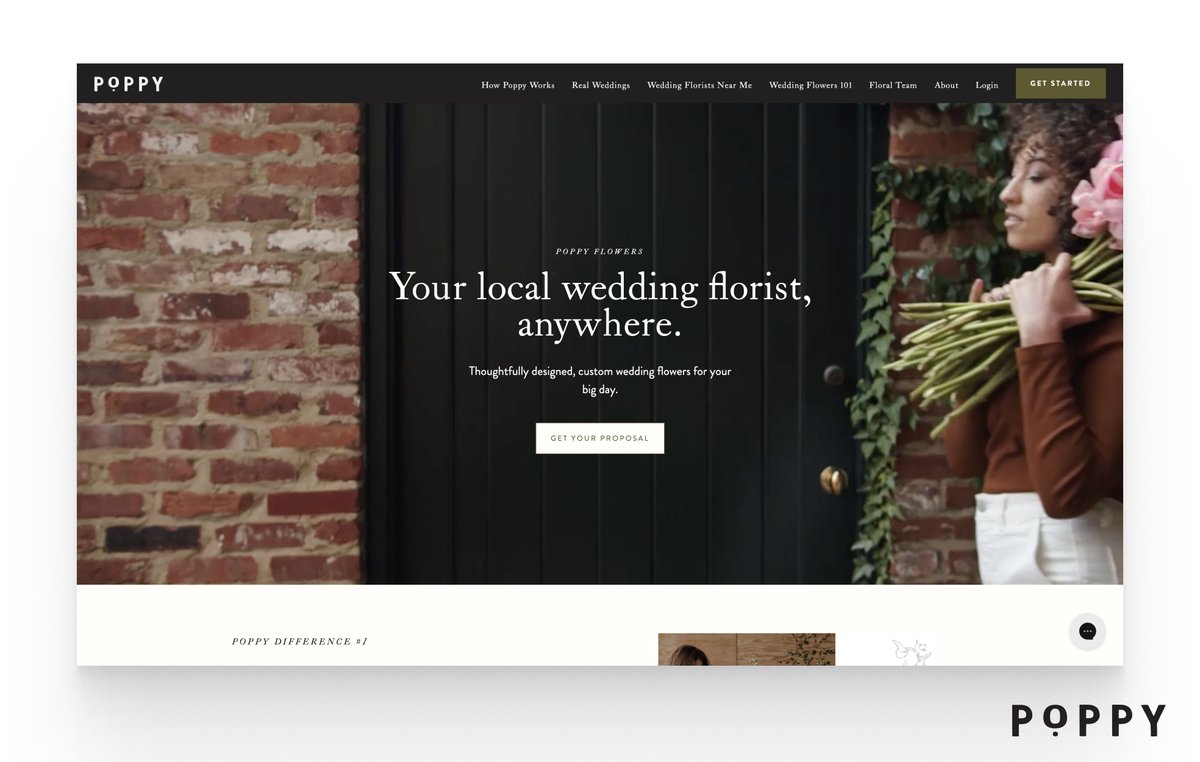
Poppy Flowers is the US's largest and fastest-growing wedding florist. Founded by a former White House florist. 800+ floral designers across the country.
When they came to us, they needed something specific: a site that could scale to dozens of local markets, each with unique testimonials, venues, pricing, and service areas.
We built 70+ location landing pages. Each one with unique content. 3,000+ venue pins on a custom Mapbox integration. Every page tailored to that specific market for local SEO.
This isn't a template duplicated 70 times. Each page has localized testimonials, market-specific pricing, and unique venue data. The CMS architecture lets their team add new locations without us.
We've been partnering with them since 2021. As they expand to new markets, we build new location pages. The system scales with them.
Here's the thing about multi-location businesses that most agencies miss. It's not about the homepage. It's about the 70 pages that actually drive organic traffic. The "wedding florist in Austin" page. The "wedding flowers Denver" page. That's where the conversions happen.
The homepage matters. But the local pages do the revenue work.
If you run a multi-location business and your local SEO strategy is a single "Locations" page with an embedded Google Map, there's a better way.
DM me if you want to have a similar robust system as Poppy's system.
A cybersecurity company with an insecure website. Sounds like a joke but it's not.
I've audited sites of companies that literally sell security products and found SSL warnings, outdated CMS versions, plugins with known vulnerabilities, and contact forms that aren't encrypted.
The irony is almost poetic. Your product protects Fortune 500 data but your website runs on a stack that hasn't been patched in 4 months.
But here's the thing that actually matters. Your buyer is a CISO or a VP of IT or a security engineer. These people notice. They look at your source code for fun and they check your headers.
If your website can't demonstrate the standard you're selling, the pitch starts from behind.
It's like a dentist with bad teeth. You can explain it away but the impression is already formed.
And in security, trust is the whole product. If the website doesn't feel secure then nothing after that is easy.
The companies in this space that get it right — clean, fast, modern, no unnecessary scripts — have a quiet advantage before the first sales call even happens.
Your website is your first security audit and your prospects are running it whether you know it or not.
I studied automobile engineering, not marketing, not design, not computer science.
Most people think that's unrelated to running a web agency. I think it's the reason we work differently.
Engineering teaches you one thing above everything else: does this work when someone who didn't build it needs to use it? That's a car, that's a bridge, and honestly that's a website too.
Every component library we build and every CMS structure we set up, it all comes back to that question. Will this still work when we're not in the room?
I see a lot of agencies that build for the handoff, the screenshot, the case study moment. It looks perfect on launch day.
But 6 months later the client's team can't figure out how to add a new section, or the blog template breaks when someone adds a longer title, or the mobile layout shifts because someone changed a padding value.
That's not a design failure. It's an engineering failure. The system wasn't built to handle real-world use by real, non-technical people.
Build it right. Build it to last. Build it so someone else can run it when you're done.
That's the engineering mindset and it applies to websites just as much as it applies to cars.
If you're evaluating agencies and want to understand how we think about long-term usability, happy to chat. DM me.