@marketplunger1 There's probably a point where potential investors read too much.
It's not because knowledge is bad, but it's because excecution is more important, and people think that if they just read the 47th book on investing or whatever, that will get them over the line.
@Moontolet@CFosilva Silvia has no strategy. She simply answers your questions. Everyone's situation, goals, and portfolio is different, so Silvia's answers are different too.
AI models predict you can turn $100,000 into $600,000 over the next decade by simply allocating to indexes and bitcoin.
Here is the logic 👇🏼
Everyone knows bonds are essentially guaranteed to lose value over the long run, so what would a portfolio look like if you replaced the 40% of bonds in a 60/40 portfolio and put bitcoin instead?
That is what I asked @cfosilvia to analyze.
My exact prompt was "What is the likely return for a portfolio made up of 30% SPY, 30% QQQ, and 40% bitcoin over the next 10 years?"
Silvia, which uses state-of-the-art AI models to answer questions like this, gave three potential outcomes:
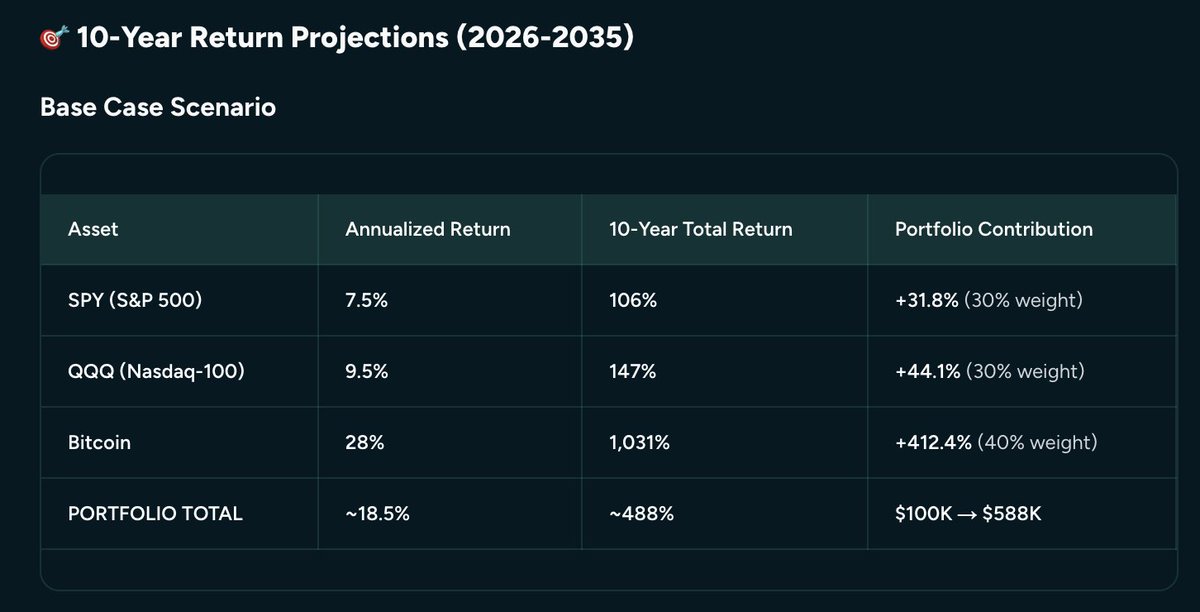
1. Base case: $100k -> $588k
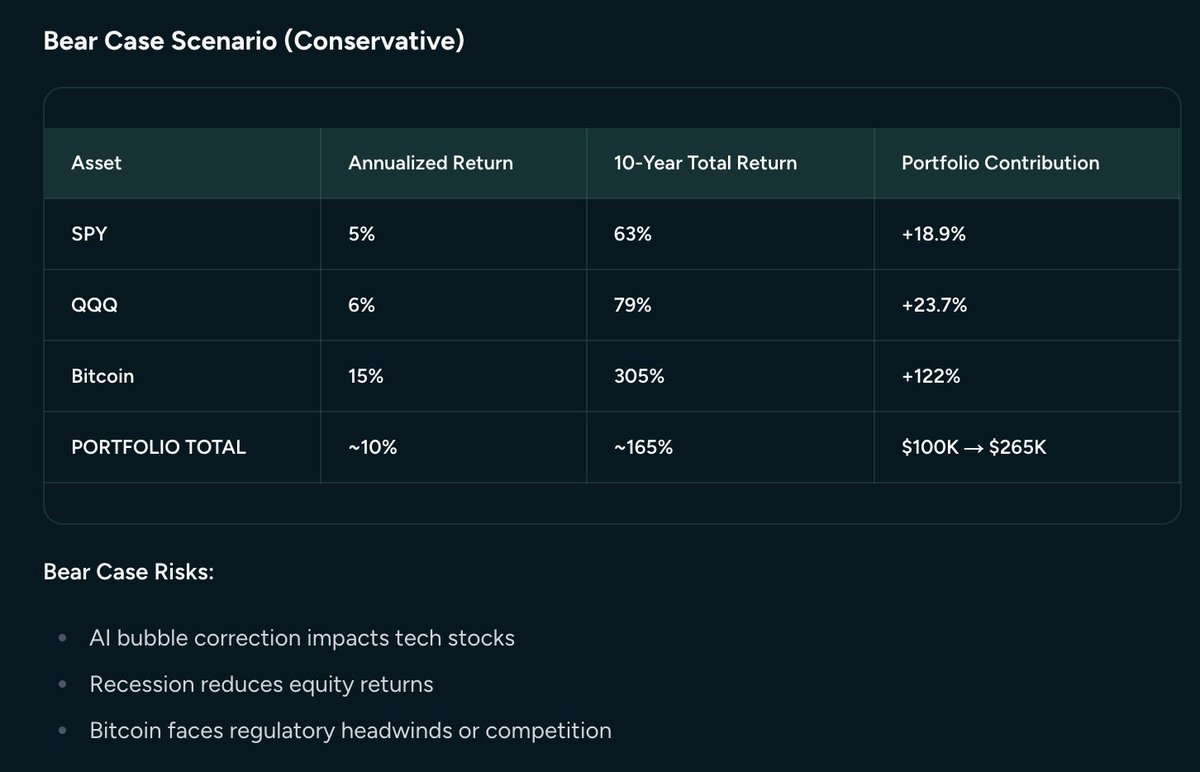
2. Bear case: $100k -> $265k
3. Bull case: $100k -> $942k
This is crazy because Silvia essentially is saying the worst case scenario for a 30/30/40 portfolio would be a 165% return over the next decade.
Silvia also did a Monte Carlo simulation to provide another answer. The median return was $100k would turn into ~ $600k for a CAGR of 17-19% for the next decade.
Not too bad, right?
This analysis took less than 60 seconds to do using Silvia. The product is by far the most valuable technology tool I use daily for personal finance.
You can sign up for free here: cfosilvia.com
The older I get, the more I realize that most of life’s breakthroughs don’t happen in big moments…they happen in silence.
In the early mornings when nobody’s watching. In the conversations you don’t want to have. In the decisions you make when nobody will ever know the diff.
@lukebelmar I appreciate your transparency and openness in a world that is so closed off. Congrats on all your success and for finding such a strong purpose!
@beaniemaxi Exactly. And it’s not just tokenomics. Its “leadership”. Most of these teams have no idea how to run an actual company or put the right people in the right seats. You can see the collapse years before it happens. You can be right every time. And stil nobody cares.
I’m not gonna post about crypto anymore outside of the major assets. It’s so obvious to me when tokenomics simply make no mathematical sense and I know it will collapse. And I can be repeatedly right for years calling this stuff out. But at the end of the day nobody really cares.
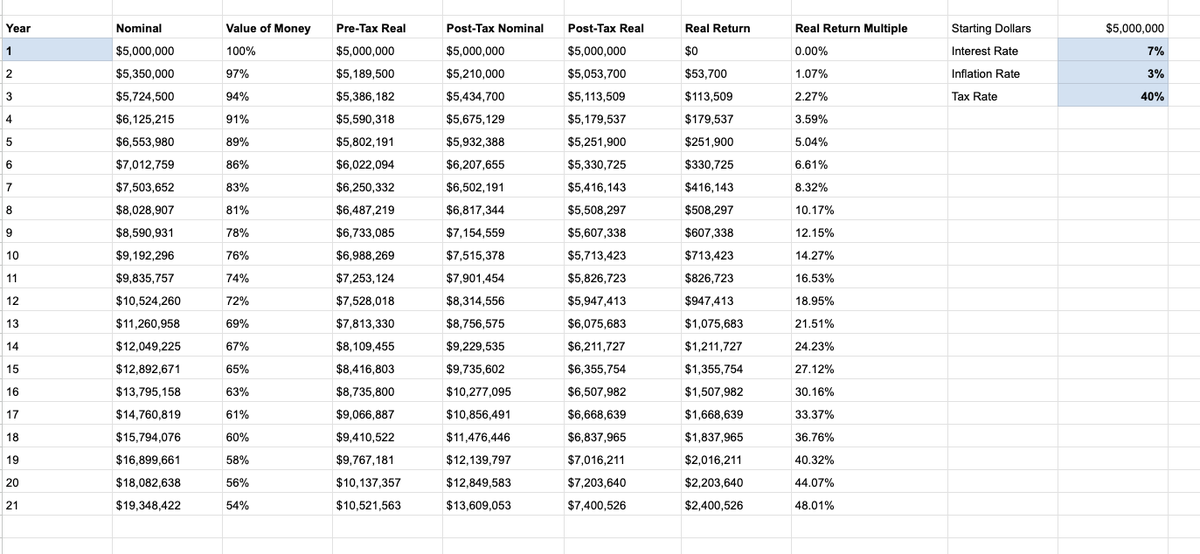
You mathmatically can't compound your way to wealth anymore... 20 years, 7% returns, 3% inflation, 40% taxes -- best case you 1.5x your investment. That is why the kids YOLO it... plain and simple.
@cjtrapp@piovincenzo_ Yes. I’ve cycled through SS and 531 and have 20 years experience in the field. If he’s doing 5 reps, slow it down. Valsalva is the way to roll.
From Grok:
Breathing and re-bracing at the top (standing fully upright) is actually the preferred and most evidence-supported method for almost everyone doing multiple-rep conventional deadlifts.
In fact, when researchers and high-level coaches looked at what actually works best in real sets of 5–20 reps, resetting the brace at the top is superior to trying to inhale and re-brace while bent over at the bottom. Here’s why the “breathe at the top” approach wins on every practical and scientific measure:
1. You can create much higher, more reliable intra-abdominal pressure at the top
• When you’re fully upright, your diaphragm and abs are in their strongest, most lengthened position. You can take a true 360° belly breath and brace far harder than when you’re folded in half over the bar.
• Multiple studies (e.g., Hagins et al., 2004; McGill et al., 2015) using needle electrodes and ultrasound show that peak intra-abdominal pressure is 20–40 % higher when bracing from a standing position vs. a hinged/bent-over position.
2. The bottom position is mechanically terrible for re-bracing
• When you’re bent over the bar, the ribcage is compressed, the diaphragm is shortened, and the abs are already stretched and weakened. Trying to inhale forcefully here collapses the brace you just had.
• Real-world EMG and pressure data (Blazek et al., 2020; Tayashiki et al., 2020) show that people who try to “suck in a breath at the bottom” actually lose 25–50 % of their core stiffness for the next rep and frequently round their low back on the following pull.
3. Touch-and-go deadlifts with bottom breathing cause more low-back stress over a set
• A 2021 study from the University of Saskatchewan (Kawamoto et al.) compared touch-and-go (trying to breathe at the bottom) vs. reset-style deadlifts (full stop + re-brace at the top) in sets of 8. The touch-and-go group showed:
• 18–28 % higher peak lumbar shear forces by rep 6–8
• Progressive anterior pelvic tilt and lumbar flexion (i.e., butt wink / cat-back)
• Earlier form breakdown and fewer total reps before technical failure
4. What elite lifters and evidence-based coaches actually do in high-rep sets
• Powerlifting coaches (Starting Strength, Juggernaut, Barbell Medicine, etc.): “Reset every rep” or treat every 2–3 reps as a mini-single with a full exhale/inhale at the top.
• Strongman and CrossFit athletes doing 10–20-rep deadlifts almost universally exhale at the top, re-set hips, and re-brace while standing tall — even if the plates barely touch the ground.
• Watch any 10+ rep deadlift set from Brian Shaw, Hafthor, Eddie Hall, Larry Wheels, Russel Orhii, etc. — they all stand up, breathe, and re-brace.
Bottom line
The old “never breathe at the bottom” advice was a half-truth that got misapplied. The correct version is:
“Don’t try to take your next breath while you’re still hinged over the bar.”
@cjtrapp@piovincenzo_ Fair point. Let me clarify what I meant bc my wording was sloppy. We’re in agreement: for a proper dl you brace at the top where the spine is unloaded. What I was trying to tell him was to slow down, get his air, brace properly, then set up for each reps instead of racing.
@cjtrapp@piovincenzo_ Sorry Chris, but you’re wrong. You take a deep breath into your belly at the bottom. Complete the rep, then reset. Breathing into belly bracing your core and protects your spine. You shouldn’t never lift heavy loads breathless. He’s doing 5 reps, not 15.
@DigitalOptimyst@piovincenzo_ Nope. You only ever breath and brace from the TOP. Full tightness should be maintained in between. If you let go of your breath or your grip at the bottom, stop the lift and start over.
@farmerpiddy@MartyBent Totally get that. BTC is the safer long term vault today, no question. I wouldn’t rule out holding larger amounts in ZEC though especially at today’s prices. It just depends on what you value more. Base layer privacy or max decentralization. Different needs/different tools.
@DigitalOptimyst@MartyBent Yeah but that’s kind of the whole point right? Like, I’d never have $100k sitting in ZCASH but I would Bitcoin, for that reason. I think maybe it comes down to the “buyers” intention and what they are looking for. Privacy? Security? Those things just all play into it
The Zcash shilling is so transparently an astroturfing campaign for people sitting on underwater bags to manufacture exit liquidity.
Zcash has opt-in privacy.
There's a 20% dev tax.
It can't scale.
Bitcoin's layer 2 privacy is superior and can actually scale.
@farmerpiddy@MartyBent Bitcoin is absolutely more decentralized today. No debate there. Different maturity levels, different design goals. Not really apples to apples.