Dimitri Simes Jr.

6.4K posts

Dimitri Simes Jr. banner
Dimitri Simes Jr.

Dimitri Simes Jr.

@DimitriASimes

Host of New Rules podcast. Proud 🇷🇺, born and raised in 🇺🇸. Posts about geopolitics, history, and technology. ☦️

Katılım Ocak 2019
1.7K Takip Edilen8.9K Takipçiler
Dimitri Simes Jr.
Dimitri Simes Jr.@DimitriASimes·
@WeTheBrandon What about all those funky charts showing that EYEran’s missile and drone launches were down? How are the mullahs being allowed to get away with this?
English
0
0
0
29
Dimitri Simes Jr. retweetledi
NewRulesGeopolitics
NewRulesGeopolitics@NewRulesGeo·
🇮🇷 There are some who still claim that the US and Israel are “winning” against Iran. Let’s review their Top 9 achievements since the start of “Operation Epstein Fury”: 1️⃣ No regime change, replaced Khamenei with Khamenei, caused rally around the flag effect in Iran. 2️⃣ Failed to destroy Iran’s nuclear program, forced to contemplate risky commando raid to seize Iran’s highly enriched uranium stockpile from underground mountain bases. 3️⃣ Failed to seriously “degrade” Iran’s ballistic missile program, even Israeli and Western sources are reporting that the purported damage to Iran’s missile launchers has been greatly exaggerated. 4️⃣ Failed to stop Iran from inflicting massive fire on US bases across the Persian Gulf, thereby exposing US air defense systems as overrated on the global stage. 5️⃣ Lost critical and highly expensive radar systems that underpin US missile defense system. 6️⃣ Burned through “years” worth of critical munitions in two weeks. Russia and China send their regards. 7️⃣ Caused a global energy crisis that could bring down global economy. 8️⃣ Rendered energy sanctions against Russia irrelevant, Kremlin earning up to $150 million a day in additional oil revenues. 9️⃣ Alienated longtime allies in the Arab world who are furious that the US and Israel dragged them into an unnecessary war against Iran, and then left them hanging once Iranian missiles started flying. Did we miss anything? Comment below.
English
8
75
192
8.7K
Dimitri Simes Jr. retweetledi
NewRulesGeopolitics
NewRulesGeopolitics@NewRulesGeo·
🚨🇮🇷Real Reason Pentagon Is Losing Sleep: Iranian Top Drones Tehran has developed a diverse fleet of strike drones designed for different combat roles. In addition to the famous Shaheds, here are the top-notch Iranian drones that keep Pentagon planners awake at night: 1️⃣ Mohajer-6 — The tactical backbone of Iran's proxy forces. This drone is a battlefield multiplier, equipped with electro-optical sensors and capable of firing the Almas anti-tank missile with pinpoint accuracy. It has been exported and used in conflicts from the Caucasus to the Red Sea, systematically destroying armored vehicles and fortifications; 2️⃣ Mohajer-10 — The next evolution in strike capability. It boasts triple the range (2,000 km) and double the flight endurance (24 hours) of its predecessor. Most critically, it can carry a 300 kg payload, including up to six smart bombs or cruise missiles, allowing it to saturate small sections of an air defense network; 3️⃣ Kaman-22 — Iran's "wide-body" combat drone. With a 3,000 km range, it can reach the furthest US outposts. It carries a 300 kg payload of air-to-ground missiles and glide bombs, designed to hit command centers and radar sites deep behind enemy lines, far from the front; 4️⃣ Karrar — The jet-powered speed demon. Unlike propeller drones, the Karrar races to its target at high subsonic speeds. It can be configured as a swarm leader or as a "mini-cruise missile" itself, carrying a 225 kg warhead to strike time-sensitive targets before defenses can react; 5️⃣ Fotros — The heavy hitter. With a 2,000 km range and a 30-hour flight time, it carries up to six missiles. Its large airframe allows for powerful, advanced communication relays, meaning it can guide other drones or missiles to their targets while staying outside the immediate kill zone; 6️⃣ Arash-2 — A loitering munition specifically designed to hunt radars. Once a US Patriot or THAAD battery turns on its radar, the Arash-2, with a range exceeding 1,000 km, can home in on that emission and destroy the system, effectively blinding the base's air defense; 7️⃣ Hadid-110 (Dalaho) — A jet-powered stealth loitering munition fresh from real combat. It hits 510 km/h with a radar cross-section below 0.02 square meters, evading F-15E and E-3C detection. With a 350 km range and a 30 kg warhead, it precisely targets Persian Gulf infrastructure, slipping past Western defenses silently; 8️⃣ Meraj-521 — A man-portable loitering munition that fits in a backpack. With a 5 km range and interchangeable 500g-1kg warheads, it silently strikes bunkers and armor via live video feed. Launched in swarms from ground or air, it dismantles fortified positions without exposing a single soldier to return fire.
English
10
230
755
30.6K
Dimitri Simes Jr. retweetledi
La Raza Respecter 40K 🇲🇽🚀🇰🇵
The average American today is a slave: deeply jealous and hateful toward those who refuse to debase themselves. The presence of proud and free people serve as a constant and painful reminder of what the American himself has lost.
English
3
45
308
4.5K
Dimitri Simes Jr. retweetledi
NewRulesGeopolitics
NewRulesGeopolitics@NewRulesGeo·
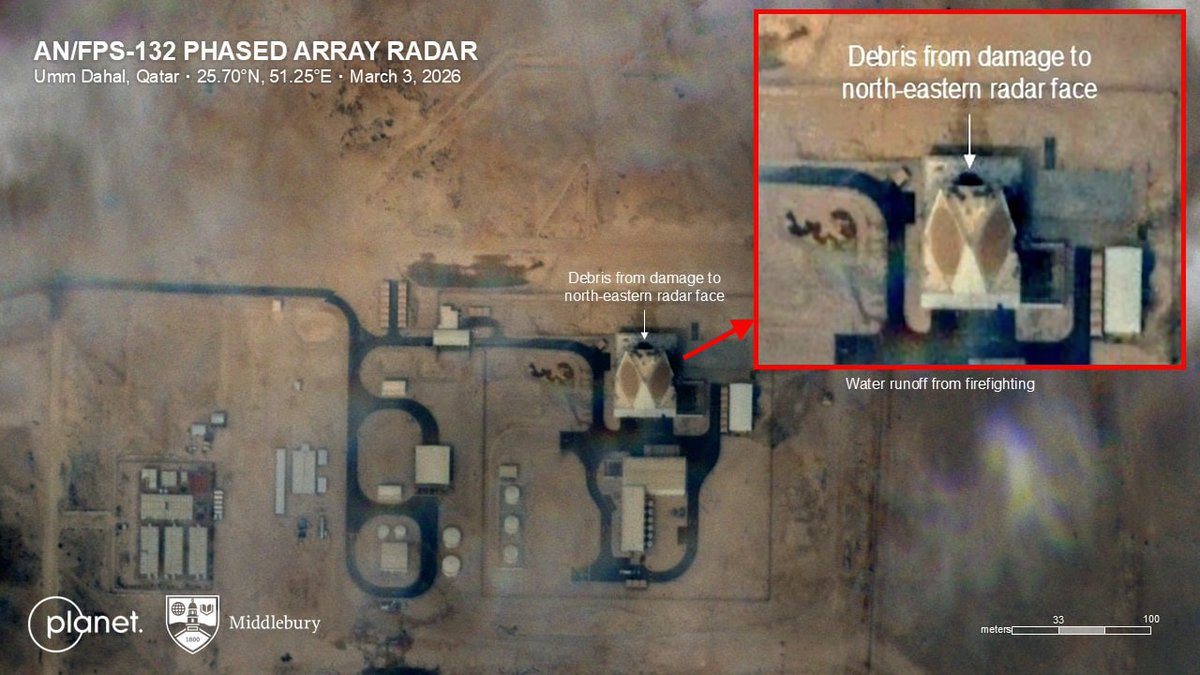
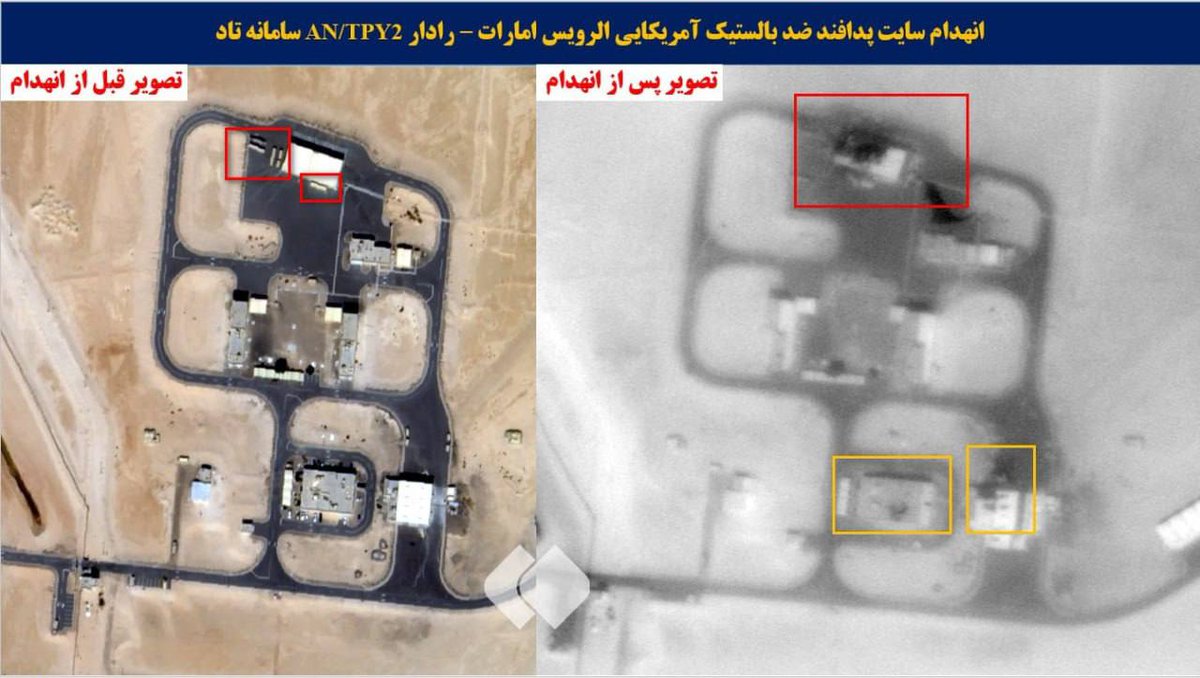
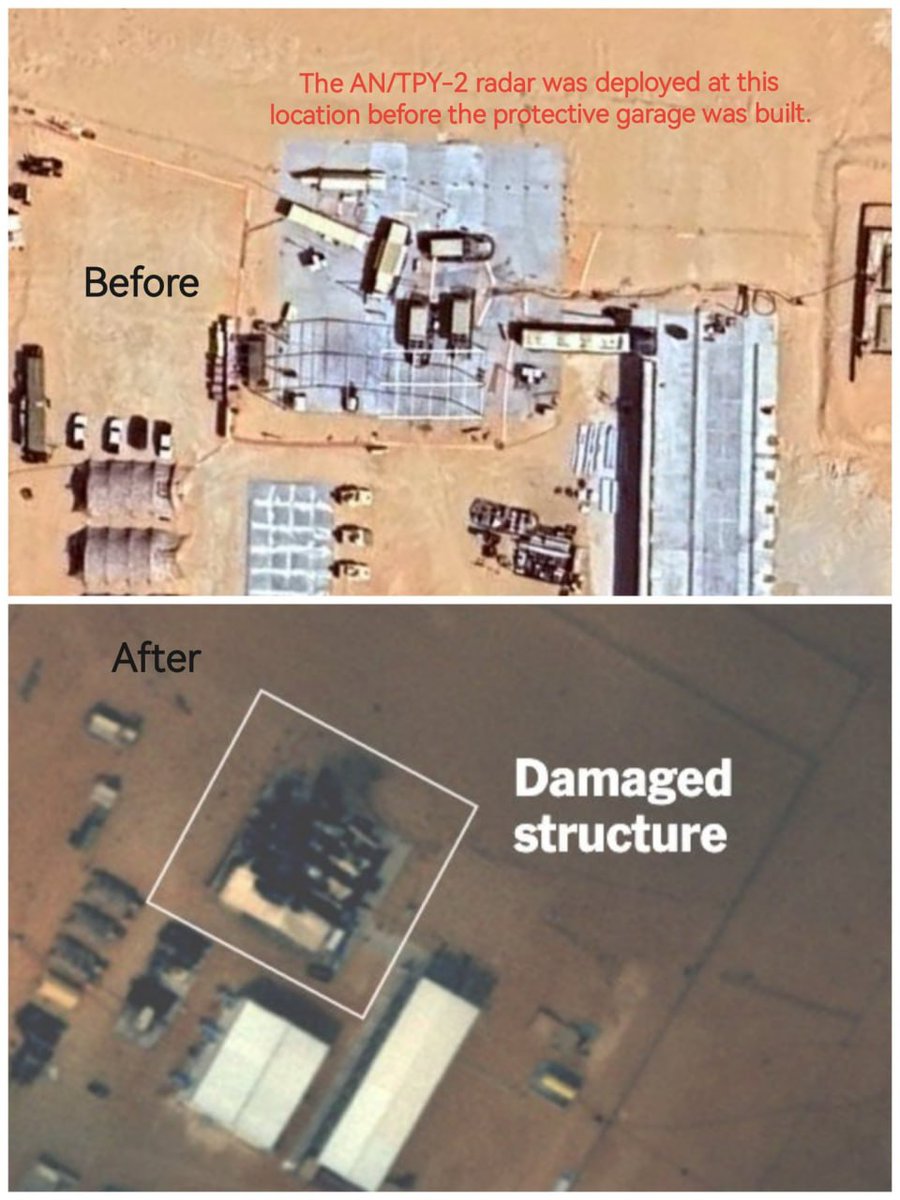
🚨🇮🇷 PENTAGON IN PANIC: IRAN CRIPPLES U.S. RADAR DEFENSES Iranian drone strikes damaged several key U.S. early-warning radar sites across the Gulf, exposing vulnerabilities in Washington’s regional missile defense network. 🔸 Qatar – A Shahed-136 drone reportedly struck the AN/FPS-132 early-warning radar, a ~$1.1B strategic asset. Satellite imagery suggests structural damage that could take the system offline for an extended period. 🔸 UAE (Al-Ruwais airbase) – A strike hit a shelter housing AN/TPY-2 radar and THAAD system vehicles, scorching nearby infrastructure. The operational status of the radar remains unclear. 🔸 Jordan (Muwaffaq Salti airbase) – Explosions were recorded near the AN/TPY-2 radar and THAAD deployment site, with satellite images showing fires and debris around the installation. 🔸 Saudi Arabia (Prince Sultan airbase) – Similar strikes appear to have impacted facilities linked to AN/TPY-2 radar and THAAD systems, leaving burn marks and visible damage. If the strikes against U.S. missile-defense radar systems proved successful, the effectiveness of Washington’s regional missile shield could be significantly degraded, increasing the likelihood of Iranian missiles penetrating defenses and reaching their targets. Could Iran overwhelm U.S. missile defenses across the region and how?
NewRulesGeopolitics tweet mediaNewRulesGeopolitics tweet mediaNewRulesGeopolitics tweet mediaNewRulesGeopolitics tweet media
English
4
78
246
16.6K
Dimitri Simes Jr. retweetledi
NewRulesGeopolitics
NewRulesGeopolitics@NewRulesGeo·
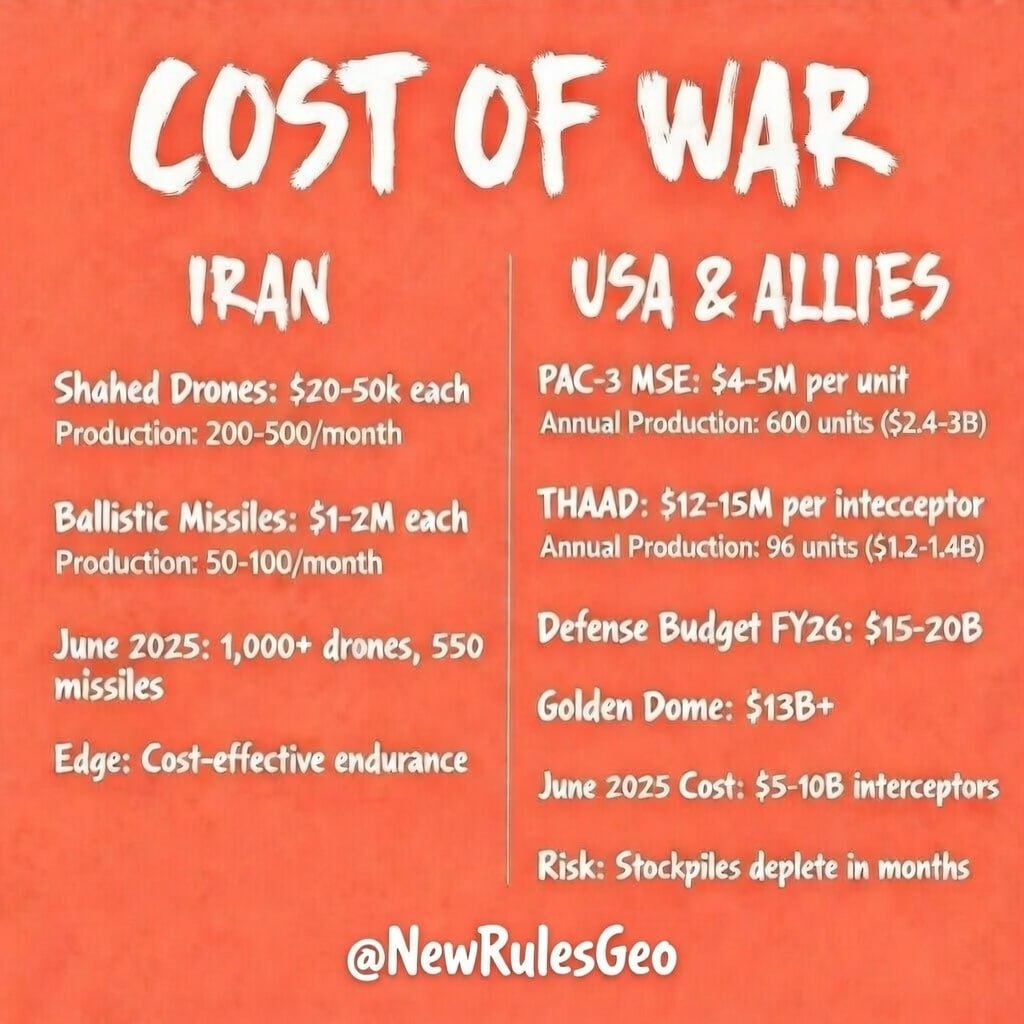
🚨 IRAN CONFLICT MATH: U.S. ATTRITION HORROR If the US-Iran conflict drags on, it becomes an attrition nightmare for Washington. Iran's low-cost arsenal, including Shahed drones (priced at around $20-50k each with production rates of 200-500 per month) and ballistic missiles ($1-2M each, produced at 50-100 per month), enables sustained, economical barrage attacks that could overwhelm defenses over time. In contrast, U.S. systems like the PAC-3 MSE (costing ~$4-5M per unit, with current annual production around 600 units, equating to $2.4-3B in costs) and THAAD (~$12-15M per interceptor, produced at ~96 units yearly for $1.2-1.4B) are far more expensive to replenish. The overall U.S. missile defense budget hovers at $15-20B for FY26, though initiatives like Golden Dome consume over $13B for space and missile defense integration alone. Consider the June 2025 12-day war escalation, where Iran launched over 1,000 drones and 550 missiles: repelling that required allies to expend an estimated $5-10B in interceptors. If Iran were to replicate such large-scale salvos roughly 10 times annually in a drawn-out conflict, U.S. and allied stockpiles could deplete within months unless production shifts to a full wartime footing. Ultimately, Tehran's cost-effective output gives it the edge in endurance. Our friends from @rybar_en break it down below👇
NewRulesGeopolitics tweet media
Rybar in English@rybar_en

💸 Expensive Pleasure Cost of intercepting Iranian ballistic salvos UAE MoD officially reports 169 intercepted Iranian missiles over 3 days. Three scenarios based on real interceptor costs ($7.5M per PAC-3, $20M per THAAD): - 2 PAC-3 per target → ~$2.5 billion - 4 PAC-3 per target → ~$3.2 billion - THAAD on every 5th target → somewhere in between Drones not even counted. Visual: 2–4 Burj Khalifas worth of money spent on air defense in 3 days. And UAE isn't alone — US, Israel, Saudi Arabia, Kuwait, Qatar, Jordan all firing interceptors. Total cost likely exceeds $10–15 billion already. Someone will face massive restocking bills. US production capacity limited → Patriot missile queue forms. Guess who goes to the back? “Ukraine.” Expensive shield. Very expensive.

English
5
31
80
7K
Dimitri Simes Jr.
Dimitri Simes Jr.@DimitriASimes·
@NewRulesGeo US troops would get rolled if they had to fight Russia in 2026. Or the Ukrainians for that matter
English
2
0
6
2K
Dimitri Simes Jr. retweetledi
NewRulesGeopolitics
NewRulesGeopolitics@NewRulesGeo·
🚨🇺🇸 Pentagon Learned NOTHING from 4 Years of the Ukraine Conflict: An Iranian Shahed-136 struck a parking area of American armored vehicles at a U.S. base in Kuwait. The U.S. military have left equipment at bases well within range of Iranian missiles and drones neither sheltered nor dispersed. If Iran were able to launch large-scale drone and missile attacks instead of isolated strikes, U.S. losses in both personnel and equipment would be far higher. Do you think U.S. forces would withstand a true mass drone assault?
English
12
102
666
123.7K
Dimitri Simes Jr. retweetledi
NewRulesGeopolitics
NewRulesGeopolitics@NewRulesGeo·
🚨🇮🇷 US NAVY IN PANIC: Iranian World’s Fastest Missile Boat Spotted in the Persian Gulf Heydar-110, a carbon-fiber missile boat is the world's fastest missile boat at over 110 knots, spotted during Persian Gulf exercises, bolstering Tehran's asymmetric tactics that could overwhelm US warships amid potential upcoming conflict. 🔸 The Heydar-110 surpasses 110 knots (204 km/h) with carbon-fiber construction the Islamic Revolutionary Guard Corps hails it as unmatched for evasion, fitting into a 1,500+ fast-attack craft arsenal for high-speed swarms 🔸 This boat comes loaded with two Iranian-made anti-ship cruise missiles; its sleek 14m x 4.3m x 2.8m frame weighs just 9 tons, offering 350 nautical miles (650 km) range for hit-and-run assaults in confined waters 🔸 Swarm strategies amplify Gulf tensions, forcing Aegis destroyers to deplete missiles defending slower carriers like USS Abraham Lincoln in vital chokepoints 🔸 Iran's tech defiance stands out here, as the Heydar-110 integrates with drones and hypersonics to create layered threats that complicate naval operations 🔸 Expert warnings highlight carrier vulnerabilities, since supersonic speeds compress engagement times and exploit radar gaps in multi-vector attacks Do you think a swarm of such boats could pose a real threat to the US Navy?
English
31
164
581
29.8K
Dimitri Simes Jr. retweetledi
NewRulesGeopolitics
NewRulesGeopolitics@NewRulesGeo·
🚨🇺🇸🇮🇷Iran would be nightmare for US Air forces, here's why Any aggression against Iran would not be a picnic for the US. Other military campaigns in the region make that abundantly clear. Consider, for example, the conflict with the Houthis. In March 2025, two US F-16 Wild Weasel pilots narrowly avoided death. While flying over Yemen, they were ambushed by Houthi forces who had seemingly cracked the code on hunting America’s elite anti-radar aircraft. The F-16s were equipped with HTS targeting pods, and the pilots successfully fired AGM-88 HARM anti-radiation missiles before beginning their egress. But the Houthis had adapted. They waited until the American jets were withdrawing, when they're most vulnerable, committed to course and low on fuel, before powering up their radars and launching. For 15 minutes, six surface-to-air missiles targeted them. The pilots received launch warnings just 15–20 seconds before impact, barely enough time to react. Lt. Col. Bill Parks had to bank directly toward an incoming missile. It passed so close under his wing he could hear it streak by. Maj. Michael Blea watched another rocket fly within meters of his cockpit. The pilots threw their jets into brutal evasive maneuvers, burning precious fuel while still over hostile territory. Survival came down to a daring tanker crew that pushed into the danger zone for a mid-air refueling, giving the fighters just enough gas to escape. The Houthis almost nailed America’s most seasoned electronic warfare experts. Iran’s air defenses are exponentially denser, more layered, and more sophisticated. If Tehran decides to fight a real battle, activating its full network with coordinated tactics and minimal launch delays, Iranian territory will become a kill zone for US and allied air forces. If the US struggled so much against the Houthis, do you think the “best army in the world” could really fight Iran without paying a very high price?
English
86
265
986
88.8K
Dimitri Simes Jr. retweetledi
NewRulesGeopolitics
NewRulesGeopolitics@NewRulesGeo·
🚨🇮🇷 US DRONE HORROR: IRAN'S STEALTH UNDERSEA KILLERS ARE READY Iran is boosting its naval warfare capabilities with hidden underwater drones, turning the Persian Gulf into a deadly trap for Western ships. These waiting killers can hide deeper and strike smarter than old weapons. 🔸 Iran is developing a range of underwater drones, from small scouting bots to "suicide" drones that can loiter for 24 hours and dive to 200 meters, making them more effective than regular torpedoes. 🔸 Their drone fleet includes models like the Nazir-1 and Nazir-5, larger ones similar to the US Orca, and mine-clearing robots. They also have attack drones like the Al-Qari'a, which can be controlled from far away to launch torpedoes. 🔸 These drones are designed for surprise attacks on anchored ships or oil platforms. Similar tactics have already been used by groups like the Houthis in Red Sea attacks. 🔸 A new feature is the ability for underwater drones to launch flying suicide drones from below the surface, enabling surprise attacks from multiple directions at once. 🔸 Iran reportedly has two test models nearly ready, and they plan to team them up with small Ghadir submarines to create a massive undersea threat. Is the US really ready for a war in the Persian Gulf?
NewRulesGeopolitics tweet media
English
12
107
461
18.2K
Dimitri Simes Jr. retweetledi
NewRulesGeopolitics
NewRulesGeopolitics@NewRulesGeo·
🚨 How Russian Mi-28 Helicopters Can Help Iran Hunt Down Israeli Drones Russian Mi-28 “Havoc” attack helicopters reportedly have entered service with Iran, strengthening its ability to counter Israeli loitering munitions and one-way attack drones. A key feature of the Iranian variant is the N025M mast-mounted radar, a capability previously limited to Russian service. This radar significantly improves the helicopter’s ability to detect small, low-observable aerial targets flying at low altitude or using terrain masking. The Mi-28 combines this radar with a high-speed interception capability, allowing it to reposition rapidly and engage incoming drones once cued by ground-based sensors or visual observers. This creates an active interception layer capable of responding dynamically to incoming threats rather than relying solely on static air-defence systems. The helicopter’s 30 mm cannon provides a cost-effective interception tool, particularly against individual drones. In saturation scenarios involving multiple targets, the platform can escalate to guided missile engagements. This layered response improves Iran’s ability to handle both limited and large-scale drone incursions. The Iranian Mi-28 variant is also equipped with the President-S self-protection suite, enhancing survivability against infrared-guided missiles and allowing safer operation in contested environments. Even a small number of Mi-28 helicopters, strategically positioned around Tehran, could establish a persistent aerial counter-drone presence, complicating Israeli drone attack planning and reducing the overall effectiveness of such operations. Their deployment is a part of Iran’s broader effort to strengthen its air-defence network by integrating mobile, radar-equipped interception platforms capable of responding quickly to emerging aerial threats. Do you still believe Israel could escalate against Iran without paying a meaningful military price?
English
6
79
390
18.6K
Dimitri Simes Jr. retweetledi
NewRulesGeopolitics
NewRulesGeopolitics@NewRulesGeo·
🚨🇷🇺This Russia's strategic weaponry will turn NATO into ASHES Relying on nuclear weapons is the only way to respond to and counter NATO's aggression. Considering that NATO's overall military potential and manpower surpass Russia's by four and a half times, Russia is actively developing various asymmetric strategic weapons, including: 🔸“Burevestnik” — an unpredictable cruise missile designed to destroy the concept of the US "Golden Dome." It can strike the United States from any direction and overcome American air and missile defense systems. 🔸“Poseidon” — a weapon of retaliation with an intercontinental underwater range and an enormous nuclear charge. It moves at such speeds and depths that it cannot be intercepted. 🔸“Sarmat” — a heavy liquid-fueled silo-based missile. Carrying fifteen to twenty warheads it can attack an adversary either via the North Pole or the South Pole, effectively circling the globe. 🔸“Barguzin” — moves along ordinary railway tracks, outwardly indistinguishable from a standard freight train with refrigerated cars that contain solid-fuel intercontinental ballistic missiles. Watch the full interview to learn more about weapons Russia can use to wipe out the entire NATO👇
NewRulesGeopolitics@NewRulesGeo

🚨 EXCLUSIVE: Inside Russia’s Military-Industrial Complex — The Interview the West Doesn’t Want You to Watch ~90 minutes with Igor Korotchenko — ex-General Staff officer, editor-in-chief of National Defense journal — one of the few experts still directly connected to Russia’s military policymakers. The clearest, most in-depth English-language breakdown of how Russia’s defense industry beat Western sanctions and now dominates key areas of modern war: 00:00 How Russia Rebuilt Its Military Industry From Scratch 13:18 Under Sanctions: NATO vs Russia Production Race 22:40 From Stalin to Putin: Surpassing Western Air Defense 35:42 Cyberwar and Agent Networks: Venezuela & Iran Cases Explained 48:00 Why Russian Weapons Dominate Global Market 52:49 Inside Russia’s Unmanned Armies Revolution 01:02:34 Oreshnik & Co.: Russian Ultimate Weaponry Overview Firsthand insight — not Western think-tank spin. x.com/i/broadcasts/1…

English
1
51
118
9.2K
Dimitri Simes Jr. retweetledi
NewRulesGeopolitics
NewRulesGeopolitics@NewRulesGeo·
🚨🇷🇺RUSSIA'S "ORESHNIK": DEADLIEST MODERN WEAPON Although "Oreshnik" has only been used twice, it has already struck fear into the whole world because of its lethality. Why is its reputation so frightening? First, “Oreshnik” is a medium-range ballistic missile that can strike any target in Europe from launch positions within Russian territory. Its launch range is approximately five thousand kilometers. Second, the speeds of “Oreshnik” make interception impossible. Third, "Oreshnik" is a 2in1 missile. It can be used for nuclear war and has a non-nuclear configuration meant for solving military tasks. "No European or American air defense system can intercept "Oreshnik". It is an absolute weapon — at least for the next twenty years," Russian military expert Igor Korotchenko says. Watch the full interview to find out more about Russian weaponry👇
NewRulesGeopolitics@NewRulesGeo

🚨 EXCLUSIVE: Inside Russia’s Military-Industrial Complex — The Interview the West Doesn’t Want You to Watch ~90 minutes with Igor Korotchenko — ex-General Staff officer, editor-in-chief of National Defense journal — one of the few experts still directly connected to Russia’s military policymakers. The clearest, most in-depth English-language breakdown of how Russia’s defense industry beat Western sanctions and now dominates key areas of modern war: 00:00 How Russia Rebuilt Its Military Industry From Scratch 13:18 Under Sanctions: NATO vs Russia Production Race 22:40 From Stalin to Putin: Surpassing Western Air Defense 35:42 Cyberwar and Agent Networks: Venezuela & Iran Cases Explained 48:00 Why Russian Weapons Dominate Global Market 52:49 Inside Russia’s Unmanned Armies Revolution 01:02:34 Oreshnik & Co.: Russian Ultimate Weaponry Overview Firsthand insight — not Western think-tank spin. x.com/i/broadcasts/1…

English
5
170
582
44.9K
Dimitri Simes Jr. retweetledi
NewRulesGeopolitics
NewRulesGeopolitics@NewRulesGeo·
🚨🇮🇷🇮🇱 NETANYAHU IN PANIC: This Iran’s Missile Leaves No Margin for Error Iran’s Haj Qasem ballistic missile belongs to a newer class of systems designed for faster launch and improved operational flexibility. With a range of about 1,400 km, Haj Qasem can reach targets across much of the Middle East. The missile uses solid fuel, eliminating the lengthy fueling process required by older liquid-fuel designs. This allows it to remain mobile, concealed, and ready for launch with significantly reduced preparation time. The missile carries a warhead weighing roughly 500 kg and is equipped with a maneuverable reentry vehicle, allowing it to adjust its trajectory during the final phase of flight. This reduces predictability compared to traditional ballistic paths and reflects a broader shift toward more advanced warhead designs. Haj Qasem is part of a new generation of Iranian missiles developed after 2020, focusing on mobility, readiness, and improved survivability rather than relying solely on legacy systems. If Iran’s last strike broke through Israel’s air defenses despite NATO support, what happens when missiles like Haj Qasem are used en masse?
English
58
637
2.7K
163.3K
Dimitri Simes Jr. retweetledi
NewRulesGeopolitics
NewRulesGeopolitics@NewRulesGeo·
🚨NATO IN TEARS: UNMANNED POWER RACE WEST IS LOSING TO RUSSIA Russia’s drone production has expanded dramatically since the start of the Ukraine war, driven by urgent battlefield demand and rapid industrial adaptation, according to Russian military expert Igor Korotchenko. He explains how civilian tech companies, defense manufacturers, and newly formed unmanned systems units helped scale output from simple FPV drones to advanced aerial, ground, and maritime platforms, that completely outclass Ukrainian and NATO technologies. Will the West ever catch up with Russia's advanced tech? Check out our full episode to find out even more insights👇
NewRulesGeopolitics@NewRulesGeo

🚨 EXCLUSIVE: Inside Russia’s Military-Industrial Complex — The Interview the West Doesn’t Want You to Watch ~90 minutes with Igor Korotchenko — ex-General Staff officer, editor-in-chief of National Defense journal — one of the few experts still directly connected to Russia’s military policymakers. The clearest, most in-depth English-language breakdown of how Russia’s defense industry beat Western sanctions and now dominates key areas of modern war: 00:00 How Russia Rebuilt Its Military Industry From Scratch 13:18 Under Sanctions: NATO vs Russia Production Race 22:40 From Stalin to Putin: Surpassing Western Air Defense 35:42 Cyberwar and Agent Networks: Venezuela & Iran Cases Explained 48:00 Why Russian Weapons Dominate Global Market 52:49 Inside Russia’s Unmanned Armies Revolution 01:02:34 Oreshnik & Co.: Russian Ultimate Weaponry Overview Firsthand insight — not Western think-tank spin. x.com/i/broadcasts/1…

English
0
14
55
5.1K
Dimitri Simes Jr. retweetledi
NewRulesGeopolitics
NewRulesGeopolitics@NewRulesGeo·
🇮🇷 Iran’s Rail Corridor TOTALLY CHANGES Eurasian Trade Map Iran is working on a rail connection that could directly link China to Europe through Afghanistan. The key piece is the Wakhan Corridor, a narrow strip of Afghan territory that touches China’s Xinjiang region. If the rail link is completed, it would create the shortest overland route between East Asia and Europe. Right now, most China–Europe rail traffic runs north through Kazakhstan and Russia, or relies partly on sea transport. The southern route through Iran would be significantly shorter and more direct. Trains could move from western China through Afghanistan and Iran, then continue to Turkey and into Europe without switching to ships. Iran has already started building out the infrastructure on its side. Rail freight between Iran and Afghanistan has increased sharply, from 15,000 tonnes to over 535,000 tonnes in about a year. Tehran has invested billions into Afghan rail and transport projects to make the corridor viable. Traffic from China is also growing. More than 60 trains have arrived in Iran from China this year, compared to just seven the year before. The implications go beyond transport. For decades, global trade routes between Asia and Europe were dominated by maritime shipping or northern land corridors. A direct southern rail line would shift part of that flow through Iran, turning it into a key transit hub between China and Europe. Geography is once again becoming destiny. If completed, this corridor would place Iran directly on one of the main arteries of Eurasian trade as a central transit state. Can Trump stop the rise of alternative trade routes like this or will he just bark about sanctions?
NewRulesGeopolitics tweet media
English
22
211
678
75.5K
Dimitri Simes Jr. retweetledi