Dr Matt Hart

309 posts

Dr Matt Hart

Dr Matt Hart

@DocMattHart

Paediatric Anaesthetist. Regionalist and TIVA diva.

Sydney, New South Wales Katılım Temmuz 2015
82 Takip Edilen109 Takipçiler
Dr Matt Hart
Dr Matt Hart@DocMattHart·
@propofoldream @MichiIntrona We have one going through ethics at the moment. Main limitation for generalisability will be it's only designed to investigate this in adolescents, so a similar one in adult land would be most helpful...
English
1
0
2
50
George Zhong
George Zhong@propofoldream·
@MichiIntrona So we desperately need a clinical study designed to find: (1) Time to LOC (2) Time to onset of NMB (3) Range/variance of (1) and (2) For pump vs manual bolus For a clinically useful range of pts
English
2
1
2
113
Michele Introna
Michele Introna@MichiIntrona·
We are, of course, fully aware that this is a technical paper, and that clinical data will eventually be needed(like LOC, BIS, so on). However, we deliberately chose TTPE and Ce/Cp as endpoints because they allow a fair, model-based comparison between the two techniques. In parallel, we are already working on additional analyses that are more explicitly clinical, which will be presented separately. The infusion rate is certainly open to discussion. To be honest, a 3-second bolus appears quite extreme, and the literature provides no clear guidance on what should be considered an appropriate or realistic administration speed. Our intent was simply to explore a range of conditions, including such an upper-limit scenario. What our results clearly show is that the difference in the rise of Ce between the two techniques is far smaller than one might intuitively expect. This, in itself, is an important point that addresses a common misconception. What is certain, however, is that boluses delivered at such high speeds mainly serve to rapidly saturate the central compartment, producing a marked haemodynamic impact, with all the associated consequences. @propofoldream @DocMattHart
Nicholas Chrimes@NicholasChrimes

A few things: Manual bolus is over 15secs. I reckon I’d typically deliver the initial bolus over ~3 secs. Time to peak effect is not what’s relevant, it’s time to sleep. Clinically this is not the case. TCI inductions (even for non-RSI) are much slower (too slow) inductions.

English
6
1
2
242
Dr Matt Hart
Dr Matt Hart@DocMattHart·
@MichiIntrona (Apologies for the broken reply, the character limitation is at times frustrating!)
English
0
0
2
29
Dr Matt Hart
Dr Matt Hart@DocMattHart·
@MichiIntrona Meaning the difference in TTPE of 20-30 for 2-2.5mg/kg boluses might be seen as unacceptable locally. Were a patient to aspirate prior to intubation, you would likely be criticised by a large number of colleagues and medicolegal system here if you used a "slower" technique.
English
0
1
2
58
Dr Matt Hart
Dr Matt Hart@DocMattHart·
@MichiIntrona In e.g. AUS/NZ/UK there is emphasis on rapid administration of induction agents. 3s might seem "extreme" from your perspective, but wouldn't be called that here. A quick straw poll of my department here suggests 15s is "slow"! Highlighting again cultural variation.
English
0
1
2
69
Dr Matt Hart
Dr Matt Hart@DocMattHart·
@MichiIntrona I actually think it's a good study. I think what is highlighted in this discussion though is how the lack of evidence for individual components of the RSI leads to a large variation in acceptable practice in different societal / geographic contexts. This affects practice.
English
0
1
2
53
Dr Matt Hart
Dr Matt Hart@DocMattHart·
@NicholasChrimes onlinelibrary.wiley.com/share/author/Q… The anecdotal speed difference is why we worked with our local pump manufacturer to add an RSI mode to our pumps, which allows clinicians to give a manual bolus, and the pump will then account for that in its PK modelling. Best of both worlds.
English
0
1
7
1K
Nicholas Chrimes
Nicholas Chrimes@NicholasChrimes·
A few things: Manual bolus is over 15secs. I reckon I’d typically deliver the initial bolus over ~3 secs. Time to peak effect is not what’s relevant, it’s time to sleep. Clinically this is not the case. TCI inductions (even for non-RSI) are much slower (too slow) inductions.
𝘈𝘯𝘢𝘦𝘴𝘵𝘩𝘦𝘴𝘪𝘢@Anaes_Journal

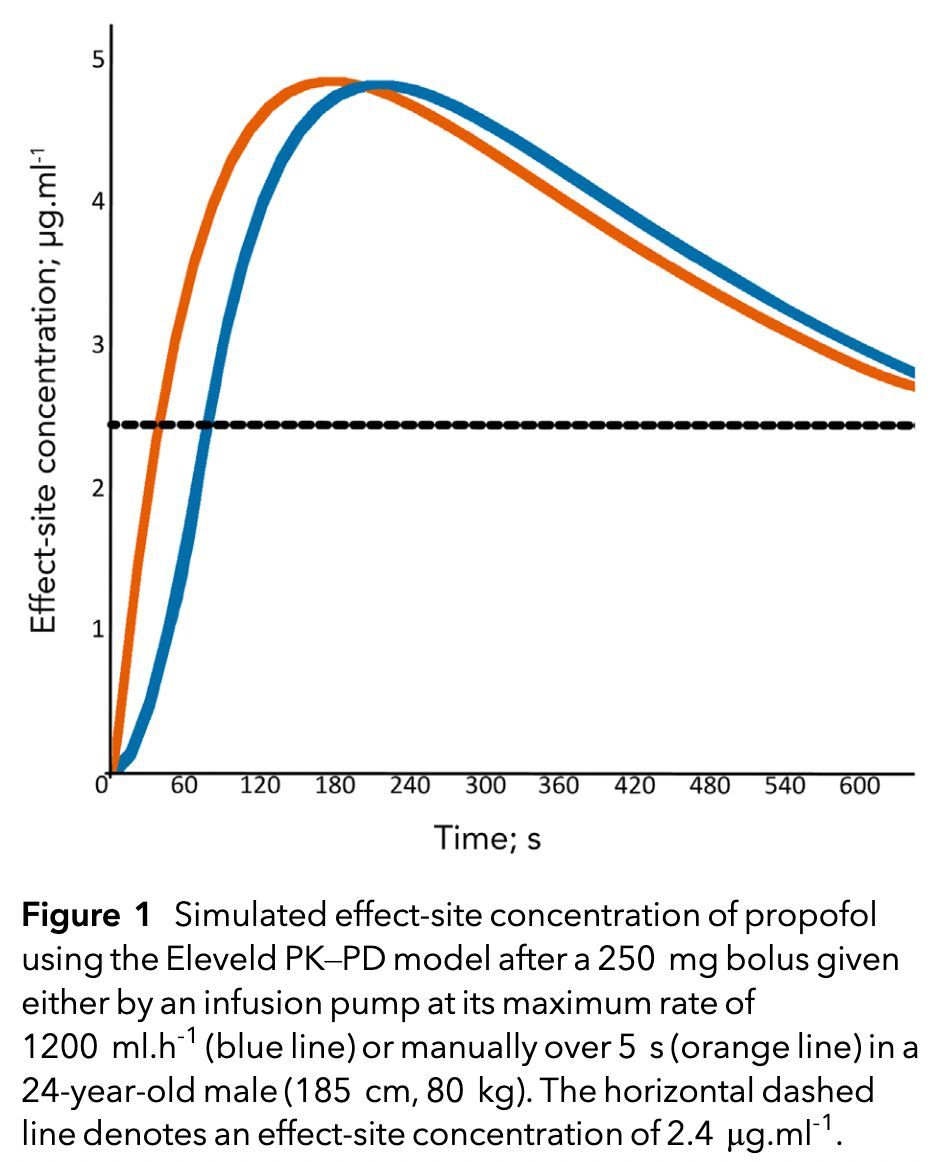
Target-controlled infusions have been criticised as too slow for RSI, due primarily to the maximum infusion rate of most pumps (~1200 ml/h). Effect-site concentrations at time-to-peak effect were nearly identical between target-controlled and manual infusions. #anaesthesia #MedTwitter doi.org/10.1111/anae.7…

English
8
5
24
7.8K
Dr Matt Hart
Dr Matt Hart@DocMattHart·
@NicholasChrimes Using time to peak effect (~200s) also makes the relative difference percentage they quote smaller. They say a 2.5mg/kg bolus is only 14% slower, based on 229s TTPE vs 200s TTPE for a bolus. 29s difference in time to LOC may be more problematic.
English
0
1
1
398
Dr Matt Hart
Dr Matt Hart@DocMattHart·
@NicholasChrimes @Anaes_Journal The Orihara study retrospectively analysed 5 years worth of anaesthetic records, so underestimating less likely. Other factors may be at play though, e.g. environmental exposure or sensitisation from high use. Either way I use it like roc: only if I have a good reason 😂.
English
1
0
0
25
Nicholas Chrimes
Nicholas Chrimes@NicholasChrimes·
In Australia & NZ you should only be using rocuronium if there’s a benefit to the patient from its rapid onset. That doesn’t necessarily require it to be RSI, could just be challenging FMV, short safe apnoea time, etc. If you just want to reverse w sugammadex, use vecuronium.
𝘈𝘯𝘢𝘦𝘴𝘵𝘩𝘦𝘴𝘪𝘢@Anaes_Journal

The chance of having an allergic reaction to a neuromuscular blocking drug is: • suxamethonium: ~1 in 1500 people • rocuronium: ~1 in 3300 people • atracurium: ~1 in 15,000 people Women were up to eight times more likely to have a reaction than men. #anaesthesia #MedTwitter #allergy doi.org/10.1111/anae.7…

English
6
15
41
11.8K
Dr Matt Hart
Dr Matt Hart@DocMattHart·
@NicholasChrimes @Anaes_Journal I suppose it's one of the problems of trying to make inferences from rare outcomes. Pharmacovigilance data like that from France risks underestimating, but aligns with similar studies from Korea and UK.
English
0
0
0
16
Sherlocked Verne
Sherlocked Verne@sherlockedverne·
@Anaes_Journal The simulated pumps such as iTIVA and simTIVA have this feature.... Can be easily incorporated in tci pumps .... A good start!
English
1
0
3
73
Dr Matt Hart
Dr Matt Hart@DocMattHart·
@mick_kerr @Anaes_Journal We were motivated to develop this precisely because as you say some people still think letting a pump deliver the initial bolus over a minute or more is fine.
English
1
0
1
44
michael kerr
michael kerr@mick_kerr·
@Anaes_Journal Set the induction duration to longer, bolus by hand, press go on the pump, done. People are too worried about the tci being inaccurate from the hand bolus that they forget it always was and end up doing stupid things like letting a pump "R"SI a full stomach at 1200ml/hr(20ml/min)
English
2
0
1
182
Dr Matt Hart
Dr Matt Hart@DocMattHart·
@mick_kerr @Anaes_Journal That's what this new mode does. You deliver the bolus by hand, and because you've told the pump what bolus amount was given it accounts for it in the TCI model. You get the "best of both worlds"; delivering a manual bolus but preserving the model.
English
0
0
0
51
Dr Matt Hart
Dr Matt Hart@DocMattHart·
@Andyrooz22 @Anaes_Journal That's what this mode lets clinicians do. You deliver a manual bolus that you feel is appropriate for the patient, as a rapid manual push, and the pump accounts for this because you've told it what manual bolus you gave.
English
0
0
0
32
Dr Matt Hart
Dr Matt Hart@DocMattHart·
@DrGeorgeHarvey @Anaes_Journal The orange line represents the simulation of what this new mode does (a clinician delivered bolus that the pump is aware of and incorporates in its modelling) vs what pumps do at present (20ml/min infusion speed).
English
0
0
1
38
Dr Matt Hart
Dr Matt Hart@DocMattHart·
@foi_requests @Anaes_Journal The orange line represents the simulation of what this new mode does (a clinician delivered bolus that the pump is aware of and incorporates in its modelling) vs what pumps do at present (20ml/min infusion speed).
English
0
0
1
38
Dr Matt Hart
Dr Matt Hart@DocMattHart·
@DrNickB_ObAnaes @Anaes_Journal It's available on all Arcomed pumps now I believe. Other manufacturers could likely also implement similar functions if they felt so inclined.
English
0
0
2
41
Dr Matt Hart
Dr Matt Hart@DocMattHart·
@DrNickB_ObAnaes @Anaes_Journal The slight difference here is that the anaesthetist themself delivers the bolus manually (not limited by pump infusion rates), but the TCI pump is aware of this bolus and incorporates it into the PK-PD modelling.
English
1
0
2
56
ObsAnaesthetist
ObsAnaesthetist@DrNickB_ObAnaes·
@Anaes_Journal This was possible with the older BBraun TCI pumps - you would set the target hit pause, hit bolus program how many mls bolus to give. The pump would deliver bolus & then calculate the value & start TCI accordingly The new Braun touch screen versions do not allow this!! Please fix
English
2
0
2
206
Dr Matt Hart
Dr Matt Hart@DocMattHart·
@johncampbell01 @Anaes_Journal The blue line simulates what TCI pumps currently do (bolus delivered at 20ml/min), whereas the orange line simulates this new mode; a clinician delivered rapid manual bolus which the pump knows about and incorporates into its modelling.
English
0
0
1
37