Don

3K posts

Don

Don

@Don_Bond007

Mumbai Katılım Ocak 2023
124 Takip Edilen118 Takipçiler
Don retweetledi
Vikas Vij
Vikas Vij@TheClubJunto·
US-China “G2 Risk”: India’s Wake-Up Call 1. Anti-China push & US urgency to hedge against Beijing helped in manufacturing FDI shift to India 2. FY27: CAD 2X, FII exits, IT risks, Net FDI down 85% from FY21 3. China+1 is not dead, but there is no time for complacency INSIGHTS: Rupee Stability Risks in FY27 a. India’s “Net” FDI (Inflows Minus Outflows) decline trends are as follows: FY21: $44B FY22: $39B FY23: $28B FY24: $11B FY25: $3.5B FY26: $6.7B b. In FY27, Current Account Deficit (CAD = Exports Minus Imports) will jump from $42B in FY26 to $90B (2X) in FY27 due to higher oil import bill. c. If Net FDI too goes negative in FY27, the Balance of Payments deficit will deepen further. (BoP is already negative in FY26). d. India’s two major forex earners are both under threat from AI as follows: FY26 IT Exports @ $149B FY26 GCC Exports @ $98B AI Threat: 5% Annual Deflation $12B forex hit per year Make Yourself Indispensable a. “China Plus One” strategy emerged globally because the US policymakers and US industry leaders decided it is too risky to depend only on China. b. The US companies mostly chose India to diversify their risk, and not because India offered any extraordinary advantage. c. India must ask itself: Why has the US suddenly adopted a conciliatory China approach after years of anti-China rhetoric? As economic conditions tighten, the American CEOs might be rediscovering China’s massive structural advantages as follows: 1. Industrial Clusters: End-to-end supply chain ecosystems 2. Infrastructure: Gold standard in ports, rail, power, export connectivity 3. Execution at Scale: Ability to deliver high volumes with precision at top speeds e. India must not forget: While “China Plus One” strategy is irreversible, China remains the world’s most complete manufacturing machine. One cannot assume that “China risks” alone will keep diverting FDI to India forever. f. In a dog-eat-dog world, nations survive by making themselves indispensable. India should ask itself: Is there even one thing where the world cannot do without India? g. The Indian government should meet top industry leaders and devise a plan (just like Korea dealt with its national champions decades ago with an iron hand.) India needs private capital for: Faster infrastructure execution Deeper industrial ecosystems Investments in logistics Investments in manufacturing scale Investments in long-term R&D and AI h. Global trade does not run on goodwill (like “Trump, my friend.”) It runs on self-interest. In a normalized environment, capital flows to the strongest, fastest, and most efficient ecosystem. ENDQUOTE “Money has no flag.” – Napoleon Bonaparte @arabicatrader
English

15
23
102
10.4K
Arvind Datta
Arvind Datta@datta_arvind·
@Vivek_Investor Let the leaders take the lead... Public will follow. Public follows the leaders.
English
1
0
7
520
Sharad Shah
Sharad Shah@arabicatrader·
Good morning Today is my 37th marriage anniversary
English
258
11
745
38.3K
Don
Don@Don_Bond007·
@datta_arvind Kya sir, kuch to samaj ke question karo
English
0
0
1
58
Arvind Datta
Arvind Datta@datta_arvind·
I have a question ❓ Why was this never followed previously?
ANI@ANI

#WATCH | Delhi: Prime Minister Narendra Modi has reduced his convoy size significantly. Reduction in vehicles was done while maintaining essential security components as per SPG protocol.

English
18
2
49
5.8K
Don
Don@Don_Bond007·
@DJKara7 We don't have that and that's why we are looking for AI
English
0
0
0
13
DJ Kara📉
DJ Kara📉@DJKara7·
India hasnt invested in AI as most problems of our country can be solved by common sense. We don't need AI yet.
English
5
3
28
2.1K
Don
Don@Don_Bond007·
@datta_arvind What Is good for 1 which is bad for 2 so......
English
0
0
0
28
Arvind Datta
Arvind Datta@datta_arvind·
What goes around, comes around and same thing hits you hard, some day. We call it Karma. So be good, do good.
English
1
2
26
1.3K
Don retweetledi
शिक्षित बेरोज़गार
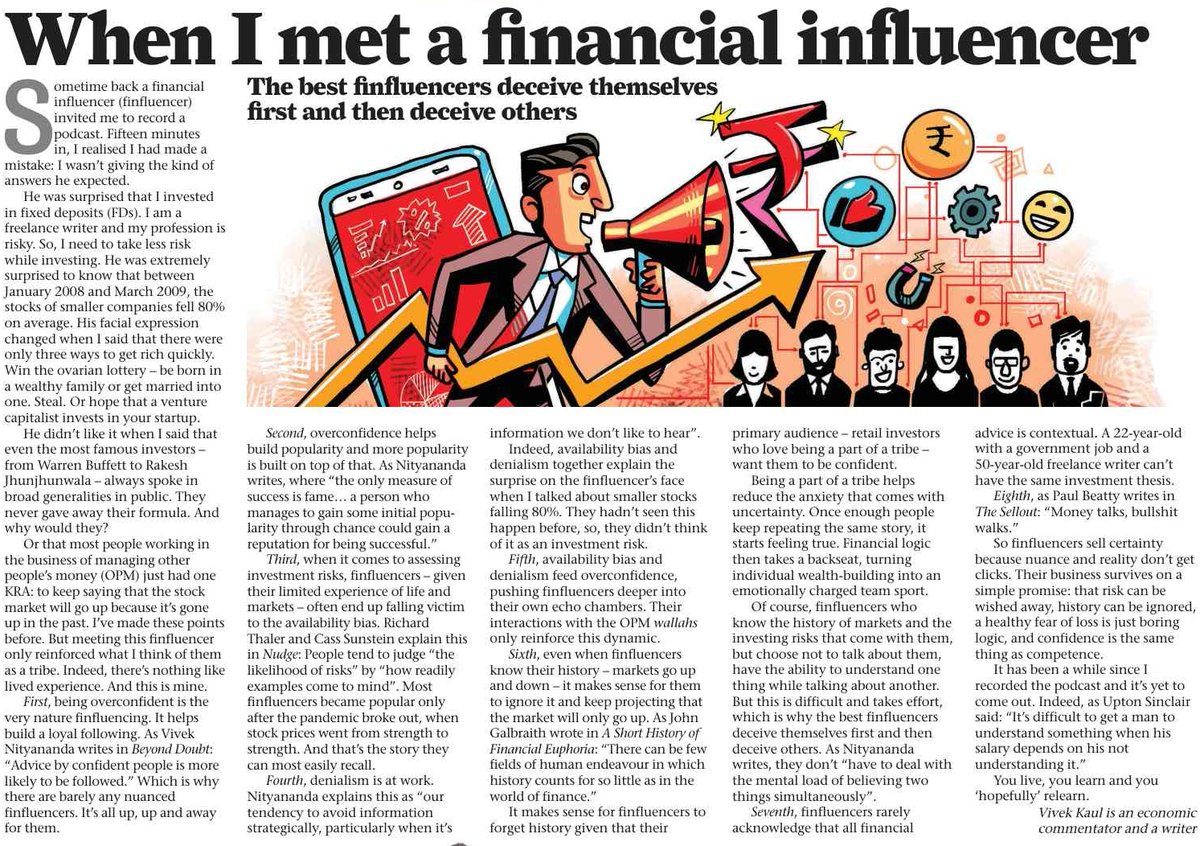
When I met a financial influencer My weekly Paisanomics column in the Mumbai Mirror. Something I had great fun writing. Do read and share. Sometime back I sat across a finfluencer to record a podcast. He was shocked I kept money in FDs. Shocked that smaller stocks fell 80% between 2008-09. He didn’t like it when I said that even the most famous investors – from Warren Buffett to Rakesh Jhunjhunwala – always spoke in broad generalities in public. They never gave away their formula. And why would they? The podcast still hasn't dropped. Funny, that. Or as Upton Sinclair once said: “It’s difficult to get a man to understand something when his salary depends on his not understanding it.” Here's what I've figured: finfluencers don't sell investing. They sell certainty. Being overconfident is the very nature finfluencing. It helps build a loyal following. As Vivek Nityananda writes in Beyond Doubt: “Advice by confident people is more likely to be followed.” Which is why there are barely any nuanced finfluencers. It’s all up, up and away for them. Knowing history is bad for their business. Most finfluencers became popular only after the pandemic broke out, when stock prices went from strength to strength. And that’s the story they can most easily recall and want to sell. And the best ones deceive themselves first – so they don't have to work as hard deceiving you. Confidence is not the same thing as competence. Never has been. Indeed, as Paul Beatty writes in The Sellout: “Money talks, bullshit walks.” mumbaimirror.indiatimes.com/opinion/when-i…
शिक्षित बेरोज़गार tweet media
English
8
32
139
9.9K
Don retweetledi
Vikas Vij
Vikas Vij@TheClubJunto·
Build a "Fortress" Balance Sheet for Your Household 1. India did not prepare for bad times during Goldilocks years 2. Risk: CAD +3% of GDP ➜ ₹ Falls ➜ $ Capital Exits ➜ Vicious Loop 3. Oil is India’s blood supply. If oil stays high, RBI has less $ left to fight. STRATEGY: India’s Vulnerability Loop a. In FY26, India’s “Petroleum, Crude & Products” import bill was $180 billion. Oil prices were moderate for several years, and India enjoyed a “Goldilocks” economy. Now suddenly the oil price cycle has changed. India’s import bill in FY27 is estimated at $250 billion (jump of 40% from $180B). b. This represents an additional annual burden of $70 billion ($250B - $180B). India’s Current Account Deficit (CAD = Imports Minus Exports) in FY26 was $42 billion. If you add $70 billion to it, the CAD for FY27 will be $112 billion. c. India’s GDP for FY27 is estimated at $4.2 trillion. CAD @ $42B was 1% of GDP. CAD @ $112B will be 2.63% of GDP. That creates a serious discomfort. d. If rupee weakens due to rising CAD, India’s oil import bill rises further (dollar becomes expensive). If CAD exceeds 3% of GDP, it is a redline risk for S&P and Moody’s to downgrade India’s credit ratings. Foreign investors don’t like that kind of risk. e. If RBI raises interest rates to attract foreign debt capital (to defend the rupee) and curb inflation, it hits the housing market and corporate debt, slowing down the economy. So, RBI has to choose which child to feed: GDP growth or the common man (who is hit by inflation). It may not be able to feed both. f. RBI has $690B forex reserves as of today. If rupee falls due to worsening CAD, then RBI has to use forex reserves to defend the rupee. If reserves deplete from current levels, plus CAD remains deeply negative for more than two quarters, it can trigger FDI and FII exits. That creates a vicious self-reinforcing cycle. Risk Modeling is Critical a. Risk Modeling is not fear-mongering. BlackRock manages $12 trillion for investors. Its risk engine Aladdin runs 5,000 risk scenarios per day. Jamie Dimon of JP Morgan sleeps every night asking this question: What happens if the world shuts tomorrow? Will my bank survive? b. An import-dependent nation must constantly ask: What happens if oil prices rise? What happens if foreign capital exits? What happens if even NRIs don’t subscribe to an emergency RBI bond issue? What happens if AI commoditizes IT services? You don’t assume best-case scenarios in a dog-eat-dog world. You prepare for worst-case scenarios. c. Oil-deficient China, Japan, Korea, Taiwan understood 40 years ago that either you remain dependent on others or you make others dependent on you. Those who export are masters, and those who import are slaves. It’s common sense. Your Personal Strategy a. Do your personal risk modeling. Don’t ask: Can this stock go up? Ask: Can this stock go down? Can the stock market give negative returns for the next 5 or 10 years? Can high inflation hit my basic needs? Can I lose my job? Do I have strong liquidity for a medical emergency, a child’s education, or to pay EMIs? b. Don’t bet your last shirt on the Indian stock market. Diversify sufficiently into gold, U.S. ETFs, and fixed deposits. If the worst happens and interest rates rise in India, stock investors will lose and FD owners will gain. c. If you are leveraged, start getting out now. If you have no cash, start building your 1-year emergency fund now. Fix the roof while sun is shining. Don’t wait for dark clouds to gather. Who knows, rainstorm might be just “one Nvidia earnings miss” away. @arabicatrader
English
17
46
203
17.3K
Don
Don@Don_Bond007·
@DJKara7 + Target+ quality oriented promotions for government officials else termination without pension.
English
0
0
0
22
Don retweetledi
Sharad Shah
Sharad Shah@arabicatrader·
ZXX
3
14
118
7.5K
Don
Don@Don_Bond007·
@DJKara7 We are developing country and need to pay 2,3k per month so paisa to lagega.....
English
0
0
0
46
DJ Kara📉
DJ Kara📉@DJKara7·
You are being robbed and you don't know it ! Indian transtion costs for trading are astronomically high compared to other markets. As an example : For a $1000 cash (delivery) buy + sell round-trip: **US** (zero-commission brokers like Robinhood/Fidelity): ~$0.02 total (mostly SEC fee on sell side; exchange fees negligible). **India** (Zerodha-style discount broker): ~₹225 or ~$2.40 total. Breakdown (at ~₹94.5/$): STT ₹189 (0.1% each side), stamp duty ₹14, txn charges ~₹6, DP ₹15 + tiny SEBI. Indians pay ~100x more in frictional costs. This daylight robbery. It seems the only purpose of the government is to tax people whenever and wherever they can .
English
26
50
220
12.6K
Don
Don@Don_Bond007·
@datta_arvind Depends how you want to spend not how you want to live
English
0
0
0
68
Arvind Datta
Arvind Datta@datta_arvind·
What's a good retirement fund number to target? I certainly believe having $1 million (~₹9 crores) in liquid assets (bonds, FDs, mutual funds, equities, PPF) is a good sum to plan for retirement.
English
55
5
190
47.5K
Don
Don@Don_Bond007·
@Beatnik_BaBa So what can be done, please elaborate with exact terms
English
0
0
0
2
Beatnik
Beatnik@Beatnik_BaBa·
Hipocrate government
NDTV India@ndtvindia

🔴 #BREAKING | 993 रुपये महंगा हुआ सिलेंडर, कॉमर्शियल गैस सिलेंडर के दामों में भारी इजाफा

English
1
0
2
219
Don
Don@Don_Bond007·
@TheClubJunto Sir, We are very good at stock market management so maze karo......
English
0
0
1
95
Don retweetledi
Vikas Vij
Vikas Vij@TheClubJunto·
India’s Supply Chain Dependence Rising a. 45% of India's critical mfg imports from China; trade deficit up 2.5X b. Indian oligarchs refuse to invest in industrial tech c. US/China: Strong govt push to firms for IP ownership; Indian Industry: Land, License, Lobbying INSIGHTS: Deepening China Dependence a. Imports from China doubled in last 5 yrs ($132B in FY26) . Exports to China declined in last 5 yrs ($19B in FY26). The trade is completely one-sided. b. India’s imports are not discretionary consumer goods, but core inputs for manufacturing. These include solar modules (65% of total imports), APIs (70%), EV batteries (85%), electronics (43%), machinery (40%), and organic chemicals (44%). c. Unless India builds domestic capacity for manufacturing value addition, the economy remains structurally vulnerable to disruption risks from an unreliable trade partner. Rise of Sovereign Moats Forward-looking countries are actively pursuing techno-nationalism to push private capital into “sovereign moats.” UNITED STATES a. By an Executive Order in Nov 2025, companies like Anthropic and OpenAI are now legally barred from hosting their primary model training outside U.S. soil. b. The US federal tax agency now requires companies to capitalize and amortize R&D expenses over 5 yrs (US) and 15 yrs (foreign), effectively making it tax-prohibitive to move R&D abroad. c. Work visa controls are pushing tech firms to hire expensive U.S. engineers. Auto companies have been forced to relocate factories from Mexico to the U.S. Midwest. CHINA a. Reliance cancelled plans to produce lithium-ion battery in India because China refused to license its technology. China has blocked Meta’s $2 billion acquisition of Chinese agentic AI startup Manus. b. China’s IP criminalization campaign 2025 has led to 31,000 “IP violation” criminal investigations – creating a deterrent for top Chinese talent against working for foreign employers. c. New regulations are designed to give market access to foreign tech firms only if they build R&D centers on Chinese soil with patents co-owned by the Chinese entity. KOREA & TAIWAN a. In Dec 2025, Korea launched a $110 billion R&D fund, requiring private companies to match govt investment in futuristic technologies. b. Korean government is leading a 20-year plan to create a next-generation semiconductor infra hub in Yongin, pushing private sector to commit investments of $470 billion. c. Korea has increased R&D tax credits up to 35% for SMEs. Taiwan Chip Act (2025) provides the largest R&D tax breaks in the nation’s history. INDIA a. Revolving Door Strategy: Retired high-ranking bureaucrats and ex-regulators are appointed to corporate boards, who have direct “telephone access” to policymakers. b. Regulatory Capture: Legislation drafting is generally outsourced to corporate law firms, which have top conglomerates as their clients. It bakes in industry-favourable language at the draft level itself. c. Policy Influence: Industry groups submit “recommendations” for sectoral policies (telecom, airports, energy, etc.) creating barriers for global competition. There is no threat of "Innovate or Die." Endquote: Crony Capitalism India’s story can be summed in just one quote: "Crony capitalism creates oligarchies that slow down growth. It replaces public interests with special interests. A natural question, then, is why do people tolerate it? Why do they vote for the politician who perpetuates it?" – Then RBI Governor, Dr. Raghuram Rajan, Lalit Doshi Memorial Lecture, Mumbai, Aug 11, 2014 @arabicatrader
English
9
46
136
9.8K
Don
Don@Don_Bond007·
@ankitatIIMA Sir, sirf voting rights bandh karva do , etna hi kafi hai, they will be treated as baggers
English
0
0
0
3
Don
Don@Don_Bond007·
@DJKara7 And people
English
1
0
0
11
Don
Don@Don_Bond007·
@datta_arvind It's all about how to make things breaking news , in India it's all about content
English
0
0
0
19
Astro Sharmistha
Astro Sharmistha@AstroSharmistha·
Very first opinion poll came on 15th Feb, where BJP got 90 seats in Bengal. Public made me mad by saying 'aapka prediction to geya". Then slowly in every 10days numbers kept on increasing for BJP. Today almost all the opinion polls declared BJP as the winning of Bengal election. What you cannot see, a good astrologer can see. Jai Shree Ram.
English
376
545
6.3K
330.2K
Neeraj Bajpai
Neeraj Bajpai@NeerajCNBC·
@anuragsingh_as A $1 million retirement fund is enough to live well in any Indian city anytime. (4% formula)
English
14
1
66
5.4K