

Drew Fudenberg
149 posts

I'm so happy and grateful to be recipient of this year's R.K. Cho Economics Prize, sites.google.com/view/rkcho, joining the list of such a great list of laureates!!
English
Drew Fudenberg retweetledi
On Iran and Anthropic:
Robert Mugabe, Zimbabwe’s dictatorial president since 1987, won the big prize in the country’s lottery in 2000. Why did he go out of his way to concoct such a charade? A surface-level answer: Because he could. Once you destroy institutions constraining your power and behavior, you can act in largely unrestricted fashion, whether it is for personal enrichment, personal aggrandizement, or simply projecting even greater power.
But there is a deeper, more problematic answer as well: What better way to further decimate institutional checks on your power than showing how much of a farce the existing system of rules is.
It is not just a coincidence that such behavior can do damage to norms, institutions and security and stability of the country. It is part of the design.
Mugabe’s lottery win echoes in two fateful decisions by the Trump administration, which will have long-lasting and troubling implications, are just. Trump and his allies are pursuing these actions because they can and because these actions are consistent with their agenda of upending all rules and constraints on their future behavior.
The first problematic action is the US-Israeli attack on Iran and the killing of the country’s supreme leader Ayatollah Khamenei. Leave aside the loss of life and the immediate chaos, it should be obvious that such a move will trigger a long period of instability in the Middle East.
There should be no doubt that the Iranian regime was repressive, murderous and bad news for its own people’s economic and social well-being. The supreme leader, leading Iranian elites and the country’s feared Revolutionary Guard had blood in their hands and the repression had intensified lately.
But none of this justifies the United States and Israel initiating a war in the Middle East, without support from international allies or from the public in the United States (still considered a democracy where people’s views should in principle matter). But even worse, this act violates the sovereignty of another nation and risks plunging the entire region into carnage.
And however awful Ayatollah Khamenei’s track record may be, he’s no Nicolas Maduro (who had only a few diehard supporters even in the Venezuelan military). By virtue of his religious role, Khamenei enjoyed respect and authority among the Shiites and even the broader Muslim mission community, and his killing risks turning him into a martyr, which is the last thing that Iran or the region needs.
The second is the Department of Defense (it is still painful to call it the Department of War even if recent actions confirm that this change of name wasn’t just for optics) designating the AI company Anthropic a supply-chain risk. The official designation is typically used for companies from foreign adversaries, such as China’s Huawei. It bars federal contractors using the Anthropic’s models and heralds major restrictions on what the company can do in the future. The Secretary of Defense Pete Hegseth announced “Effective immediately, no contractor, supplier, or partner that does business with the United States military may conduct any commercial activity with Anthropic.”
The reason? Because Anthropic wanted safeguards against its models being used for mass surveillance of Americans and autonomous weapon systems. Neither of these two provisions would have put meaningful restrictions on the DoD in practice. Mass surveillance is illegal under US law and autonomous weapon systems are a not near-term possibility.
Yet, it is the showdown that matters, just like Mugabe’s lottery winning.
This action will also have major consequences, perhaps more far-reaching than the attack on Iran. Regardless of what one might think of current AI capabilities, there is little doubt that who controls AI will have momentous implications for democracy, business, communication and privacy. This designation can be interpreted by many in the industry that it will be the US government, not the private sector, that controls AI.
Even more far-reaching are the broader implications of this action: this administration, and perhaps future administrations, can now bring hugely disproportionate penalties on any contractor they disagree with. Security of private property rights, which has been a mainstay of American state-business relations for centuries, is now looking much shakier. It also sends exactly the wrong signal to the world that Pentagon is intent on mass surveillance and the development of autonomous weapon systems (why else bother about these two ineffective provisions in the contract?).
The absurdity of both actions is what harkens back to Mugabe’s lottery win. Trump came to power promising no foreign adventures, and now has spearheaded a potentially riskier one than the Iraq war, with even flimsier justification. There would have been no bite to the provisions that Anthropic wanted in the contract, since current AI systems are nowhere near reliable to be used in autonomous weapon systems and the US government has plenty of other tools that can be (and sometimes are) used for mass surveillance.
The shock value and the norm breaking are part of the intent. Mugabe’s lessons continue.
English

Remarkable that this is unremarkable
Axiom@axiommathai
Putnam, the world's hardest college-level math test, ended yesterday 4p PT. Noon today, AxiomProver solved 9/12 problems in Lean autonomously (3:58p PT yesterday, it was 8/12). Our score would've been #1 of ~4000 participants last year and Putnam Fellow (top 5) in recent years
English
Really excited about this paper. Part of our continued efforts to make sense of what ML models are and aren’t doing.
Keyon Vafa@keyonV
Can an AI model predict perfectly and still have a terrible world model? What would that even mean? Our new ICML paper formalizes these questions One result tells the story: A transformer trained on 10M solar systems nails planetary orbits. But it botches gravitational laws 🧵
English
Drew Fudenberg retweetledi

If you are interested in developing computational approaches to understand 3D genome organization, get in touch!
jobRxiv@jobRxiv
Computational 3D Genome Biology at USC with @gfudenberg University of Southern California, Department of Quantitative and Computational Biology, Los Angeles, USA jobrxiv.org/job/university… #ScienceJobs
English
@LHSummers @fkojima79 @Harvard Dale was a great economist and department chair. He was also very friendly and had an amusingly dry sense of humor. I will miss him.
English

RIP Dale Jorgenson, my @Harvard colleague and friend. Dale was for many decades a towering figure at Harvard and in the economics profession. His contributions to the econometrics of production and consumption were seminal and are today part of the corpus of economics.
English
@rigotti_luca very sad! he was a great scholar and a very nice man. maybhis name be a blessing.
English
@ben_golub @IvanWerning @johnjhorton That was the story last term. At least at the start of this term we are no longer deemed sufficiently entertaining to go maskless.
English

In Chess, computers can beat humans but have not replaced them. After a bit of hoopla back then, today essentially nobody cares.
Devin Pope@Devin_G_Pope
Beautiful graph showing the recent domination of computer chess engines like AlphaZero and Stockfish. I guess this graph scares some people, but it makes me optimistic about the future of humans!
English
@FrogandToadbot Poor Toad must never go skiing 😞 . Or even backpacking in high mountains
English

“Winter is beautiful,” said Frog. “Come out and have fun.”
“Blah,” said Toad. “I do not have any winter clothes.”
English
@CaltechEconThry @ElliotLip To clarify: This is for repeated play rock paper scissors against the same opponent
English
@CaltechEconThry @ElliotLip Easy to write programs that do well vs most undergrads. I used to give that as an undergrad HW
English

When you play rock-paper-scissors with someone, do you try to randomize or try to predict what your opponent will do?
English
@ShengwuLi @O_Goss_ @ElliotLip @ben_golub @msiniscalchi In learning models, some “off path” actions are played by young agents as experiments.
English

@O_Goss_ @ElliotLip @ben_golub @msiniscalchi Selten’s argument is that ‘reasonable’ equilibria should be robust to small departures from rationality.
But I’m not aware of his using trembles as an interpretation of the empirical content of the off-path parts of an equilibrium.
English
Naive query about extensive-form games. When a strategy chooses an action at an off-path node, what is the empirical content?
Someone must have argued that these are what we would observe after trembles by the players. But who and when?
@ElliotLip @ben_golub @msiniscalchi
English
Drew Fudenberg retweetledi

Join us for our TE session on Frontiers of Mechanism Design at ASSA Meetings. Friday, Jan 7, 3:45-5:45pm EST. Gabriel Carroll, Laura Doval, Yingni Guo, and Shengwu Li will give overviews of their recent work aeaweb.org/conference/202…
English
English

And this seems as good an opportunity as any to reveal to Twitter that I now have long hair 😉
Thanks so much to @greenpeasclub @mikadinozzo for this incredibly accurate likeness:
QED! (And check out the project website at greenpeasclub.com)

English
@ShengwuLi @ben_golub @jasondhartline It looks like the paper measures citations relative to the average for the journal, and takes the journal the paper is in as exogenous. So their measured effect could come from a link between abstract length and journal quality.
English
@ben_golub @jasondhartline The study does not contradict the prediction that long abstract means authors do not care about reader’s time.
English
Abstracts exceeding 200 words are a signal that the authors do not believe the reader’s time is valuable. This is usually bad news about the rest of the paper.
Evan Washington@evanewashington
is there any academic sin worse than an overlong abstract? like buddy i'm trying to decide if i wanna read your paper at all, i'm not trying to read your entire paper to find that out
English

"Alice will be in touch with you in the coming days to schedule a follow up meeting with Bob and ..."
English

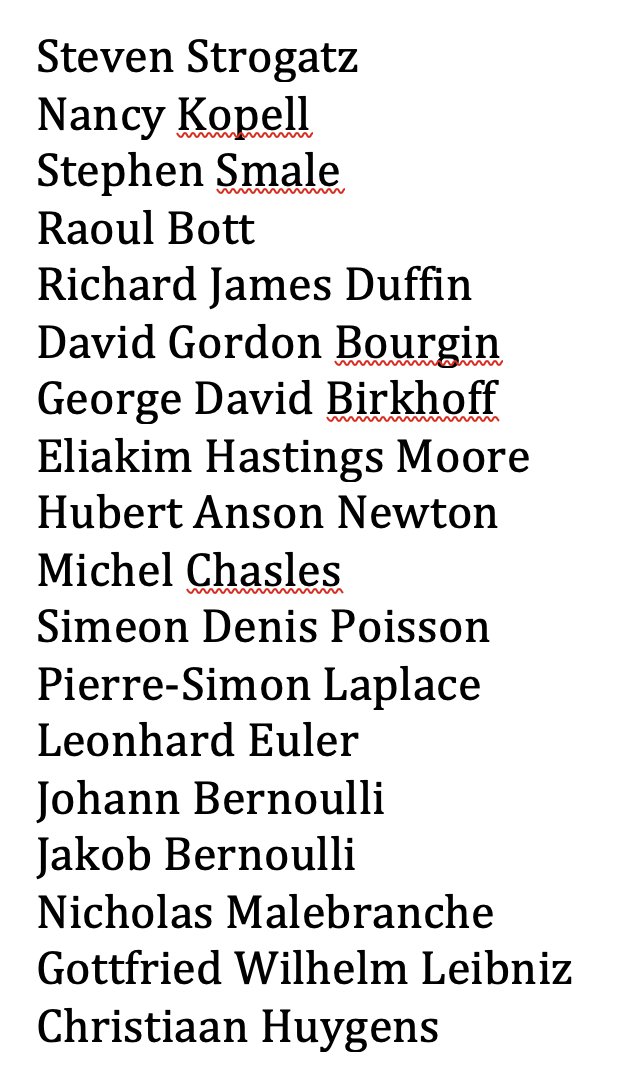
@stevenstrogatz E. Moore leads to Kenneth Arrow and then to lots of economists, including several other Nobelists.
English
Here’s a little slide I showed at Steve Smale’s 90th birthday party. Each person was mentored by the person below them. (By the way, our family chart is not as remarkable as it may seem; many mathematicians have lineages that can be traced back to Euler or other luminaries.)
English
@takuo_sugaya Congratulations! Great job sticking with it, it’s too bad it took so long.
English
Ten years after going to the job market... Thank you everyone for the support!
English