Adam J. Fein

9K posts

Adam J. Fein banner
Adam J. Fein

Adam J. Fein

@DrugChannels

Expert insights from Dr. Adam J. Fein on pharmaceutical economics and the drug distribution system. Contact me at [email protected]

Philadelphia, PA Katılım Mart 2009
4 Takip Edilen19K Takipçiler
Adam J. Fein
Adam J. Fein@DrugChannels·
From Valeris: 𝐌𝐞𝐝𝐢𝐜𝐚𝐥 𝐁𝐞𝐧𝐞𝐟𝐢𝐭 𝐌𝐚𝐱𝐢𝐦𝐢𝐳𝐞𝐫𝐬 𝐀𝐫𝐞 𝐄𝐦𝐞𝐫𝐠𝐢𝐧𝐠 𝐚𝐬 𝐚 𝐂𝐫𝐢𝐭𝐢𝐜𝐚𝐥 𝐌𝐚𝐫𝐤𝐞𝐭 𝐅𝐨𝐫𝐜𝐞: 𝐖𝐡𝐚𝐭 𝐌𝐚𝐧𝐮𝐟𝐚𝐜𝐭𝐮𝐫𝐞𝐫𝐬 𝐍𝐞𝐞𝐝 𝐭𝐨 𝐔𝐧𝐝𝐞𝐫𝐬𝐭𝐚𝐧𝐝 Learn more about Valeris’ technology solutions and data analytics capabilities: drugch.nl/4bv62T0 Read the article: drugch.nl/4bmg0HJ #sponsored
Adam J. Fein tweet media
English
0
0
0
531
Adam J. Fein
Adam J. Fein@DrugChannels·
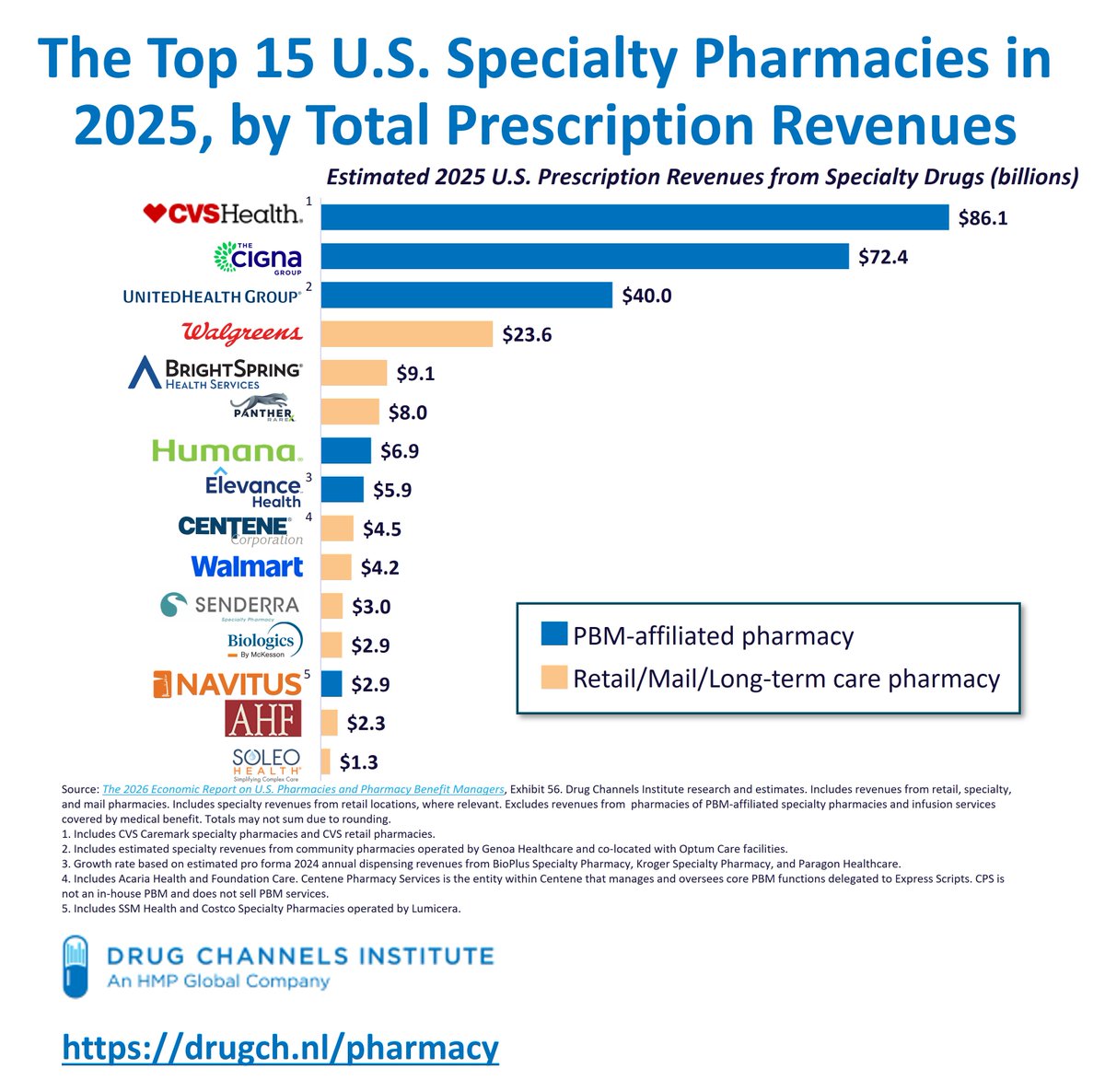
𝐓𝐡𝐞 𝐓𝐨𝐩 15 𝐔.𝐒. 𝐏𝐡𝐚𝐫𝐦𝐚𝐜𝐢𝐞𝐬 𝐨𝐟 2025: 𝐌𝐚𝐫𝐤𝐞𝐭 𝐒𝐡𝐚𝐫𝐞𝐬 𝐚𝐧𝐝 𝐑𝐞𝐯𝐞𝐧𝐮𝐞𝐬 𝐚𝐭 𝐭𝐡𝐞 𝐁𝐢𝐠𝐠𝐞𝐬𝐭 𝐂𝐡𝐚𝐢𝐧𝐬, 𝐏𝐁𝐌𝐬, 𝐚𝐧𝐝 𝐒𝐩𝐞𝐜𝐢𝐚𝐥𝐭𝐲 𝐏𝐡𝐚𝐫𝐦𝐚𝐜𝐢𝐞𝐬 Next week, Drug Channels Institute will release the 2026 𝑬𝒄𝒐𝒏𝒐𝒎𝒊𝒄 𝑹𝒆𝒑𝒐𝒓𝒕 𝒐𝒏 𝑼.𝑺. 𝑷𝒉𝒂𝒓𝒎𝒂𝒄𝒊𝒆𝒔 𝒂𝒏𝒅 𝑷𝒉𝒂𝒓𝒎𝒂𝒄𝒚 𝑩𝒆𝒏𝒆𝒇𝒊𝒕 𝑴𝒂𝒏𝒂𝒈𝒆𝒓𝒔—our 17th edition and the most comprehensive analysis of the U.S. drug pricing and dispensing system. Here’s what the numbers show: • Total prescription dispensing revenues reached $751 billion in 2025, up 10% vs. 2024. • The top 15 organizations captured nearly three-quarters of total revenues. • The four largest players account for more than half of the U.S. market. • GLP-1 drugs continue to reshape revenue mix and competitive positioning. • Vertically integrated insurer-PBM-pharmacy models are strengthening their dominance. The chart shows who made the list—and how specialty and mail pharmacy revenues are driving the story. Read the full breakdown here: drugch.nl/top15-2025 Is this level of concentration sustainable — or does further disruption lie ahead? #pharmacy #PBM #healthcare #drugpricing #specialtypharmacy #healthpolicy
Adam J. Fein tweet media
English
1
11
12
1.7K
Adam J. Fein
Adam J. Fein@DrugChannels·
𝐃𝐨𝐞𝐬 𝐖𝐚𝐥𝐠𝐫𝐞𝐞𝐧𝐬' 𝐭𝐞𝐜𝐡𝐧𝐨𝐥𝐨𝐠𝐲 𝐬𝐡𝐨𝐰 𝐭𝐡𝐞 𝐟𝐮𝐭𝐮𝐫𝐞 𝐨𝐟 𝐫𝐞𝐭𝐚𝐢𝐥 𝐩𝐡𝐚𝐫𝐦𝐚𝐜𝐲? A cool deep dive on how @Walgreens invested in centralized fulfillment and AI-run inventory: • 12 robotic micro-fulfillment centers • $500M in savings • 16M scripts/month centralized (~25% of total Rx) • 40% more vaccines in automated stores • Forecast error cut from 15% to ~1% The theory: Automation lower costs and frees pharmacists to do higher-value clinical work. Is this the future operating model of pharmacy? Or are they just catching up to structural margin pressure? Full article: @AIMmediahouse drugch.nl/4ltzDAX
English
0
0
4
1.9K
Adam J. Fein
Adam J. Fein@DrugChannels·
From @PaySign: 𝐑𝐞𝐬𝐡𝐚𝐩𝐢𝐧𝐠 𝐏𝐚𝐭𝐢𝐞𝐧𝐭 𝐀𝐟𝐟𝐨𝐫𝐝𝐚𝐛𝐢𝐥𝐢𝐭𝐲: 𝐓𝐡𝐞 𝐏𝐨𝐰𝐞𝐫 𝐨𝐟 𝐄𝐱𝐩𝐞𝐫𝐭𝐢𝐬𝐞 𝐚𝐧𝐝 𝐀𝐠𝐢𝐥𝐢𝐭𝐲 Request an analysis of your copay assistance program: drugch.nl/4u67KTm Read the article: drugch.nl/4sLYUJ7 #sponsored
Adam J. Fein tweet media
English
0
0
0
812
Adam J. Fein
Adam J. Fein@DrugChannels·
🚨𝐏𝐁𝐌 𝐈𝐧𝐝𝐮𝐬𝐭𝐫𝐲 𝐔𝐩𝐝𝐚𝐭𝐞 2026: 𝐓𝐫𝐞𝐧𝐝𝐬, 𝐂𝐡𝐚𝐥𝐥𝐞𝐧𝐠𝐞𝐬, 𝐚𝐧𝐝 𝐖𝐡𝐚𝐭’𝐬 𝐀𝐡𝐞𝐚𝐝 (Live Video Webinar) 🚨 The PBM market is heading into another pivotal year. On April 10 (12:00–1:30 p.m. ET), I’ll be hosting a live webinar to break down: • New DCI market share data • The FTC’s Express Scripts settlement • Rebate and net pricing trends • Implications of CAA 2026 • Specialty pharmacy dynamics • 340B developments • What’s next for PBM compensation models • And more I'll be joined by Bryce Platt, Director at DCI and an expert on PBMs’ contractual and business relationships with plan sponsors. Clear facts. Sharp analysis. Live Q&A. If PBMs affect your strategy, you won’t want to miss this. Register: drugch.nl/april2026
Adam J. Fein tweet media
English
0
0
2
871
Adam J. Fein
Adam J. Fein@DrugChannels·
𝐌𝐞𝐫𝐜𝐤 𝐂𝐮𝐭𝐬 𝐃𝐫𝐮𝐠 𝐏𝐫𝐢𝐜𝐞𝐬–𝐚𝐧𝐝 𝐌𝐞𝐝𝐢𝐜𝐚𝐢𝐝 𝐚𝐧𝐝 340𝐁 𝐏𝐚𝐲𝐬 𝐌𝐨𝐫𝐞 The law of unintended consequences remains undefeated. The American Rescue Plan Act of 2021 (#ARPA) eliminated the 100% Medicaid rebate cap beginning in 2024. Manufacturers of high-list/high-rebate products can now owe Medicaid more than 100% of a product's sales, i.e., negative net prices. CBO projected that removing the cap would reduce the federal deficit by $17.3 billion. But as usual, CBO scoring ignored behavioral adaptation to the new incentives. When rebates can exceed 100%, the conventional high-list/high-rebate model becomes economically unsustainable. ARPA is therefore one of the forces accelerating the emergence of the Net Pricing Drug Channel (#NPDC) and the deflation of the gross-to-net bubble. Ironically, lowering the list price for a highly rebated drug can actually increase the net price after rebates and discounts. Why? Because the Medicaid rebates and #340B ceiling prices are both linked to changes in a drug’s list price relative to inflation. When the inflation penalty pushes rebates above 100%, cutting the list price shrinks the penalty. Hence, new prices rise. @Merck highlighted this dynamic in in its latest 10-K filing: "In early 2025, Merck lowered the list price of the Januvia family of products to more closely align them with net prices. The lower list price has reduced the rebate amount Merck pays to Medicaid, resulting in higher realized net pricing." In other words, a law designed to extract more than 100% of a drug's revenue from manufacturers in Medicaid has backfired, leading Medicaid and 340B covered entities to pay *higher* net prices. See Merck 10-K, page 59: drugch.nl/4lbt3yZ
Adam J. Fein tweet media
English
1
1
7
2.2K
Adam J. Fein
Adam J. Fein@DrugChannels·
From @CardinalHealth Sonexus™ Access and Patient Support: 𝐓𝐢𝐦𝐞 𝐭𝐨 𝐄𝐯𝐨𝐥𝐯𝐞: 𝐇𝐮𝐛𝐬 𝐅𝐥𝐞𝐱 𝐭𝐨 𝐍𝐞𝐰 𝐃𝐞𝐦𝐚𝐧𝐝𝐬 Download 2026 insourcing and outsourcing trends for patient hubs: drugch.nl/4l4cgxr Read the article: drugch.nl/4b5RFV1 #sponsored
GIF
English
0
1
1
802
Adam J. Fein
Adam J. Fein@DrugChannels·
📢 Preorder Now: DCI’s 2026 𝑬𝒄𝒐𝒏𝒐𝒎𝒊𝒄 𝑹𝒆𝒑𝒐𝒓𝒕 𝒐𝒏 𝑼.𝑺. 𝑷𝒉𝒂𝒓𝒎𝒂𝒄𝒊𝒆𝒔 𝒂𝒏𝒅 𝑷𝒉𝒂𝒓𝒎𝒂𝒄𝒚 𝑩𝒆𝒏𝒆𝒇𝒊𝒕 𝑴𝒂𝒏𝒂𝒈𝒆𝒓𝒔 The rebate era is slowing. Vertical integration is tightening. List prices matter less. Net economics matter more. Welcome to the Net Pricing Drug Channel. In 2025: • Prescription dispensing revenues reached $751B • GLP-1s drove the majority of retail revenue growth • The Big Three PBMs processed 80% of claims • The gross-to-net bubble hit $416B • Federal PBM reform became law The 17th edition examines what these structural shifts mean for pharmacies, PBMs, manufacturers, payers, and patients. ✔ 12 chapters ✔ 500+ pages ✔ 270 exhibits ✔ ~1,300 endnotes ✔ Completely updated market share, pricing, and profitability data If you operate anywhere in the pharmaceutical ecosystem, the economics are changing under your feet. 📘 Free 32-page overview: drugch.nl/2026overview 💡 Limited-time preorder pricing: drugch.nl/pharmacy Here’s how the chapters map to the full drug channel architecture 👇 Serious question: Is 2026 the year PBM economics fundamentally change — or just the beginning of a longer transition?
Adam J. Fein tweet media
English
0
5
9
1.8K
Adam J. Fein
Adam J. Fein@DrugChannels·
Big news: Mark Cuban @mcuban has just joined the agenda at the 2026 𝐃𝐫𝐮𝐠 𝐂𝐡𝐚𝐧𝐧𝐞𝐥𝐬 𝐋𝐞𝐚𝐝𝐞𝐫𝐬𝐡𝐢𝐩 𝐅𝐨𝐫𝐮𝐦. In two weeks, I’ll be sitting down with him for a fireside chat. Expect a lively and thoughtful discussion as I try to coax this shy entrepreneur out of his shell. 😉 #DCLF2026
Adam J. Fein tweet media
English
1
5
19
1.4K
Adam J. Fein
Adam J. Fein@DrugChannels·
@Scheids90 @bobjherman @statnews Section 11.5.4. includes an updated exhibit titled "340B Software Vendors and Ownership, 2025." Includes Verity (Cigna), Wellpartner (CVS), SunRx (MedImpact), 340B Complete (Walgreens), and numerous currently independent TPAs.
English
0
1
3
180
Adam J. Fein
Adam J. Fein@DrugChannels·
𝐂𝐢𝐠𝐧𝐚 𝐕𝐞𝐫𝐭𝐢𝐜𝐚𝐥 𝐈𝐧𝐭𝐞𝐠𝐫𝐚𝐭𝐢𝐨𝐧 𝐔𝐩𝐝𝐚𝐭𝐞 (𝐖𝐢𝐭𝐡 𝐚 340𝐁 𝐓𝐰𝐢𝐬𝐭) Bob Herman @bobjherman at @statnews uncovered that Cigna Group’s Evernorth Health Services now owns 100% of CarepathRx, a company that helps hospitals and health systems build and operate in-house specialty pharmacies. Recall that in 2025, Evernorth also invested $3.5 billion for an undisclosed stake in Shields Health Solutions, the former WBA subsidiary with a similar hospital-focused specialty pharmacy model. Why it matters: ✅ Manufacturers’ limits on #340B contract pharmacies have pressured Express Scripts’ 340B profits. ✅Expanding deeper into hospital-owned specialty pharmacies is a clever vertical integration play that helps preserve access to 340B-driven profits through a different channel. P.S. Yes, both deals will appear on DCI’s soon-to-be-updated (in)famous vertical integration slide. 😉 Story: drugch.nl/4rFqMhF
English
1
8
22
9.7K
Anthony DiGiorgio, DO, MHA
Anthony DiGiorgio, DO, MHA@DrDiGiorgio·
Most people don't understand how incredibly complex 340B is. I barely get it myself. 340B creates a pricing spread. Hospitals buy drugs at a steep federally mandated discount and get reimbursed at a much higher rate. That difference is a huge revenue stream for hospitals. Manufacturers have tried to limit some contract pharmacy arrangements, which squeezed certain middlemen. So what happens next? Instead of losing access to that spread, insurers and PBMs move deeper into the hospital itself. Insurer owns the PBM. PBM buys a specialty pharmacy platform. That specialty pharmacy operates inside a 340B hospital. Now the same corporate family can still capture the margin. Different structure. Same spread. This is what a federally created arbitrage program does. It does not lower costs. It does not simplify care. It encourages vertical integration so the largest players can internalize the subsidy. When government creates a guaranteed pricing distortion, capital reorganizes around harvesting it.
Anthony DiGiorgio, DO, MHA tweet media
Adam J. Fein@DrugChannels

𝐂𝐢𝐠𝐧𝐚 𝐕𝐞𝐫𝐭𝐢𝐜𝐚𝐥 𝐈𝐧𝐭𝐞𝐠𝐫𝐚𝐭𝐢𝐨𝐧 𝐔𝐩𝐝𝐚𝐭𝐞 (𝐖𝐢𝐭𝐡 𝐚 340𝐁 𝐓𝐰𝐢𝐬𝐭) Bob Herman @bobjherman at @statnews uncovered that Cigna Group’s Evernorth Health Services now owns 100% of CarepathRx, a company that helps hospitals and health systems build and operate in-house specialty pharmacies. Recall that in 2025, Evernorth also invested $3.5 billion for an undisclosed stake in Shields Health Solutions, the former WBA subsidiary with a similar hospital-focused specialty pharmacy model. Why it matters: ✅ Manufacturers’ limits on #340B contract pharmacies have pressured Express Scripts’ 340B profits. ✅Expanding deeper into hospital-owned specialty pharmacies is a clever vertical integration play that helps preserve access to 340B-driven profits through a different channel. P.S. Yes, both deals will appear on DCI’s soon-to-be-updated (in)famous vertical integration slide. 😉 Story: drugch.nl/4rFqMhF

English
8
20
71
6.8K
Adam J. Fein
Adam J. Fein@DrugChannels·
From PHIL: 𝐁𝐞𝐲𝐨𝐧𝐝 𝐃𝐓𝐏 2.0: 𝐇𝐨𝐰 𝐅𝐥𝐞𝐱𝐢𝐛𝐥𝐞 𝐃𝐢𝐫𝐞𝐜𝐭-𝐭𝐨-𝐏𝐚𝐭𝐢𝐞𝐧𝐭 𝐏𝐫𝐨𝐠𝐫𝐚𝐦𝐬 𝐏𝐨𝐰𝐞𝐫 𝐁𝐞𝐬𝐭-𝐈𝐧-𝐂𝐥𝐚𝐬𝐬 𝐏𝐚𝐭𝐢𝐞𝐧𝐭 𝐄𝐱𝐩𝐞𝐫𝐢𝐞𝐧𝐜𝐞𝐬 Learn more about PHIL’s DTP 2.0 platform, PHIL Direct: drugch.nl/4s51OYX Read the article: drugch.nl/4l1r3Jq #sponsored
Adam J. Fein tweet media
English
0
0
0
758
Adam J. Fein
Adam J. Fein@DrugChannels·
𝐃𝐫𝐮𝐠 𝐒𝐚𝐥𝐞𝐬 𝐃𝐫𝐨𝐩: 𝐓𝐡𝐞 𝐆𝐫𝐨𝐬𝐬-𝐭𝐨-𝐍𝐞𝐭 𝐁𝐮𝐛𝐛𝐥𝐞 𝐃𝐞𝐟𝐥𝐚𝐭𝐞𝐬 𝐢𝐧 𝐉𝐚𝐧𝐮𝐚𝐫𝐲 2026 George Hill of Deutsche Bank analyzed January 2026 sales for 11 brand-name drugs that reduced their WAC list prices. Together, these products represent roughly 2% of total U.S. prescription volume. Purchases at invoiced prices declined by approximately $3.6 billion (-50%) from December 2025 to January 2026. 👇 That’s the gross-to-net bubble deflating in real time. Other factors were at play, including biosimilar and generic competition and formulary positioning. But the dominant driver was clear: meaningful list price reductions flowing directly through the drug channel. As we move toward a Net Pricing Drug Channel (#NPDC), pharmacies, wholesalers, and PBMs will face increasing pressure on spreads, fees, and margins. The bubble won't just shrink. It will reveal how much of the drug channel’s economics rely on high WAC list prices. Question for the DCI community: 𝐈𝐟 𝐥𝐢𝐬𝐭 𝐩𝐫𝐢𝐜𝐞𝐬 𝐜𝐨𝐧𝐭𝐢𝐧𝐮𝐞 𝐭𝐨 𝐟𝐚𝐥𝐥, 𝐰𝐡𝐢𝐜𝐡 𝐩𝐚𝐫𝐭 𝐨𝐟 𝐭𝐡𝐞 𝐜𝐡𝐚𝐧𝐧𝐞𝐥 𝐟𝐞𝐞𝐥𝐬 𝐭𝐡𝐞 𝐠𝐫𝐞𝐚𝐭𝐞𝐬𝐭 𝐢𝐦𝐩𝐚𝐜𝐭 𝐟𝐢𝐫𝐬𝐭? (𝘚𝘰𝘳𝘳𝘺, 𝘧𝘶𝘭𝘭 𝘳𝘦𝘱𝘰𝘳𝘵 𝘯𝘰𝘵 𝘱𝘶𝘣𝘭𝘪𝘤𝘭𝘺 𝘢𝘷𝘢𝘪𝘭𝘢𝘣𝘭𝘦.)
Adam J. Fein tweet media
English
0
2
7
1.6K
Adam J. Fein
Adam J. Fein@DrugChannels·
𝐍𝐨𝐯𝐨 𝐒𝐞𝐧𝐝𝐬 𝐀𝐧𝐨𝐭𝐡𝐞𝐫 𝐒𝐢𝐠𝐧𝐚𝐥: 𝐓𝐡𝐞 𝐍𝐞𝐭 𝐏𝐫𝐢𝐜𝐢𝐧𝐠 𝐃𝐫𝐮𝐠 𝐂𝐡𝐚𝐧𝐧𝐞𝐥 (#𝐍𝐏𝐃𝐂) 𝐈𝐬 𝐂𝐨𝐦𝐢𝐧𝐠 Novo Nordisk’s price cuts for Ozempic and Wegovy reinforce the migration toward net pricing in the drug channel. Because of how CMS chose to implement the IRA, the law is inadvertently pushing manufacturers to narrow the spread between list prices and what pharmacies actually receive for drugs subject to a maximum fair price (MFP). Meanwhile, commercial payers are increasingly skeptical of the gross-to-net bubble surrounding GLP-1 therapies, especially as more of these products are sold at lower net prices to cash-paying patients. Cutting the list price helps relieve that pressure. Delaying the change until 2027 also helps protect Novo's formulary positioning, given the rebate guarantees that PBMs have made to health plans. The broader trend is becoming clearer: net prices, not list prices, will increasingly determine access, economics, and competitive strategy. Source: @Loftus @WSJ drugch.nl/4qPOhnf
English
0
2
2
1.5K
Adam J. Fein
Adam J. Fein@DrugChannels·
𝐃𝐫𝐮𝐠 𝐂𝐡𝐚𝐧𝐧𝐞𝐥𝐬 𝐍𝐞𝐰𝐬 𝐑𝐨𝐮𝐧𝐝𝐮𝐩, 𝐅𝐞𝐛𝐫𝐮𝐚𝐫𝐲 2026 Incentives are shifting. The drug channel is adjusting. Here’s what mattered this month: ✅ Mark Cuban’s @mcuban $0.02 on the FTC-ESI settlement ✅ What patients want from health insurance ✅ Why the QALY paradox could block MFN ✅ How #340B drives hospital vertical integration ✅ Plus: Meet the expanding Drug Channels Institute team! If you follow drug pricing, PBMs, 340B, or policy reform, this one’s for you 👇 drugch.nl/4b7Jngs
English
0
0
1
888
Adam J. Fein
Adam J. Fein@DrugChannels·
I have long argued that international reference pricing is a flawed policy shortcut, not a sustainable solution. Benchmarking U.S. drug prices vs. other countries overlooks fundamental structural differences in healthcare financing, delivery, and value assessment frameworks. This timely Health Affairs article raises a deeper legal and policy question at the intersection of quality-adjusted life-years (QALYs) and Most Favored Nation (MFN) pricing models: When Congress explicitly prohibits a particular methodology in statute, can the executive branch effectively circumvent that prohibition by adopting foreign prices derived from the banned methodology? As the authors explain, the U.S. ban on QALYs reflects a "bipartisan compromise to protect vulnerable groups from being disadvantaged in the pursuit of cost containment." Referencing foreign prices is not a neutral act when those prices are grounded in frameworks that U.S. law has deliberately declined to adopt. Kudos to Dominique Seo, Kenneth E. Thorpe, and T. Joseph Mattingly II @joeymattingly for a thoughtful and nuanced take on these complex issues. Full article: drugch.nl/4cGuzXm
English
0
4
11
2.2K
Adam J. Fein
Adam J. Fein@DrugChannels·
From @CareMetx: 𝐓𝐡𝐞 𝐒𝐭𝐚𝐭𝐞 𝐨𝐟 𝐏𝐚𝐭𝐢𝐞𝐧𝐭 𝐀𝐜𝐜𝐞𝐬𝐬: 𝐖𝐡𝐚𝐭 𝐈𝐧𝐝𝐮𝐬𝐭𝐫𝐲 𝐋𝐞𝐚𝐝𝐞𝐫𝐬 𝐑𝐞𝐯𝐞𝐚𝐥 𝐢𝐧 𝐚 𝐍𝐞𝐰 𝐒𝐮𝐫𝐯𝐞𝐲 𝐀𝐛𝐨𝐮𝐭 𝐇𝐮𝐛 𝐌𝐨𝐝𝐞𝐥𝐬, 𝐓𝐞𝐜𝐡𝐧𝐨𝐥𝐨𝐠𝐲, 𝐚𝐧𝐝 𝐭𝐡𝐞 𝐑𝐨𝐚𝐝 𝐀𝐡𝐞𝐚𝐝 Download the 2026 Patient Services Report: drugch.nl/3OdeK0g Read the article: drugch.nl/3MPQOzK #sponsored
Adam J. Fein tweet media
English
0
0
1
688
Adam J. Fein
Adam J. Fein@DrugChannels·
𝐌𝐞𝐝𝐢𝐜𝐚𝐫𝐞 𝐏𝐚𝐫𝐭 𝐃 𝐏𝐡𝐚𝐫𝐦𝐚𝐜𝐲 𝐍𝐞𝐭𝐰𝐨𝐫𝐤𝐬 𝐢𝐧 2026: 𝐒𝐮𝐩𝐞𝐫𝐦𝐚𝐫𝐤𝐞𝐭𝐬 𝐃𝐨𝐦𝐢𝐧𝐚𝐭𝐞 𝐚𝐬 𝐃𝐫𝐮𝐠𝐬𝐭𝐨𝐫𝐞𝐬 𝐒𝐭𝐚𝐥𝐥 𝐚𝐧𝐝 𝐈𝐧𝐝𝐞𝐩𝐞𝐧𝐝𝐞𝐧𝐭𝐬 𝐖𝐚𝐥𝐤 𝐀𝐰𝐚𝐲 Have preferred pharmacy networks peaked? DCI's analysis of CMS’s new enrollment data shows: ✅ Only 8 major PDPs still offer preferred networks (a record low) ✅ Supermarkets dominate—Albertsons and Publix are preferred in every major plan ✅ Walmart, the original preferred-network pioneer, has slipped ✅ Independents have largely walked away Thanks to the IRA and the CAA, the economics behind preferred networks are getting weaker. Preferred networks reshaped pharmacy competition for a decade. In 2026, they increasingly resemble a legacy contracting tool whose time may have passed. Full analysis: drugch.nl/4tFUftt #Medicare #PartD #PBM #Pharmacy #HealthcarePolicy
Adam J. Fein tweet media
English
1
2
1
1.1K
Adam J. Fein
Adam J. Fein@DrugChannels·
💊 Prescription drugs: smaller slice of spending, bigger hit to consumers In 2024, hospital care dwarfed outpatient prescription drugs in total U.S. healthcare spending, but consumers felt the opposite at the pharmacy counter: 🔹 Hospital care spending: ~$1.6T 🔹 Outpatient prescription drugs: ~$467B ➡️ ~$1.2 trillion more spent at hospitals Yet when it comes to what patients pay directly: 🔸 Consumers paid $14B more out of pocket for outpatient prescription drugs than for hospital care 🔸 OOP share of spending: 11.8% for drugs vs. 2.5% for hospital care Bottom line: Prescription drugs account for a much smaller share of total healthcare spending, but a much larger share of what consumers pay themselves. Details: drugch.nl/4re6onX #DrugPricing #Healthcare #PrescriptionDrugs #Hospitals #DrugChannels
Adam J. Fein tweet media
English
1
4
4
1.3K